Archive for the Series Category


Shoujo Manga MagazineYuri Watch: Maria-sama ga Miteru

September 5th, 2010

Calling The Margaret (ザ マーガレット)”shoujo” is not correct, I know. I’m just too lazy to come up with another title for this series of “I’m reading magazines for teen and tween girls that have Yuri stories.” Technically, The Margaret is actually josei, as it’s marketed to older teen girls, but since Sean and I are the only ones who care, I won’t belabor the point.(Wait,. yes I will – here’s a fool-proof method to know if a magazine is shoujo or not – does it come with awesome giveaways of bags and jewelry and stationary and stuff? If  you said, “Yes!” – it’s shoujo. If the answer is, “uh, no, all there is is an insert of a mini comic,” it’s josei. Got it? good.)

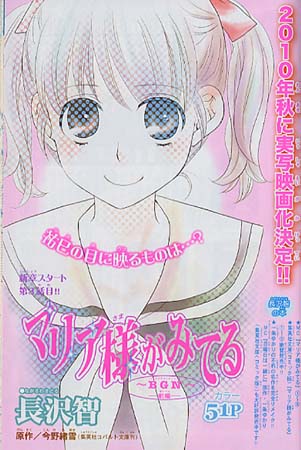
The real point of today’s review is not to talk about The Margaret, but the newly re-started serialization of the Maria-sama Ga Miteru manga which had ceased publication after Volume 8. The original serialization ended with the graduation of Youko, Sei and Eriko.

The story picks up in what will become Volume 9, in the new term. Yumi, Yoshino and Shimako are all second-years. Sachiko, Rei and Shimako are now the Rosas…and there’s something up with Shimako. She’s been “strange” recently, they all notice. And they have to assume that it is at least in part because of the first-year she’s been hanging around with, Nijou Noriko.

The first thing, Sachiko and Rei decide, is that Shimako needs to cough up her one last secret, because it’s bothering her. And so they concoct an annoying plan to “out” Shimako as the daughter of a Buddhist Priest.

The plan they create is still ham-handed after all this time. But I’m reminded of something as I read it. A “year” later in story time, Shimako will be sitting with Yumi and Yoshino, cheerfully telling her friends the very, very last piece of her incredibly complicated family situation. She’ll be smiling and laughing – and enjoying the carpish gaping of the other two as she spills the beans. So heavy-handed, yes, and obnoxious, yes, but now looking back, I think Rei and Sachiko may have been *right.*

The manga shifts from Noriko’s point of view right to Yumi’s and we get to relive the whole irritating thing over again, this time knowing full well that Yumi, at least, thought they were sandblasting a cracker.

Also in The Margaret magazine is “Bushido Sixteen,” a girls’ kendo sports drama, which has all the requisite sweat and tears and guts and rivalries and good stuff. And there’s way less non-con than there was the last time I picked up an issue. So, while not as Yuri-fied as Nobara no Mori no Otome-tachi – which has gotten very Yuri indeed, there in Nakayoshi – The Margaret has some lovely platonic romance and rivalry between girls. All good.

Overall – 9

I think that’s it for girls’s manga and Yuri. For now. Here’s hoping that there’s more on the horizon. For one thing, the girl’s magazines have the best furoku!


Maria-sama ga Miteru Drama CD: Parasol wo Sashite

September 3rd, 2010

The good news is that, phew, that’s behind us now. No more Rainy Blue ever again…until the manga catches up. D’oh!

Well, for the moment, we can wallow in the comfort of the 14th Drama CD of the Maria-sama ga Miteru series, Parasol wo Sashite, in which Yumi gets back both her favorite umbrella and her beloved onee-sama.

This Drama CD is a 2-disk set, each disk has about 45-60 minutes of material.

The first disk has the half of the book in which Yumi meets Katou Kei and her older relative, the entirely adorable Yumiko. The second has the appearance of Youko and the revelation of what Sachiko has been going through for the past few months.

Two scenes in this story were critical to my understanding of the characters. When Touko snaps at Yumi outside the cafeteria, it occurred to me that, at that point, Touko has no idea that Yumi does not know what’s up with Sachiko. So, to see Yumi having fun with classmates is upsetting. Of course, yes, Touko’s a absolute jerk about it, which adds to the drama of the scene. But in the second half of the book, Touko knows that Yumi doesn’t know, which is probably one of the very first bricks in the wall she builds between Yumi and herself.

The second scene that really blew me away, was the scene with Kei’s older relative, Yumiko. Kei imagines her to be a taciturn old lady and Touko later points out that she was clearly used to frowning alot. But something about Yumi’s unexpected kindness opens up Yumiko in a way that I think she could never have expected. Yumiko tells Yumi something so important that I missed it the first 30 times I read/watched/read/listened to this scene. She says, simply, that if Yumi loves her onee-sama, she should tell her. Verbalizing this changes Yumi’s whole perspective…and Yumiko’s own life.

Of course it was nice to encounter Sei and Youko again, and “meet” Kei.

And the whole bit at the end that had gotten cut out of the anime, about Youko being too competent to forget an umbrella, then not having one, proving that she was totally discombobulated and Sachiko’s mother obsessing over convenience store food were told in full, to my immense pleasure.

The second disk also includes a bonus track, in which the actresses point out that it had been almost a year since they recorded Rainy Blue and how they were all kinda tense about that not being resolved.(Most of them have now read the novels, something I find fascinating.) But the thing that makes the bonus track priceless is right in the very beginning, when they are all talking about how emotional this CD is and Itou Miki says that saying “I love you Yumi,” was really emotional for her. When Itou-san says the words, “I love you, Yumi,” Ueda Kana immediately replies, “I love you too, Onee-sama!” And I, and the entire cast of Maria-sama ga Miteru screamed of “Ow! That hurt!” as our hearts exploded from the cuteness. (^_^) Toyoguchi Megumi says something like, “Aw, c’mon, I don’t want to see that!”

So, although it took a really long time to get…Parasol wo Sashite was totally worth it.

Ratings:

Overall – 9.5

Now that I think about it, this novel had *three* adorable adult characters – Sachiko’s mom Sayako, Kei’s relative Yumiko and “Miffy-chan,” the middle-school teacher who returned Yumi’s umbrella.


Yuri Manga: GIRL FRIENDS, Volume 4

August 19th, 2010

GIRL FRIENDS Volume 4 is the kind of story-telling that fills volumes of literature, but manga fans generally can’t stand. Having established in previous volumes that both Mari and Akiko feel the same way about one another, manga fans (who have been trained to be terrible readers by illicitly scanned porn doujinshi and impatiently written fanfic) bitch endlessly “why don’t they just get together (i.e., have sex) already?”

Maddeningly for them, this series is not a porn series. Instead it is a graphic novel series about a shockingly realistic – and therefore frustrating – relationship between two girls young enough that merely identifying one’s feelings at all is problematic. One of the complaints I’ve heard regularly about this series is that it is not realistic at all, but I feel that it absolutely is realistic. The folks I’ve heard this from the most live in a culture and with families that are largely tolerant and accepting of same-sex couples. I can assure you that in parts of the world where there is not a high level of acceptance and/or tolerance, this kind of agonizing hesitation is quite normal.

In Volume 4, Akiko is confused, hurt, frustrated and puzzled by Mari’s lack of response to her kiss at the end of Volume 3. It seems obvious to Akiko that she’s communicated her feelings properly but, inside Mari’s head, the bunker has been shut down. Having only words and unreliable emotions with which to parse Akiko’s actions, Mari has convinced herself that this was merely a kiss between friends…despite all evidence to the contrary.

The bulk of the volume is taken up with the class trip, and the comedy of errors, misunderstandings and miscommunication that keep Mari and Akiko apart. Some of it is not their fault, but a great deal of it is simply lack of a quiet moment to have the talk that they need to have. When, over a heart-shaped stone that is supposed to guarantee eternal love, they finally have that talk – amazingly – much of what keeps them apart dissipates into the nothing it really was.

Now, at last, the two can start developing their relationship. We watch their first halting steps through the jaded eyes of their friend, Sugiyama, in what to me was a really miserable chapter about broken dreams and the death of innocence. But, hey, that’s realistic too.

Ratings:

Art – 8
Story – 8
Characters – 8
Yuri – 8
Service – 4

Overall – 8

Volume 5 will simultaneously bring fans the climax they desperately want and the end of the series so they have something to whine about – also a critical factor in fan enjoyment. ^_^


Maria-sama ga Miteru: Premium CD, Volume 2

August 3rd, 2010

Maria-sama ga Miteru Premium CD, Volume 2 jumps right into the drama. By which I mean the drama of Yoshino and Rei coming to terms with the fact that their relationship will have to change forever.

In “Kibara Panic,” a date with Nana becomes a race to see who Rei’s omiai partner is. Yoshino learns that Nana is disturbingly like a former Yellow Rose that she knows well….and is at least her equal in every way.

Yoshino is forced to come face to face with her feelings about Nana in “Kibara Shinken Shoubu.” Yoshino begs Rei not to let go her as she tries to ride a bicylce, but when Rei and Nana cross swords in the dojo, it’s Yoshino ends up casting the past aside to embrace the future.

Both of these were brilliant, funny, emotional dramas. Yoshino and Rei, the bickering couple of the Yamayurikai, cannot go on as they have. For Yoshino to grow, Rei has to let go, something she doesn’t really want to do. Yoshino also has to stop being grasping, but she knows she’s cheating by having someone else to lavish attention on. In the second drama, Yoshino has time to recognize that her love for Rei is obsessive and has been in many ways, suffocating to her beloved cousin.

Nana is a wonder. She’s Yoshino’s equal on every level, and has more than just vocal similarities to the former Rosa Foetida. She likes interesting things, is up for an adventure and no matter what Yoshino throws at her, she’s right there to stand by Yoshino’s side. Using Nabatome Hitomi was a stroke of genius, because it does give Nana more than a little of that slightly “hrm…this sounds familiar” feeling.

The final track is a bonus talk by Ueda Kana selling us all the current Marimite goods and reminding us to follow the Oshaka-sama mo Miteru series (about Yuuki and his life at Hanadera  and which I have been reading and may just review at some point, because the last book had a great ending.)

Ratings:

Overall – 9

A really lovely CD if you like the Yellow Rose family. Which I do.


Azumanga Daioh Omnibus (English – Yen Press Edition)

July 21st, 2010

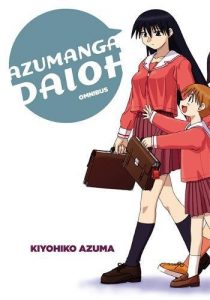
It was only a few weeks ago that I had the pleasure of reading and reviewing ADV’s Azumanga Daioh Omnibus. Today, I have the pleasure of reviewing the Azumanga Daioh Omnibus by Yen Press! Reading this same collection twice in a short period of time has given me a completely different perspective on it.

Let’s take a few steps back before we start. Reading the ADV edition made me realize how far we’ve come with translation – and how far Azuma has come as an artist. The cleaned up art in this edition removes an obstacle to enjoyment. As a result, the story seems less rough this time around.

In this edition, Yen didn’t hesitate for a second – honorifics are in place, names remain unchanged. And you know what? It’s *still* not perfect! ^_^ I’ll get into why that is, in a moment.

Let’s first talk about the story itself. Like Azuma’s current hit, Yotsuba&!, Azumanga Daioh ran in Dengeki Daioh, a magazine for adult men. I mention that because as one reads this story of a group of girls moving through high school, it’s hard to avoid some really obvious issues that, when thought about a shade too long, make one feel creeped out. Chapters begin with alternating pictures of the main cast, some of them of a “pinup” sensibility. And there’s a character who represents the readership – an adult male who obsesses about young women inappropriately and who has no mental filter, so does not hesitate to say what he is thinking. This character, we are later told, is a nice man, but it’s hard to reconcile ourselves to that – unless you’re him. Which the original audience was. Nice guys – who just *happen* to be inappropriately obsessed with young girls = the original audience of Azumanga Daioh. I mention this in case you are not this audience and are reading this book thinking “who thinks this is funny?” The Kimura-senseis who were reading it, that’s who. ^_^;

Aside from this persistent creepiness, the story is pretty realistic. This group has a number of extreme characters, but Japanese comedy is largely made up of extremes. A good (legal, free!) example of this is the live-action Moyashimon, in which screaming and flailing make up a large part of the “comedy” every episode.)

Other people have noted that this is really the story of Chiyo-chan and the girls she befriends. Chiyo-chan is a genius at 10, and has been skipped up to high school. During her three years she meets and becomes friends with the rest of the cast, does school festivals and school trip and field days and other normal activities. Because she is an outsider, it makes sense that most of the people she gathers around her are also outsiders – quiet, serious Sakaki-san, loopy Osaka, hyper Tomo and her childhood friend, Yomi. So these normal, everyday activities are seen through the eyes of not-normal people and thus turned into comedy.

I said at the beginning that despite the skill of the translation it still wasn’t perfect. Here’s why. As you fix the really big things, it becomes easier for us to see the small things. ^_^ So, yes, we have honorifics and names and you did your best with the puns, but now we can see things like the problem with Osaka’s accent.

The problem with Osaka’s accent:

Osaka is a big city, with a lot of businesses and is well-known for being a “foodie” town. It’s not the political capital of Japan – it’s considered the business/finance capital of Japan. The people there speak very fast and very loud and are seen as being really wacky and money obsessed. If anything, Osaka sounds more like New York than anywhere else, IMHO. (And having been there for a total of like 2 hours, I’m obviously an expert. ^_^) I’d say that isn’t far off. I liked Osaka a great deal and I want to get back. So, the joke is that Ayumu, who comes from this crazy, energetic, loud, wacky, busy city is kinda loopy and slow and not at all like “an Osakan.” Got that?

When they brought Ayumu over to America, they translated the *wrong part of the joke.* Yes, Ayumu is slow and laconic. But her accent isn’t. The joke is not that she’s slow and loopy – it’s that she’s from *Osaka* and is slow and loopy. Imagine you’re a kid in Iowa and the teacher says, “Hey, we have a transfer student from New York City” and everyone panics because they’ll be CRAZY and probably pack heat and deal drugs and graffiti and gangs and OMG!!!! And then they walk in and they are like, “Hi….my…name…is….Terry.” and they sort of wander off in the middle of their sentence. That’s Osaka.

By giving Osaka a Southern accent Yen has blown that joke completely to hell, thanks. But, hey, we’re all still working on this translation thing, so I give them credit for trying. Just – get a comedian on staff, okay? You’re obviously all too literal. ^_^

Other than that one thing – I have no complaints at all. This book looks and feels good. It made me laugh and got me a little sniffly at the end, like it was supposed to. It has the one of two cats I can stand in manga (The cat in What’s Michael? is the other) and I still grin and say “heh” in my head upon breaking chopsticks evenly.

Ratings:

Art – 7
Story – 8
Characters – 9
Yuri – 4
Service – 4

Overall – 9

My sincere thanks to Yen Press for supplying this copy (and a copy of Book Girl and the Suicidal Mime, which I am now reading and really, really enjoying to my utter shock! I may manufacture a reason to review it, just because it is really original so far.)

And FYI – this books *totally* passes the Bechdel Test.

It’s a funny book, the new edition is solid and despite my little discussion of the accent issue, it’s still a very excellent read. I’ll be donating this copy to the AnimeNEXT traveling Manga Library, so if you can’t buy it or get it at a library near you, look for it at an anime show in your neighborhood! If your library has a Graphic Novel section, why not buy this read it and donate it? It’s a great book to share with others. Then they’ll laugh when they break chopsticks evenly, too.