Archive for the Series Category


Azumanga Daioh Manga Omnibus (English – ADV Edition)

April 26th, 2010

I swear to you that this is true. Last week I said to myself – y’know, I haven’t read Azumanga Daioh in forever, let’s crack open the old Japanese editions and re-read them. And that afternoon, the English-language Azumanga Daioh Omnibus was delivered.

Do you know, I have never read the English edition of Azumanga Daioh? Well, not entirely true – I scanned the first volume when it first came out, shuddered with distaste, and didn’t buy it. I understood why ADV made the choices it did. And in many ways, I agreed with those choices, as they made the manga more accessible to a wider audience outside the core fandom. By calling Yukari-sensei “Miss Yukari” and when the students called her Yukari-chan, “Yukari baby,” they would make it easier for a non-manga fan to follow the comic. I never disagreed with their choice. I just didn’t enjoy it for myself.

Once again, allow me to clarify – I do not believe that fans want “literal” translations. What we want is an authentic reading experience. This is a subtle, but critical difference.

A literal translation of an idiom won’t kill us (unless it’s a particularly bizarre or obscure idiom. For example,  try thinking of a cute way to translate “pig in a poke” to another language.) It doesn’t really matter if you write “staring off into the middle distance” or “staring off into the day after tomorrow.” Readers will get it, whichever way you chose.

However, Kaorin is a nickname,  and therefore doesn’t really need to be translated. It’s more authentic just to leave it. We have nicknames – we get it.

Why honorifics? Because Yukari-sensei, Yukari,  and Yukari-chan all mean completely different things. It’s perfectly respectable for her mother to call her Yukari-chan and perfectly not respectable (or respectful) at all for her students to do so. As ADV learned, when we all wrote to tell them so. And they listened, as we can see with the lovely translators’ notes, explaining the choices made (and the personal touch they provide) for later volumes.

Azumanga Daioh manga was the first real battlefield where this particular war was fought. The fans have mostly won this now, although there are still pockets of resistance among publishers. Ironically, one of the few instances left that *really* bugs me is in Yotsuba, by the exact same author. “Miss Stake” would only have been good localization if the character’s name was “Chigau.” “Shimau” is a form of the verb “shimasu” and as a result, the choice of translation is irrelevant and annoying. But not to the mythical people who read manga who know nothing about it, might potentially walk in off the street and grab Yotsuba off the shelf because it’s cute. They won’t, because they don’t exist and Yotsuba, which is wonderful and deservedly won all sorts of award nominations, is buried on the far right bottom corner of manga shelves because manga is shelved alphabetically by title, where no one who isn’t looking for it will ever find it.

Ahem.

I digress.

So, anyway, ADV caved and as a result, later volumes of the English adaptation were much less irksome. And, interestingly, as ADV was carving a tighter niche in translation/localization, the artist was doing the same thing with his art.

As a result, reading the omnibus volume of Azumanga Daioh, the manga, is like a little historical retrospective of both ADV’s learning curve and Azuma Kiyohiko’s.

I enjoyed it thoroughly.

Many times I find myself laughing out loud – at 4-koma comics? Is it possible? Yes – possible and probable in this series. I can say just about anything and it’ll make you smile – “Get out of the way, Oji-san!” or mention an iriomote cat named Maya or anything Osaka ever says or, heck, just hold out two evenly broken chopsticks and say, “hehhh.” And you’ll laugh.

Because where most 4-koma comics are amusing, Azumanga Daioh is *funny.*

The absolute best part of this volume is that I cannot *wait* to donate it to my local library. I hope that many people will take it out and enjoy Chiyo-chan in a penguin costume and The Red Raccoon Dogs in gakuran and the Morons.

Oh wait – that’s the second best thing about this volume, The number one best thing is that we have a new Okazu Hero to add to our list. Thanks Kevin R. for your support of Okazu and sponsorship of today’s review! Email me so I can send you your Okazu hero’s badge and my thanks to you personally.^_^

Ratings:

Art – starts 5 evolves to 7
Story – 8
Characters – 9
Yuri – 4
Service – 4

Overall – 9

The manga industry has come a really long way since Azumanga Daioh and so has Azuma’s work. But it’s still hard to top this series for belly laughs.
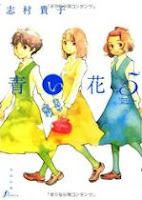


Yuri Manga: Aoi Hana, Volume 5

April 22nd, 2010

You know the 5 Stages of Death? Well, Coming Out also has certain stages. 1) First, you have to admit to yourself you are /fillintheblank/. 2) Then you admit it to someone close to you. Just one person, because your sure it’s going to turn them against you. 3) Then you admit it to someone else – sometimes a perfect stranger, because that’s safer than family or friends. 4) The biggest hurdle is vocalizing it to your family. If that stage is not horrible (and for many people it is,) you start becoming more comfortable with the whole thing, until the final stage 5) Acceptance. For that to happen you have to accept yourself. It’s a bonus if the people around you accept you too, but it’s most important that you accept yourself.

In Aoi Hana Volume 5, Fumi has made it past the third stage. And really, she’s not sure how she got there. But it’s okay, because she’s well on her way to accepting herself. And she’s also already incredibly strong, although she doesn’t yet realize it.

It’s once again time for the Drama Club to put on their play and emotions are running very high. Despite themselves, last year’s first-years are turning into rather mature second-years that are admired by the new students. Kyouko stuns people with her performance in Mishima Yukio’s Rokumeikan. (The link is to the collection of plays in which Rokumeikan is included.) Even Akira, who comes down with sudden nerves, finds herself caught up in the moment and shines on stage.
Haruka learns that Fumi, too, is a lover of women, and we follow a flashback when she learned of her sister and Hinako’s relationship. When Fumi meets Haruka’s sister, she is keenly aware – and a little jealous – of their comfort level with each other.

Even Mogi’s clandestine relationship with Akira’s brother is noted.

Everyone is growing up.

I only wish I had “met” Fumi when I was young. I could have used a media representation like her.

With vacation planned and old flames coming back into the story, Volume 6 promises to be full of fireworks – can’t wait!

Ratings:

Art – 8
Characters – 9
Story – 9
Yuri – 5
Service – 1

Overall – 9

Does *anyone* like Chizu? The more we see of her, the less I like her.


Ikkitousen Xtreme Xecutor Anime

April 19th, 2010

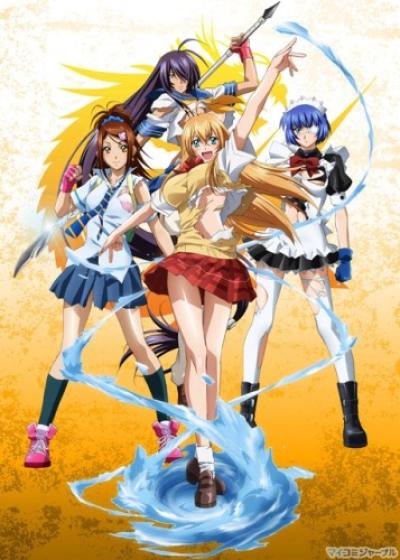
In Ikkitousen: Xtreme Xecutor, we pretend that Ikitousen:GG never happened and go crawling back to the Romance of the Three Kingdoms with our heads down, asking humbly for it to take us back.

On the positive side, the main characters are the women and they are strong – very, very strong. On the negative side, we have to look at them from the ground up to remind ourselves repeatedly that women are no more than breasts and vaginas. However, you can see that even the animators are getting tired of this and whole scenes pass without a single panty shot.

Bachou appears and does something odd – she asks Hakufu to teach her. Although she knows that historically she served Ryuubi, she’s impressed by Hakufu’s power. (And the scene in which Hakufu takes Bachou in as a student may well be be the best scene in the current series.)

We’re introduced to two evil psycho sisters from Nanban  – and yet *another* person claiming to be Kantei fills in the quota of plot complications.

Overall, the story has been as de-Yurified as it can be. If there’s any tension that surpasses the historical context this time, it is that we’ve been seeded with the idea that Kanu and Ryomou have some unfinished business from both their historical past and their current lives. But for the most part, the focus is on the fighting – which is perfectly fine with me. Honestly, if we could lose the service altogether, I’d think this was one of the best series ever. :-)

Ratings:

Art – 7
Story – 7
Characters – 8 (Am I projecting? Yes, yes I am)
Yuri – 1
Service – 14 million

Overall – 7

I’m not taking one for the team when I watch this – I actually really like this series. ^_^


Yuri Manga: GUNJO, Volume 1

April 9th, 2010

(Note to people looking for scanlations of this book. The author does not work herself to the bone and pay money out of her pocket so you can steal her work. Scans are not cool – they are theft. You want the book, click the picture and go buy it. Otherwise, you’re devaluing her time and effort and there is no justification for it, other than you are selfish.) 

“Is it settled?”

“It’s settled.”

With these few words begins one of the most profound, most emotionally engaging manga I’ve ever read.

Gunjo, Volume 1 (羣青 上)by Nakamura Ching is a journey from madness to madness, from profound misery to profound misery and from derision and fear into depths of despair where there is respect and even love.

It begins in the moments after a horrible crime has been committed. A woman has asked someone to kill her husband for her. She has asked someone she knows she can use – another woman, a lesbian, who has been in love with her since high school. The woman who requested the death is abusive, derisive. The woman who committed the crime is passive, almost apathetic. She flinches in the face of the other’s harsh words, but doesn’t fight back.

In between incredible, sudden violence, at moments when their existence is most tenuous, there is tenderness. No, it’s more like that there is only tenderness in the moments when they are most fragile.

We only learn later that the one woman has been serially abused by her husband, after a life with an abusive father. And we only learn later that the other woman walked away from a relationship and a life to commit this act of violence for her.

There is no real moral ambiguity here – these two women are violent and broken. They are insanely bad for one another and have together done something unspeakable. And yet, in the darkest moments, they realize they want to live and try to create something like a life out of the chaos they’ve created.

Nakamura-sensei’s art is detailed and realistic – and in those moments of terrifying violence it reaches the level of sublime. Her writing is subtle – and painful and hurtful – and breathtakingly beautiful especially when the situation is uncertain. There is a mastery of tension of just about every kind in every word and line of this story.

Moving, brutal, sublimely gorgeous and profoundly disturbing.

I’ve said it before and I’ll continue to say this – Gunjo is the best manga I have read to date.

Ratings:

Art – 10
Story – 10
Characters – 10
Yuri – 7
Service – 1

Overall – 10

I would love to hear from those of you who bought Volume 1 of Gunjo – what did you think of it, now that you’ve had a chance to see it for yourself?


Yuri Manga: Sasamekikoto, Volume 6 (ささめきこと)

March 29th, 2010

When you’ve got a logjam, there’s only two ways to break it up. Either something has to crack under pressure, or some external stimulus has to be applied to clear the congestion. In either case, I expected a “terrible crisis” to happen in this volume.

In Sasamekikoto, Volume 6 (ささめきこと) *both* things happen. And I was wrong – there is no “terrible crisis.” Well, there is, but it’s not that terrible, really.

I don’t want to spoil too much, because this was a very good volume, but let me say this: The one consistently weak thing about this story has been Ushio’s cluelessness. Well, that’s been taken care of now.

And now, I am even more interested to see where the series goes from here.

I loved that the crazy birthday party meme from the Drama CD was reused for this volume in a way that left one not feeling wrung out and irritated.

I foresee a ridiculously grin-making climax, but not at least for another volume, maybe two. Kind of weird for a series that became so thickly wrapped in angst, but also kind of a relief.

Ratings:

Art – 7
Characters – 8
Story – 9
Yuri – 7
Service – 1

Overall – 8

Damn this series, now I’m singing Jinsei ha Party all over again. Gah.