Archive for the Series Category


Yuri Manga: Yuri Tengoku (and Strawberry Panic)

January 22nd, 2004

Something Old, Something New, Something Borrowed, Something Blue
Part 3

When one person has a good idea, it is inevitable that there will be a rush of copycats, trying to get their two cents in, too. Anime and manga are no different. It appears that the yaoi market has matured, so many manga publishers are rushing to get new yuri products to market as fast as they can. The second half of 2003 gave us more anime and manga with yuri elements than I’d ever seen before at one time, and 2004 is shaping up to be even more chock-full of lilies.
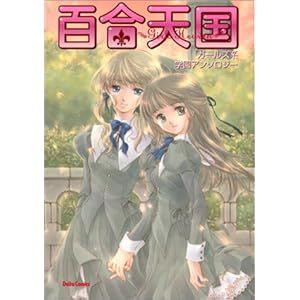
Today, I’ll briefly cover two publications that have been released that are *clearly* something borrowed. This past August, the first yuri manga magazine since Mist* went out of print, was released (not counting lesbian publications, Phryne, Anise and Carmilla, which aren’t specifically manga magazines – they cater(ed) to a more general lesbian population.) I’ll talk about Yuri Shimai later, in more detail. But almost immediately upon Yuri Shimai’s tail feathers came yet *another* Yuri magazine, this one cleverly and subtlely called Yuri Tengoku(Lily Heaven).

This is more of a slick, widely distributed doujinshi than a true magazine. It may be a one-shot, certainly there’s no advertisement inside for a second volume. The cover and the first few pages are nicely done color art of schoolgirl couples, but nothing suggestive in sight. The stories inside range from (IMHO) utterly mediocre fairly decent – but I am very not into moe art, of which there was a preponderance. Of the dozen or so stories, there were only about three or four where the characters actually looked to be the age they were supposed to be, and of those, only one that went beyond a confession followed by nothing much.

Call me unreasonable, but by the end, I *longed* for a story about a bored housewife and lesbian trucker. And I *am* being unreasonable, since Yuri Tengoku says right on the cover that it’s an anthology of stories of love connections between girls. So one shouldn’t expect more than a few kisses here and there. And that’s about what one gets. The stories are very sweet, I can’t fault that – and most of them end with at least the possibility of some further developments between the girls in the future (at least one hopes so!)

I will say this in favor of YT, it did not suffer from an overabundance of fanservice – just erred on the ootsey-cutesy side. Only one story really wandered into that particular field and, as it was played for laughs, it was actually pretty funny.

Interestingly, Yuri Tengoku suffers from a layout issue that plagued ALC Publishing’s first Yuri Monogatari. There’s no spacer art or splash pages between stories, so the transition from one to another is abrupt. Hopefully, if Daito Comics does another issue, they’ll be able to resolve that issue.

Is it Yuri? Indubitably. Is it worth it? That depends on whether you like sweet stories about girls in school uniforms. If that’s your thing, then it’s worth it.

I can’t really rate it, since, as an anthology it has a wide array of art style and story.

***

Another brand new “me-too” entry into the Yuri manga market is another loli-art-style entry,
Strawberry Panic, brought to us by Dengeki Comics, who also brought us the manga for Battle Athletes, Stellvia of the Universe (which I will review later on) and Azumanga Daioh…as you can see, Dengeki is our friend. ^_^

(Please look at the Strawberry Panic category for all my later reviews of the anime, the light novels and manga.)

Strawberry Panic is not only *another* Yuri story, but is strongly “me-too”ing the schoolgirl theme Marimite; i.e., girls’ relationships forming at private schools, only this time with a slightly more sexual twist. From what I can tell, the story revolves around three schools, all of whom draw their “little sisters” from among the younger students (ala the soeur system of Lillian.) When a girl is chosen, she is initiated into her school by an older student who “lilys” her. (I swear they used the word “lily” as a verb.) The relationship is defined in the write-up as being more than friendship and the word lily is sprinkled liberally throughout. As I haven’t seen any more than this website, I can only imagine what it all means. B

*Mist magazine was the coolest Yuri manga magazine ever. It was Yuri from beginning to end; mostly manga, some short stories and usually a “photo” story, which was really silly The stories were for a mature female audience, so they were essentially Yuri porn. I have two copies gifted to me by a friend and they are my prize possessions. If I ever find any more, you can be sure I’ll scoff those babies up!

If you’re looking for good Yuri manga and doujinshi, don’t forget to stop by the English and Japanese-language manga and doujinshi at the Yuricon Shop, where the girl always gets the girl and the Yuri is really decent stuff written by lesbians for a adult audience.


Yuri Anime: Aim for the Ace! / Ace wo Nerae!

January 20th, 2004

Something Old, Something New, Something Borrowed, Something Blue


Part 1

This week, I’ll be running over a few Yuri titles which are, as I say above, old, new, borrowed and blue. Call it a “theme week.”

First up, today, something old. And now I’m torn, which of the many, many old series that I’ve grown to love, do I review?

Let’s start with this one:
Ace wo Nerae!, (Aim for the Ace!), from 1973. This is probably one of the oldest truly *shoujo* anime out there.

Ace wo Nerae, adapted from the popular manga of the same name (another Margaret magazine Yuri classic!) is the story of Oka Hiromi, a first year student at Nishi High School. Hiromi, like many other girls in the school, deeply admires Ryuzaki Reika, known as “Ochoufujin,” the shining star of the girl’s tennis team. Ochoufujin, along wth the other upperclassmen, make up an unbeatable women’s tennis team which has attracted over 100 first-year newbies – including Hiromi and her friend Maki. Hiromi is happy as a clam to be near to her idol, Ochoufujin, and even get the occasional kind word from her, but everything changes the day the new coach shows up.

For some reason the new coach sees potential in Hiromi that no one, not even Hiromi herself, can fathom. He singles Hiromi out and begins working her mercilessly, even replacing one of the ace upperclassmen with a terrified and, subsequently, harrassed, Hiromi.

Ace wo Nerae will immediately remind viewers of another Margaret manga classic Oniisama E (Brother, Dear Brother) since the character designs and direction for the anime were done by the same people; and the plot is the usual shoujo fare of the seemingly average girl being catapulted into the rarified world of the great ones in her school. The biggest difference is that in Ace, Hiromi finds herself not only capable of handling the stress, but grows to be a very strong person and a very strong tennis player, as opposed to just growing up a little as a result of her experiences. We actually get to see her game improve over time and, as she matures and becomes the player the coach knew she could be, she steps into a position as one of the team aces.

In terms of Yuri, Ace definitely straddles the line between adoration and romance Because this manga and anime are from 1973, the Yuri is encoded in small, subtle things. You won’t see tearful confessions of love, much less a kiss or anything, but watch Hiromi carefully, as she dresses to bring flowers to Ochoufujin…or if you can find it, there’s a wonderful screencap from the Ace wo Nerae movie, as Hiromi and Ochoufujin head off to America together (a code in itself, really, as America is always seen in lesbian fiction as the place to escape to to be together.) Hiromi is wearing a three-piece white suit and tie, her hair has gone completely masculine. She looks about as butchy as someone could possibly have drawn a girl in the early 70’s.

As a representative of early Yuri, Ace wo Nerae is a spectacular example, but expect a fair dollop of cheesy-ness, as the character designs, music, art, etc are all over 30 years old. The op art graphics and laughable opening theme are delightfully retro now.The most important thing is that the characters are genuinely likeable and their motivations fathomable. I give this one a strong recommendation, if you want to see where many of the conventions of Yuri come from.

Ratings:

Art – tough to call, because it’s so dated. For its time, 7
Story – 9
Characters – 9
Character Design – 8
Music – Makes me giggle every time I hear it, 6
Yuri – 2 Negligible, but not not there.

Overall – 8

As always, for updates on Ace wo Nerae and other classic anime and manga, join us at the Yuricon Mailing List.


Yuri Anime? Kaleido Star

January 18th, 2004

Okay, okay, I take it back

I take it all back! Kaleido Star is definitely a yuri anime. Not only are Anna and Mia still sharing a bed (in an apartment that has plenty of room for them to sleep apart if they really wanted) but there’s this *thing* happening between Leila and Sora, which, while it isn’t love or physical attraction, is definitely an intimate connection. Watching them perform together is not all that different from watching a love scene.

The funny thing is, I read a review of Kaleido Star recently on a Japanese website, and was like, “Leila and Sora? Are they nuts?” Yeah, well – I was wrong, they were right. ^_^

Don’t get me wrong – this is still a superficial, silly, fluff-filled anime. There is no big story here…it’s just about people who have a vision and want to make that vision come true. The vision just happened to be about doing acrobatics. The first dozen or so episodes weren’t riveting, but the characters have a more realistic passion now and I actually care whether Sora and Leila develop the Maboroshi Oowaza, the Ultimate Trick. Don’t ask me why…I don’t know. ^_^

I’m upping the Yuri rating on Kaleido Star to about a 7 out of 10.


Various Yuri Anime

January 16th, 2004

Traces of Yuri

Part 2

Kaleido Star:
Another inoffensive (this time, really) anime, it seems to have been co-produced by and licensed by ADV. I can only imagine that they are targeting this towards a TV release, because there is *nothing* in this anime that would offend the mildest of viewers, with perhaps the exception only of the ecchi “Spirit of the Kaleido Stage,” who can’t be seen by anyone else but the lead. Since we (and he) do not actually get to see anything naughty, it would make a pretty good TV choice.

The plot is basically the same as  the old classic shoujo anime Aim for the Ace,Ace wo Nerae , (which I will review next week,) only this time instead of Tennis, the venue is something remotely Cirque de Soleil-ish. The lead, Naegino Sora, is a sweet, enthusiastic and energetic girl, without being too genki, too shy or too aggressive. She’s not afraid to speak her mind, but she’s not rude either – the perfect modern Japanese girl. Sora’s dream is to perform on the “Kaleido Stage” in America as an acrobat/performer. Of course, her dream comes true…with
many challenges that will force her to become a stronger and more mature person, etc., etc.

Is there yuri? There is, but, not much.

Mia & her roommate/partner in crime,
Anna are definitely and obviously a couple. They ping the gaydar from about Episode 3 onwards, and as the story (what little of it there is) develops, they seem more and more obvious. The only thing like confirmation we get is in Episode 19, where we actually see them sharing a bed, facing each other and close enough that they have to be touching. That’s about all. It’s not hot lesbo sex, kids, but would probably slide by a TV censor easily. The series is continuing on Japanese TV, so I’ll keep watching, but I do not expect Mia and Anna’s wedding episode anytime soon. :-)

If *you* know of a series that you think has yuri content, then by
all means, let me know at [email protected]
or join the Yuricon Mailing List and tell us all about it!

*In case you care, my fetishes are, in no particular order: psychotic and/or nasty women; competency, chicks with weapons, uniforms and classic literature or mythology used cleverly.


Yuri Manga: The New Hana no Asuka-gumi

January 14th, 2004

Everything old is new again!

Part 2

Here’s another old series that’s been resurrected for a new audience…the original shaped an entire genration of girls in the mid-80’s…hopefully the new iteration willl do the same!

Atarashii Hana no Asuka-gumi (The new Hana no Asuka-gumi) is one of several excellent manga series running currently in
Feel Young Comics monthly magazine. I’ve raved about this series before, and the plotlines and character relationships are very complex, so I’ll attempt to keep this short, but will probably fail. :-)

Kuraku Asuka is an uber-cool 14-year old girl who hangs out on the streets of
Shinjuku in Tokyo. Her best friends are the members of the local gang; the Shinjuku Omoteban or Outside Group, while Asuka herself was once part of the Uraban or Inside Council that runs all the gangs of Tokyo. The leader of the Zenchuu Uraban, or Central Inside Group…i.e., the folks in charge, known as Hibari-sama, once upon a time, had fallen in love with Asuka and named her “Minister of the Left,” an important post in the organization. But Asuka was in love with, and being manipulated by an older girl, Yohko, who was an outsider to the organization and quite sociopathic. Asuka rejected Hibari, Yohko ultimately died and the series ended after 37 volumes of manga (Asuka Comics,) 2 anime OVAs, three-seasons of a TV show, and half a dozen drama CDs. Now, Hana no Asuka-gumi is back and I think it’s worth following. For one thing, there was quite alot of yuri subtext, which became overt text in the original. The fact that it’s running in Feel Young, which is a josei manga magazine (for older female readers) gives me hope that there will be more subtext than ever. Certainly the world of Asuka is primarily a girl’s world – there are a few guys with minor roles, but that’s about it.

In mostly every arc, you can expect:  lots of internecine rivalry between the area gangs and Asuka; Asuka rescuing a damsel in emotional and sometimes physical, distress; lots and lots of fighting; cool conspiracies as Hibari tries to either get Asuka back, or get revenge upon her.

The yuri subtext lies mainly in the two dysfunctional relationships Asuka has with Hibari and Yohko. Hibari (whose face we never see, and who carries a broken doll around) treats Asuka like a toy to be dressed up and, of course, undressed. In the original story, there was NO doubt that Hibari desired Asuka. In the end, it was on Hibari’s bed, as Hibari lay above her, that Asuka rejects Hibari and the Zenchuu Ura for the last time.

Yohko’s relationship with Asuka is a more complex. In some way, she does love Asuka, but her own twisted nature makes her unable to express it in any way, except by emotional manipulation. Yohko is *not* a nice person. Asuka openly tells Yohko twice that she loves her, but it only enrages Yohko. For the most part, the only way they can express their emotion is by fighting physically -at least this way they can touch each other. Yuuki (one of the few boys in the story) comments quite calmly to Yohko that its obvious that Asuka is really in love with her, so its not just me reading into it. :-)
And, for the record, he uses the word ai (love) not suki (like/love.)
Bear in mind that throughout this story. Asuka is 14 years old, with intimacy issues, while Yohko is 18 and a sociopath…there’s no way this relationship could work. :-)

Asuka is way too cool for her age, and her friends in the Omoteban are a blast: Miko (Yohko’s half sister) is whacked and funny;  Hime is composed and beautiful in a way that *no* 13-year old ever is. :-) The New Asuka has brought back all of the old characters, including alot of the smaller roles, the area gang leaders, the women of the Ranjuku Detention Center, and all of the Zenchuu Ura, including the incredibly hunky Kazuga (Hibari’s Aide-de-camp.). So there are plenty of uber-cool women to watch for.

The new series seems to be post-Yohko, but I live in hope that she will appear, if only because every other arc in the entire Asuka universe had Yohko at the center of it.

The author has her own website which has downloads, games and other Asuka-related stuff. You can find that all at
Takaguchi.net, along with info on the author’s other popular series, some of which are yaoi.

Ratings: Art: 8 out of 10, the old series was a little cleaner than the new (but the new characters look more their age). Character: 10 out of 10. You don’t get better than Asuka! Story – 8 out of 10 for now, since the arc is developing slowly…. Yuri: 2 out of 10 so far – no Hibari/Asuka, no Yohko/Asuka…only the hint that Hibari has a new favorite. Overall – 7 out of 10.

And, as always, you’ll always be kept up to date on any new yuri-ness on the Yuricon Mailing List!
