Archive for the Series Category


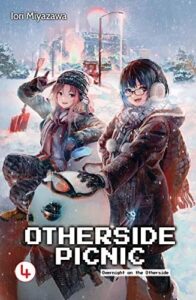
Otherside Picnic Anime

February 14th, 2021

Miyazawa Iori has rather quickly entered the landscape of Yuri creators in recent years. With a lead story in the Yuri issue of SF Magazine in 2019, followed by the J-Novel licensing Side by Side Dreamers, and then the outstanding science fiction novel series, Otherside Picnic, Miyazawa has set a whole new sets of benchmarks for Yuri in a very short time.

The Otherside Picnic novel series has been fascinating. With an overt mix of Japanese netlore, science fiction, action and horror tropes and a big scoop of Yuri on top, I’ve enjoyed all of the novels so far. My reviews and others’ are all on Okazu in the Otherside Picnic category. Sorawo and Toriko are unusual as characters, compared with my usual fare. The post-apocalyptic unpredictability of the Otherside/UBL and its interactions with this world, give the series a Jorge Luis Borges-ish sensibility that I genuinely appreciate.

Otherside Picnic follows the adventures of college student Sorawo, as she find herself in an alternate reality that is embedded within locations in and around Japan. In this “Otherside,” Sorawo meets attractive Toriko, and finds herself traveling back and forth to the Otherside to gather artifacts for money, and help Toriko find a person who has gone missing on the Otherside…a person who clearly is more than just a friend.

It was with some trepidation that I saw the first key visuals of the Otherside Picnic anime. What was a darkish story about two young adults had already been given much-too moe illustrations in the books, and now it was the moe that was getting the focus, not the dark, not the deep, not the Russian science fiction, not the action, not the creative thinking around the creatures of the UBL. I won’t lie. I was deeply disappointed. Now that I have managed to watch the anime, which is streaming on Funimation.com, I’m still a little disappointed.

The first reactions I read of the anime seemed to focus on the translation, which chose “wiggle-waggle” for kune-kune. That didn’t bother me, as くねくね means wavy, or wriggling. I think the distaste there was the typical otakuish preference for the exotic other. I can see both sides and frankly glad they didn’t go with something like “The Wriggler”.  That is not the problem. ^_^; The problem is that they completely punted on animating the kune-kune, which are, based on the original description, very similar to the monsters of Side-by-Side Dreamers – a sort of familiarly shaped thing, but made of streamer-y parts. Something between those flappy advertising tube men, and the A-jin. The Otherside Picnic manga from Square Enix is way closer to my idea of what they ought to look like than the anime, which just…didn’t bother. The detailed burned-out buildings in the background look great. I wish they had given the same care to anything in the foreground.

Instead of a pleasantly befuddlingly creeping psychological horror, the anime is a comedy-action series, in which running and screaming takes up all the space the “what the ever-loving fuck reference is that?!?” of the novels. The pacing makes it impossible to appreciate the well-crafted horrible unrealness, before the screaming starts. For anyone who has come to the anime from the novels, it’s bound to be a little disappointing.  Even more importantly, if you are enjoying the anime, and decide to try out the novels, be prepared to be be actually creeped the fuck out. The anime makes everything so silly and cute, but the books do no such thing.

It’s not that this anime is unlikable. Actually, it’s very enjoyable, and the voice acting has been superb. As Sean Gaffney noted in conversation, Hanamori Yumiri as Sorawo is particular good, as her lack of affect when explaining her not-at-all-usual family life, actually increases the emotional impact. And if you’re not sure whether you might like this story, I’d definitely say give the animation a try….

…with “try” being the operative word. I know I have been banging on this for years, but Funimation is terrible at streaming. Streams cut out, commercials get stuck on loops, subtitles don’t work at all, or work wrong. I want so much for them to do this well, but they don’t. The first time I tried to watch the first episode, it took me 4 *days* to be able to get the whole thing watched and I ended up watching it with no subtitles at all, because the option never appeared. (Not a crisis, as I knew the story and can sort of understand, but that is not the point.) Funimation still gets a ‘D’ on streaming. I fear that a merger between Funimation and Crunchyroll will mean CR loses all of it’s decent streaming to Funimation’s vastly inferior system instead of the other way around.

Ratings:

Animation – 6 Unsatisfying. This COULD have been amazing and it’s just not
Story – 7 – Not as compelling as everything is crunched for time
Characters – 7 Sorawo comes off as more compelling, Toriko less, Kozakura feels even more like an afterthought
Service – 4 The key visual art was creeperish, and the moeification of the characters is itself a distracting bit of pointless service
Yuri – 5 Implicit and explicit in places and part of the overarching plot.

Overall – 7

So far at least, the anime feels like a children’s version of the novels. Goofy funhouse screaming rather than creeping psychological horror. Not bad in any way, just not good in the way the novels are good.


Battle Athletes OVA/TV Anime Complete Blu-Ray set, Guest Review by Eric P.

February 3rd, 2021

Happy Wednesday and welcome to another Guest Review Wednesday here on Okazu! Today we welcome back our long-time friend and Guest Reviewer, Eric P. It’s always a pleasure to have him here and today he’s going to take a look at the new release of Battle Athletes Complete TV Series & OVA Blu-Ray! As always, please give him a warm welcome back. Take it away Eric!

Set in the far-off future of 4999, Battle Athletes centers on young Akari Kanzaki who follows in her legendary mother’s footsteps.To do this, she attends University Satellite to compete in various sports tournaments for the top title of Cosmic Beauty, meeting different people along the way and growing up as both an athlete and person. That is the basic story  for the 6-episode OVA, while the TV version, Battle Athletes Victory, included far more elements in order to fill out its 26-episode length. In the TV-length series, Akari’s journey starts with her training to be a contender for University Satellite, followed by the actual Cosmic Beauty competition.  Everything culminates with—Akari and the other athletes fighting to protect Earth from an alien invasion. Turns out Cosmic Beauty was a front in searching for the best athletes to help decide Earth’s fate by tournaments, like a bloodless version of Mortal Kombat.

If that last part sounded goofy, it is, but it still works in its strange way. The TV version is sillier in nature than the OVA, with the humor driving much of the plot (the big revelation of Akari’s mother in the third act still makes me chuckle—it is something neither the characters or the viewers could ever see coming). Some viewers may better appreciate the more focused storytelling of the OVA with its minimal episode count, along with its more solid characterization. Akari herself develops at the right pace for the protagonist she is supposed to be, whereas in the TV version she is more likely to test viewers’ patience. As a consequence of having multiple episodes to pad the time out with, Akari struggles that much longer to come into her own. The real reason she is deemed special by everyone around her is due to her mother’s blood, and it takes quite a lot in drawing out that greatness like she is some kind of prophesied hero—which, she actually is by the end.

At the beginning of Victory, the one most responsible in driving Akari to be her best is her tomboy friend/fellow athlete from Osaka named Ichino. There are indications of something stirring between them as we follow them, but it never fully blooms due to their mutual denial. By act two they are forced to part ways, and the University Satellite is where Akari meets her new teammate in both the OVA and TV, Lunar-Priestess-in-training Kris Christopher. In the OVA, Akari gradually develops feelings for her that she later finds impossible to deny. Kris however remains a sexually ambiguous enigma since everything she does, including her kiss with Akari in the end, all get explained away by her religious customs.Victory is different in that regard, for there is no subtext in Kris’s love-at-first-sight attraction toward Akari. Her relentlessly obsessive pursuit drives Akari to maintain a distance much of the time for comedic purposes, although later on Akari does come around to embracing her teammate; if not so far as reciprocate her feelings quite yet. Once all the athletes gather to fight for Earth, as you might guess, we get the Yuri love triangle/rivalry that seems inevitable—the inhibited Ichino and uninhibited Kris have it out, with Akari helplessly stuck in between. Just as inevitable, the triangle ends unresolved, since leaving it up to the viewers to decide who Akari would choose was apparently meant to be part of the appeal.

This Sci-Fi Sports Yuri Comedy series was one of my gateway titles into Anime while growing up in the 1990’s. Like most Anime fans, I have watched several others as the years went by with only so much time to revisit old favorites now and then—then Discotek came along to license-rescue and re-release the complete collection in one Blu-ray set to be discovered anew. Originally standard-format, this is not an HD transfer so the picture quality remains the same as the original Pioneer DVD’s. Regardless, we get to have everything on one single disc including the special features. There is one other highlight that Discotek deserves kudos on—always missing from the Pioneer release but now restored, is the epilogue montage through the final TV closing credits, showing where all the characters wind up after the story’s end.

Having watched this series for the first time in so long, much of it still holds up well enough entertainment-wise—while some of the elements did not hold up as much as I would have liked. When I was younger, I thought it was neat how Victory was made up of a diverse cast of multicultural characters, with one athlete representing a major nation. Now I can finally recognize the outdated culturally ignorant stereotypes attributed to these characters. Some stick out like sore thumbs more so than others, especially with the conniving Chinese athlete Ling-Pha and African athlete Tanya, whose hyper-animalist nature will no doubt rub plenty of viewers the wrong way (she is more sensitively depicted in the OVA). Also, even though this series takes place in the far future when humanity is at its most advanced, a clear sign of the 1990’s is when the surrounding characters still react to homosexuality like it is something strange and stunning (and use dated language like “swing that way”), although Kris never views her feelings as such.

Despite the warts that mark it as a product of its time, my appreciation for Battle Athletes has not lessened, now that we have a new version. It is still a classic with charm one can only find from the 1990’s—one has to take it for the light, fun entertainment it was meant to be without taking it too seriously. Especially for those wishing for a newer sports-themed Yuri story to happen in the near future, there exists the original such title as an option until then.


Ratings:


Art—OVA:7, TV: 6 (The OVA being Original Video Anime, of course the animation would have more to it than the more limited TV series with the latter’s still/recycled shots. Either one is very ‘90’s, but not in a bad way)

Story—OVA:6, TV: 7 (The OVA and TV versions both have their strengths and weaknesses the other does not have, making it a matter of preference. I just happen to get more out of Victory, with the additional character stories and its inclusion of Ichino)

Characters7 (The characterization may be more solid in the OVA, but we get far more characters and get more time well spent with them in the TV version, so it rounds out either way)

Service—OVA:7, TV: 3 (Both versions have it, yet the OVA is comparably more voyeuristic. Even without the scenes of nskedness, the camera takes plenty of convenient shots of the female athletes in their uniforms and body positions—it helps even less that the OVA version’s headmaster character is depicted as a stereotypical “loveable”[??] lech toward the athletes)

Yuri7 (I would be remiss not to give a quick mention to two other athletes, Lahrri and Mylandah, in which at least one of them closely fulfills the traditional EPL role. Victory reveals tidbits of their complicated rivalry/friendship, but you will not find the same thing in the OVA)

Discotek’s Release9 (If I had just one complaint—both inside and outside the slipcase the cover features almost each major character, yet it somehow misses Kris everywhere, while Ling-Pha somehow always appears twice. What’s the dealio, Discotek?)

Overall—lucky number 7


Erica here: Thank you very much Eric for taking a look at this now-classic Yuri series for us! I’m glad you didn’t forget Mylandah and Lahrri. They will always be the reason I love this series. ^_^


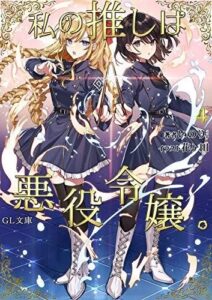
Watashi no Oshi ha Akuyaku Reijou. Volume 3 (私の推しは悪役令嬢。)

January 25th, 2021

I don’t really know how to review this book. ^_^;  There’s so much to tell you and so little I can say!

In Volume 1, we met former office worker Oohashi Rei, who wakes up one day in the world of her favorite otome game, “Revolution,” as the protagonist Rae Taylor. As Rae, she opts out of the usual romance routes and instead focuses all of her acumen and knowledge of the game on her actual interest, the villainess Claire François. Then the revolution comes crashing down over the two of them.

In Volume 2, Claire and Rae, now a couple, work together to create a better world for themselves, their friends, their country, and…

spoiler warning/ Because both these books are available from Seven Seas in English, I am going to assume you have read them. If you have not read them, this review will contain inevitable spoilers, starting with the cover, because it is right here next to these words and I can’t hide that. If you haven’t read the first two volumes, this review may be largely incoherent and there are even MORE spoilers ahead. Don’t keep reading if you want to avoid spoilers. Do go read Volume 2, then come back. ^_^ /spoiler warning
So, going back to my previous statement.

Claire and Rae work together to create a better world for themselves, their friends, their country, and…their children.

Watashi no Oshi ha Akuyaku Reijou. Volume 3 (私の推しは悪役令嬢。), which I read on US Kindle in Japanese*, begins a year after the revolution. Claire, Rae, and their children Aleah and Mei**, the orphans they adopted in the tear-jearker epilogue to volume 2, are a happy family who are dealing with some major issues that are clearly foreshadowing future plots. Rae and Claire are teachers at the Academy they formerly attended as students, when they are approached by the government with a life-changing request: Diplomatic relationships with the Bauer Kingdom’s former (possibly current?) enemy, the Nur Empire is being established. A team of exchange students are being shared between the two countries. Several students from the Academy are going…and so are Claire and Rae, who decide to take Aleah and Mei with them.

We’ve already established that all norms are off the table in this series, so the plot here is a little bit of everything – school drama, romance, socio-political drama, and some other things and then the demons arrive. From this point on the book is spinning plates and juggling balls and then an axe or two on a high-wire.  And it all works, except I have about 300 questions. ^_^  I’ll just hope that some of that is clarified in future chapters and, eventually, volume 4.  I was worried through the entire first half of the book about two things that were never the problems I thought they’d be. But…what? Why? How? I’m not unsatisfied, I just want more!

I’m going to be really impatient until all of you have read it, too, so I can scream all my questions at you! ^_^

The second half of this volume are a series of deeply schmaltzy and satisfyingly goopy extra chapters that cover a number of celebratory events in Rae and Claire’s life, like birthdays and Christmas and their wedding. Rae and Claire get more and more touchy as the story goes on. Apparently Inori-sensei has offered up the bed scenes as an extra on her Pixiv Fanbox (which I think is a terrific idea and admit, I’m tempted. For the record, her Fanbox is being translated into English and Korean, so don’t be afraid to support her.) Rae and Claire’s wedding is a very pointed commentary on modern Japanese life and laws and an incredibly sweet scene. For a second time, the final scene of the book had me reaching for the tissues. How far Claire and Rae have come in a year is laid bare for all for us to see. (happy tears)

But, Erica! I hope you are flailing your hands at me in an attempt to get my attention. Did you say Rae and Claire’s wedding?!? Yes. And that is not the only wonderfully gay bit – nor is it arguably, the most important gay thing in this book. There are at least three other incredibly important conversations that I hope like heck have made a difference for someone, somewhere. And Rae and Claire are VERY clear about what they are to one another to the people around them in so many words.  They are physically affectionate with each other and with the twins, as well. I honestly loved that affectionate kisses and hugs and touching were just normalized in this story.

Ratings:

Art – 8
Story – 9
Characters – 10
Service – Kind of? You’ll have to trust me that its fine, really.
Yuri – 10
Queer – 10

Overall – 10

Absolutely fantastic, but I have so many questions.

What about <spoiler>? What did they do?
What is the deal with <spoiler and spoiler>?
Were the <spoiler> there for shits and giggles?
What is going to happen with <spoiler>????
Why on earth is <spoiler>?????????

*The one thing I do honestly like about using Kindle for Japanese-language books is the translation function. It’s not perfect, but it helps not having to do more than highlight a term once the JP dictionary has been downloaded.

** In case it is not obvious, Aleah rhymes with Claire in Japanese and Mei rhymes with Rae.


I’m in Love With the Villainess, Volume 2

January 8th, 2021

Remember how amazed we were in Volume 1, when the characters of Claire, Misha and Rae had a frank discussion of sexuality? Well, I’m In Love With The Villainesss, Volume 2 has looked at Volume 1 and said, “Hold my mead”….

Rae Taylor is an extraordinary young woman, because in fact, she is not a young woman. She is a corporate drone from our world who has found herself in the world of her favorite otome game as the player character. Instead of romancing the princes, however, Rae has opted for a new route; one in which she is romancing the villainess, the aristocratic and strong-willed Claire François. Here in Volume 2, the holodeck controls are off and Rae and Claire run full speed towards a resolution that even Rae with her knowledge of the game can not predict.

As a reader and as a writer, I ascribe to what we called at the Fanfic Revolution called the “one-handwave” theory. This theory allows every world is allowed one massive, ridiculous, inexplicable thing that must be accepted at face value and cannot be questioned. This volume of I’m in Love With the Villainess, *immediately* blew that theory to hell in the most hilarious way I have ever seen. And then it did it again. And again. The rules? They are for some other story. This story could not have cared less what rules say. Massively important plot points were handled with literal magical handwaves, while actual time and attention were given to discussions of same-sex attraction, gender dysphoria, and, of course, the social impact of income inequality and political upheaval. It was compelling to say the least. It was a little too on the nose for this week, in particular.

This volume is significantly larger than volume 1. Given the resolution there’s only one thing the author left undealt with so Volume 3, when we get it, ought to address that.

In the meantime, this was an amazing read. Whatever benchmark might have been set by Volume 1, was shattered with sound-of speed waves as this volume goes blasting by it. It got exponentially queerer as the story went on. Final tally – 6 queer characters among the main cast, and a happy ending for our principles. And an epilogue that made me ugly cry at 2AM.

I give it my strongest recommendation. If you have not read this series, I hope you will. I know isekai isn’t everyone’s thing, but this is a shining example of exactly what I was talking about in my essay about queer representation Author Inori doesn’t consider that the limits of the worlds that previously existed are the limits of what the worlds could be. They’ve taken an already played-out plot driver and used it to explore very real-world situations in fantasy cosplay and come up with a different resolution. Rather than just assuming what was is what has to be, this series models a new ideal.  I feel even more confident that this was the right choice for my Top Yuri of the year for 2020, and it is going to be very, very hard to beat for 2021. But you know….I really hope something does beat it, because that would be something. ^_^


Ratings:

Art – 7 Okay. I’m still angry we didn’t get a picture of Claire in the tux in V1.
Story – 10 Perfection
Characters – 10
Service – 3 Yes, but…somehow this time didn’t bother me at all.
Yuri – 10
Queer – 10

Overall – 10

“Miss Claire, watch over me now.” I am slayed.


Bloom Into You Regarding Saeki Sayaka, Volume 3

December 24th, 2020

Capping this weird, and horrible and amazing year off is the volume that I have been waiting for since April, when I raved about the Japanese edition. At last I can share with you, the joyousness of Bloom Into You Regarding Saeki Sayaka, Volume 3!

Saeki Sayaka, a girl who tends overthink most things, is confronted by a situation that requires faith in the future.

I almost don’t want to tell you anything about it, because I want you to enjoy the whole thing on your own, without my prompts. I’m also tempted to just quote huge chunks of my initial review at you, since the things I loved about the book in Japanese hold up beautifully in English, thanks to the deft translation by Jan Cash and Vincent Castaneda and Jenny McKeon’s adaptation. They captured Sayaka’s cool, reflective, outside voice and the increasing turmoil inside her head beautifully.

The humor fit perfectly, even the one thing I *felt* but wasn’t entirely sure was real, was communicated well. Everything here is as polished as it needed to be, with the result that I picked this long-waited volume up after dinner and did not put it down until I had finished it.

The Regarding Saeki Sayaka series was an unexpected bonus for this reader of Bloom Into You. Sayaka was the reason I kept tuning in. This novel reminded us again of the importance of Miyako as an older role model for Sayaka. How much angst and loneliness might she have to struggle with without someone to just talk to? Instead, this series had carefully, cleanly laid the path out for us to see Sayaka become a person who understands she likes women and feels neither shame nor confusion about it. Having cleared the way of negativity, we are allowed to watch Sayaka become interested in someone for their own sake, for the first time in her life. And, so, we can fully enjoy that moment, alone in her room, when Sayaka says, “I have a girlfriend.” out loud, to her own amazement. ^_^

I tip my hat to Hitoma Iruma whose work here – which included a brief conversation about gaydar, as well – is some of the best they’ve done.  I am so very much looking forward to Iruma and Nakatani’s next collaboration. With this book, Bloom Into You is over, but we have End Blue (エンドブルー) to look forward to.  They really seemed to bring out the best in each other, and here we are, able to reap the benefits. Even if you weren’t a huge Bloom Into You fan, I recommend this LN series.

My sincerest thanks to the folks at Seven Seas for their work on this series. Clay Garderner’s interior design was lovely, Nicky Lam’s cover, as well. And thank you Seven Seas for crediting *everyone* who worked on the book. It’s a pleasure to see the team get their due.

Ratings:

Art – 10
Story – 9
Character – 10
Service – 3
Yuri – 9

Overall – 9

Spending time watching Sayaka bloom into herself is absolutely worth your time.