Archive for the Series Category


Rose of Versailles Anime, Part 1, Disk 1 (English)

June 17th, 2013

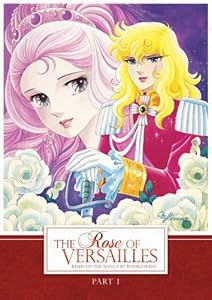
There is no question in my mind when I call Ryoko Ikeda’s Rose of Versailles a classic. Historical drama is always “timeless”, but centuries after the French Revolution and decades after the debut of the anime, we are still compelled by the story of Lady Oscar Franciois de Jarjeyes and her Queen, Marie Antoinette. Now that Part 1 has been released by Nozomi/RightStuf, there are synopses and reviews all over the place, I reviewed the series once, way back in 2004. The story of the French Revolution is well-known. ^_^ I will confine myself this time to talking about the captivating and charismatic lead of the series – Oscar.

We begin the anime introduced to the peculiar circumstances of Oscar’s upbringing, raised as a boy although her sex is not a secret. With  this simple plot device, Oscar is disassociated from her predecessor, Princess Knights Sapphire. No one is being fooled by Oscar, everyone is content to take her as she appears – young, beautiful, as talented at sword fighting as any man, a natural leader who just happens to be a girl.

So, it struck me very hard that, in the first disk, both her father and Andre’ misunderstand Oscar so badly.

Her father hears Oscar reject the role of Captain of the Royal Guard and takes it as a personal insult. His argument is “Don’t you understand what you’re doing to my reputation?” But of course, she doesn’t care – and why should she? He doesn’t care about her. That much is obvious when he chooses a life and a name for her. Her father is clearly using Oscar as a pawn in his game. This is not to say he isn’t proud of her accomplishments (and, no doubt takes credit for her looks and athleticism, as well). To some extent it’s understandable that he has no idea who she is – what father knows who his 14 year old daughter is?  And so, while he completely misunderstands, even when she tells him she does not want to “babysit a girl”, he can be vaguely forgiven.

But Andre’. He has been by Oscar’s side from the time they were small. Surely he understands that Oscar is not objecting to the position or the life of a soldier, but being relegated to caretaking a *girl*? Apparently not, because as she rides away, he calls out to her, telling her that this is her last chance to regain her womanhood. I gaped at his cluelessness. But then, he’ll be clueless about a lot of things for a while yet to come.

What makes Rose of Versailles work as a story once the characters are established and they get to Versailles,  is that it is laid out with plausibility. So plausible, in fact, it came as a shock to learn how much Ikeda’s characterizations deviate from reality. I have tremendous sympathy for both Marie Antionette  and Madame du Barry and would love to see a story built around them that cast them in the roles of celebrity and CEO respectively, to see how their story might play out in the 21st century.

Speaking of 21st century, let’s look at how distance makes us see Oscar differently than she might have appeared when she debuted in the 1970s. Ikeda writes her without any recognition of the influence of the Church on things such as gender roles, but then it had been more than 300 years since Joan of Arc was killed in France and Europe was fully engaged in the Age of Reason. So the Oscar we see in the anime is a girl raised as a boy and who is both capable and competent enough to wear the privilege she has been given. At no point in time in Disk 1 does she appear to pine away for more feminine accouterments, nor does anyone attempt to shame her for her appearance or position. We, from our distance from the Revolution (and from  the original manga and anime) can look at Oscar’s adaptation of the male role and argue whether we might consider her merely cross dressing or transsexual (and later we can argue a bit about her sexuality, as well, for fun. ^_^)

What I think is plain is that Oscar, with her white uniform, represents a kind of ideal, a “pure” nobility. She believes in her word and in the social compact. The excesses and politics of Versailles repulse and bore her, but she will do everything she has to to do to do her job as well as it can be done. Here in Disk 1, the theme of “Duty” is established and this concept, more than anything else, will drive the rest of the story.

I’m reminded once again that I can only take a little of Rose of Versailles at a time. Like Oscar, I prefer to be out in the field or woods than watching court gossip. ^_^ But you know, once I started watching this story again, I’m also reminded just why it’s a classic. It’s that good.

Ratings:

Art – 8 Strongly 70s. Gotta love those eyes.
Story – 9
Characters 9
Yuri – 0
Service – 6 Even the women of the Court know Oscar’s uniforms are all service, all the time. ^_^

Overall – 8

When much of what we like in anime now is long forgotten, Rose of Versailles, and the drama of the French Revolution, will remain.


Light Novel: Oshaka-sama mo Miteru ~ Kyoki Ippou (お釈迦様もみてる 潔き一票)

June 9th, 2013

It’s been pretty obvious that the Oshaka-sama  series has been echoing the Maria-sama series. Every glimpse we had of Yuuki in Marimite has been explicated through the shadow series. It was, therefore, quite obvious to me at the end of the last novel in the series, what the next novel would entail. In Maria-sama ga Miteru ~Manatsu no Ichi Page (マリア様がみてる 真夏の一ページ) Yumi learned  – to her shock – that Yuuki is the Hanadera Student Council President.* He says, rather deprecatingly, that Kashiwagi was playing a joke on him when he nominated him. In Oshaka-sama mo Miteru ~ Kyoki Ippou  (お釈迦様もみてる 潔き一票), we learn the truth.

We learn a number of truths, in fact.

Elections are on everyone’s mind – except for Yuuki’s. Since Kashiwagi is graduating, he’s really not thinking about next year at all. But when two of his classmates corner him and make some demands he not run with their fists, his reaction is not what they expect.  He runs into Kashiwagi who apologizes to him, then kisses him – Yuuki is not pleased, but he can’t get back what’s been taken. The next day, vexed and confused, he learns he’s been nominated by Kashiwagi for the position of President. Yuuki is deeply concerned about his friends’ reactions, but can’t yet bring it up to them.

At this point, we get a turn with each of Yuuki’s friends on the council. Andre-sempai and Rampo-sempai have no interest in running – they were there for Kashiwagi. Rampo tells Tetsu (Takada) to run, Of course the Yakushiji twins insist Arisu run – they adore their underclassman and want Arisu to shine. But the chapter that really, honestly, blew me away was Kobayashi’s.

Kobayashi Masamune, known to his friends as “Shounen”. He sees Kashiwagi alone and asks him if he can have a word. Alone on the grounds with Kashiwagi, Kobayashi asks a question that has been bothering him for ages… “Why not me?” Kobayashi points out that he had passed through the gates moments before Yuuki, was also undeclared as Heishi or Genji. So…why not him?

What passes is not possible to synopsize. Kashiwagi’s answer is gentle, apologetic, cold, a little cruel and when they are done speaking, Kobayashi feels that he has seen a little glimpse of Kashiwagi’s true nature…and he’s terrified at what he’s seen. The word “monster” comes to mind.

The four first-years finally speak of their desire to run for Student Council together, support Yuuki as President and they’ll be like the 3, erm, 4 Musketeers (Arisu assures them that 4 is acceptable.)

And so, when they run, there is one candidate each for each of the positions: President – Fukuzawa Yuuki, Vice President – Takada Magane, Treasurer – Kobayashi Masamune, Secretary- Arisugawa Kintarou.

Yuuki wins unanimously.

We learn that it might have been a prank on Kashiwagi’s part, but a well-played one. We learn that the Council next year is going to be load of fun (as we knew). We learn that Yuuki is incredibly well-respected by nearly all the other students, including many of the upper classmen and we learn, at last, the answer to the question “is Kashiwagi gay?” He may be bisexual, but he’s definitely “interested” in Yuuki.

Since elections are over, I’ll presume the next book is graduation and one last fresh hell for Yuuki and the gang before Kashiwagi takes himself offstage for a bit. Andre-sempai will be gone, as well. Yuuki will no doubt be relieved – and I admit, so will I.  I hope we can quickly move to the late summer when Yuuki and Yumi team up to trick Sachiko. Operation OK ahoy!

Ratings:

Overall – 7

* I don’t have a review of the Marimite novels from 12-21, because originally I was translating them. When I changed my stance on fan-produced translations, I pulled these from Okazu. I apologize for the inconvenience. I did review the story for my look at Maria-sama ga Miteru Anime Season 3, Disk 1.


Yuri Anime: Sweet Blue Flowers / Aoi Hana Disk 3 (English)

June 6th, 2013

swbDisk 1  is about beginnings and Disk 2 is about endings.  I’d sum up Disk 3 of Sweet Blue Flowers as somewhere between “what does not kill us makes us stronger” and “time heals all wounds.” Disk 3, is, in fact, about growing up and moving on.

Sugimoto’s sister’s wedding has arrived and with it, the house of cards that Yasuko has built must begin to crumble. When she tries to have it all work one last time, Fumi does something that won my wholehearted admiration when I read it the first time – she tells her to get lost. Not like that, of course, Fumi is kind, but firm, telling Sempai to learn to move on gracefully. Which is what Fumi then does.

To move forward, Fumi turns her thoughts backwards, setting in motion the remaining volumes of the manga. Knowing that very shortly the series will come to an end, I wonder if Fumi and Akira can both move on gracefully – and I absolutely hope they will. The end of the anime reminds me that the friendship between them is a good one. I’d hate to see it end.

I do have one complaint. The translation for Fumi’s lines in this last disk lost her “voice” entirely. She sounded exactly like Akira who sounded like Shinobu. In other words, everyone sounded like a 20 year-old guy. Fumi’s language is very pretty – she’s soft-spoken in voice and words. Akira sounding like Shinobu is one thing – she’s kind of mean to him, but Fumi? It could have been worse, but it could have been better.

This anime  is beautifully animated, well-acted by some newcomers to the voice acting world. It was strongly written and has pretty much set a standard for Yuri anime for many that is going to be very, very hard to beat.

I’m once again thankful to Nozomi/Rightstuf for bringing it over and to all of you for supporting them and buying the series. Now we need anime to roll around through the current non-Yuri phase and pick up something of interest to us once again. ^_^

Ratings:

Art – 9
Story – 10
Characters – 10
Yuri – 8
Service – 3

Overall – 10

Whether we want to move forward or not, this disk reminds us, the rest of the world will not stop for us. ^_^


Space Pirates of the Minusuka Manga (ミニースカ宇宙海賊)

May 30th, 2013

msspmangaSpace Pirates of the Minusuka Manga (ミニースカ宇宙海賊) is the manga adaptation of the Bodacious Space Pirates anime. As such, it looks, feels and sounds like the work by committee it is.

Adapted from the second novel (or the second arc of the anime), the manga rushes through Marika’s ascendance to captain of a space pirate vessel, instead focusing on the appearance of Princess Gruier Serenity and the search for the  Golden Ghost Ship. Of course a few things are different than the novel and anime.

The story is rushed, and feels cramped as every character is squeezed in, in a way that neither the novel nor the anime had to deal with. Character designs are slightly different – IMHO, slightly blander – than the anime. Misa seems to have taken the brunt of the blow – she’s no longer sexy, slightly camp and up for anything. In the manga, she’s scolding and kind of a downer. Marika has escaped simplification to some extent and maintains her leadership skills, her down-to-earth personality and her ability to make decisions.

When Jenny and Lynn appear, they are draped unnaturally across one another (not really, but they are embracing in an awkward way in public) and Lynn maintains her hold on Jenny throughout. If you didn’t know they were a couple, you’d have to guess that Lynn had some possession issues. ^_^;

Marika throws herself at Chiaki a lot more often than she did in the anime. Which isn’t a bad thing, in and of itself, but it does render Chiaki down from being complex foil for Marika to merely there to being merely tsundere and not much else.

Service is almost non-existent until they get into spacesuits. NOTHING is that skintight. Not even skin. There’s at least one panel that made me shout in imagined agony at the idea of full asscrack-fitting spacesuits. Ow. Ow. Ow.

So, while not as fun as the novel or compelling as the anime, if you desperately want more time with the characters, this is as good a way as any.

Ratings:

Art – 6
Story – 7 (pulled up a point by being an echo of the more fleshed-out story we know)
Characters – 6 Everyone is a shadow of themselves, except Misa, who is completely different
Yuri – On it’s own = 3 Remembered from the anime – 5
Service – Those spacesuits. Ow.

Overall – 6

Sometimes translation isn’t your friend. For the title, they probably should have gone with “Miniskirt Space Pirates” rather than the “Space Pirates of the Minsuka” which they chose. I still prefer “Mouretsu Space Pirates”, or “Fierce Space Pirates”, or they could have stuck with the official English title, “Bodacious Space Pirates.” Gotta give ’em points for creative incomprehensibility, though. ^_^


Yuri Anime: Sweet Blue Flowers / Aoi Hana Disk 2 (English)

May 24th, 2013

swb Where Disk 1 of Sweet Blue Flowers was full of nostalgia and longing, Disk 2 is a brutally beautiful look at all the different kinds of pain people can inflict upon one another without ever meaning to – or wanting to – do so.

With the backdrop of the school play (and Sugimoto being simply too cool as Heathcliff,) Fumi finds herself unsure of her sempai’s feelings. As the days pass, she is more and more sure that Sugimoto likes someone else. When she discovers the truth and confronts Sugimoto, she finds an uncomfortable truth waiting for her, as well.

If the entire series was just this one disk, it would still be one of my favorites. The life lessons in it are deep and abiding. It’s a love song to young love and to Kamakura and to the springtime of youth. Above all, it is a love song to young girls who find themselves in love with other girls. You are not alone, you are not wrong, you can love and lose and love again. That’s a hell of a chorus and I am glad this series is out there, singing those important words.

I’ll say this once again, because it cannot be said too many times – despite her own words to the contrary, Fumi is an incredibly strong character. As I watched this series over again, I felt honored to be allowed to share in Fumi’s story.

The world could use more Fumis.

Ratings:

Art – 8 (with some lapses toward the last two episodes)
Story – 10
Characters – 10
Yuri – 8
Service – 8  Sugimoto as Heathcliff is pure service. ^_^

Overall – 9

I’m so on pins and needles about the end of the manga. I know what I want it to be, but what will it be? /worry worry/