Archive for the Staff Writer Category


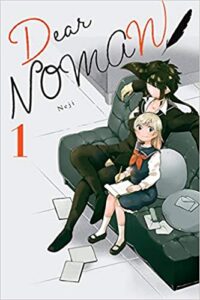
Dear Noman, Volume 1 – Guest Review by Luce

May 12th, 2021

Welcome to another Guest Review Wednesday here on Okazu! Today we have a new Guest Reviewer, Luce, who is going to take us through a series I haven’t even had a chance to look at, so yay, I’m totally ready to learn something new. ^_^ Please give Luce you attention and consideration!

I’m Luce, long-time follower of this blog, and I own too many Yuri manga. Not that that’s much of a bad thing, though… I can be found as silverliningslurk on Tumblr, and farfetched #1235 on discord. Anyway, on with the review!

Mashiro is ostensibly a normal school girl—except she can see ghosts and spirits. After a terrifying encounter with one, she meets Bazu, a crow Noman (the name this series gives to anything not living) and Nelly, who both work for the Border Preservation Society. Due to an accidental bond (read: kiss) with the vitriolic Bazu, Mashiro ends up deciding to work with them to bring Nomans to peace and prevent them eating souls.

There are likely a good many series that deal with a supernaturally gifted human teaming up with a supernatural being to fight monsters, and I doubt this series will do anything new, per se. We have the initial monster, the one the new girl manages to talk around from violence, and the more obviously sentient one. I haven’t read too many of these, so it’s not a tired trope for me. It’s interesting enough, even if the grading system the Society uses for these monsters confuses me somewhat. I hope future volumes will shed some light on it.

What is probably slightly more novel is a canon lesbian. Well, at least one. It’s not the happiest of stories though, as she is a Noman… But it is possible it could take a turn for the better. Another character states that her death happened at least a few years ago, and says that things have ‘changed for the better’. Not that that helps her much, at the moment. This volume leaves that story on something of a cliffhanger, albeit a low stakes one, so we’ll have to find out in the next volume. As for being yuri between the main characters, it has potential. The only problem is the visual age gap. I say visual because Bazu, being a crow Noman, doesn’t have a stated age, and clearly didn’t age by human standards whilst alive, so it’s hard to tell. Her body is most definitely adult, while Mashiro says she is fourteen, and looks younger partly because she’s small, and partly because she’s drawn to look young. Age is a funny thing in manga anyway.

Quite a lot happens here, although the pacing didn’t feel rushed to me. I’m curious to see what happens with the lesbian noman, and with what I imagine to be foreshadowing, in that Mashiro frequently writes letters to her deceased older sister. I also want to see Bazu and Mashiro evolve and grow, regardless of whatever it will turn into a relationship or not. Bazu is pretty harsh and aggressive initially, although we see later than she has a good reason for her hatred. Mashiro is a little naive, and perhaps blunt, but she does genuinely care about Bazu, and wants to learn more about her. I’m intrigued to see the effect they have on each other.

All in all, for a series that looks like it could be quite light, it gets surprisingly dark, but it balances these quite well. I like it, and I’m looking forward to the second volume, slated to come out in English from Yen Press in June.

Art – 6
Story – 7
Characters – 7
Service – Bazu has, to borrow another character’s comment from a different series, ‘some mad cleavage’. It is, thankfully, not used in a servicey way, and there aren’t many lingering close ups. I’d say 3.
Yuri – there are kisses between women. They don’t mean a great lot emotionally… Until they do? We shall see. Canon lesbian puts it up to 5.

Overall – 7

Erica here: Sounds like it could be worth a read. Thank you very much for the fab review! This series reminds me a bit of Ghost Talker’s Daydream, with it’s tragic lesbians. ^_^;

You can find Dear Noman, Volume 1 on Amazon, Comixology/Kindle, RightStuf, Global Bookwalker and manga stores near you!


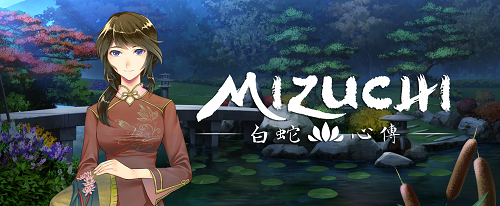
Mizuchi 白蛇心傳 Visual Novel from Aikasa Collective, Guest Review by Louise P

June 17th, 2020

It’s my favorite day of the week today, Guest Review Wednesday! And today we have our Senior VN reviewer Louise P to tell you about a lovely new VN by the folks at Aikasa Collective. So, welcome back and  take it away Louise!

If you watched anime in the early 00s you probably were sick of sitcom shows set in some remote home, often Japanese style, filled with a bunch of young people who will not communicate properly, that we were supposed to find cute. Something that was very hard to do when characters were constantly in conflict due to either ignorance or malice. 

It’s wonderful then that we have Mizuchi, which follows Linh after she is rescued from being executed by Ai, a mysterious snake woman that Linh sees as a goddess. Linh ends up living with Ai and the two are later joined by Jinhai, a traveling former monk who has a lot of history with Ai.

Mizuchi‘s setup might sound familiar to you but that is where the similarities end. For starters while Linh may be the main character Ai and Jinhai are not jealously competing to seduce her. Instead we are given time for everyone to get to know each other in the usual manner for a visual novel, by talking about the food they are going to eat and the little quirks in the languages they speak.

But this is a yuri visual novel, we’re here for romance. Mizuchi does well by clearing the low bar of ensuring that the characters fall in love as they learn about and help each other. We fall in love with Ai along with Linh as she walks us through ‘baby’s beginners book of feminism’. Jinhai has plenty of opportunities to be dashing and kind so that by the time the game contrived a reason for Linh to fall out of a tree into Jinhai’s arms I was ecstatic rather than bored. 

It was really nice that so much of Linh’s time with Ai and Jinhai is learning skills and knowledge from them that were denied to her by her family or by wider society. Linh doesn’t just fall in love with Ai and Jinhai but also improves herself by learning from them and being mentored. Linh’s grows from someone who just goes along with what people set for her into a person committed to deciding their own fate. 

The story doesn’t ignore Ai and Jinhai’s relationship either. They are charmingly written like they are a pair of on again off again ex-girlfriends. It is delightfully clear in the way that the two both snipe at each other but also have nothing but good things to say about each other when they are alone. Ai will openly admit to how noble and kind Jinhai is but then at the same time she will wave a freshly butchered pig’s head in front of the very vegetarian ex-monk.

Mizuchi capitalizes on this charm with some of the best sprite animation since Heart of the Woods. I’m not a fan of sprites taking center stage, however the sprites in Mizuchi are endlessly endearing. Characters settle behind tables, slide smoothly in and out of frame and all three main characters have expressions that match them well. Particularly with Ai and Jinhai who have exppresions that play to their strengths to get the reader to fall for them in the same moments Linh does.

Sadly this wonderful found family situation is often hijacked by the wider framing. Whenever we are reminded of the village Linh has escaped from, the story develops a mean streak that does not gel with the scenes of day to day life.

At the beginning of the story, Linh is saved from execution in her hometown by Ai. This was brought about by a wrongful and sexist accusation of adultery. However Linh regularly desires to return to her family who we had last seen giving her over to a bloodthirsty mob. How she expects this to work out on her return is not something the reader ever learns it just becomes irrelevant way too late in the story. So at several points in the story we have Linh, our main character, pining to return to a town that we the reader have only come to hate. It is a real mood whiplash.

This is further compounded when Ai, the person who overtly points out the cruelty in patriarchy, constantly has her power demonised both in the story and by Jinhai. Whenever Ai gains or exercises power within the story she is criticized so much more than any of the men who willfully harm others for their own gain.

Jinhai openly says that if Ai were to rise to her true potential Jinhai would seal her. When this inevitably happens in the climax of a few routes Jinah jumps to seal Ai away even though the only reason Ai is transforming is to deal with a far more malevolent threat. A threat that is overtly male coded compared to whatever threat Ai poses. 

For a story about three women living together, where the main character is saved from being executed by a society that has deemed her worthless, having the final conflict being: “Oh no our powerful friend is now too powerful.” seems like entirely the wrong tone to take. 

Which is a shame because as I said earlier for most of the game these are charming characters who play off each other well and respect each other. Perhaps the best part of the game as a whole was that all three never stopped being friends in any of the routes. No matter who Linh ends up with the other never becomes jealous just to throw some additional conflict into the situation. Mizuchi does know that it is possible to be happy for others.

The story of Mizuchi is, at its core, one of three women supporting and nurturing each other, that eventually blossoms into a love that helps all of them become better people. A good relaxing summer romance read.

Ratings:

Art – 9
Story – 7
Characters – 8
Yuri – 6
Service – Well there are sex scenes and bathing scenes 10?

Overall – 7

Erica here: Thank you so much for the review. This sounds like it really hits all the marks on narrative, and style. Thanks for walking us through it. ^_^ Thanks very much to Aikasa Collective for the review copy!


Yuri Manga: Kiss & White Lily For My Dearest Girl, Volume 9 (English) Guest Review by Christian LeBlanc

May 29th, 2019

Hello and welcome to Guest Review….Thursday. Yeah, I dropped the ball yesterday and simply forgot to post this. But I didn’t want you to miss this terrific review by Senior Kiss & White Lily Correspondent, Christian LeBlanc of 3DComics! So please welcome Chris back and give him your kind attention as he breaks it all down once again for us.

Let’s cut right to the chase: this penultimate Volume 9 of Canno’s high school “Yuritopia” Kiss & White Lily For My Dearest Girl (translation by Leighann Harvey, lettering by Alexis Eckerman) is a better end to the series than Volume 10, and if you enjoy these books well enough but happen to only own a few volumes, you owe it to yourself to add this one to your collection, because s*** gets real.

How real? Well, one girl forgets her toothbrush after sleeping over at her girlfriend’s house, someone else gets so angry at the world that they turn to cosplay to cope with it all, and in the climax of the series, another girl tells off their mom and then makes out with the girl she likes! (Suggested listening for this scene: your favourite pump-up music, be it something from Sailor Moon, Kill La Kill, or, if you want to get real campy, the opening 27 seconds of “Everything Louder Than Everything Else” by Meat Loaf.)<

With that out of the way, let’s back up a little and talk about our final new pair of characters. Asuka Sakurada finds herself repeating her final year of high school due to a basketball injury that made her miss too many days (it must have been a concussion or something, because she’s only shown with a broken leg in flashbacks, and I assume the poor girl would have had access to crutches). As a senpai forced to join her kōhai, she gets a *huge* chip on her shoulder about it, attending only the bare minimum of classes, refusing to integrate or socialize with anyone, etc. Her self-destructive attitude becomes extreme enough that she turns to that most delinquent form of rebellion, cosplay, which is how she meets Mikaze Hagimoto. Asuka cosplays a character who has a lot in common with Mikaze and vice-versa, the two hit it off, and we quickly see them making out on school benches, fashion wigs and all.

All of this is framed as a tragic romance, by the way – the first two words in the book are “It’s over.” If you’re like me and have a predilection for the melancholy, it means good times all around: put on your favourite gloomy Cure record and enjoy the tearful scenes that are to come. (I joke slightly, but it does get dark for poor Mikaze, who takes the break-up very hard indeed: the color has gone out of her world, she can’t concentrate in school, she starts skipping classes…we see later on in flashbacks that she spent at least one night alone with Asuka, which perhaps sheds light on why she’s having such a tough time, if things had gotten that intense between them.)

I think a much stronger ending would have seen these two making peace with each other as friends, but, you’ve already seen the cover, and you’ve probably read at least a few volumes of this series before, so you’ll just have to put on a different Cure record, I guess (one of their happy ones, that make you want to live). This is why Volume 2 will always be my favorite, by the way – Chiharu is rejected, but we get to see her *move on*, and she gets the entire volume in which to do so. Here, it feels like Canno wanted to explore a good break-up story, but had to wrap things up in order to get her characters posed happily for the cover shot; Asuka’s sudden change of heart even feels more like a plot requirement than anything sincere.

As for flagship characters Ayaka and Yurine, both characters get the plot resolution that the entire series has been building towards. Both of their chapters start with the same event (viewing exam results, the only thing that makes Ayaka feel alive…I worry about how she’s going to cope after high school, actually), and then follows either Ayaka or Yurine for the rest of their respective chapters as they resolve their plots in a neat bit of parallel story-telling. Yurine even gets a call-back to the very first chapter of the series, which makes it feel like a better ending than Vol.10, even without things “officially” wrapping up.

For analysis, let’s back things up again a bit. Ok, a lot: having lived and died centuries before Yuri began 100 years ago, René Descartes likely did not anticipate getting the opening quotation, “Conquer yourself rather than the world!” In this book, this means bringing about change through internal, rather than external, factors. Ayaka can’t change how her mom feels, but she can change how she accepts and internalizes the support she gets from others. Yurine doesn’t stop feeling alienated because of how she performed on any external exams, but by realizing she’s been gradually becoming a “normal girl” with her own community of friends all along. Mikaze tries to become someone “special” enough to win back her ex-girlfriend, but realizes it’s much healthier to try and accept the break-up, who she is, and that neither partner should have to change to suit the other. And Asuka stops cutting herself off from everything, after realizing she’s gone too far in cutting Mikaze out of her life. To drive the point home, Asuka’s pocket mirror keeps getting passed back and forth between her and Mikaze, further reflecting (sorry) this focus on the self and internal change.

In all, it’s a wonderful volume of Kiss & White Lily – we get closure for plots that have been in motion since the very first chapter (along with some related tender scenes), Ai Uehara and Kaoru Machida each get some good scenes to help lighten the mood (Ai could be one of Yuri’s best supporting characters ever, if we only got to see her more often), Asuka and Mikaze bring some enjoyably melancholy drama, characters in Kiss Theater flit in and out of cameos as always, and anyone who’s ever been on a cover of K&WL appears in at least one panel.

Canno’s Continuity Corner: there’s an incidental panel of Ayaka and Yurine starting Year 2 from Volume 3 (this time drawn as background characters); Lyrical Seira, which Asuka and Mikaze are cosplaying as, is the anime from their childhood that Sawa and Itsuki went on a movie date to see in Volume 5; there’s some bonus Valentine’s Day vignettes at the end featuring our cover-stars from Volumes 5, 6 and 7; we briefly see Yurine’s little sister again (poor Sumire – this marks her last appearance in the series, and she only gets the one panel, just like in Vol.7). In one of my favourite tiny details, the exam results show Nagisa and Hikari from last volume placing in the top 10, consistent with their characterization as high achievers – not only that, but Nagisa is even 4 places higher, which fits with how she had complained “Why does everyone always put Hikari and me on the same level? I have better grades!” while a visual of their test results shows her getting 98 vs Hikari’s 97.

Ratings:

Art – 9 The thicker blacks compared to the Japanese edition aren’t as destructive this time around; I looked, but couldn’t find any tell-tale moiré patterns. A point is still taken away for how much art gets trimmed off the edges, though. Canno’s art is gorgeous, expressions are delightful, and backgrounds really contribute to the atmosphere in a few key scenes.
Story – 9 Plot resolution, dramatic tension, sweetness, cosplay…this one has a lot going for it.
Characters – 10 Ayaka and Yurine have grown a lot as characters, and their relationship has evolved over time to reflect that. Asuka and Mikaze with their cosplay were a fun change of pace as well.
Yuri – 8
Service – 3 As Erica said in her review of the Japanese edition: “I’m not gonna lie, that kiss was pretty hot”

Overall – 10

I still remember back in April 2018, how excited I was when the 2-page colour illustration from the opening was teased on Twitter, showing Ayaka and Yurine holding hands while they emerge from a cold, snowy winter and walk off into the warm spring-like foreground together; I immediately retweeted it stating “THEY ARE HOLDINGS HANDS THIS IS HUGE THIS IS NOT A TEST” in all caps. It’s still one of my favorite illustrations from the series.

And, you don’t have to be a genius like Yurine to know how things will end up, but you’ll still want to see how it all happens in the final Volume 10, which is set to come out on October 29, 2019 from Yen Press.

Erica here: “anyone who’s ever been on a a cover of K&WL appears in at least one panel.” Foreshadowing the entirety of Volume 10, frankly.
Christian, you deserve an award for this review. It was absolutely brilliant and got both laughs and thumbs up from both members of the household here at Okazu Central. Well done.


Yuri Manga: Kiss & White Lily for My Dearest Girl Volume 8 (English) Guest Review by Christian Le Blanc

April 17th, 2019

Welcome back to Guest Review Wednesday here on Okazu! Today we have a special Guest Review by Christian Le Blanc of 3DComics! His love for Kiss & White Lily is infectious. Let’s all be whisked away by his enthusiasm!

“Love is not gazing at each other, but looking in the same direction together.”

So opens Volume 8 of Canno’s Kiss & White Lily for My Dearest Girl from Yen Press (translation by Leighann Harvey, lettering by Alexis Eckerman), and it’s as romantic a spin as can possibly be put on this volume’s tsundere vs. tsundere cover stars. Hikari Torayama (reddish-brown hair, Tiger type, Ayaka analogue with her long hair and headband) and Nagisa Tatsumi (silver hair, Dragon type, Yurine analogue with her cool personality) are rivals for the position of Student Council President. Who can’t stand each other. And who also, as luck would have it, live together – a twist of fate has landed Hikari as a guest in Nagisa’s house. We need this plot device to force them to spend time together, because otherwise they’d avoid each other like the plague and we’d have a different pair of girls on the cover. Which would be a shame, because once I got over the fact that these two are not going to be acting lovey-dovey and give me anything to swoon over, I started to enjoy their relationship, which exists as a mirror for Ayaka and Yurine. Ayaka and Yurine are rivals who want to be more than just that, while Hikari and Nagisa can’t think of anything they’d rather be than rivals with each other. “Even if we stop being rivals someday…we might eventually see eye-to-eye,” Ayaka tells Hikari…”But just as classmates, of course!” she adds, still in denial.

The Tao of Canno

It’s easy to suppose how Canno came up with Hikari and Nagisa – start with the idea of tsundere vs tsundere, and then inform their personalities and rivalry with Tiger vs. Dragon, the eternally-opposed yin and yang of Taoist mythology (the kanji in Hikari’s last name means “tiger” and “mountain,” while Nagisa’s means “dragon” and “sea”). Both are symbols of strength, of course, and both girls dominate over the rest of Seiran High School: they excel in academics, they’re in competition for Student Council President, and they feel ‘larger than life’ compared to everyone else; they’re the boss characters, if Kiss & White Lily were a video game brawler (now there’s a thought!). Of Tiger traits, Hikari demonstrates protection: “She’s good at taking care of people.” She’s concerned about the smaller, more vulnerable clubs, and picks up after Nagisa at home. Of the Dragon traits, Nagisa demonstrates prosperity: she favors the larger clubs, and acknowledges that “My family is relatively well off.” They hang out on the forbidden school roof a lot (the heavens); naturally, the little white cat they’re looking after together adores Hikari and hates Nagisa. Maybe they complement each other, maybe they even need each other, but it’s no accident that we don’t see them exchanging chocolates in next volume’s Valentine’s Day back-up story. All the same, through their three chapters together, it’s fun not only watching them bicker, but also seeing how they react whenever something threatens to send them in different directions.

Our Returning Champions, Ayaka and Yurine

The book opens with Ayaka considering her own run at the presidency, which organically introduces our cover stars who go on to enjoy the spotlight in the next three chapters. Yurine has started to act goofy and awkward around Ayaka, a result of her growing and changing feelings towards her, especially after Ayaka helped her out of her depressive episode last volume. She’s torn between wanting to support her friend, knowing she could help the school as much as she helped her, but also knowing she won’t get to see as much of her if she wins. When Ayaka tells her her decision concerning the elections, it helps Yurine realize her true feelings for her, and grow out of her selfish and simplistic ‘deredere’ (constantly, clingingly affectionate) archetype. She can finally be honest with herself, something Ayaka is still struggling with when we see them again in the fifth and final chapter.

Speaking of this last chapter, Ayaka’s cousin and roommate Mizuki has had just about enough of Ayaka’s blitheness. She’s graduating soon, and, having been her emotional support for the past several years, wants to make sure Ayaka will have someone she can talk to after she’s gone. When she realizes that Ayaka still doesn’t even have so much as Yurine’s phone number, she demands that she asks her for it first thing in the morning, later hinting that she needs to be way more honest with herself.

It isn’t until the walk home from school that day that Ayaka finally does clumsily take the next step, managing to ask Yurine for her number. She tells her “Sorry. I kept you waiting too long” when she makes her miss her crosswalk light, but I think it’s meant to apply to more than just that.

This entire chapter, Yurine has been the model example of supportive. She knows Ayaka’s been trying to tell her something, and gently gives her the opportunity. Instead of making a huge embarassing deal out of getting her number, she just lets her know that she can call her anytime. Which is good, because Ayaka’s mom phones her that very night, triggering one of those depressive episodes that Mizuki was so worried about. Yurine handles it like a frigging champ, though. She didn’t really know what she was doing when she helped her out of a similar episode in vol.5 (we see an allusion to this episode on this chapter’s title page), but between that experience, and the help she got from Ayaka last volume, she’s become the epitome of everything you’d want in a friend helping you out when you’re at your lowest.

Lastly, we’re treated to two bonus stories at the end of the book. I didn’t really need an origin story for how Nagisa was recruited into the student council, but it did at least give Canno an excuse to bring back the eternally beleagured treasurer from vol.3 (who Yukina kept butting heads with…she even gets a name in this volume!). The other story brings back Amane, Ryou and Nina, the cover stars from vol.6, to show where the little white cat came from.

In fact, there’s a ton of returning characters this volume, obscure and otherwise: Rika “not good with her hands” Kouno is in one panel, who was only ever in two pages in vol.4. Tsubasa and Karin appear in one panel at the dorm, who likewise were only ever on two pages from vol.2 (Tsubasa was the one who accidentally locked Chiharu and Maya in the dorm’s storeroom together). We see members of the public relations committee again from vol.5, and, charmingly, their club sign that’s still only taped up over the more permanent “science” placard underneath. Characters who had leading roles in previous volumes play supporting roles here as well (we only get the back of Izumi’s head in one panel, but she’s there!). Not only does this provide more of an ensemble feel for the book, but it’s a good bit of world-building that makes Seiran High School feel more ‘real’ and lived-in. Further realism is established via small details like how Nagisa has a ‘lazy’ version of her hairstyle when she’s lounging at home, and how she and Hikari are on a first-name basis, sans honorifics, when noone else is around. This all makes re-reads a lot more interesting for me, because it always feels like I’m catching some small detail or other that I hadn’t noticed before. We’ll be seeing more adherence to continuity, as well as progress on Ayaka and Yurine’s relationship, in the penultimate Volume 9, due out very soon on May 21st, 2019 from Yen Press.

Ratings

Art – 7 I feel so petty bringing this up, but the English edition again uses significantly thicker blacks than the Japanese version, which causes tones and shading to suffer on occasion. Worse, however, are the jpeg compression artifacts visible on the front and back covers. As for the art itself, it is as detailed and charming as ever. Hair in particular has a great deal of definition and shading, rendering it with a great deal of volume and depth, and the snow and moon in the last chapter are rendered beautifully. (I’ll admit that maybe…in the right light…Canno isn’t all that great at drawing cats, but that just adds to the charm for me)

Story – 9 I average an 8 for Hikari and Nagisa, and a 10 for Ayaka and Yurine. We’re nearing their endgame, and watching Yurine be there for Ayaka was one of my favorite chapters in the series. Leighann Harvey has done a wonderful job translating every word, barring a weird side note concerning the quotation at the start of the book: my wife recognized the quotation, which is from Antoine de Saint-Exupéry’s Le Petit Prince (uncredited here). The quotation at the start of the Japanese edition is already in English, and is closer to the more proper quotation “Love does not consist in gazing at each other but in looking outward together in the same direction.” I think Leighann Harvey must have translated the Japanese version of the quote into English, ignoring the English version that was already there, all of which says nothing of the original French version of the quotation (!). Not a big deal, just a neat peek behind the curtains of translation.

Characters – 9 There’s a ton of character development going on in this volume.

Yuri – 7 That might seem like a high number considering three out of four main characters are tsundere, but you have to keep in mind that nearly everyone at Seiran is in some form of Yuri relationship.

Service – 1, by default. (I thought it was a cute touch when Nagisa’s mom told her to stop laying around in her underwear, but Canno withheld such salaciousness from the visuals)

Overall – 9


Ms. Vampire Who Lives in my Neighborhood Anime (English) Guest Review by Christian Le Blanc

April 10th, 2019

Welcome back to Guest Review Wednesday! Today we have a special Guest Review by Christian Le Blanc of 3DComics! Christian has kindly watched an anime so I don’t have to, freeing me to finish up Princess Principal instead. ^_^ (About which I quite probably will do a review one day. ) So let’s please welcome Christian back and  give him our full attention. The floor is yours, Chris!

Sophie Twilight is, let me assure ya,
An anime fangirl vampira.
At the end of each night
In her coffin sleeps tight
With a bishoujo dakimakura.

Ms. Vampire Who Lives in my Neighbourhood (Tonari no Kyūketsuki-san), which is streaming on Crunchyroll, is a 12-episode comedic slice-of-life anime series based on the 4koma manga by Amatou serialized in Comic Cune magazine. Ms. Vampire herself, Sophie Twilight, is a centuries-old vampire who is practically the poster-girl for “Non-Threatening Vampires” magazine – she doesn’t drink blood straight from humans (she orders bottles of it online instead), and she enjoys manga, anime, and ordering anime statues and body pillows off the web. When she first meets our other main character, Amano Akari, she tells her “Don’t be afraid. I’m just your run-of-the-mill vampire passing by. Nobody suspicious.”

Akari is a normal…well, human, anyway…high school student obsessed with dolls, and becomes infatuated with the doll-like Sophie Twilight at their first meeting – so much so that, by the end of the first episode, she’s moved herself into Sophie’s house, much to her parents’ puzzling beatific indifference. Akari’s friend Hinata starts hanging out with them, as does Sophie’s vampire friend Ellie. Most of the humour comes from the culture clash of vampires and humans as they all spend time together – Ellie prescribes treatments for the human cold based on outdated concepts of the four humours, Sophie tries feeding nails to Akari because she doesn’t understand ‘food’, Akari makes a cold, bloody treat for Sophie which results in her penguin-shaped shaved ice maker looking like something removed from Silent Hill for being too disturbing, etc. Our cast enjoys each other’s company at Sophie’s house, the mall, high school, the beach, Akihabara, etc. Obscure bits of vampire lore come into play, but always in a cute manner, of course.

This being a moe comedy, almost everything about this show is light. The faux-baroque score is very whimsical and cute; nothing you’ll likely remember (aside from the opening and ending songs), everything just seems to fit the scene, and nothing really stands out as distracting. The color scheme is light as well – bright, pastel colors that suit the tone of the show and make it pleasant to watch. Any quarrels that *do* appear get resolved by the end of each segment; the first episode makes it look like Akari is going to become a constant harasser to a Sophie who just wants to be left alone (see: Ms. Koizumi Loves Ramen Noodles), but Sophie quickly realizes she misses Akari when she’s not around. Even the fact that it’s based on a 4koma means that the pacing is generally quick and light, jumping from beat to beat.

Naturally, any Yuri in this show is light, as well – the four main characters are all just friends, although Akari plainly crushes on / lusts after Sophie – just like in Ms. Koizumi Loves Ramen Noodles, our pursuer pictures herself and the pursued together in wedding dresses. Ellie, for her part, crushes on / lusts after almost any young girl she sees. Hinata also has a mild crush on Akari, just to round things out.

All in all, it’s mostly just a cute show to relax with if you want some light comedy and pleasant, fun character interactions without angst or drama, and just a smidgen of the supernatural with Yuri elements.

That said – when I first approached Erica about writing this review, there were only 3 or 4 episodes up. I could choose to review whatever episodes were already released, or, wait for the series to end and report back. While the chances were pretty slim, I decided to hold back and wait just in case any problematic issues came up that I should address. As you’ve probably guessed, I did find a little something.

Ellie (Sophie’s vampire friend), as I mentioned above, is the thirstiest character on the show. She’s also the youngest-looking character on the show – in fact, they spend time addressing the fact that she was turned into a vampire right around the onset of puberty, so she laments that she never got to grow more mature-looking. Akari’s human friend Hinata even mistakes her for a child at first, prompting Ellie to grope Hinata’s chest in anger before storming off, which makes poor Hinata depart in tears (wait, wasn’t this a comedy?). Ellie’s portrayed as a sex-positive 400-year-old vampire, who looks and acts like a child most of the time…which makes it ultra-gross when she gropes Akari’s butt at the hot springs, wears a revealing succubus costume for Halloween, suggests Sophie buy Akari a thong for Christmas, etc. It’s not that the characters are being flirty and suggestive from time to time that bugs me, it’s that they’re doing this while looking and acting like little kids who are drawn, and written, much younger than they are. It’s creepy enough seeing the camera pan slowly across Akari’s butt dimples at the beach, but watching her play with her dolls later in the same episode encreepens it that much more.

Ratings:

Art – 6
Story – 4 (not necessarily bad, just nothing really eventful happens)
Characters – 4
Yuri – 3
Service – yes, unfortunately.

Overall – 5

If you’ve read all this and it still mostly sounds like something you’d enjoy if it didn’t have the problematic bits, then give it a try and, depending on your tolerance, you may want to just skip past the first halves of episodes 5 & 7, the post-credits scene of episode 9, and episode 10 in general. You might even watch this and feel that I’m overreacting, and, that’s ok; I’m not out to spoil your fun, but I definitely want you to understand why this show might not be someone else’s idea of fun.

Erica here: Comic Cune is, of course, the home of moe, creepy characters, creepy not-quite Yuri and cake. If the service of the anime irks, but you like the premise, take a look at the magazine. The fan service tends more towards what cake are we eating today?

I also want to shoot a stern look at Disney for forcing this absurd title on the anime when clearly “My Neighbor the Vampire” should have been the translation. This translation absolutely ruins the flow.

Thanks Christian for taking a look at this for us!