Archive for the Yuri Anime Category


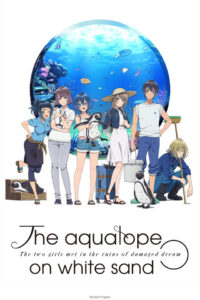
The Aquatope on White Sand, 1st Cour, Guest Review by Megan

October 27th, 2021

Welcome to our record-breaking 7th guest review in 2 months! This is made possible entirely through the support of our Okazu Patrons and the energy and talent of our guest reviewers! I’m absolutely delighted to bring you so many guest reviews and hope that, if you enjoy these, you’ll become an Ozazu Patron and help us continue to pay our writers industry standard rates for their efforts!

Today we’re bringing back Megan with a thoughtful and lovely look at one of this years prettiest anime, The Aquatope on White Sand, streaming now on Crunchyroll. (I asked to cover the second cour myself, so we’ll be back early next year season to talk about the rest of it. ^_^) In the mean time, please welcome Megan back! The mic is yours, Megan.

The Summer 2021 anime season saw the debut of not one, but two Yuri anime from fan favourite studios. Season 2 of Dragon Maid drew most of the attention, but the original 2-cour series from PA Works studio, The Aquatope on White Sand, also quickly drew a Yuri audience.  

Aquatope begins with a young woman, Fuuka, leaving her idol job in Tokyo after she gave an opportunity up for another member of the group. Her dream is over, but on a whim she takes a flight to Okinawa where she meets Kukuru, the acting director of Gama Gama aquarium. With only weeks to go before the planned closure of the aquarium, Fuuka decides to support Kukuru with her dream of keeping Gama Gama open. 

The entire cast is likeable, but the bulk of development goes to our leads, Fuuka and Kukuru. Fuuka is kind, almost to a fault; both with her idol and aquarium jobs, she prioritises others’ dreams above her own. Her arc sees her grow in confidence and learn to pursue her own dream again. Kukuru was the bigger surprise of the two leads. From the promo material and first episode I didn’t expect her to be quite as serious and focused on her work as the aquarium’s director as she turned out to be. The dynamic between the girls also works out differently than you might expect at first: in the early episodes Kukuru is the one giving emotional support to Fuuka as she faces up to her mother in episode 5, but in the second half of this first cour Fuuka emerges as the more mature of the pair. 

While the show’s first half doesn’t definitively commit to a friendship or romance reading for Fuuka and Kukuru’s relationship (the show’s awkward attempt in episode 9 to advance a “big sister” interpretation for Fuuka is one of the writings’ rare missteps), either way there is a lot to offer here for Yuri viewers. Aquatope depicts the pair’s emotional intimacy beautifully, with both their emotional and physical closeness growing as they support each other with running the aquarium and overcoming their own issues. Wherever the second half of the show takes them, here’s hoping they have a future together. 

The other main character of Aquatope could be said to be the aquarium itself. When the first episode aired and included a magical realist scene of Fuuka getting swept up in an underwater vision, I was sceptical since the show seemed otherwise well-grounded, but the magical element ended up working in the show’s favour. The pairing of an aquarium with these ineffable magical visions makes thematic sense; even now, so much of the sea is still a mystery to us. In several episodes we also meet characters who have visions at the aquarium that help them move on from turning points in their lives. Along with the stories of the supporting cast, this helps build a connection to Gama Gama as a place that feels worth saving. 

The aquarium feels like a believable location thanks to the fantastic animation effort from PA Works. Where Aquatope might lack in impressive “sakuga” sequences, it makes up for with a consistent high quality both in the character and background art throughout these first 12 episodes. The fish are mostly rendered in CGI, but it looks acceptable, and closeups and the penguins are animated in 2D. Particular praise should be given to the background art team, Gama Gama and surroundings were so well-rendered they came off as real places. 

Spoiler warning: Please skip past the section starred off below, if you prefer to remain spoiler-free.


***

***

***

***

For a “iyashikei” (healing) anime, Aquatope often struck a serious, even melancholic note from the early episodes. The closing episodes of this first cour paid off these hints, and secured my recommendation of the show for mature anime viewers who find it increasingly hard to relate to the teen-centered themes of most anime. The first cour of Aquatope is about the experience that, perhaps as much as any other, defines becoming an adult: giving up your dream. 

It testifies to the show’s strong writing, no matter how much we as the viewer might wish for a different outcome, the closure of Gama Gama feels like a logical conclusion to everything that came before. We’d seen how unsuccessful Kukuru’s initiatives to draw visitors to the aquarium had been, and episode 10 introduces a new, much larger and more centrally located aquarium opening up that renders Gama Gama aquarium irrelevant. In truth, the writing had been on the wall since the start, and Kukuru locking herself up in the aquarium as a typhoon beats down her attempts to fortify the building is an effective visual for both Kukuru and perhaps the viewer’s denial of the reality of the imminent closure. 

The finality of episode 12 is surprising for a two-cour show. Many people I know watching week-by-week thought it actually was the final episode and were surprised to find out it was only the halfway point. For viewers who usually like their anime on the shorter side, the first cour presents a satisfying and complete story on its own, without the meandering some other two-cour anime can fall prey to, with almost every episode developing the leads and their relationship, or the aquarium setting itself in important ways. This pacing helps Aquatope to feel, in my experience, more consistently engaging than some other similar anime, including PA Works’ prior series about working women such as Sakura Quest

***

***

***


Aquatope presents a moving and mature story of pursuing and giving up dreams, and of the leads’ growing emotional intimacy. The show is shaping up to be a new favourite for slice of life and Yuri viewers, and I can highly recommend giving this overlooked anime a try. 


Ratings: 


Story – 9, a well-written and smartly paced story of giving up your dream, and what comes next Characters – 8, everyone is likeable and the leads get some good development 

Art – 9, a consistently beautiful effort by PA Works 

Yuri – 6, nothing explicitly romantic but the leads’ emotional intimacy is lovely 

Service – 1, a beach episode with the girls in swimwear, otherwise, no 

Overall – 9 


PS It took me a while to figure out what the word “Aquatope” means. I was reading vol 3 of (excellent and very queer-inclusive fantasy LN series) Reign of the Seven Spellblades, which used the word “Biotope”, a word similar to “habitat”. So “Aquatope”, I presume, means “aquatic habitat”. 

Thanks as always for reading my review! I’m looking forward to hearing your thoughts in the comments ^_^ 

Erica here: Thank you so much, Megan! Your thoughts echo my own completely. It’s a beautiful anime with some strong values and lessons that are both gentle and inexorable. I’m looking forward to covering the second cour. It’s a bit selfish of me, but I wanna write about this lovely anime, too! ^_^


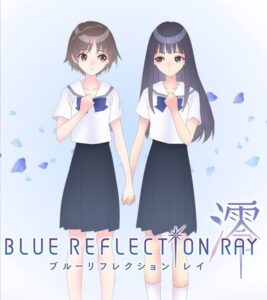
Blue Reflection Ray, Guest Review by Aurakin

October 20th, 2021

Very excited to welcome you back today to Guest Review Wednesday on Okazu! Today we welcome a new reviewr to our family. Aurakin will be taking us through the recent anime Blue Reflection Ray, based on the game, streaming now on Funimation. As you know, I love having guest reviews. It broadens the amount and kind of content we can have, provides different perspectives, and gives us a chance to support writers. If you enjoy Guest reviews and want to help us keep paying our writers industry standard rates, consider becoming an Okazu Patreon.

Welcome Aurakin – the floor is yours!

*Note: Blue Reflection Ray is based on the game Blue Reflection. Since I haven’t played it, I won’t be making any comparisons.*

Ruka Hanari struggles to make friends. She is scarred by an event in her past, and finds herself unable to reach out to others. Along comes her new roommate, Hiori Hirahara, a girl who seems able to do everything Ruka can’t. Hiori is friendly and easy-going, and Ruka finds herself drawn in. One day, as they are casually walking down the street, they get caught in a distorted reality, and Hiori senses a girl in danger. They encounter two magical girls engaged in a sword fight, with an unconscious girl being held hostage. As the victim is about to fall off a roof-top, Hiori leaps forward to help – and suddenly transforms. 

My first impression of the art style and animation was that it looked terribly cheap. The occasional 3D effects clashed with the overly sparse 2D line art and flat colors used in the rest of the show. While the studio might have suffered from the pandemic in some areas, the art style itself seems to be more of a stylistic choice rather than a lack of resources, considering what the original character designer, Mel Kishida, has worked on previously (22/7, So-Ra-No-Wo-To). 

Being a big fan of both magical girls and yuri, I was really curious about Blue Reflection Ray. It took about six episodes for it to get interesting, but once it did, I found it both charming and entertaining. The anime shone brightly whenever it delved deeper into the characters’ backstories and the bonds they were forming with each other. Watching their everyday interactions was sweet and heartwarming. The surface plot and magical intrigues seemed to pale in comparison – that has all been done so many times before, and Blue Reflection Ray didn’t add anything new or interesting to the mix.

It’s also worth noting that this anime deals with mental illness, self-harm and abuse – sometimes poorly. And with that, I have to briefly mention Masochist Uta, the single worst thing about the show. Uta lives for pain – whether it’s her own or causing it to others – and being the intensely rapey villain she is, often groping her victims or making sexualized threats, Uta alone was enough for me to strongly consider dropping this show on several occasions. Her character does get explored more in depth later in the series, but never enough to redeem her presence.

So, how about the yuri content? Surprisingly, it did not come from our two main characters. Beyond some teasing comments and visual baiting (Such as when the camera slowly pans upwards as if they’re going to kiss), the relationship between Ruka and Hiori is never defined as anything other than friendship. That said, the show does focus a lot on emotional bonds, platonic or otherwise, and I could possibly see a reading of them as an aro-ace couple.

The second cour was a pleasant surprise. We get introduced to a new pair of characters, who are undeniably queer. Their relationship, and their complicated feelings towards each other, end up being given a lot more space than I had expected from this series, with some of the gayest word exchanges I’ve ever heard in anime. Besides these two, we have several other characters who can easily be read as queer, and who played a huge part in me liking this anime. Also worth a mention, is that this is one of those shows where men do not seem to exist – they are neither mentioned nor shown.

All in all? I don’t regret watching Blue Reflection Ray, and found it enjoyable despite its flaws. Would I recommend it to anyone else? Perhaps not. It is very tropey – it just happens to have tropes that I’m personally fond of.

Ratings:

Art – 4 Not a fan of the art style. The animation looks cheap, and the 3D parts do not blend in well.
Story – 5 Average, nothing new or special about it. 
Characters – 7 Tropey but likable. Sweet interactions.
Yuri – 6 Thanks to a certain pair in the later half. (I’d say 3 at most for the first cour)
Service – 3 Less than your standard anime. Uta is responsible for most of it.

Overall – 6 Average but enjoyable.

Erica here again: Thanks so much for taking a look at this series for us! I started to watch it, but found the style (which I suspect is in line with the game, but felt very basic to me, like a really good high school animation project,) and the predictability of the storyline a little too thin on the ground for me. I am glad to hear that it gets better in the second cour, and maybe will just skip a bit. ^_^


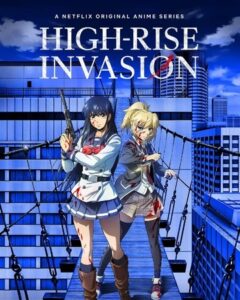
High-Rise Invasion on Netflix, Guest Review by Christian LeBlanc

May 26th, 2021

Welcome to Guest Review Wednesday on Okazu! Today’s review is a gift to me as much as to you. ^_^ I was thinking about watching this anime on Netflix when Christian said he had just watched it and needless to say, I was delighted to invite him to bring us all this review! Please welcome Chris back once again, and thank him for taking one for the team. ^_^ The floor is yours, Chris!

When I first read the description for High-Rise Invasion on Netflix (based on the manga Tenkuu Shinpan by Tsuina Miura and Takahiro Oba), I wrote it off as silly, violent edgelord fare, along the lines of what I thought those Purge movies must be like. Fortunately, I gave those movies a chance and found a suspenseful string of films that turn a critical eye on society, capitalism and marginalisation, with a cynical view of where America’s current darker impulses are leading it. Unfortunately, I also watched all 12 episodes of High-Rise Invasion.

Well, I say that, but I’m honestly of two minds about this show. The first time I watched it, I could practically hear the writers coming up with the plot: “Wouldn’t it be fuXXed if you got transported to this alternate realm where you have to go from high-rise to high-rise across rope bridges, and there’s brainwashed people in smiley-face masks trying to kill you by making it so you’ll throw yourself off the buildings, because that’s the only way down to the ground anyway, and if the masks get damaged then they have to kill themselves, and there’s all different ones so there’s like a butcher Mask, and a baseball player Mask, masked everything right, and there’s like a ton of blood whenever anyone dies, and it turns out this is all a way to create God, like how fuXXed would that be.” (dramatic pause while writer takes a long drag off a smoke to let these ideas sink in)

I mentioned to Erica that I watched it because I’d heard the main characters described as Yuri and wanted to find out for myself, and before I knew what happened I’d agreed to write a review for her. I hadn’t taken any notes the first time around, so I watched it all again and, while I’m not proud to admit this, I started to enjoy it.

To start with: is this a Yuri anime? Well, the high-school aged main character’s name is Yuri Honjo, so there’s that. Yuri quickly meets high-schooler Mayuko Nise, and unsuccessfully tries to stop her from stabbing an innocent man in the throat. After their little meet-cute, Mayuko becomes ride-or-die for Yuri, blushing and looking away whenever Yuri does something cool, gives her a compliment, hugs her, flashes her panties, bathes or changes in front of her, kisses her while she’s unconscious and struggling for her life, etc. You know, the same way we all secretly showed our feelings for that girl we liked back in high school; for her part, Yuri pretty much feels the same way about Mayuko.

Is this a Yuri romance? Definitely not. This is grindhouse action/suspense through and through, but that doesn’t mean it can’t also be Yuri, of course, and whether it qualifies or not. depends on your own feelings. Mayuko blushes her heart out at Yuri constantly, but it never goes beyond hand-holding, even though they are intimately acquainted enough that Mayuko can recognize her crush by just a quick glimpse of her posterior (which actually happens more than once). Mayuko’s first love, however, is stabbing people in the throat. If there’s ever a second season we’ll see if she has to choose between her two devotions, but for now, we’ll see her face redden either from sweet emotion, or other peoples’ sweet, sweet neck blood. (And to be fair, this is a Shounen anime, which means that the straights don’t get any further than getting exaggeratedly flustered and denying any interest in each other.)

So what’s this all about again, anyway? Well, Yuri’s main goal is to find her brother, who’s also trapped here. Mayuko’s goal is to help Yuri find her brother (and, on a personal level, stab so many throats). Kuon Shinzaki has pink and blue hair, and an app on her phone that lets her use a giant building to shoot down other buildings; she wants to become God so she can bring peace to this realm. She also has a crush on Sniper Mask, an amnesiac, self-aware Mask whose goal is to recover his memories.

Aside from that, the show tends to abandon plot points, theories and objectives almost as soon as they’re thought up. Yuri rebelliously declares to Mayuko early on “I’m not going to kill any humans. I refuse to follow this world’s rules.” A minute later and she’s enthusiastically doing her best to shoot down a helicopter with just her handgun, and she’s unloaded a full clip into an assailant ten minutes later (before he commits suicide by biting off his own tongue, naturally.)

Various exposition-dumps throughout the show explain the different types of masks and how their programming bestows powers/constraints on the wearers. There is a consistent, if convoluted, logic to the masks, but the rapidly-shifting goals and theories the main characters have obfuscate this logic, making it feel inconsistent initially. Still, trying to puzzle out these mysteries helps hold the viewers’ interest in between gory fights with the Masks (or Angels, as the antagonists refer to themselves…Angels to some, Masks to others, I guess).

Trigger warnings? This show has geysers of blood, flying eyeballs, severed fingers and limbs, decapitations, and crazy amounts of stabbing and shooting. The violence in the show doesn’t bother me all that much because it’s expected for the genre, and even gleeful in its execution. There’s a ton of violence, but very little of it feels truly horrific; it’s all in good fun.

On a sexual note, however, Yuri is forced to strip at sword-point for a rogue cop (ACAB) in the first episode, but she’s managed to set his corpse on fire before things go much further. Happily, I don’t remember any further sexual threats to anyone after this.

Is this show dumb? Oh, it is so dumb. Yuri’s brother tells her over the phone that she should immediately murder her new friend Mayuko, because “In this world, there are no such things as allies.” (This very same brother is shown leading his own litter of new pals minutes later.) Sniper Mask’s main personality trait is smoking and looking cool in his stylish suit, and is so good at shooting guns that he can shoot a knife on the ground forcing the bullet to ricochet 90 degrees towards a target hiding around a corner. Yuri happily hands a firearm to a small child because he’s excited and would really like to see it. Mayuko’s shirt gets ripped open in the second episode, and until she replaces it with a slightly darker shirt in episode 11, she’s just walking around with her chest and bra completely exposed. Yuri never fixes the revealing rip in her skirt; characters change their priorities far more often than they change their clothes. Yuri can shoot ballistics out of the sky. Someone says the name of the show out loud. Characters gain new abilities as soon as the plot requires them, and the entire raison d’être is to simply show Masks looking creepy and cool in a wide variety of cosplay and violence. No, seriously; when it looks like one character is about to die, he at least comforts himself with how cool he’s going to look.

“Tasteless” is probably the best way to describe a show with this much blood, this many panty shots, suggestively-posed corpses, and a villain who calms himself by plunging his face into a Mask’s fully-clothed chest (she’s wearing one of those anime suits where the fabric acts like it’s painted on, you see).

I’ve given you plenty of reasons not to watch this show, and yet, depending where you find your bliss, I’ve also given you plenty of reasons to watch this show. If you’re in the mood for senseless, bloody violence and you’d like to see some ladies being badass and causing most of it for once, and you can dim your brain just to the point where you can buy in and enjoy the spectacle, then you might enjoy the bright, stylized, creepy bloodshed and mystery contained in these 12 episodes.


Ratings

Art – 6 There’s a very ‘basic’ quality, but it’s also stylized, and there’s no denying the care that went into animating the many sprays of blood.

Story – 6 There’s enough of a plot that it might keep your brain entertained by trying to puzzle out what’s going on, at least.

Character – 7 Nobody’s too complex, but it can be a joy watching Yuri flip her internal ‘cold as hell badass’ switch when she goes into action, ambidextrously shooting with both hands.

Yuri – 3 There’s a cute scene near the end where, separately, Mayuko and Kuon are each helping Yuri and Sniper Mask dress for battle, both wearing the same blushy, besotted grins as they think the world of their champions. Some viewers may need Yuri goggles to find any representation, but I don’t think you’ll need a very strong prescription.

Service – 8 Panty shots, bras, stripping, bathing, changing, anatomical impossibilities, and skinny-dipping into dream-states (my number refers to quantity, not quality). Conspicuously absent is a ton of boob-jiggle; I suspect the budget for that animation all went towards depicting the copious blood-letting instead.


Overall – 7 And I’m recommending this to nobody.

Erica here: /standing ovation/ Absolutely splendid review! You may have convinced me to watch it…after all, grindhouse violence, cute blushes and throat stabbing…it reminds me of my youth. /nostalgic sigh/  LOL

One point of order, The manga is released on Shueisha’s Manga Box app, and I’m inclined to think it’s Seinen, with that amount of blood.

Spectacular review, Chris!


Otherside Picnic Anime

February 14th, 2021

Miyazawa Iori has rather quickly entered the landscape of Yuri creators in recent years. With a lead story in the Yuri issue of SF Magazine in 2019, followed by the J-Novel licensing Side by Side Dreamers, and then the outstanding science fiction novel series, Otherside Picnic, Miyazawa has set a whole new sets of benchmarks for Yuri in a very short time.

The Otherside Picnic novel series has been fascinating. With an overt mix of Japanese netlore, science fiction, action and horror tropes and a big scoop of Yuri on top, I’ve enjoyed all of the novels so far. My reviews and others’ are all on Okazu in the Otherside Picnic category. Sorawo and Toriko are unusual as characters, compared with my usual fare. The post-apocalyptic unpredictability of the Otherside/UBL and its interactions with this world, give the series a Jorge Luis Borges-ish sensibility that I genuinely appreciate.

Otherside Picnic follows the adventures of college student Sorawo, as she find herself in an alternate reality that is embedded within locations in and around Japan. In this “Otherside,” Sorawo meets attractive Toriko, and finds herself traveling back and forth to the Otherside to gather artifacts for money, and help Toriko find a person who has gone missing on the Otherside…a person who clearly is more than just a friend.

It was with some trepidation that I saw the first key visuals of the Otherside Picnic anime. What was a darkish story about two young adults had already been given much-too moe illustrations in the books, and now it was the moe that was getting the focus, not the dark, not the deep, not the Russian science fiction, not the action, not the creative thinking around the creatures of the UBL. I won’t lie. I was deeply disappointed. Now that I have managed to watch the anime, which is streaming on Funimation.com, I’m still a little disappointed.

The first reactions I read of the anime seemed to focus on the translation, which chose “wiggle-waggle” for kune-kune. That didn’t bother me, as くねくね means wavy, or wriggling. I think the distaste there was the typical otakuish preference for the exotic other. I can see both sides and frankly glad they didn’t go with something like “The Wriggler”.  That is not the problem. ^_^; The problem is that they completely punted on animating the kune-kune, which are, based on the original description, very similar to the monsters of Side-by-Side Dreamers – a sort of familiarly shaped thing, but made of streamer-y parts. Something between those flappy advertising tube men, and the A-jin. The Otherside Picnic manga from Square Enix is way closer to my idea of what they ought to look like than the anime, which just…didn’t bother. The detailed burned-out buildings in the background look great. I wish they had given the same care to anything in the foreground.

Instead of a pleasantly befuddlingly creeping psychological horror, the anime is a comedy-action series, in which running and screaming takes up all the space the “what the ever-loving fuck reference is that?!?” of the novels. The pacing makes it impossible to appreciate the well-crafted horrible unrealness, before the screaming starts. For anyone who has come to the anime from the novels, it’s bound to be a little disappointing.  Even more importantly, if you are enjoying the anime, and decide to try out the novels, be prepared to be be actually creeped the fuck out. The anime makes everything so silly and cute, but the books do no such thing.

It’s not that this anime is unlikable. Actually, it’s very enjoyable, and the voice acting has been superb. As Sean Gaffney noted in conversation, Hanamori Yumiri as Sorawo is particular good, as her lack of affect when explaining her not-at-all-usual family life, actually increases the emotional impact. And if you’re not sure whether you might like this story, I’d definitely say give the animation a try….

…with “try” being the operative word. I know I have been banging on this for years, but Funimation is terrible at streaming. Streams cut out, commercials get stuck on loops, subtitles don’t work at all, or work wrong. I want so much for them to do this well, but they don’t. The first time I tried to watch the first episode, it took me 4 *days* to be able to get the whole thing watched and I ended up watching it with no subtitles at all, because the option never appeared. (Not a crisis, as I knew the story and can sort of understand, but that is not the point.) Funimation still gets a ‘D’ on streaming. I fear that a merger between Funimation and Crunchyroll will mean CR loses all of it’s decent streaming to Funimation’s vastly inferior system instead of the other way around.

Ratings:

Animation – 6 Unsatisfying. This COULD have been amazing and it’s just not
Story – 7 – Not as compelling as everything is crunched for time
Characters – 7 Sorawo comes off as more compelling, Toriko less, Kozakura feels even more like an afterthought
Service – 4 The key visual art was creeperish, and the moeification of the characters is itself a distracting bit of pointless service
Yuri – 5 Implicit and explicit in places and part of the overarching plot.

Overall – 7

So far at least, the anime feels like a children’s version of the novels. Goofy funhouse screaming rather than creeping psychological horror. Not bad in any way, just not good in the way the novels are good.


Battle Athletes OVA/TV Anime Complete Blu-Ray set, Guest Review by Eric P.

February 3rd, 2021

Happy Wednesday and welcome to another Guest Review Wednesday here on Okazu! Today we welcome back our long-time friend and Guest Reviewer, Eric P. It’s always a pleasure to have him here and today he’s going to take a look at the new release of Battle Athletes Complete TV Series & OVA Blu-Ray! As always, please give him a warm welcome back. Take it away Eric!

Set in the far-off future of 4999, Battle Athletes centers on young Akari Kanzaki who follows in her legendary mother’s footsteps.To do this, she attends University Satellite to compete in various sports tournaments for the top title of Cosmic Beauty, meeting different people along the way and growing up as both an athlete and person. That is the basic story  for the 6-episode OVA, while the TV version, Battle Athletes Victory, included far more elements in order to fill out its 26-episode length. In the TV-length series, Akari’s journey starts with her training to be a contender for University Satellite, followed by the actual Cosmic Beauty competition.  Everything culminates with—Akari and the other athletes fighting to protect Earth from an alien invasion. Turns out Cosmic Beauty was a front in searching for the best athletes to help decide Earth’s fate by tournaments, like a bloodless version of Mortal Kombat.

If that last part sounded goofy, it is, but it still works in its strange way. The TV version is sillier in nature than the OVA, with the humor driving much of the plot (the big revelation of Akari’s mother in the third act still makes me chuckle—it is something neither the characters or the viewers could ever see coming). Some viewers may better appreciate the more focused storytelling of the OVA with its minimal episode count, along with its more solid characterization. Akari herself develops at the right pace for the protagonist she is supposed to be, whereas in the TV version she is more likely to test viewers’ patience. As a consequence of having multiple episodes to pad the time out with, Akari struggles that much longer to come into her own. The real reason she is deemed special by everyone around her is due to her mother’s blood, and it takes quite a lot in drawing out that greatness like she is some kind of prophesied hero—which, she actually is by the end.

At the beginning of Victory, the one most responsible in driving Akari to be her best is her tomboy friend/fellow athlete from Osaka named Ichino. There are indications of something stirring between them as we follow them, but it never fully blooms due to their mutual denial. By act two they are forced to part ways, and the University Satellite is where Akari meets her new teammate in both the OVA and TV, Lunar-Priestess-in-training Kris Christopher. In the OVA, Akari gradually develops feelings for her that she later finds impossible to deny. Kris however remains a sexually ambiguous enigma since everything she does, including her kiss with Akari in the end, all get explained away by her religious customs.Victory is different in that regard, for there is no subtext in Kris’s love-at-first-sight attraction toward Akari. Her relentlessly obsessive pursuit drives Akari to maintain a distance much of the time for comedic purposes, although later on Akari does come around to embracing her teammate; if not so far as reciprocate her feelings quite yet. Once all the athletes gather to fight for Earth, as you might guess, we get the Yuri love triangle/rivalry that seems inevitable—the inhibited Ichino and uninhibited Kris have it out, with Akari helplessly stuck in between. Just as inevitable, the triangle ends unresolved, since leaving it up to the viewers to decide who Akari would choose was apparently meant to be part of the appeal.

This Sci-Fi Sports Yuri Comedy series was one of my gateway titles into Anime while growing up in the 1990’s. Like most Anime fans, I have watched several others as the years went by with only so much time to revisit old favorites now and then—then Discotek came along to license-rescue and re-release the complete collection in one Blu-ray set to be discovered anew. Originally standard-format, this is not an HD transfer so the picture quality remains the same as the original Pioneer DVD’s. Regardless, we get to have everything on one single disc including the special features. There is one other highlight that Discotek deserves kudos on—always missing from the Pioneer release but now restored, is the epilogue montage through the final TV closing credits, showing where all the characters wind up after the story’s end.

Having watched this series for the first time in so long, much of it still holds up well enough entertainment-wise—while some of the elements did not hold up as much as I would have liked. When I was younger, I thought it was neat how Victory was made up of a diverse cast of multicultural characters, with one athlete representing a major nation. Now I can finally recognize the outdated culturally ignorant stereotypes attributed to these characters. Some stick out like sore thumbs more so than others, especially with the conniving Chinese athlete Ling-Pha and African athlete Tanya, whose hyper-animalist nature will no doubt rub plenty of viewers the wrong way (she is more sensitively depicted in the OVA). Also, even though this series takes place in the far future when humanity is at its most advanced, a clear sign of the 1990’s is when the surrounding characters still react to homosexuality like it is something strange and stunning (and use dated language like “swing that way”), although Kris never views her feelings as such.

Despite the warts that mark it as a product of its time, my appreciation for Battle Athletes has not lessened, now that we have a new version. It is still a classic with charm one can only find from the 1990’s—one has to take it for the light, fun entertainment it was meant to be without taking it too seriously. Especially for those wishing for a newer sports-themed Yuri story to happen in the near future, there exists the original such title as an option until then.


Ratings:


Art—OVA:7, TV: 6 (The OVA being Original Video Anime, of course the animation would have more to it than the more limited TV series with the latter’s still/recycled shots. Either one is very ‘90’s, but not in a bad way)

Story—OVA:6, TV: 7 (The OVA and TV versions both have their strengths and weaknesses the other does not have, making it a matter of preference. I just happen to get more out of Victory, with the additional character stories and its inclusion of Ichino)

Characters7 (The characterization may be more solid in the OVA, but we get far more characters and get more time well spent with them in the TV version, so it rounds out either way)

Service—OVA:7, TV: 3 (Both versions have it, yet the OVA is comparably more voyeuristic. Even without the scenes of nskedness, the camera takes plenty of convenient shots of the female athletes in their uniforms and body positions—it helps even less that the OVA version’s headmaster character is depicted as a stereotypical “loveable”[??] lech toward the athletes)

Yuri7 (I would be remiss not to give a quick mention to two other athletes, Lahrri and Mylandah, in which at least one of them closely fulfills the traditional EPL role. Victory reveals tidbits of their complicated rivalry/friendship, but you will not find the same thing in the OVA)

Discotek’s Release9 (If I had just one complaint—both inside and outside the slipcase the cover features almost each major character, yet it somehow misses Kris everywhere, while Ling-Pha somehow always appears twice. What’s the dealio, Discotek?)

Overall—lucky number 7


Erica here: Thank you very much Eric for taking a look at this now-classic Yuri series for us! I’m glad you didn’t forget Mylandah and Lahrri. They will always be the reason I love this series. ^_^