Archive for the Yuri Game Category


Yuri Visual Novel: Flowers: Le Volume Sur Printemps, Guest Review by Jye N.

January 21st, 2015

FlowersJanuary 2015 has now officially advanced from being “amazing” to being “intimidating.” I am already sure that there is no way to surpass this month in any future month of effort and feel very much like I ought to give it up while I’m on top. But no, I am nothing, if not stubborn about the sisyphean labor of blogging. Good thing I have an ace up my sleeve. But, I digress. ^_^

Today, we welcome back Jye N, who has already given us a very enlightening view of Winter Comiket this year. Today Jye returns with a review of a Yuri Visual novel, one that I have heard so much about and am terribly glad someone else has gone ahead and experienced it so I can enjoy it without effort on my part. And so, please welcome back  Guest Reviewer Jye N!  /applause/

Flowers: Le volume sur printemps is an aesthetically splendid introduction to a cycle of four planned works and a good Yuri story in its own right.  But it should be thought of as very strictly a visual novel and not as a game.

This is not tribalism – of course it’s a game, I bought it in a Sofmap from a rack of games and played it on a VITA! – but a matter of calibrating expectations.  Enjoying Flowers beyond its gorgeous art and soothing music is easier when you’re not at cross-purposes with the software or the intentions of its authors.

I approached Flowers as a standalone game in which it was my job to guide the heroine, Suou, into the arms of whichever of her classmates I judged best; naturally a strategic approach would be necessary, as interaction with other girls could swiftly result in being locked to the wrong path and the wrong girlfriend.  While the game very clearly positioned Suou’s roommates Mayuri and Rika as the core love triangle, from my casual understanding of the visual novel market and games with related mechanics (such as Persona or even Bioware titles) it seemed obvious the other half-dozen beauties would have paths of their own.  Thus any time Suou spent with anyone other than the delightful Mayuri was marred by my impatience to get back to her, and Rika became the enemy.

 This ended poorly!

Flowers: printemps tells one very particular Yuri story in the context of immersing the reader in the impossible beauty of its Catholic girls’ school setting, where it plans to keep you for three further games.  Suou’s classmates are not all absurdly pretty because they are potential girlfriends designed to cater for a variety of tastes, but because the setting is yet another iteration of the mythical maidens’ garden school where ugliness does not exist and the character designer is apt only to produce beauty.  They are no more intended to intrude on the core love triangle than the endless parade of exquisitely rendered people in Collectors are intended as rivals for Takako or Shinobu.  Likewise when Suou spends time with the mischievous twins, the dashing senpai or the pretty young teacher it is in service to the narrative of the timid main character emerging from her shell in her school life.  If we are to see these side characters in love, it will be in their own games – and indeed I’ve since learned that one of Suou’s classmates is a main character in Le volume sur ete.

The impossible private girls’ school is a setting very familiar to Yuri fans, and while this iteration does not fall far from the Maria-sama ga Miteru tree it is skillfully executed.  The opening is representative and worth watching:

This aesthetic extends to the text, which surfaces a major caveat to this review; my Japanese is far from strong and Flowers is a demanding work for the beginner.  In service to its refined air it prefers kanji to hiragana in all circumstances (I did not know there were kanji for arigatou, anata and the like), and given the choice of two kanji it prefers the more obscure.  While easier than a novel thanks to its illustrations and voiced dialogue, as a visual novel it draws from a limited palette of images and thus offers less visual context than a manga.  Suou is prone to extended internal monologues, which are unvoiced and thus more difficult again.  As a Yuri fan and manga reader I never lost the flow of events or the context, but I would often lose details.  I would not suggest a Japanese beginner should be intimidated by Flowers, but you will likely find it an exercise in reading up.  Following along with context and inference would be preferable to attempting a strict translation, as the weight of material would swiftly render the exercise a chore, but keep a dictionary handy.

The novel is a single route moderated by two mechanics; while there is alternate content for going against the tide of that route, the alternate ending is comparatively vestigial and not Yuri.  The first mechanic governs most decisions in the game, and tracks compliance to the main route.  If a decision is correct, a green glow surrounds a lily attached to the dialogue box, which grows closer to blooming.  Otherwise, the glow is yellow and the lily contracts; this is necessary for the alternate ending but unless a very particular choice is made even the most stunted lily will simply deliver you to a bad end of the main path.  A blooming lily is not difficult to maintain and will almost certainly deliver you to the main ending of the novel, unless you’re being a real jerk to Rika because you’re convinced this is the only way to secure happiness with Mayuri.  In retrospect I do not recommend that.

The second mechanic is the most gamelike part of the work, where Suou must deduce the answer to various mysteries that crop up in the story from some reasonably esoteric clues.  While the game veering into Yuri detective territory is entertaining (I would dearly love to see Shirohane Suou: Private Eye as a post-graduation sequel), it’s extremely difficult at my level of Japanese.  I brute-forced most of these segments with trial and error based on the few clues I could figure out, and I would begrudge no-one for turning to a walkthrough.  On the plus side, it is these segments where the shy Suou becomes a main character worthy of the admiration lavished upon her for reasons beyond her physical beauty: they successfully sell her as extremely intelligent and insightful, even if she’s prevented from being so bold and clever in the rest of the story (the game would have been a good deal shorter if there was a “go talk to Mayuri” button).

The story is quite long, and lavishes a great deal of time on concerns of clubs and classmates beyond the drama of the Suou/Mayuri/Rika triangle, and is further extended by the mystery segments.  The content itself will be of no particular surprise to Yuri fans – tea parties and dance class, libraries and dormitories, a bustling school in which we somehow only ever see eight students and one teacher.  Like most of its ilk we spend very little time on academics, preferring the extracurricular activities where the girls can talk freely in various combinations and vary their outfits somewhat.  School superstitions, a culture festival and cooking for birthday parties feature.  The reader should not expect to be surprised, but instead concern herself over whether those tropes work for her with this imagery to this music.

The imagery is strictly at a PG level, and the aesthetic does not match the stereotypical male-gaze moe or ecchi, but the novel is at pains to frequently visit the girls at ballet class, bed or the bath.  It misses no opportunity to get a blush out of Suou by bringing her into some kind of intimate contact with another girl.  This has the advantage that her hyper-awareness of her classmates’ bodies severely undercuts the “ambiguity” often associated with this brand of Yuri; there is no credible reading that Suou, Mayuri or Rika are straight.   And for what little I know this might reasonably represent the broad scope of opportunities to become completely flustered a young lesbian at a school for impossibly beautiful girls would enjoy.  But I certainly felt uncomfortable playing in an economy seat on a long flight when a still of young women in their underwear stayed on my screen for what seemed like a thousand lines of dialogue.

The characters are appealingly designed, though as you might expect not particularly diverse.  Their personalities had mixed success with me, no doubt influenced by a few strong performances by the voice actors (there were not many characters, but given the length of the work each had a great deal to say).  Suou is not a strong main character, but as mentioned was improved by the detective segments and the arc of the story, and in the end I could buy her as a full partner in a relationship.  Mayuri was excellent, coming across as an entirely reasonable person still at the mercy of her heart; not the designated tomboy but still a bolder character. Yuzuhira is the designated tomboy but is very entertaining, while the wheelchair-bound girl who stars in the second game appears as an acerbic off-sider and gives me great hopes for her in a main character role (amusingly, her name is a spoiler).  The Sasaki twins are less endearing, filling a more childlike role and taking up more scenes than I’d like, and the strength of the love triangle story is undercut by Rika, who comes across as possessive and emotionally unstable.  Towards the end this harmonises with the main route, in particular the way the love triangle is shown to be potentially closed (more Yuri should address their larger number of valid pairings than a strictly heteronormative story), but the damage was done: I didn’t like her.

Ultimately the main route is an iteration ‘Story A’ with elaborate decoration, but it is a good one, if not great.  It is legitimately a Yuri story, the opening alone makes it clear that these girls share a more intense attachment than the “romantic friendship” you might otherwise associate with Marimite descendants.  I found the ending to be almost entirely satisfying, with the caveat that it needs to be taken in the context of three more novels, not the last word on this world or its characters.  And indeed that is the core question for the reader – given you could get a similar or better story in manga and be done in a fraction of the time, do you find the aesthetic of this impossible school and its students pleasurable enough to luxuriate in for up to three times as long as this already lengthy novel?

For myself: I will be buying and playing Le volume sur ete.

Ratings:

Art & Music: 8.5
Story:  6 – it’s not bad, but it’s not tight.
Characters: 7
Service: 5 – I bought it as demonstrating the girls’ attraction to each other.  Bump it up if you really like skinny sixteen year-olds?
Yuri:  8 on main route.  5 otherwise.

Overall:  8

Erica here: Your comment about the kanji reminds me of a shirt a friend once made me with “monku” (complain) written all over the front and “urusai!” (shut up!) on the back, but as they had used the kanji for “urusai” no one understood the joke when I wore it. Some words one just doesn’t see presented formally, especially informal shouting to “shaddup!”. ^_^

Thank you for the delightful review, Jye. We look forward to your review of the sequels!


Yuri Game: Gone Home Game – Guest Review by Jackie S.

March 12th, 2014

gonehomeIt’s Guest Review Wednesday and amazingly we have a new Guest Review by a brand new Guest Reviewer. Please welcome reader Jackie S, who has offered to take a look at a game that got a lot of buzz in lesbian/female/gaymer circles. A games that got so much buzz, in fact that I even heard of it. ^_^  

Take it away Jackie!

There are spoilers in this review.

In the computer game Gone Home, by the Fulbright Company, the year is 1995. You play 20-year-old Kaitlin Greenbriar, who has just returned to the US after a year abroad in Europe. You arrive after midnight at the new home your family moved into while you were away, but discover that no one is home. The object of the game then is to explore the house and discover clues regarding the whereabouts of your family.

The main narrative focus of the game and major point of interest for Okazu readers is the story of your 17-year-old sister, Samantha. Without her older sister around to confide in, Sam decided to write about her year as a series of journal entry “letters” addressed to you. As you progress through the house, you unlock narrations of Sam’s letters. Her entries tell the story of moving to a new school, being intrigued by another girl, finagling a way to meet said girl, becoming friends, becoming girlfriends, and their relationship from there.

First off, Sam is a fantastic, interesting character. She passes the “Would I invite this character over for lunch?” test with a resounding YES. Example: About three rooms into my exploration of the house, I found her assignment for health class lying around. It was a pretty awful assignment about the reproductive system – put sentences about “The Menstrual Cycle” or “The Life of a Sperm Cell” in order – that included the gag-worthy line “It is incredible how the female body knows how to prepare for pregnancy!” She had done the assignment and put them in order… within the context of a tragic, wartime romance story. (^_^) Unfortunately (but unsurprisingly) the teacher seemed to lack a sense of humor…

When Sam first sees Lonnie, her eventual girlfriend, she’s interested from the get-go. She hatches a plan to interact with her by challenging her to a game of Street Fighter, which doesn’t go quite as smoothly as planned (she gets her butt kicked) but accomplishes the main goal of making contact. Sam’s excitement as they start hanging out is obvious, and later her fervent hope that she’s reading the situation right really rang true for me. (A lot of this can be attributed to very good voice acting done for the narration.) It took me a while to realize, but Sam never questions her sexuality or her being in a relationship with another girl. She knew before the timeline of the game started that she likes women (“since, like, She-ra,”), and seems to have already accepted that as a part of who she is. That doesn’t mean, however, that she doesn’t struggle with parents, friends, and classmates knowing/finding out. The biggest issue for Sam, though, is the future of her relationship with Lonnie. Not because they’re gay, but because Lonnie, who is a year ahead of her, is in JROTC and planning on joining the army right after graduating. And then she’ll just be… gone. All of the issues in Sam’s life seem to be coming to a head as you near the end of her storyline and progress to the attic of the house. Honestly, I was a bit worried about what I would find in the attic…

**SPOILER  ALERT**

Thank goodness they didn’t decide to use the “lonely, rejected gay teenager commits suicide” trope. The ending is a little bittersweet, but also hopeful, and avoids a too-neatly-wrapped, unrealistic happily-ever-after ending.

***

For me, one of the best things about Gone Home was how real it felt. Even though you never meet them, your family members feel like real people, especially Sam. The house feels like a real home that people actually live in. The level of detail the creators put into all of the STUFF in the house is pretty incredible: books, recorded VHS tapes, mugs, pads of paper, soda cans, bottles, and so much more, most of which you can pick up and inspect more closely. (I tend to spend way more time than necessary in games exploring every nook and cranny, but in this game that tendency was rewarded with all sorts of interesting discoveries! Like Dad’s adult magazine collection! 0_o) The nostalgia factor is also strong – it really feels like 1995 in there. The music, sound effects, and lighting combined to create an atmosphere that really fit how I would feel exploring a strange, empty house during a thunderstorm (of course) after midnight. Heck, I had to keep reminding myself that I wasn’t playing Resident Evil, and no one was going to jump around a corner at me wielding a chain saw. Which I sometimes have to remind myself of walking around my OWN not-strange house at night during storms.

Ratings:

Visuals – 8 Not the most visually stunning or beautiful game I’ve ever played, but the sheer level of detail of all the different knickknacks and paraphernalia is quite impressive.

Controls/Gameplay – 9 I don’t usually play computer games (more of a console gamer), but I picked up the controls pretty easily. I really liked being about to pick up and interact with so many things in the house. It took me about 3.5 hours to beat the game, and while I think I missed a couple things, I’m pretty sure I found most items of interest. YMMV on how much replay value there is and whether it’s worth spending $20 for a 3-4 hour game. (Though I got it on sale for $10!)

Story – 10 For two reasons: 1) Sam’s storyline by itself isn’t exactly groundbreaking, but as far as I’m aware it’s the first time such a story has been the main narrative focus of a game that isn’t a visual novel/dating sim/whatever. 2) I haven’t really talked about it, but the stories you can piece together about your Mom, Dad, and the great-uncle who willed the house to your dad are also fascinating, if much harder to suss out than Sam’s.

Characters – 10 Sam alone gets this, but reason #2 in my story rating also applies.

Yuri – 10 The main storyline is about a lesbian, in a lesbian relationship. It is not a “Story A” AND

**SPOILER** doesn’t end with any gay teenagers committing suicide. \(^,^)/

Service – 0 Because finding your Dad’s porn stash is more of a disservice…

Overall – 10 For what this game is trying to be, it does a fantastic job.

Erica here: Thank you Jackie for this review, it certainly sounds like it deserved all the praise it received. And Steam runs sales all the time. ^_^


Yuri Game: Heileen 3 – Sea Maidens, Guest Review by C. Banana

April 5th, 2013

heileen headerToday we have a special treat. Long-time commenter C. Banana has joined the Borg taken up the pen and become an Okazu Guest Reviewer! How excited am I? Very, I assure you. As you know, I do not game, so I am thrilled to be able to let C. tell us all about a Yuri game. Take it away C!

I’m here to talk about an indie dating sim/visual novel in the form of Heileen 3: Sea Maidens from Winter Wolves. For those who don’t know, Sea Maidens is the standalone expansion to the otome game Heileen 3: New Horizons offering four potential Yuri romances. It does help to play the first two Heileen games but it’s not necessary as the third game explains enough that newcomers won’t be lost. If you’re considering buying the first two games, keep in mind that some Yuri fans may not like them, as they’re more Yuri-lite than the third game expansion gets. That said, if you own an Android tablet, Heileen 1 & 2 can be found cheaper on Google Play.

The setting for the Heileen series is during colonial times on an expedition to the New World. The game series puts the player in the shoes of the titular Heileen, a very young noblewoman, who starts out the series very spoiled and immature -although she does get better over time. The events of the first two games involve the initial expedition crashing, resulting in Heileen and friends being stranded on a tropical island. At the end of the second game, Heileen is rescued by relatively friendly pirates which starts off the events of the current game.

Before delving into the romance part, the simulation part of the game should be get a comment. Basically, you train Heileen’s stats and skills to possibly get a possible non-romantic profession ending for Heileen. Usually in simulation games, the first part of the fun comes from the discovery of all the mechanics. The next part of the fun comes from using knowledge of the mechanics to figure out the puzzle of how to use them to achieve your goals. Unfortunately, the simulation side of Heileen 3 is way too simple to find any of this kind of enjoyment from the game and it doesn’t affect the romance scenes at all, anyway.  It’s lucky for the game that the simulation and profession bits are not the main draw – but it does seem like a missed opportunity as it could have added to the game’s enjoyment.

As for the romances, they’re set up in the usual visual novel way, where the choices you make direct who Heileen ends up with (if anyone at all).  For Sea Maidens, the romantic choices are a childhood commoner friend (Mary), a vivacious women in her early forties (Lora), an ex-slave African woman (Ebele), and an irascible pirate lady (Juliet).  As this game was built off the original otome game, the early parts of the game do involve Heileen heavily crushing on guys. If you  only own Sea Maidens, the guys become  impossible to romance.  All of the romances are reasonably long as each playthrough should last multiple hours unless a player is skipping text like crazy.

***

Subcribe with Patreon Enjoy today’s post? Subscribe to Okazu with Patreon!
***

As for my comments on the romance paths…

Heileen/Mary – One thing that really surprised me about this route is how high the drama was during this romance, especially for a childhood friend option.  Luckily though the drama didn’t overstay its welcome for me and I ended up enjoying this route quite a bit.  As someone who’s played the first Heileen, it was nice touch that there was quite a bit of contrast to the Mary route in the first game as Heileen shows herself as much more mature and competent during the third game’s Mary route.

Heileen/Lora – A confession I’ll make is that I liked the Heileen/Lora route in the first Heileen game.  That said, playing this route in Heileen 3 actually creeped me out a little as the mother/daughter vibe of their relationship is played up at the same time during this route.  I’m pretty sure people who can get past that would enjoy the route a lot more than I did.

Heileen/Ebele – This romance certainly plays out significantly nicer than the others as, during this route, conflict between Heileen and Ebele is kept to a minimum.  I liked this route in a mild way but unfortunately that doesn’t give me a lot to say about it.

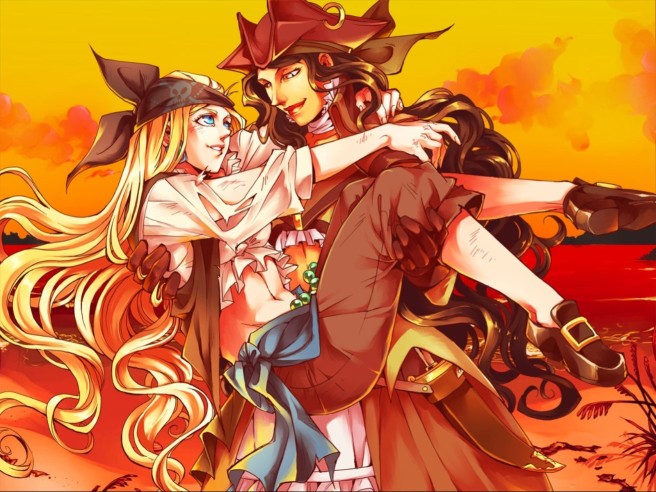
Heileen/Juliet – I romanced Juliet the first time through and on subsequent playthroughs, I kept being tempted to play through her route again.  One really positive thing about this route is that both Heileen and Juliet go through a fair amount of character development during this route.  The ending CG is without a doubt my favourite of the bunch.  Also, in what universe is a kickass pirate lady not considered a plus?

heileen-juilet ending cg


All in all, the potential romances offered are different enough that most people should find one route that they particularly like.

Art – 7
Story – 8
Characters – 8
Yuri – 5 to 9
Service – 5

Overall – 8

Erica here. Thank you so much for this review and the lovely picture which we all can enjoy. ^_^ Sincerely, I can’t thank you enough. 

As always, if any of you, my dear readers, would like to offer a Guest Review, please take a look at these guidelines. I’m always on the lookout for points of view that are not my own and reviews of things I can’t or won’t review. Thanks again C. and here’s to more great Guest Reviews!


Yuri Game: don’t take it personally, babe, it just ain’t your story, Guest Review by Mara)

October 14th, 2011

This is not so much a “Yuri Game” as a “Game with Yuri Elements” but that makes a clunky review header. Anyway, it is my very sincere pleasure to welcome back Guest Reviewer Mara, with another great game review!~ 

don’t take it personally, babe, it just ain’t your story is the newest game from creator Christine Love, who has also written Digital: A Love Story. The narrator is John, an arguably pathetic guy who is at least smart enough to be aware of it. John has just started teaching literature at a high school that has its own internal social network called Amie.

As a teacher, John is allowed access to his students’ profiles and messages, both public and private and is flat out told to monitor them at his discretion.  This is not just a plot element but worked into how we, as readers, experience the story. As the central narrative moves forward, all of the characters are messaging and posting in time with the main story, whether they are present in the scene or not.

Every time someone in the class posts, the player is alerted to it and can read the posts in a submenu. This gives the central characters a powerful sense of constant presence. Even if the main story leaves these characters behind; we still see them talking to each other and posting their status. This device was the selling point in the story for me as it really hammers home the fact that the main narration is just John’s incomplete view. By reading the students’ posts we are privy to their opinions on how the story unfolds, and we can see the gradual bubbling of incidents yet to happen.

It is through this mechanism that we learn of the first Yuri subplot in don’t take it personally. Two of John’s students, Kendall and Charlotte, have just broken up – apparently in a major way – and we see some of the residual fallout of this in the messaging that occurs right at the beginning of the game.  The online communication we see also highlights an important difference between Kendall and Charlotte. While Charlotte is pretty much the same in person as she is online (sensible, accepting and polite) Kendall is a loud witty troll online, but very subdued in person when John first meets her. It is only after the breakup story concludes that it becomes clear that Kendall’s perkiness begins to shift back into her offline persona.

One particular story route does deal with Kendall and Charlotte directly and the possibility of them getting back together. The result is something incredibly adorable in that teenage “this moment is the most important ever” sort of way. Although I did occasionally cringe at attempts to give the characters a unique voice; there was a sense of the raw emotional immediacy that seems to plague teenage life that felt truly genuine in how Kendall and Charlotte’s relationship played out.

However, Kendall and Charlotte are not the only Yuri draw in this game; there is another couple who, although they have much less exposure (John only meets one of them), were the couple that made the game for me. They are the mothers of Akira, another of John’s students, Ichigo and Hazuki.

Akira’s early story deals with him coming out to his friends and peers, having realised for himself very recently that he is gay. It is a sequence that is pretty much free of drama as everyone’s reply is ‘I already assumed so, ages ago’. This irritates Akira, as for him finding out he was gay was an important event and a powerful moment of self discovery…only to find that everyone else had already assumed it.

This is compounded for Akira, as his mother Hazuki by comparison, has a coming out story that spans a year with subplots, themes and a cast too big to fit on the stage. Although this and one other mention is all we get to know about Hazuki, we still get a solid flavour as to what her character is. That, and she induces intergenerational coming out envy in her son, which is just awesome.

We do get to meet Ichigo, in full mama-wolf mode during the end of a sequence where Akira is harassed by another character. Ichigo is straight to the point about the problem and refreshingly appropriate and direct. She also appears in the scene wearing a very dashing suit. I do have to say it is nice to see a mother turn up to protect her son and not be shown as a hysterical protective monster. Instead, Ichigo comes off as perfectly sensible especially, after she turns up again in the resolution of the main story to sort everything out and is instrumental in a very well-written big reveal.

don’t take it personally, babe, it just ain’t your story is a short visual novel. You can get through all the routes within a few hours. However, with both the offline and online world to read, it feels like a truly packed experience. The rhythm that builds up though each chapter allows the important points of each event to be easily digested, like lightly fried dumplings. The art is pleasant, although inconsistent, as two artists split the tasks, meaning that the art for the event cg and the profile pictures have a different feel than the sprites.

I am very willing to forgive this and indeed a few other flaws in don’t take it personally. Why? Well considering this was made for the most part by one person, who put it out for free, and I never felt for a moment that the effort put on this project dropped. don’t take it personally was easily more interesting and is more engaging than games I have bought for eight thousand yen (looking at you Yukkuri Panic and Koihime Musou.) To see such talent and effort available for free is truly humbling.

In conclusion, I seriously recommend this for two good reasons. It is entertaining and free. You cannot go wrong with that.

So:
Art – 6
Story – 6
Characters – 9
Yuri – 9
Yaoi- 9
Service – 6

Overall – 9 (Hey, big achievements mean a lot to me)

What are you still doing here? :  : Go and read the visual novels of Christine Love!

Erica here; Mara, thank you so much for bringing this game to our attention! (That’s the “we” of the Yuri Network, not the royal “We.”) ^_^

The game sounds like it’s fun and your review might even get me to try it. 

Just a quick note: There will be no YNN Report this week. I’m at New York Comic Con (Table 1158, Comic Book Legal Defense Fund!) and won’t have access to a keyboard and I’ll be damned if I try to write the YNN on a phone….


Yuri Game (or not): Final Fantasy XIII Guest Review by Taz

July 7th, 2010

51D6yXi2hjLI’ve said this before, and you know it well if you are a regular reader but, for anyone who might discover this review through the magic of search, I don’t play games. It’s not that I am philosophically opposed to them – I don’t find them an entertaining way of spending my time. Not board games, card games, RPGs, Visual Novels or computer games. Games simply are not my cup of tea.

So, I am always thankful when someone who has played a game with Yuri content writes a guest post for us! In this case, I’d like to welcome Taz, who answers the question, “Is FFXIII Yuri, or not?”

This review, like pretty much every review on this site, contains spoilers.

Take it away Taz!

In brief summary, the plot of FFXIII is as follows: A band of heroes, some more likely than others, get branded with the “l’Cie” cursed seal that comes with a mission, called a Focus: to become the beast Ragnarok and destroy the world. Through positive thinking and sheer bullishness, they resist their mission and instead defeat the being who tried to make them tools of apocalypse.


A large portion of the game involves your characters discovering new abilities, burdens and challenges. At the end-of-chapter divisions you’re often rewarded with a cut scene flashback from the near two weeks preceding the beginning of the game. Both the chapters and the flashbacks go towards showing you just how much can go wrong in a fortnight. This is balanced with heartfelt speeches about not losing hope (and sometimes not losing Hope) and being true to themselves. The speeches are in turn balanced by some wonderfully badass fight scenes and the characters Lightning and Fang (yeah, the names in this game border on unfortunate) being generally awesome.

Fang was a good suspect for being lesbian from the first release of her character design. She had the anime version of tough-girl styling and was named Fang, for a start. Also, Square couldn’t be accused of subtle weapon design: Her double sided lance must have raised a few amused and appreciative eyebrows. When first mentioning Vanille, Fang refers to her as her ‘partner.’ Considering that they were given the same mission at the same time, it’s not such a telling remark. That one of her next comments is about being willing to tear apart both worlds for the other woman does sort of draw attention to the possessiveness of the title, however. When Vanille is in more peril than usual, Fang starts to invoke the nearly requisite Psychotic LesbianTM scene, but it’s not so bad since she can’t actually make herself go through with it.

Vanille is a lot less obvious contender. My first impression was that she’s the bubbly, happy, possibly dim archetype with a little of the feral child (a la Mikoto of Mai HiME). Her attitude and actions in the early part of the game take on some very different implications when you learn more of her story. Of course, she’s still a version of the bubbly, happy type, but she’s not nearly dim enough to misunderstand just how seriously not good things are.

Yuriwise, what the game doesn’t have are the markers that define “couple”– no kissing, no confession. Fang and Vanille do hug a number of times and exchange significant looks. They are also inclined to shout each others names in distress, and at least once (well, Fang does, Vanille is busy feeling guilty) in happiness when they’re reunited. At the end of the game, they do become one… literally become one beastly Ragnarok who doesn’t destroy the world, but wipes out the monsters that are rampaging around, and makes a crystal pillar between Pulse and Cocoon which……might have served more purpose than looking impressive. Inside said impressive pillar, the two have become crystal versions of their human forms, holding hands in a sort of yin-yang like pose. It makes an absolutely gorgeous screenshot but also tends to make you think, “But actually, that would really suck.”

Art – 10
One of the few things that people really agree on concerning Final Fantasy is that it’s pretty.

Characters – 8
This, people are not going to agree on. There are some tedious moments, but by the end I even liked Hope and Snow fairly well, and I really didn’t think I would. And, though not mentioned specifically before in this review, Sazh is fantastic.

Story – 7
The story is uneven. There are some wonderful parts and some distinctly not-wonderful parts. It could just be me who feels this way, but I think that epic plots need to stop having significant connection to God, for at least a decade, so that it actually has a little shock value again.

Yuri – 3
There’s quite enough fodder for fond hopes, but nothing leaves the realm of implication.

Service – 3
It’s a video game, which with their semi controllable characters could be the impetus behind most self insert fan fiction…. Maybe I’m going easy on it, but as I don’t remember any bouncing boob shots (remember Tifa?), I think they kept it comparatively classy. Of course, manly Snow did get the Eidolon that was actually two hot babes.

Overall – 8

Final Fantasy XIII is what it aims to be: a fun game. It would still be a fun game even if there weren’t highly slashable characters, but they are a huge bonus.

Thank you Taz for an excellent – and amusing – review. Sounds like they’re the next generation’s Xena and Gabrielle.

It’s a safe bet that the ambiguity is placed there on purpose, since ambiguity sells. I’m beginning to understand that, too – by forcing you, the viewer/player to make decisions about the characters, it means you *make decisions*. Once you’ve picked an opinion, you buy into that opinion, and so, work harder at reinforcing it. That means you have to buy into the game as a whole, or why would you care at all? The more ambiguous a situation, the more you have to care to make your decision make sense. So, in effect, the less the story tells you, the more you’ll defend your point of view about it. It’s an interesting bit of psychological manipulation, isn’t it? ^_^