Archive for the Yuri Manga Category


Yuri Manga: Sweet Blue Flowers, Volume 3 (English)

April 11th, 2018

Today’s review is a special sneak peak at a piece of writing for the “Big Book o’Yuri”! Thank you to all my Okazu patrons for making this possible. If you want to support my work – and to get another patron-only sneak peek from the book this spring, be part of the Okazu family! 

Deborah Shamoon, in her introduction to Passionate Friendships writes, “Prewar girls culture created a private space of girlhood, a community of friends insulated from the pressures of a restrictive patriarchy.”

By the late 20th century, the readership of shoujo manga and literature had been well trained to admire – and desire – this “private space of girlhood,” as epitomized by sex-segregated schools festooned with the accouterments of western religious orders. In the year of Maria-sama ga Miteru‘s apotheosis from popular novel to anime series, another equally influential series was being serialized in Ohta Publishing’s Manga Erotics F magazine, Shimura Takako’s Aoi Hana/Sweet Blue Flowers.

Okudaira Akira has herself admired and desired admission to an all-girls’ school, where students walk slowly so as to not ruffle skirt pleats and greet each other with old-fashioned greetings. On her way to school, the modern world intrudes on her idyll and she rescues another girl from a groper on the train. The other girl turns out to be a childhood friend of Akira’s, Manjoume Fumi. They pick up their friendship as if they’d never been apart.

Fumi is going to another girls’ school, more modern than Akira’s old-fashioned one, but no less fraught with the passions that infuse the kind of Yuri story that I have labeled a “descendant of S.”

Even though it was written for the adult readership of Manga Erotics F (an eclectic manga magazine) Aoi Hana embraces the interior lives of its adolescent female characters. The focus is not on sex, but on sexuality and the maturation of the characters’ personalities as they go through the paces of high school life. Joining clubs, making friends, school festivals remain the focus, as is common with much of manga but, after some perfunctory crudeness in the first volume, there’s a surprising lack of voyeurism; an almost an enforced naiveté, in the way the girls view – and are viewed by – the world.

Fumi is very much the embodiment of Shamoon’s “the shoujo,” with her shy personality and verbal reticence, she “does not appear as a threat,” and is meant to be seen as a Yamato Nadesiko, “pure and virginal.”

Fumi comes out several times in the course of the series, in a much more realistic example of “coming out” than usual for manga of any kind. She “comes out” to Akira early on, when she explains that she’s going out with an older student, Sugimoto. She follows this in a later volume by clarifying that she likes girls generally, has had a physical relationship with another woman prior to Sugimoto and reinforcing that she likes Akira in a romantic and physical sense. As Fumi matures, her confidence grows, as we can see in an even later volume, when she comes out again to friends and yet again to a grandmother. This kind of repeated “coming out” to different groups with differing levels of intimacy would be familiar to most sexual and gender minorities. (We can amuse ourselves imagining her later coming out to her parents, as well, although that is not addressed in the manga directly.) For this series of repeated coming out scenarios, Aoi Hana deserves a place of honor. As we’ve mentioned in the trope chapter (reference needed), although coming out is possibly the defining trope of western LGBTQ literature featuring teens (especially in YA literature) it’s largely absent from Yuri manga as a standard trope.

In the end, Sweet Blue Flowers, which gained its own apotheosis into an anime in 2009. It was dressed in the trappings of an ‘S’ tale, but was ultimately a same-sex romance told with a modern sensibility and for an audience which preferred happy endings over the “death or marriage” of early Yuri.

***
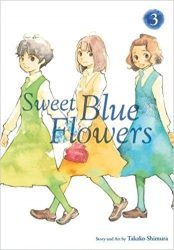
 

In Volume 3 of  Sweet Blue Flowers from Viz,  we are treated to the spectacle of Fumi’s repeated coming out and the affect it has on her circle of friends, most especially on Akira, who must find a place within herself to understand what Fumi’s feeling mean to her. 

The second-years are maturing, rather quickly. Mogi is dating Akira’s brother, and Kyoko seems to have all of a sudden sprung fully into adulthood. With the even more condensed omnibus format, time seems to have contracted here and we’re almost left breathless at the changes from the beginning of the volume to the end. 

This adaptation is exceptional. Reproduction and translation are all seamless, and we’re able to have a very authentic manga reading experience. The only downside of this is that it highlights the creator’s inherent weaknesses in story telling. Shimura creates character-driven narrative, but sometimes the narrative needs slightly more than just interior monologue to drive it. ^_^;

What this volume is, without question, is very lesbian. Fumi isn’t the only gay character any more now that we know that Tamashina-sensei is Ono’s older sister’s lover. And, while the impact of that is hardly touched upon in the narrative, the addition of a role model is important for Fumi. To have someone to talk to…the value of that in a young lesbian’s life cannot be overstated.

This volume is, in my opinion the strongest of what Viz will release as four volumes. We can see the progress the young women make as people, before the story turns back into itself to fulfill the requirements of a romance series.

Ratings:

Art – 8
Characters – 8
Story – 7
Lesbian – 6
Service – 1

Overall – 8

The fourth and final volume of Sweet Blue Flowers in English has a June release date. And then, we’ll be able to talk about the ending. ^_^ There’s a lot to discuss.



Yuri Manga: Nameless Asterism (English)

April 9th, 2018

Nameless Asterism by Kina Kobayashi, is a school life story. It begins with three girls, Shiratori, Washio, and Kotooka who have been friends for years. Kotooka has a boyfriend (a new one in a string of boyfriends, apparently) and Washio and Shiratori are determined to be supportive. But as Shiratori watches Washio, it becomes obvious to her that Washio has feeling for Kotooka. When she discovers Washio kissing a sleeping Kotooka, she lets Washio she knowsn. Washio admits her feelings, but promises that the three of them being friends is more important to her than her feelings, so she will say nothing.  Only, the love polygon doesn’t end there and the end of the volume adds, rather than subtracts, people from it.

This manga presented me with a bit of a personal mystery. As I read it I felt absolutely certain that I had read this story already.  But I could not, for the life of me, remember where or when. 

In Japanese manga volumes that collect magazine chapters, one of the technical credits in the back indicates where a story chapter was first published – what magazine, which issue, whether it is original for this book or originally published as a doujinshi…that kind of thing. Sadly for me, English-language volumes do not typically provide anything more detailed than the name of the creator and publisher.  I’m not complaining, really, I know I’m one of few – if any – people who care, but it would have saved me a few moments of searching. ^_^ It turns our that this is  series is from Gangan Comics Online. by Square Enix. As it happens I am reading a Gangan Comics Online comic right now, Ani no Yome to Kurashiteimasu by Kuzushiro . But other than that one, I don’t read many Square Enix titles. However, after more research, I found a review here on Okazu for an extremely similar one-shot story called “Isshun no Asterism” about three schoolgirls – one of whom sacrifices her love for another to preserve their friendship – by Amagure Kido a few years ago. So that explains that. ^_^ 

In any case, the characters here are sympathetic, if a tad uncomplicated for this adult reader. Even in high school, even in love, I remember having more of an internal monologue than just one thing.  But the characters are not unlikable and while I hold out no hope whatsoever that Washio will end up with Kotooka, nor do I think she’ll find space in the narrative to come out to herself or anything, really, it’s  a pleasant and swift read. And with Seven Seas, you can always count on consistently high quality of reproduction and translation. 

Ratings:

Art – 7
Characters – 7
Story – 7
Service – 1 on principle
Yuri – 4

Overall – 7

Nameless Asterism is a completed 5-volume set in Japanese. In English, Volume 1 and Volume 2 are currently available and Volume 3 will be hitting shelves this autumn. 

Many thanks to Seven Seas for providing a review copy!


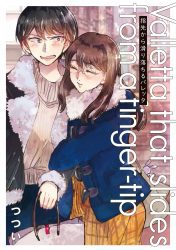
Yuri Manga: Yubisakikara Suberiochiru Valetta (指先から滑り落ちるバレッタ)

April 5th, 2018

Yubisakikara Suberiochiru Valetta (指先から滑り落ちるバレッタ), transliterated on the cover as “Valletta that slides from a finger-tip,” by Tsuitsui is a collection of stories that ran in Comic Yuri Hime magazine. 

In the first story, two female friends go to a love hotel together because they want to try staying at one.  Although nothing happens between them, they become a little closer as a result, and recognize that they care about  – and maybe for  – one another.

A businesswoman takes in the high school girl who is seeing the college-age guy next door as she sits out in the rain, giving her s cup of hot coffee to warm up. They become friendly, and when the guy dumps the girl (after sleeping with her of course) Yui is there to help pick up the pieces of Konatsu’s heart…until they fight and Konatsu stops coming by. Yui brings herself to ask the guy next door where Konatsu’s school is. They make up and will once again be able to share a cup of coffee.

Nagano is being bullied by Miyuki, but Nagano doesn’t care. She tells Miyuki she knows she was behind it and Miyuki wants to know how to make it up to Nagano. “Pretend to be my friend,” Nagano replies. As they pretend to be friends, Miyuki’s old friends ostracize her and start bullying her. But Nagano is there for her and Miyuki finds that she just doesn’t care any more about the old friends, either. She and Nagano exchange pretty barrettes, from which the title comes, (although mistransliterated for English. It ought to be “A Barrette That Slides From Fingertips.” The addition of “my” or “your” before Fingertips, while not literal would be more poetic. “The Barrette That Slides From My Fingertips.” is what I’m going with…thinking of this from Miyuki’s perspective, as Nagano first bought her a barrette, which precipitated her falling out with her henchchicks.

The final story follows a “tough-as-nails” businesswoman who has held a torch for her old school friend for years, but when her friend says she’s getting married, Mei is able to see that the clumsy, sincere woman who works for her seems to actually like her. They might even get together.

I quite like Tsutsui’s messy, sketchy art. And the story-telling basics are solid. 

Ratings: 

Art – 6 It’s got issues, but I like it anyway. Needs maturing, and some work on the eyes, particularly
Story – 5 Basics for the qualifying round. Now it’s time to move on
Characters – 8 Definitely the strength of the volume
Service – 4 There is some
Yuri – 7 There is some. Mostly feelings, very little relationship

Overall – 7

I’d like to see the artist get a whole volume’s worth of story down, now that we’ve got the compulsories out of the way.


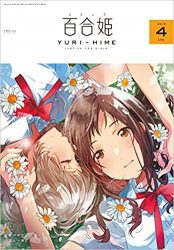
Yuri Manga: Comic Yuri Hime, April 2018 (ミック百合姫2018年4月号)

April 4th, 2018

Comic Yuri Hime, April 2018 (ミック百合姫2018年4月号) was a little light on the continuing series, but spent most of its pages building on a bunch of newer ones that were pretty good. 

No surprise, I liked the AI-focused “Roid,” by Shirushi. I apparently like android x human relationships. ^_^

Tamasaki Tama’s military-ish school drama “Koushin Koinu KoibumI wo” continues to flail for a plot, but is fun to read anyway. 

As I suspected (because it was kind of obvious) the story in “Watashi no Yuri ha Oshigtoto desu” by Miman, is now fulling focused on Tachibana’s concern for and being disconcerted by Kanako’s obsessive feelings about Hime. I don’t want them to be a couple, but I think Tachibana could be good for Kanako, because right now, she is not a stable person. I would like to see them help each other out.

“Tsuretsure Hibi” by Omurais was a nicely drawn, pleasant slice of two women’s life together without drama. That was awfully nice.

Moke has a lovely little girl meets and falls for a cafe owner in “Yuuhi to, Aroma to, Koi Moyou,” while Nacht’s “Dandelion Tearoom” was a  straight-up paranomal fantasy and Nantsufuji’s “Kimi ha shoujo” took a bit of a darker turn, as Shinou comes to grips with the fact that she’s had sex with a virtual stranger.

Lots of other stories, including the series they choose to make anime of, (by which I have so far remained unmoved.)  Yuri Hime@Pixiv is also clearly allowing them to try out some new material and see how it plays before moving it to the magazine or to publication.

Ratings: 

Overall – Holding steady at 8 

Monthly Comic Yuri Hime still is holding the line with something for everyone. The May issue is already on shelves!


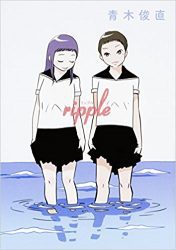
Yuri Manga: ripple (リップル)

April 3rd, 2018

There are days, here on Okazu, when it’s a little harder to not be just a tad snarky or cynical about Yuri manga. In fact, I suppose it’s something that every generation does – going through all the various contortions of growing up, coming out and being a gender, romantic or sexual minority and then being all world-weary when the next generation does it all over again. In regards to Yuri manga, I’ve seen roughly three or four “generations” of artists “discover” that girls fall in love with each other sometimes. And yes, there are days that I shake my head with  an amused smile at all the sincere doujinshi and manga that have hatsukoi or hajime(ru/te/ta) in the title. But I never, ever want to be this guy, acting like his own personal journey marks the end of all similar journeys and be a jerk about a sincere story

With the build-up of yet another Story A in Aoki Toshinao’s ripple (リップル), (with Shimura Takako’s name boldly labeled on the obi for very important marketing reasons,) you might even have forgiven me for rolling my eyes just a bit. But, I didn’t, and I’m glad because yes, ripple is indeed another Story A and no, it breaks not one panel of new ground and yes, it is very banal…but I liked it anyway. Apparently, every once in a blue moon sincerity is a replacement for competence. 

Neither art nor story here is exciting. A girl named Minami falls for a girl in her school named Nami. Their courtship is typical, their relationship follows all the general patterns of all relationships. Nami has a secret which is painfully obvious to us from the first mention – she’s liked a girl previously, and that girl broke her heart, a story she admits to at the climax of the volume. Again, you might forgive me for eyerolling, and again I say…but I didn’t.

Minami helps Nami to shed the baggage of her former relationship in a full-color final chapter. They like each other, and they sleep together and they are happy together, the end. And it was not creepy, nor painful nor boring. Just all pleasant and human and real.

Ratings:

Art – 6 better than I could do, but not great
Story – 6 Girl meets and falls in love with another girl
Characters  – 7 Likable and sympathetic, acting their age, which is sort of nice
Service – 3 A very little partial nudity in the final pages, So sex, but not sexed up.
Yuri – 9

Overall – 7

I believe, from the bottom of my heart we will always need stories that tell the basic plot of “there is a girl who likes a girl. The other girl likes her back. They like each other, the end” because there will always be a new generation of readers who have never read that before. And there is always someone who has not seen their experience in a manga before. And so, no matter how far on we have come in our personal journey, it’s important to remind ourselves that yes, stories like ripple should always have a place in our genre.