Archive for the Yuri Manga Category


Yuri Manga: Comic Yuri Hime January 2015 (コミック百合姫)

February 17th, 2015

CYH0115To say that the January 2015 cover of Comic Yuri Hime (コミック百合姫) alarmed me is not an understatement. Since the repatriation of Yuri Hime S content into Comic Yuri Hime, I have had the nagging sense than the editor is trying again to shift the content away from “stories women – perhaps even lesbians – like,” to “stuff that appeals to fanboys.” When the magazine originally relauched, it had become less “typical fetish”y, slightly more adult, more lesbian and a teeny bit darker. In recent issues, it’s ended the lesbian series and strongly ramped up the Yuri fetishtry.

The cover has a purely moe piece of art, accompanied by the decision that alarmed me. Instead of the usual Kanji 百合姫, the magazine title is written in hirigana as ゆりひめ. Why would that matter, you may ask? Moe is not just the cutifying of characters, or the simplification of the art, it is also very much about keeping female characters infantile. It’s about obsessing about their “innocence” “awakening” and “budding”  and other euphemisms for puberty. In Eureka’s Yuri Culture issue, Rica Takashima wrote an essay on the relationship between “Yuri” and this tendency to never move lesbian love or life beyond high school or enter the real world. It keeps the idea of “Yuri” firmly locked in that not-real-life space of school life. Lesbians die after leaving high school in this version of Yuri. Or, more appealing to ultra-conservative male otaku, they get married, leave their careers, have babies and remember that one affair fondly. The end.

Rica makes a pretty good case. Women’s progress in Japan is stagnant. You’ll notice that, for all that both BL and Yuri have grown in popularity, there has been an almost complete lack of movement on LGBTQ rights in Japan. I say almost, because a few years ago, it was reported that Japan would recognize Same-sex marriages of Japanese citizens done outside the country, but has yet to actually do so. This week Shibuya Ward announced that they would discuss the idea of issuing SSM certificates. Unfortunately Western media reported it as if they were definitely going to, but it is not a certainty. We’ll find out next month when (if) the vote is actually held….

And here we are, looking at the last of the Yuri magazines and watching it shove “Yuri” back into the school life closet where lesbians just disappear after high school and Yuri is no longer even allowed it’s kanji, but has to use more childish hiragana.

There is a textured little sticker image on the cover that says “The contents are the regular Comic Yuri Hime.” I am neither reassured, nor pleased. The situation is getting worse, if the March issue is any indication. As bad as the Yuri Hime S cover art was, it was never this horrible. To be honest, I can’t even credit this as “art” in any meaningful sense. Two blobby heads with few features, no discernible setting. This is not what I am looking for in Yuri.

It’s 2015, and my choice once again appears to be creepy tit-squeezing and bodily fluids-soaked porn and infantile love stories. Yuri has been almost completely disappeared back to 2000s level. I am sure it’s just a dip before the next peak, but UGH. Like women’s rights in the political sphere, it seems that every decade female Yuri fans  are forced to remind the powers that be that we’re still here and this stuff stuff skeeves us.

That all said, the stuff I still like in the pages of Comic Yuri Hime remains stuff I like. I even found myself not disliking this issue of “Yuri Danshi,” as the Yuri Joshi contingent joins the crew of delusionals.

Of all the stories I am reading, the one I flat out enjoy the most is “Love Desu,” by Kuzushiro. It’s horribly violent, not at all cute, and I gasp with relief when I get to it. In this issue, the one character shot a bobby pin into the other character’s eye. Thank the gods for this story. Thank Kuzushiro-sensei too. One more blobby face with a blank expression and I was going to gouge my own eye out with a bobby pin.

Ratings:

Overall – 7

I’m asking nicely – can’t someone please write a decent pro sport Yuri series? Please? I am so so so so so so done with school drama.

The May issue of Comic Yuri Hime is also available for pre-order.


Yuri Manga: Hakugin Gymnasium, Volume 2 (白銀ギムナジウム 下)

February 10th, 2015

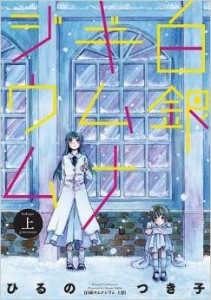
HgGn2When we left off at the end of the first volume of Hiruno Tsukiko’s  Hakugin Gymnasium (白銀ギムナジウム 下), Eimi and Fiona are both gone, and Toutou and Eris acknowledged their feelings for one another.

Volume 2  begins with Chloe and Athena who, separately, come to realize that they mean a lot to one another. In the course of this arc, we also learn that the Gynasium – which has been home to so many girls – is going to be closed.

Toutou and Eris, who are now the age Fiona and Eimi were when they left, find Fiona. Living alone, outside town, making a living as a piano teacher, Fiona is fine…she says. But we can see that while she is “fine” she’s not happy.

Toutou and Eris reveal that the Gymnasium is going to close and ask Fiona to participate in the closing ceremony. She agrees. Secrets come to light that night that heal some old wounds and open others.

The day of the closing ceremony comes and Eimi also comes to say goodbye to her true home. And, finally, Fiona and Eimi have it out, laying bare their feelings and what went wrong.

The Gymnasium closes,  but as we follow Fiona returning to her home from town, and finding Eimi there waiting for her, we have to hope the the other stories have as happy an end, and that Miss Maria was completely, totally wrong.

Like the first volume, the art is old-school (an old-school story about an old school) and the ending is, as well. As much remains opaque as is settled. Will Toutou and Eris be able to be together as Fiona and Eimi are? Has Eimi renounced her family in order to remain with Fiona? How about Chloe and Athena…are they a first love that is untenable, or do they go somewhere together? And what about all the children who were at the Gymnasium because their families didn’t want them?

Ratings:

Art – 9
Story – 7
Characters – 8
Yuri – 8
Service – 1

Overall – 8

Questions remain unanswered, but hey, at least Fiona and Eimi are together.

Ratings:


Yuri Manga: Whispered Words, Volume 2 (English)

February 8th, 2015

ww21Whispered Words, Volume 2  (Amazon / RightStuf) is the English-language edition of Sasamekikoto, Volume 4, Volume 5 and Volume 6.

And, as I said in my reviews to those volumes, when this much pressure has been built up…something’s gotta give.

The series started as a mostly-comedic “best friend with a crush” plot, expanding out to almost all the possible Yuri tropes that we were familiar with. For that alone, this was a pretty terrific series. But then the veil of comedy became thinner and thinner and we started to see a serious drama beginning to unfold…and more importantly, the abyss of possible tragedy. In a fascinating sort of reverse meta, the characters are painfully aware of the impending calamity.

Sumika and Ushio are speaking to one another, but nothing is being said. Everyone around them can see what lays between them. Even when they know what it is, they can’t just say it. The logjam becomes untenable. Thankfully, the tragedy that breaks it up is laughably mundane. Phew.

This volume has some of the best storytelling I’ve seen in schoolgirl Yuri manga. No complicated school rituals, no gender switched plays…no tortured metaphors. Just two people you can imagine knowing, in a situation you can imagine happening, and the manga is still funny and ridiculous and painful in places…just like life.

Technically, Volume 2 is a notable improvement over the first printing of Volume 1. I know just how difficult it is to publish a 100% error-free book, and it amazes me how jarring even a single typo is. Generally speaking, I think 1 error per 100 pages is acceptable. This book has fewer than that. Nice work by One Peace.

Volume 2 includes a sweet little short about a schoolmate of  Ushio and Sumi’s with powers of divination who can’t see her own future. It has a very “awww” ending.

The best part of this review? Volume 3 is already shipping. If you gave up on this series, for whatever reason, I ask you right now, as a personal favor – give Volume 3 a chance. It’s worth it. I promise.  ^_^

***

All Yuri All the Time! –  Subscribe to Okazu withSubcribe with Patreon

***

Ratings:

Art – 8
Characters – 8
Story – 8
Yuri – 4
Service – 1

Overall – 8

Many, many thanks to One Peace for the review copy.  Volume 2 was as emotionally wrecking as I suspected, and I’m very glad it’s in English for us all to be brutalized. ^_^ Volume 3 ahoy!


Yuri Manga: Hakugin Gymnasium, Volume 1 (白銀ギムナジウム 上)

February 6th, 2015

Hakugin1Hirono Tsukiko’s Hakugin Gymnasium, (白銀ギムナジウム 上) is a non-linear tale of love and loss, betrayal and redemption. You know, like pretty much every other romance ever written. ^_^

In this first part of two, we meet Fiona and Eimi, two girls who reside at the Hakugin Gymnasium, an orphanage/ boarding school. Eimi was abandoned by her parents but somewhere out there, they still exist, while Fiona has no idea if her parents are alive or dead. Since the two of them were left at the Gymnasium on the same day, they are inseparable. But, when Eimi’s real parents reach out to her to bring her home, there’s nothing Fiona can do. And so, her beloved Eimi leaves her behind. As soon as she’s old enough, Fiona leaves the Gymnasium, walking away to create a solitary life for herself without the person she loves most in the world.

Time passes and Toutou and Eris, two younger students who admired Eimi and Fiona and their closeness, have now grown up to be about the same age Fiona and Eimi were when Eimi left. Toutou is increasingly aware of feeling for Eris, but instead of turning towards her, Eris is falling for a guy. A guy who is 100% clear about Toutou’s feelings and is pleased with himself for stealing her love.

More and more, Toutou finds herself thinking about Fiona, and wondering if the ache she feels in her chest now is similar to Fiona’s when Eimi left. Toutou goes through a crisis in which she finds herself about to harm Eris, and breaks down. To her surprise, she learns that her feelings are fully returned. Outside the room, Miss Maria, the head teacher, cries at the pain that awaits them

In the final chapter of this volume we learn something we had not previously known. Although we knew all along that Fiona’s feelings for Eimi went beyond friendship, in a short flashback we now can see that Eimi’s feeling were the same. And again, we see Miss Maria trying desperately to protect them from what appears to be inevitable unhappiness.

While in Japan in October at Toranoana’s Yuri section, I saw this book and it’s sequel. (Yay for technology. I wasn’t sure if I had ordered this book through Amazon JP yet, so pulled out my phone, checked my orders online and voila! knew I hadn’t gotten them.) So I picked up this volume. That night I flipped through it and realized that I really needed both volumes. The narrative was slightly too non-linear – and it wasn’t looking happy there by the end.

Never in my life have I been so happy that I waited until I had both books to read a series. 

You’re going to want to have Volume 2 right there when you read Volume 1. Trust me on this.

The name of the orphanage is interesting.  Hakugin (which means “white silver”) Gymnasium, (where Gynmasium is pronounced with a hard ‘g’. Gim-na-zhi-um) is set in somewhere in the Europe of the imagination, where girls wear long skirts, high laced boots, and poor orphanage/boarding schools have a grand piano. It’s quite likely a reference to Moto Hagio‘s early BL work Juichigatsu no Gymnasium (11月のギムナジウム), which famously, she has said she originally considered centering around girls, but instead chose to make about love between boys.

The art is a style I very much like. Like the title, it hearkens back to an earlier time. More like Himitsu no Kaidan (another classic boarding school story, reviewed here on Okazu: Volume 1 | Volume 2). I found the whole thing an attractive and compelling read, if maybe not the cheerfulest thing I’ve read this month. ^_^;

Ratings:

Art – 9
Story – 7 very non-linear. No adherence to Aristotelian principles here.
Characters – 8 Surprisingly very well developed
Yuri – 8
Service – 3 Partial nudity

Overall – 8

So here, in sometime, someplace Europeanish, we’re getting a story about love between girls. Two stories, in fact – one apparently happy, one apparently tragic. But we have a volume yet to go.


Yuri Manga: Tonari no Robot (となりのロボット)

February 5th, 2015

TonarinoRobotTonari no Robot is a bittersweet little love story about a humanoid robot and her friend, a human girl.

The robot, known as “Praha” to her build team, is called Hiro by Chika. Hiro and Chika met when Chika was 4 years old. And over the years they stayed friends, Chika aging as humans do, while Hiro outwardly remains the same.

I say outwardly, because Hiro is not just a robot, she is meant to closely approximate human behavior and learning. Over time, her build team helps her be more and more like a human (although they themselves aren’t all that normal) and of course Chika helps. Chika is an example of human complexity every single day and while she does not age, Hiro does changes because of this.

And, when Chika tries to teach Hiro about things like love and physical intimacy, Hiro’s build team is forced to accommodate new, unexpected situations.

We learn in the second half of the volume that the Praha type is meant as one of several types of humanoid robot types, designed for generalized and specialized functions. As we spend more time with build team, and less with Chika, Hiro’s Chika-less life seems not nearly as fun as it was when she was attending high school along with her friend.

In the final chapter we learn why – Chika has moved on and become an adult. Now 27, she is no longer this child who befriended Hiro, or a schoolmate. And, although the ending is happy, I am reminded by the final panel why all such human/robot stories are doomed to be bittersweet. Aging gives the human existence a time-frame, boundaries, limits on what we have time to do.

Throughout this volume, I was constantly reminded of Yokohama Kaidashi Kikou and how the humans in that story were almost markers of time passing, while Alpha’s one deep, abiding relationship is with another android. We do not have to be sad that humanity is fading away in YKK, Alpha and Kokone will always have one another. Not so Chika and Hiro. Even the build team will one day cease to exist, but Praha might continue on like my poor beater car, still chugging away long after it is obsolete. Or, worse, Praha will fail and the Praha team will be long gone, and old and no longer needed and no one will be there to help Chika in her old age.

And so, I call the book bittersweet. Nothing in the book itself is bitter, but as a human reading it, I can’t not think about inevitable loss that is to come.

***

Support Yuri News and Reviews –  Subscribe to Okazu withSubcribe with Patreon

 ***

I guess I’m feeling my age today, because the book itself is not at all depressing! ^_^ It’s sweet, it’s cute, it’s got moments of adorable embarrassment, and traditional “robot misses the point” cuteness and above all, Nishi UKO-sensei’s art is, as ever, exquisite.

Ratings:

Art – 10
Story – 8
Characters – Chika is adorable and Hiro cute in that dorky robot way, but I really liked the bitchiness and ranting of the build team members best. Completely real.
Yuri – 9
Service – 4 There is a bit in the middle

Overall – 8

Although I felt a twang or two in the heart region while reading it, the fault lay neither in our stars nor in Nishi UKO-sensei’s work, but my own fragile operating system.

Note of interest – Praha, and the other robot build names, are Czech.