Archive for the Yuri Manga Category


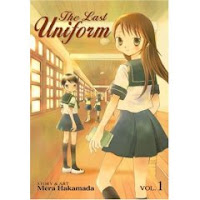
Yuri Manga: The Last Uniform, Volume 1 (English)

August 13th, 2007

My sincere thanks to the folks at Seven Seas for providing me a copy of The Last Uniform for today’s review. Your generosity is sincerely and greatly appreciated!

As you may know, if you have been reading my reviews of the Yuri Hime magazines for the past few months, I do not like Hakamada Mera’s art. And the recent entries by Hakamada in those magazines have outright repulsed me. Nonetheless, I am going to say that The Last Uniform is, in every other way other than the art, an enjoyable manga. (My original review of Saigo no Seifuku says pretty much the same thing – if the art was better and the characters looked their age, I most likely would love this manga. But they don’t. So I don’t.)

The manga takes place at the ubiquitous girl’s school in one of the dorms, where the rule is that everyone must share a room. There can be no single-person rooms. So, when a new student transfers in, she is placed with roommates Ai and Fuuko. Ai is exceptionally upset about this – more than she can even deal with. By the time she realizes why, so has her new roommate, who goes out of her way to stay out of their way and even encourages Ai.

In addition to Ai and Fuuko, an older pair of students, Tsumugi and Beniko, are also involved in a gavotte around their feelings for one another. Their relationship is complicated by an upperclassman who openly courts Beniko, but to no avail.

These two relationships are the main focus of the manga, with some side stories and a key flashback.

The plot, such as it is, revolves around normal school life, with the trials and tribulations twisted only slightly to reflect the student’s feelings for one another. There are some kisses, but no outright confessions in this volume. By the end of Volume 1 the couples are neither together, nor are they apart. It’s a story of beginning more than endings though, so the reader can remain hopeful that things might progress.

As with all of the Seven Seas books I’ve reviewed so far, the translation and adaptation are nearly seamless, which makes for a pleasant and smooth read. If only the art wasn’t so darn unappealing…oh well. (And remember that this is *my* opinion. You might not be bothered by it as much as I am. I am bothered by it a great deal. I don’t like the oversize, misshapen heads and the little-girl bodies.)

Of all of the so-far released books in 7S’s Yuri imprint, remembering that Kashimashi is NOT part of their Strawberry line, Last Uniform is pretty much the only one with actual Yuri. The others have “Yuri-service,” where the two female protagonists are shown in a variety of posed positions in still art or screencaps as if they are potentially lovers, but there’s no actual emotional connection. Like the Newtype effect, many people cannot discern the difference between two women in love with one another or two women who are merely posed to look as if they desire one another. (Thinking about it, this explains the popularity of lesbian porn for men – the viewers can’t differentiate/don’t care about the fact that they are just two women being paid to have sex on one another. But I digress.)

In any case, the strength of this book is the characters’ feelings for one another, which reads pretty convincingly and not at all unpleasantly.

Ratings:

Art – 3
Story – 5 (nothing new or earth-shaking, but nothing taxing or horrible)
Characters – 8
Yuri – 8
Service – 1 (but only on the basis that someone, somewhere will always get off on something, as the author clearly does on school uniforms.)

Overall – 6

As the only manga with actual Yuri in the Strawberry imprint, I think it does a fair job. I’ll never sing paeans of praise to this series, but you could do worse….




Yuri Manga: Kashimashi ~ Girl Meets Girl, Volume 3 (English)

August 8th, 2007

I have two gentlemen to thank for today’s review. First and foremost, Daniel P. who sponsored today’s review by hitting up my Wish List. Thank you very much Daniel! And secondly, Mike H. who just yesterday wrote me a wheedling email wanting to know when I would review this manga already. Mike – I’m reviewing it, ‘kay? Stop whining. ^_^

The plot of Kashimashi Girl Meets Girl, Volume 3 is no different from my review of the Japanese edition in 2006. For a basic outline (with the usual mild spoilers) of the plot in Volume 3, please go ahead and read that review. This time I’m going to focus on the adaptation to English.

First of all, I continue to be both impressed and pleased by the translation and adaptation of this manga. Not only is Seven Seas attempting to capture the feel and sense of the original, but leaving honorifics and cultural relics untranslated, but in this issue I noticed a sincere effort to capture the *voice* of each character. This simply puts this adaptation orders above every other translated manga company out there, except for ALC. Because we also work hard to keep the character’s voices intact through our translations and adaptations.

If you know anything about me as a writer or editor, have ever attended a writing workshop with me, or even just read my Fanfic Writer’s Workshop, you’ll know that lack of “voice” in writing, much less translation, is my bete noir. I cannot stand it when all the characters in a book, manga, anime, whatever, sound the same. Rarely do they, in the original, but American translators, by virtue of being one person translating several chapters/volumes, often smooth out the voices to the point that all the differences in speech disappear. Maintaining them in any translation is difficult. And kudos to 7S for obviously working at it.

But.

(You just *knew* there had to be a “but,” right?)

Unless Tomari has all of a sudden become an old Jewish guy, I’m just not convinced that “putz” is the right word as a translation for “baka.” *I* don’t even use putz – and I’m an old Jewish woman. My Dad…*he* uses putz. “Idiot” “Moron” “Stupid” – all are perfectly good insults that don’t make Tomari sound like my father. ^_^

One other thing I wanted to point out on the good side: I noticed immediately that all the characters, save Sora-sensei (who is alien and a freak above that) now call Hazumu “she” or “her.” Well done. Thank you.

The Stupid Plot Complication Disorder (SPCD) this volume is far more exhausting than Yasuna’s merely not being able to see men, and I can swear to you that the conflicts, such as they are, will drag out for most of the next two volumes. But I’ll also council you to stick with the story, because IMHO, the end isn’t at all bad. Check back here for an upcoming review of the final volume, which came out this summer in Japan.

Ratings:

Art – 8
Characters – 7
Story – 7
Yuri – 9
Service – 4

Overall – 8

Asuta and his fantasies…total snooze. What a paucity of imagination that boy has.


Yuri Manga: Yuri Monogatari 5 available for Pre-Order

August 5th, 2007

ALC Publishing, the world’s only all-Yuri publisher, is pleased to announce that “Yuri Monogatari 5” is now available for Pre-Order on the Yuricon Shop!

This fifth volume of ALC’s 100% Yuri anthology contains more Rica ‘tte Kanji!?, more Yuri from Eriko Tadeno, stories by fantastic Yuri doujinshi circles UKOZ and Sakuraike, and by artists and writers from Europe and North America. YM5 is 224 pages of Yuri, including a new story by Althea Keaton who was featured in Curve magzine.

Pre-order now and save 25% off the cover price. Get your copy of YM5 today: http://www.yuricon.org/shop/manga.html#YM5

Remember – for *every* book you purchase from ALC, 100% of the proceeds go directly to making more Yuri events and publications. Save some money, get yourself 100% Yuri and support Yuri in the west all at once!

ALC Publishing – where the girl always gets the girl.


Yuri Manga: Claudine

July 30th, 2007

In the late 1960’s, women began entering the manga industry in Japan with a vengeance. Until then manga – even manga for girls – was drawn by men. The women best known for making a splash in the manga market are known collectively as the Magnificent 49ers, because they were all born in the year 1949. The 49ers made a huge impact, and they are frequently credited with the creation of shoujo manga, that is, comics by women for girls.

In the early 1970’s many women experimented within this new genre – it is at this time that the first manga that would later be seen as the origins of today’s Boy’s Love (Tomas no Shinzou) and Yuri (Shiroi Heya no Futari) were drawn. Following these were many manga in which gender roles, crossdressing and same-sex love were dealt with. We now look at many of these stories as early examples of the Yuri genre.

Ikeda Riyoko, the author of two of those manga, Oniisama E and Rose of Versailles, was clearly fascinated with gender. In both of the above there is a main character who is a woman, but dresses and acts like a man. In both cases this character is seen as physically attractive to the women around her. Both Sainte-Juste and Oscar have tragic endings, but both die free from regret and in love – Oscar with her long time friend and lover Andre’ and Rei, known as Sainte-Juste, with the young girl Nanako, who had freed her from the bonds of an abusive relationship with her half-sister.

Ikeda wrote another series dealing with a women who dresses like a man, Claudine. It is quite possible to call this a manga about a transgender character, as much as it is a Yuri manga. There’s no way to know whether Claudine’s desire was to be able to love women freely and dress in the clothes of and have the prerogatives of a man – like many butch women of her time – or whether she truly wanted to become a man. Either way, this classic Yuri manga is a pretty amazing, but painful, character piece.

The manga begins as a doctor of psychiatry discusses the case of Claudine, a patient of his for many years. She was brought to him as a young child, when her proclivities for dressing and acting like a boy were already well established. The doctor is very sympathetic – he never really tries to “fix” her, instead providing her with a non-judgmental ear for her to vent to.

Claudine’s first love is a servant, Maya, who returns her love unconditionally. But they are discovered and Maya is sent away, leaving Claudine to begin to loathe herself and her attraction to women. As a young woman, Claudine heads to the city where she once again falls in love with a woman and is once again betrayed – this time by the girl herself. Claudine, who comes from a family of power and wealth longs only for love. But she will not find it and in the end, she can only see one way out. The doctor learns of her suicide on the phone and mourns the passing of the tormented girl.

It’s a very Well of Loneliness type story, in which the “moral” of the story appears to be that women who love women will die horrible deaths. An ending that was stock in the world of lesbian romance until … erm … okay, it’s still pretty stock. But for any women who were loving women in the middle of the sexual revolution of the 70’s, reading Claudine must have come as a “whoo-hoo!” moment. Think about it – what’s the one thing everyone wants from the universe? Everyone wants to see themselves reflected in some form of media. Whether it be TV, movies, song, manga, what have you – the one thing we all want is to see some sign that we *exist.* That’s why gays and lesbians trawl through media pointing out even the “are they or aren’t they?” characters. Because the more examples of our selves we can find, the more validated we feel.

And in the 70’s, in the middle of a burgeoning wave of manga for girls, to those women who had loved or did love another woman, something like Claudine would be a life-line of external validation.

No, it didn’t have a happy ending – manga rarely had happy endings in the 1970’s, regardless of the romance. Or at all until the 90’s really. And even now, the majority of anime and manga favor ambiguity and resets over actual happy endings with resolutions. (There’s all sorts of cultural reasons for this that I won’t get into here. Ask me about them some day when we meet.) The bottom line is, Claudine probably made a bunch of early otaku lesbian and transgender (or those who wished they could transition) folks very excited.

So, whether you perceive Claudine as a lesbian narrative or a transgender one, it’s a pretty significant manga. Personally, I like it. Like Well, with which it has so much in common, it holds a special place in my heart.

Ratings

Art – 8
Story – 6
Characters – 6
Yuri – 8
Service – 2

Overall – 7

I like to think that, when young Satou Sei was combing literature for reflections of her own feelings and she came across Well, she might have also come across Claudine and, like myself, rejected the tragedy, even as she acknowledged its place in her personal history…. Us Comp. Lit. majors must stick together after all. ^_^


Yuri Manga License Announcements from San Diego Comic Con

July 28th, 2007

Seven Seas has announced that they have licensed Hayate x Blade, which makes me happy for several reasons. A while back, they asked me to send a list of good Yuri titles and, while I said that it was not Yuri, I suggested that they look into this because it is so *good*. Based on their recent acquisitions of the Ichijinsha properties and now HxB, it looks like they really took my list quite seriously.

7S also announced licenses for Hakamada Mera’s Akatsuki-iro no Senpuku Majo, and two novels, Girls Love and Girls Revolution, neither of which I am familiar with. I’ll look into them.

(Now, can you guys at 7S send me the review copies you promised, so I can review your books, already?)

Tokyopop has announced the Kannazuki no Miko manga, which will give us a whole new generation of degenerates who think rape is sexy as long as it’s two women. The ending – not nearly as Yuri as the anime. I look forward to the mental gymnastics the end will cause in readers who inisist in Chikane and Himeko as a couple. :-)

Will be away all day, so more announcements tomorrow, if there’s any to be had.