Archive for the Yuri Manga Category


Yuri Manga: Indigo Blue

January 23rd, 2004

Something Old, Something New, Something Borrowed, Something Blue
Part 4

Once again, I present for your inspection a truly excellent piece of unknown yuri manga – Indigo Blue, by the young, out lesbian mangaka, Yamaji Ebine. This is not to be confused with Blue, by Nananan Kiriko, which was originally published in 1996. Indigo Blue is a more recent book by several years – and one can tell instantly that it’s not bound by early shoujoai conventions and assumptions.

As I remarked in my earlier review of Free Soul, Yamaji-sensei’s work is very clean and minimalist, with rich textures being provided by solid characterization and a background of jazz music, rather than the typical shoujo manga use of screentones. Indigo Blue is an exploration of human sexuality, and is also a step closer to the mature solidity of Free Soul from her earlier works, one more of which I will review later on.

Indigo Blue tells the story of Retsu, a young novelist. She is currently dating her editor, Ryuuji, and seems very happy with him, although she knows she is not in love with him. A friend of hers introduces her to Tamaki, a bohemian young woman who is aware of Retsu’s work, but seems to be uninterested in Retsu as a person. Nonetheless, Retsu can’t get Tamaki out of her head. After various attempts at meeting once again, Retsu finally manages to meet up with her, only to be told that Tamaki is uninterested in pursuing a relationship – even a friendship – because she is a lesbian and Retsu is not. Tamaki simply has no time for women who are straight who fall in love with lesbians….

Retsu is horribly confused by this – she can’t get this woman out of her mind, but she doesn’t think she is attracted to her. Only when Tamaki kisses her suddenly and walks away, does Retsu realize that yes, in fact, she is very attracted to her .

Ultimately they become lovers, but still, Retsu can’t find it in herself to break up with Ryuuji, who is clearly in love with her, even asking her to marry him. The complicated life and network of lies that Retsu has to maintain is eventually and accidentally destroyed by a well-meaning friend, with far-ranging consequences.

In a move that signals her rejection of older shoujoai conventions, Yamaji-sensei has not only a happy ending, but one that will satisfy yuri fans everywhere, i.e., the girl gets the girl. But in more than one sense, the ending is really not important – Indigo Blue is more about the journey than the destination. The story could have very well ended the other way and I think I would have been just as satisfied, since it was Retsu’s growth that was the issue…not the gender of her lover. Okay, maybe not *as* satisfied. ^_^

To be fair, this is not a perfect story. As a protagonist, Retsu herself is really the story’s biggest weakness. Her self-examination at times becomes a little tiresome, especially when compared to Free Soul’s Keito or Love My Life’s Ichiko. Her constant questioning about sexuality in general and sexual preference in particular almost takes on a nagging tone by halfway through the book. The other major weakness is Ryuuji’s ultra-mature response to learning that he has been deceived. It might be the most desirable response, but it didn’t seem quite realistic…on the other hand, it made for a pleasant lack of screaming and throwing things-type drama.

Once again, I highly recommend this book, along with all of Yamaji Ebine’s other work, as an example of an excellent modern Yuri story.

Ratings:
Art – 9
Characters – 7
Character Design – 8
Story – 8

Overall – 8


Yuri Manga: Yuri Tengoku (and Strawberry Panic)

January 22nd, 2004

Something Old, Something New, Something Borrowed, Something Blue
Part 3

When one person has a good idea, it is inevitable that there will be a rush of copycats, trying to get their two cents in, too. Anime and manga are no different. It appears that the yaoi market has matured, so many manga publishers are rushing to get new yuri products to market as fast as they can. The second half of 2003 gave us more anime and manga with yuri elements than I’d ever seen before at one time, and 2004 is shaping up to be even more chock-full of lilies.

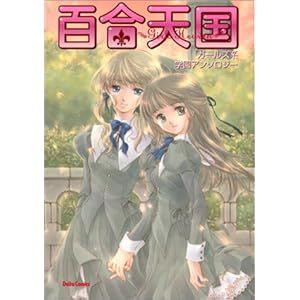
Today, I’ll briefly cover two publications that have been released that are *clearly* something borrowed. This past August, the first yuri manga magazine since Mist* went out of print, was released (not counting lesbian publications, Phryne, Anise and Carmilla, which aren’t specifically manga magazines – they cater(ed) to a more general lesbian population.) I’ll talk about Yuri Shimai later, in more detail. But almost immediately upon Yuri Shimai’s tail feathers came yet *another* Yuri magazine, this one cleverly and subtlely called Yuri Tengoku(Lily Heaven).

This is more of a slick, widely distributed doujinshi than a true magazine. It may be a one-shot, certainly there’s no advertisement inside for a second volume. The cover and the first few pages are nicely done color art of schoolgirl couples, but nothing suggestive in sight. The stories inside range from (IMHO) utterly mediocre fairly decent – but I am very not into moe art, of which there was a preponderance. Of the dozen or so stories, there were only about three or four where the characters actually looked to be the age they were supposed to be, and of those, only one that went beyond a confession followed by nothing much.

Call me unreasonable, but by the end, I *longed* for a story about a bored housewife and lesbian trucker. And I *am* being unreasonable, since Yuri Tengoku says right on the cover that it’s an anthology of stories of love connections between girls. So one shouldn’t expect more than a few kisses here and there. And that’s about what one gets. The stories are very sweet, I can’t fault that – and most of them end with at least the possibility of some further developments between the girls in the future (at least one hopes so!)

I will say this in favor of YT, it did not suffer from an overabundance of fanservice – just erred on the ootsey-cutesy side. Only one story really wandered into that particular field and, as it was played for laughs, it was actually pretty funny.

Interestingly, Yuri Tengoku suffers from a layout issue that plagued ALC Publishing’s first Yuri Monogatari. There’s no spacer art or splash pages between stories, so the transition from one to another is abrupt. Hopefully, if Daito Comics does another issue, they’ll be able to resolve that issue.

Is it Yuri? Indubitably. Is it worth it? That depends on whether you like sweet stories about girls in school uniforms. If that’s your thing, then it’s worth it.

I can’t really rate it, since, as an anthology it has a wide array of art style and story.

***

Another brand new “me-too” entry into the Yuri manga market is another loli-art-style entry,
Strawberry Panic, brought to us by Dengeki Comics, who also brought us the manga for Battle Athletes, Stellvia of the Universe (which I will review later on) and Azumanga Daioh…as you can see, Dengeki is our friend. ^_^

(Please look at the Strawberry Panic category for all my later reviews of the anime, the light novels and manga.)

Strawberry Panic is not only *another* Yuri story, but is strongly “me-too”ing the schoolgirl theme Marimite; i.e., girls’ relationships forming at private schools, only this time with a slightly more sexual twist. From what I can tell, the story revolves around three schools, all of whom draw their “little sisters” from among the younger students (ala the soeur system of Lillian.) When a girl is chosen, she is initiated into her school by an older student who “lilys” her. (I swear they used the word “lily” as a verb.) The relationship is defined in the write-up as being more than friendship and the word lily is sprinkled liberally throughout. As I haven’t seen any more than this website, I can only imagine what it all means. B

*Mist magazine was the coolest Yuri manga magazine ever. It was Yuri from beginning to end; mostly manga, some short stories and usually a “photo” story, which was really silly The stories were for a mature female audience, so they were essentially Yuri porn. I have two copies gifted to me by a friend and they are my prize possessions. If I ever find any more, you can be sure I’ll scoff those babies up!

If you’re looking for good Yuri manga and doujinshi, don’t forget to stop by the English and Japanese-language manga and doujinshi at the Yuricon Shop, where the girl always gets the girl and the Yuri is really decent stuff written by lesbians for a adult audience.


Yuri Manga: Free Soul

January 21st, 2004

Something Old, Something New, Something Borrowed, Something Blue
Part 2

I want to tell you today about something new.Very new. Very, very new. And because it’s a josei manga currently running in josei monthly magazine Feel Young Comics, I have never seen mention of it anywhere – but you *should* know about it.

Free Soul, by out lesbian mangaka Yamaji Ebine is, perhaps, the first mainstream lesbian manga running in a monthly comic magazine, with openly gay characters and fairly explicit lesbian sex. This is as yuri as shoujo yuri gets, by which I mean, its 100% yuri. No punches pulled, no holds barred. No encoding, no symbols, no subtext. This is a story about a lesbian, by a lesbian, with lesbian sex. You see why you need to know about it? :-)

Free Soul is the story of Keito, an  aspiring mangaka. At some point in her life, she met a woman called Angie – an African-American lesbian singer – who radically altered her life. In homage to Angie, Keito has been searching for people who knew her, to learn more about this woman who affected her so strongly. As she meets these people, she relates them and their stories to what she knows of Angie, collecting all these stories into a manga. As the story progresses, so does Keito’s manga.

In a sense, Free Soul is a meta-story, the story about the creation of a story.

As she researches Angie’s life, and interacts with the people who knew her, Keito finds herself attracted to more than a few of the women she meets. But it is Nikki, a mysterious and evasive, but incredibly sensual, woman who captures Keito’s heart. Nikki is the “free soul” of the title. She can’t be pinned down and, for all the time they spend together, Keito knows almost nothing about Nikki’s life or nature. Nikki’s open sexuality and desire for Keito make this one very hot manga series, but Keito’s reactions are very down-to-earth and realistic. I give this the very highest recommendation I can give to yuri fans – you *need* to get this manga. Not only will your purchase make a point (hey, publisher – this rocks!) but you’ll be supporting one of the few out lesbian mangaka in the business.

Yamaji Ebine’s characters are very real, their stories believable, their reactions make sense. Very few conventions of shoujo manga apply here, even her art style is pared-down and minimalist. You’ll never find bubbles in the background, but you will be given a strong background music track – Yamaji-sensei’s writing is bound to western jazz and lesbian/bi singers and artists. Musical artists and their albums appear
over and over in her writing, giving it a smooth, mellow sound (especially if you know the music.)

Free Soul is on-going, but the author favors pleasant – if occasionally ambiguous – endings, so it is unlikely to end tragically, another quality that sets her work apart from earlier yuri entries. Yamaji Ebine is a name you’ll see here quite often, so keep your eyes open for her work!

Ratings:

Art – 9
Story – 8
Characters – 9

Overall – 9 out of 10.


Yuri Manga: The New Hana no Asuka-gumi

January 14th, 2004

Everything old is new again!

Part 2

Here’s another old series that’s been resurrected for a new audience…the original shaped an entire genration of girls in the mid-80’s…hopefully the new iteration willl do the same!

Atarashii Hana no Asuka-gumi (The new Hana no Asuka-gumi) is one of several excellent manga series running currently in
Feel Young Comics monthly magazine. I’ve raved about this series before, and the plotlines and character relationships are very complex, so I’ll attempt to keep this short, but will probably fail. :-)

Kuraku Asuka is an uber-cool 14-year old girl who hangs out on the streets of
Shinjuku in Tokyo. Her best friends are the members of the local gang; the Shinjuku Omoteban or Outside Group, while Asuka herself was once part of the Uraban or Inside Council that runs all the gangs of Tokyo. The leader of the Zenchuu Uraban, or Central Inside Group…i.e., the folks in charge, known as Hibari-sama, once upon a time, had fallen in love with Asuka and named her “Minister of the Left,” an important post in the organization. But Asuka was in love with, and being manipulated by an older girl, Yohko, who was an outsider to the organization and quite sociopathic. Asuka rejected Hibari, Yohko ultimately died and the series ended after 37 volumes of manga (Asuka Comics,) 2 anime OVAs, three-seasons of a TV show, and half a dozen drama CDs. Now, Hana no Asuka-gumi is back and I think it’s worth following. For one thing, there was quite alot of yuri subtext, which became overt text in the original. The fact that it’s running in Feel Young, which is a josei manga magazine (for older female readers) gives me hope that there will be more subtext than ever. Certainly the world of Asuka is primarily a girl’s world – there are a few guys with minor roles, but that’s about it.

In mostly every arc, you can expect:  lots of internecine rivalry between the area gangs and Asuka; Asuka rescuing a damsel in emotional and sometimes physical, distress; lots and lots of fighting; cool conspiracies as Hibari tries to either get Asuka back, or get revenge upon her.

The yuri subtext lies mainly in the two dysfunctional relationships Asuka has with Hibari and Yohko. Hibari (whose face we never see, and who carries a broken doll around) treats Asuka like a toy to be dressed up and, of course, undressed. In the original story, there was NO doubt that Hibari desired Asuka. In the end, it was on Hibari’s bed, as Hibari lay above her, that Asuka rejects Hibari and the Zenchuu Ura for the last time.

Yohko’s relationship with Asuka is a more complex. In some way, she does love Asuka, but her own twisted nature makes her unable to express it in any way, except by emotional manipulation. Yohko is *not* a nice person. Asuka openly tells Yohko twice that she loves her, but it only enrages Yohko. For the most part, the only way they can express their emotion is by fighting physically -at least this way they can touch each other. Yuuki (one of the few boys in the story) comments quite calmly to Yohko that its obvious that Asuka is really in love with her, so its not just me reading into it. :-)
And, for the record, he uses the word ai (love) not suki (like/love.)
Bear in mind that throughout this story. Asuka is 14 years old, with intimacy issues, while Yohko is 18 and a sociopath…there’s no way this relationship could work. :-)

Asuka is way too cool for her age, and her friends in the Omoteban are a blast: Miko (Yohko’s half sister) is whacked and funny;  Hime is composed and beautiful in a way that *no* 13-year old ever is. :-) The New Asuka has brought back all of the old characters, including alot of the smaller roles, the area gang leaders, the women of the Ranjuku Detention Center, and all of the Zenchuu Ura, including the incredibly hunky Kazuga (Hibari’s Aide-de-camp.). So there are plenty of uber-cool women to watch for.

The new series seems to be post-Yohko, but I live in hope that she will appear, if only because every other arc in the entire Asuka universe had Yohko at the center of it.

The author has her own website which has downloads, games and other Asuka-related stuff. You can find that all at
Takaguchi.net, along with info on the author’s other popular series, some of which are yaoi.

Ratings: Art: 8 out of 10, the old series was a little cleaner than the new (but the new characters look more their age). Character: 10 out of 10. You don’t get better than Asuka! Story – 8 out of 10 for now, since the arc is developing slowly…. Yuri: 2 out of 10 so far – no Hibari/Asuka, no Yohko/Asuka…only the hint that Hibari has a new favorite. Overall – 7 out of 10.

And, as always, you’ll always be kept up to date on any new yuri-ness on the Yuricon Mailing List!


Yuri Manga: YajiKita Gakuen Douchuuki

January 13th, 2004

Everything old is new again!
Part 1

Yes, now that all the otaku of my generation have grown into curmudgeonly old farts who now edit the magazines they once read as kids, you’ll be seeing more and more “revivals” of series from the 70’s and 80’s. Face it, when they remade Beverly Hillbillies into a movie, you just *knew* we were doomed, right? Well, in the case of anime and manga, this isn’t such an evil trend. Here’s a title that you should keep on the lookout for, with great characters, Yuri sub- (and sometimes, overt-) text and action-filled plots:

YajiKita Gakuen Dochuuki, (Yaji and Kita’s School Diary) is a manga series from Bonita magazine from the early 80’s. This was one of Bonita Magazine’s most popular series ever, with Kita consistently topping the “most popular character” category in the annual poll.

I can believe it.

Yaji and Kita and their adventures parody two comedic figures from Japanese literature who wandered from town to town, encountering bad guys and generally making fools of themselves. In this iteration, they are two schoolgirls who wander from school to school, fighting the bad guys and generally saving the day. Shinokita Rei (Kita-san) is a butchy, serious blonde girl, with a penchant for rescuing (and becoming the object of affection for) lovely young ladies and Yajima Junko (Yaji-san) is a tall, lovely brunette girl with a impetuous nature and a habit of rescuing (and becoming the object of affection for) beautiful boys.

In practically every arc of YajiKita, you can be sure of a few things –  the Yakuza will be involved, there will be much fighting, Yaji and Kita will be inutterably cool, the girl will fall in love with Kita and the boy with Yaji. The girls are all doll-like and beautiful and the boys are all *so* pretty. And Kita looks incredibly hunky on her motorcycle….sigh. YajiKita is running once again in Mystery Bonita magazine, so keep your eyes peeled for the collected volumes! I promise to report as soon as I’ve managed to take a look.

Ratings:

Art – 8 out of 10. It’s very realistic and clean.
Story – 6 out 0f 10 for realism, but 10 out of 10 for fun.
Character design – 10 out of 10 for Kita alone. ;-)
Yuri – 6 out of 10 – lots of fun service, little substance.

Overall – 8 out of 10