
Archive for the Yuri Manga Category


Monologue Woven For You Volume 3, Guest Review by Matt Marcus

August 16th, 2023

The role of Reviewer will be played tonight by Matt Marcus. He is a cohost of various projects on the Pitch Drop Podcast Network, as well as the author of the blog Oh My God, They Were Bandmates analyzing the manga series How Do We Relationship.

The stage is set: Haruka has resolved to hide her acting past indefinitely while Nao has resolved to break the impasse once she passes her next big audition. Are all the secrets going to spill out? Are we going to finally learn what happened with Haruka in high school? Is Yuki going to ask out her still-in-high-school coworker?

The answers are yes, yes, and thankfully no (for now). Hope you all enjoyed the show! See you next time.

…OK that’s a bit too underwhelming even as a joke, but to be honest the story itself doesn’t fare much better.

Woe be me to think that this story centering around The Theatre wouldn’t be extra dramatic. A Monologue Woven For You, Volume 3 starts out the gate with Haruka having a minor health scare that motivates Nao to rush to her side, even though her audition is the next day. So what’s Haruka’s conclusion? Is it that her lover cares very much for her wellbeing? No, it’s that she is going to drag down Nao, snuffing out her shot at thespian greatness. She wrestles with what to do until she discovers the program for her last performance in Nao’s bag, showing that her past was known the whole time. She decides that after seeing Nao off to her audition she will ghost her. You can’t become a great artist without a little trauma, right?

You can probably figure out the rest from there. Nao is panicked. She tracks down Jun, who isn’t very helpful until she decides to try, at which point she isn’t very effective. Haruka meets Rei, the high school theater geek, who unsuccessfully tries to guilt Haruka into un-quitting acting. Somehow, Nao takes a wild leap in logic to deduce that Haruka is sulking in the auditorium in which she last performed. Nao confronts her, prompting Haruka to finally tell her why she quit.

After beginning acting at a young age, Haruka joined a local theater troupe while she was in high school. There she became close friends with a girl a year older who was an accomplished child actor. Haruka looked up to her as her role model. All of that comes crashing down when Haruka beats her out for a leading role. Her friend has a meltdown, blaming Haruka for stealing her golden opportunity, and quits acting altogether. Haruka comes away from this with a deep sense of guilt for “killing” the acting career of someone she thought was truly talented. And that’s it, that’s the trauma on which this entire plot hinges.

Haruka is still wallowing in this guilt until Nao pushes back, saying that Haruka saved her from quitting acting, and that it is her dream for the two of them to act together on stage. They reconcile, and a year later the two succeed in co-leading a play for their college drama club. Nao goes on to be a professional actor, while Haruka continues to act as a hobby. They move in together, and everyone’s happy. Cue the orchestra.

I will be honest: I thought the melodrama was both over the top and contrived and the payoff a bit rushed. I don’t think after two volumes of teasing that I would ever be satisfied with Haruka’s inciting incident in high school, and what we get is more or less as pedestrian as you could get. I had mentioned in my review of Volume 2 that I wasn’t sure if the story wanted me to trust in Haruka’s decision never to act again. Seems a bit foolish now to think that she could have chosen to stay in the audience, but given the way the story framed her stance I think my confusion was warranted. A slightly less storybook ending could have demonstrated Haruka’s outlook maturing as she looks back on the opportunities she threw away. For most people, there are times in your life where you have to give up on participating in something you love but you discover a new way to appreciate it, like an injured athlete becoming a coach. You can wring a lot of impact from such stories of loss, however it would fall flat here because Haruka’s decision to leave the troupe was not foisted upon her; it was entirely self-inflicted. Seriously, someone should have just told her that the fault lies with the girl who quit over a bruised ego. Like, maybe her parents. Or Jun. Or Nao! (I have the “it’s not your fault” scene from Good Will Hunting running on loop in my head now.) Given where Yasaka-sensei wanted to take the story, it would have been better to seed more hints that Haruka was drawn to act again, but felt ashamed about it.

To pivot away from the story, there is one interesting part of the art that didn’t strike me as obvious until this review, which is the use of blur to show depth of field. There are of course cinematic perspective tricks used in other manga, but the way it is implemented here feels somewhat unique. It had been there the whole time–hell, it’s on the Volume 1 cover with the cherry blossoms–but for whatever reason I only noticed it in this volume. Aside from that, there is only one bit of art that I felt was really well composed and drawn, which is the cover page to chapter 15, with Nao standing under a streetlamp at night.

All in all, this series ended up very “mid” as the kids say. The story could have relied less on contrived and stretched out tension, the art is fine but not amazing, and I don’t think it draws out all of the potential out of the college setting. That said, it’s not a bad time. If you want some fluff with a heaping of melodrama, you could do worse.

Art – 7 The art stayed consistent throughout
Story – 6 The melodrama was overwrought
Characters – 5 They’re acting to the rafters but they can’t elevate the script
Service – 0 Nada
Yuri – 8 / LGBTQ – 1 They teased a second ‘ship but didn’t commit

Overall – 7 Would give it a perfunctory standing ovation
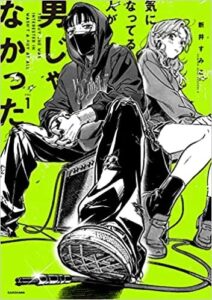


Kininatteru Hito Ga Otoko Janakatta, Volume 1 (気になってる人が男じゃなかった)

August 14th, 2023

Black art and letters on vivid green background, a girl with curly hair sits next to an androgynous, masked, hoodied girl, while sitting on a guitar amp.Aya is a high school student who loves music of the 90s-00s. She’s content to sit and listen to the Foo Fighters in her ear buds, but when she see an old CD shop, she pops in and is awestruck by the cool guy behind the counter. She keeps dropping by to see the cool “onii-san” who share his musical tastes with her, but she’s still pretty tongue-tied when trying to talk about anything with him.

That onii-san has a secret, though. “He” is not an older cool guy, she is the girl who sits next to Aya every day at school, Mitsuki. Mitsuki works at her uncle’s CD shop, and he stresses about her constantly; everything from her loner life to her old guy taste in music.  Mitsuki is not terribly interested in being cool, or being friends with cool girls like Aya, but she is worried that Aya might figure out what is going on.

Aya eventually figures out what is going on.

So does a classmate who is, thankfully, more amused than anything else. He’s kind, sort of trying to get them together.

The thing is, when Mitsuki isn’t thinking about it…she really is pretty cool. ^_^

Kininatteru Hito Ga Otoko Janakatta (気になってる人が男じゃなかった), subtitled in English “The Guy She Was Interested In Wasn’t A Guy At All,”  by Arai Sumiko began life as a comic distributed online to instant approval by an international groups of fans who clamored for more. Luckily we got more and here we are with the first print volume of this manga.

With its uniquely visible color scheme of black, white and a vivid green, new pages of this comic were always super noticeable whenever they came across my feed. The art in this manga reflects the online sensibility too, I think. With unique perspectives on panel structure, body language and expression, this comic feels somehow grounded in street art and manga art at the same time. The change in artistic confidence from beginning of the volume to the end is visible, but the art solid all the way through.

The plot idea isn’t the first of it’s kind, but I am hopeful that it will be better-handled than others, given that we address the assumption here in volume one. Also dealt with is the jealousy of old friends when a new friend/interest appears, a story that will bleed into the next volume. Everything about this book gives me the sense that Arai-sensei has complete control of the narrative. I wasn’t entirely sure how the “he’s a she” was going to be played, but so far, it’s pretty solid, especially for a manga that was online first.

Ratings:

Art – 8
Story – 7
Characters – 8 I think I kind of like the uncle, even if he is a bit extra ^_^
Service – 1 The setups for Mitsuki and Aya are like 5/10ths kabedon
Yuri – 4 Getting there, no question

Both Aya and Mitsuki have recognized attraction for each other, where will it go? How many other 90s bands will be name checked? Tune in to Volume 2!

For free sample chapters in Japanese, you can check this manga out on Comic Walker!


Watashi no Yuri ha Oshigoto Desu!, Volume 12 (私の百合はお仕事です!)

August 8th, 2023

Two girls in green, old-fashioned Japanese school uniforms embrace. A girl with blond hair and glasses tenderly holds a girl with blue hair, who holds on tentatively.Quite recently, we had a wonderful review on Okazu by Christian LeBlanc on Yuri is My Job!, Volume 11. That review motivated me to reach right into the middle of my to-read pile and pull out the Japanese edition of the next volume, Watashi no Yuri ha Oshigoto Desu!, Volume 12 (私の百合はお仕事です!). Volume 11 leaves us in a tense spot, and I knew from reading chapters in Comic Yuri Hime, that Volume 12 was gonna be explosive. Re-reading it all together was…phew. I want to say Content Warning, but explaining why is a spoiler, so please check at the bottom of this post.*

At the end of Volume 11, we are left with Kanoko in a very tight spot – “in a pinch” as they say in the manga/anime world rather more often than we do in English. She has, for better or for worse, been invited to Youko’s hotel room. Of course that leaves us, the readership over 30 or so, screaming our lungs out at the page. \(‘O’)/

What follows is two delusions colliding, like a truck into a overpass pile. Kanoko, obsessed with Hime, unwilling to see past her, is a unmovable object wholly unprepared for Youko’s delusion. Youko, used to using her body and using other women, doesn’t take Kanoko’s personality into account at all…in fact she barely sees her as she slams her use of sex into Kanoko at 100kpm. The whole situation is messy and appalling, and hurtful, even if no one gets hurt. Kanoko takes a couple of emotional hits. That they were deserved does not take away from the fact that it didn’t have to be – should not have been – like this. Youko is wholly loathsome throughout.

So, the finale, when it comes, is a less of a balm to raw emotions (that will come later) than another vehicle slamming into that same accident under the overpass.**

Finally, Sumika and Kanoko actually talk.

And here, at last, is where I disagree with my esteemed colleague Christian. I completely see his interpretation of Miman’s story calling out “S” culture, but I believe that this whole story has been validating it. Yes, what ‘S’ has become – a pastiche, a trope – can be harmful when people who don’t understand their own feelings find solace in a fantasy that has been handed to them that they don’t really understand. (This is exactly what happened to Sumika and Nene.) But at it’s core, being sisters, being bosom friends, having someone to just talk to, is a powerful thing for girls in a world that invalidates and mocks girls’ feelings and interests.

Although I am looking into an uncertain future, it is my belief that Kanoko and Sumika will actually become a very strong Schwester pairing. And in making that prediction, I think I see the end game of this whole series. Hime, Mitsuki, Sumika and Kanoko will have all been thrown into this ridiculous set-up, with personalities that do not mix or match…but out of all of this, they will become fine sisterly pairs that perfectly match the setting and feel of Liebe Academy and confirm the timelessness of the iconic pair of “sisters” in Yuri manga. Where Mayu, Matou‘s message was “We can leave all this behind now,” this manga might well be saying ‘There will always be a place for you in our book.”

Or, I’m wrong and we’ll see what happens! ^_^

Ratings:

Art – 7 As a study in horrified faces, this is a great reference
Story – 9 Explosive and powerful, also horrifying
Characters – 8 Phew
Service – Yes. Youko’s large breasts. Yes
Yuri – 0 Whether there any Yuri in this volume is very much open to debate. I say no.

Overall – 9

* Spoilery Content Warning for sexual assault…although that doesn’t happen, it is very much a thing and must be dealt with by those of us who must deal with it. The story does address it.

** It’s a closed fist.


GunburedXSisters Volume 3 & Volume 4, Guest Review by Eric P

August 2nd, 2023

Two women with Catholic church-themed clothing glare at us, holding weapons.Where last we left off in Volume 2, Shannon had been clued into Maria’s non-human nature, Dorothy came across colder than ever in her intentions with Maria, and the insane Doctor J vowed to take Maria’s power while leaving the latter a clue of her sister’s well-being—then the volume left us with an image foreshadowing that Maria may well not like the official answer.

After the typical monster-of-the-week formula of the first two volumes, things are finally ramping up to something serious—against the church, the town, and even other members of the grotesque. Standing front and center of the building apocalyptic chaos is none other than Noelle, the beloved sister Maria had devoted all her time and being into searching for. All personal relationships are put to the test, for it is no longer a simple battle between good and evil which, in retrospect, it certainly never has been. Shannon’s loyalty to Dorothy—and cartoonishly obsessive infatuation (they made Dorothy dolls as a hobby)— has amounted to no payoff as they recognize the bond between her and Maria, and their desperate resorts afterwards only puts them at odds with Dorothy and make them question whether they can continue as a Holy Knight. And Dorothy, the same deviant nun who we came to know as confident and cleverly manipulative of the people around her, has discovered she herself had been manipulated her whole life. Conspiracy gets unearthed of the Church’s true relationship with the vampires, and their actual objective in maintaining balance/power with the town, shaking her world and putting her at a loss for once in her life. The ultimate question becomes whether our protagonists can pull together, individually as well as a team, in time to fight for what matters most, and especially figure out just what that is.

Reading Mariko S.’s review of the first volume intrigued me enough to check it out, while at the same time remain cautious in whether or not this was the kind of series I would continue reading. I was left curious enough to check out the next volume—before I knew it I consumed all four and found it to be a strangely pleasant surprise. The best way to describe GunburedXSisters to give newbie readers an accurate idea of what they are in for is like a cross between Chrono Crusade and Murcielago. It has the religious-themed fantasy action entertainment of the former, while spiced with the borderline deviant humor/morality of the latter—not to mention the hardcore ugly lesbian sex.

A girl with animal ears, holds a nun in red in her arms.This series had just the right amount of crass humor and profane language that fit the characters as well as the story’s tone, making it feel it could work as hard R-rated entertainment if it were ever adapted. For that much I give kudos to the translator for bringing a natural-sounding art to the voices. Where I would knock one point back in the translation is Shannon’s pronoun reference. Shannon is made out to be non-binary as I came to understand, but especially in Vol. 3 the same characters seem to bounce between referring to Shannon as a “she” and “they” in the same few pages, which at least I found confusing.

If you were starting to think the whole Yuri focus of this series would center on Dorothy and Maria with Shannon on the side, you are in for a treat as the story’s second half broadens its scope to Shannon and a love-at-first-scent werewolf girl named Kiki, who knowingly places herself as Shannon’s rebound girl without shame/apology. And with the escalating crisis, two veteran Crimson Sister nuns named Helen and Miranda are called into action, a duo that the author himself admitted was inspired by a certain Sailor Moon couple. It can be enough to make readers think back on Helen and Miranda and realize, “Ah yes, I see it now.” Even with all the additions it is of course the star couple of this series that shine more than ever. Dorothy, who right out of the gate came across like a sadistic sociopath, we find out that she—still technically is, but does have a heart in her own way regardless. And Dorothy and Maria’s relationship is able to evolve from the slave dynamic to that of true partners on every level, in a way that made sense for both them and their story, while contributing to the evolution of Maria’s powers.

Everything culminates to a fitting climax, if not so much a definitive conclusion. While the story does finish on a closed loop, the open end still leaves room for a continuation if the author ever feels like returning to this title—an idea he entertains in the afterword, and something I certainly wouldn’t mind happening when all is said and done.

Ratings:

Art—10 It’s as good as it should be for a series like this, with facial expressions especially top notch

Story—8½ This was pretty much a story about how only outcasts and people of otherness are able to bring needed change to a set system—a prevalent theme without going deep and deterring from the mindless action/sexual romp that the series was still meant to be

Characters—9 Everyone comes into their own before the end, and all new characters like Kiki were able to easily jump in without throwing anything out of place

Yuri—9 Chloe is the only odd girl out in a series that ended up otherwise packed out in Yuri-friendliness

Service—10 Yep, enough said

Overall—9 For everything it was supposed to be and set out to do, I believe it did it well enough—the only problem being that there could’ve been more to it, which there may or may not be in the future.


Yuri is My Job!, Volume 11, Guest Review by Christian LeBlanc

July 26th, 2023

Two girls in old-fashioned Japanese school uniforms in a shady garden. On a bench sits a blonde wearing glasses, one arm up on the back of the bench, turned to talk to a silver-haired girl standing behind her. They smile at each other in an easy and friendly way.To fully appreciate the wretched hive of scum and villainy Miman puts on display in  Yuri is My Job!, Volume 11, I strongly recommend going back and re-reading volume 9 and volume 10, which begin this arc. If earlier volumes could be said to be a parody of Class S, then these volumes are a scathing attack on the concept.

Miman is putting on a masterclass of layers and blurred lines in this volume, and so, with my literary degree in one hand, a copy of Erica’s By Your Side: The First 100 Years of Yuri Anime and Manga in the other, and a Blu-ray of Maria Watches Over Us playing in the background, I want to go a little bit in depth on what’s going on in these volumes.

This necessitates spoilers, of course, so let me briefly describe what happens in this book: 

Sumika (the gyaru) and Kanoko (the walking anxiety attack) are going out, but Sumika is ok with the two of them taking their time, not wanting to push Kanoko into anything she’s not ready for (I’d say Sumika is good at reading non-verbal communication, but Kanoko’s body language only knows the phrases ‘flinch’ and ‘look like someone just shot her dog’ whenever Sumika gets too close). 

Nene (the cook) and Sumika used to be schwestern at Café Liebe, but grew apart after a falling out which we are shown in full detail, along with the two of them confronting their past in a particularly raw, honest chapter. 

Meanwhile, we see to what extent former employee Yoko (who LARPs Class S outside of café hours playing, as she accurately says in Volume 10, the role of “Instigator”) is involved in all of the above. 

All the while, rehearsals continue for the play that the characters of Liebe will be performing. That’s right: the characters in Yuri is My Job! are playing the roles of Liebe Academy students at the café, and those characters in turn are rehearsing for a play that they’ll perform for café patrons. The play itself is adapted from A Maiden’s Heart, which is what the Liebe Academy characters are based on, so I believe that performing the play will actually summon a giant Yuri ouroboros (Yuriboros for short) that will alchemically transform the world of Yuri is My Job! into our reality.

Actual queerness is touched on, we get to see Sumika’s fluffy and bubbly side as she’s excited to be Kanoko’s girlfriend, we get a lot of drama and even some resolution, and as an added bonus for some of you, Hime is only in this for 16 pages including splash illustrations and Afterwords. There is something extremely not right about Sumika’s and Kanoko’s relationship, however, and I imagine this will come to a head in the next volume. 

Ratings:

Art – 9Story – 9 Diana Taylor (translation) deserves a commendation for handling all the nuances of the multi-layered conversations and exchanges.Characters – 9Service – 4 A tiny bit of nudity with much implied, nothing shownYuri – 10

Overall – 9

Still here? Ok, grab your einnerung nachtisch with buchwelt, dig in, and remember, we’ll be spoiling plot points the way Yoko spoils joy. Let’s dish!


To put it simply, this whole story arc is about the negative repercussions that happen when you apply Class S tropes to real-life relationships. 

We learn in Volume 10 that Yoko was already familiar with A Maiden’s Heart, the in-universe novel series on which Café Liebe is based. “I’ve always wanted to live in those sorts of settings,” she says, even choosing to base her character off of Therese, “who uses her wiles to rile other people up. Should be fun, right?”

True to her word, she soon starts dating Nene, “even if it’s just for fun.” Yoko never takes it very seriously, and in the spirit of Class S, ends things as soon as she ‘graduates’ from the pretend school (ie, quits Liebe after her “main employer found out that she was moonlighting”), leaving Nene feeling betrayed, and Nene’s relationship with Sumika quite damaged. (Yoko suggested going out with Nene in the first place to make Sumika jealous so she would realize her true feelings for Nene, but everything backfired spectacularly because that’s not how any of this works).  

Nene and Sumika do eventually patch things up, but it’s significant that Nene is a cook at this point, no longer playing among the Class S sisterly roles of schwestern. Also significant is how this discussion takes place at the café with no customers or anyone else around; Sumika and Nene are both in plainclothes, not performing, outside of the ‘false’ world of Liebe.

As for the influence of Class S on Sumika and Kanoko’s relationship: 

As Sumika slowly realizes that she’s caught feelings for Kanoko, she remains largely in denial about what her affections mean, telling herself “I do love Kanoko-chan . . . but that’s a sisterly love. I just want to protect my little sister.” She’s partially in denial because she’s always thought of herself as straight, and partially because she’s always viewed any kind of romance as a destructive force: “that stupid thing called romance that’s the real villain.” Sumika even describes the concept of schwestern to new hire Haruko as “if you took the romance out of a romantic relationship.” She’s confusing Class S concepts with real life; fittingly, she’s depicted practicing for the play-within-a-play while alone, taking that Class S lifestyle home with her. (Hime and Yano, for their part, are only ever shown rehearsing in-character and during work hours, suggesting they’ve learned to compartmentalize these concepts).

Sumika also rehearses the play with Kanoko at her place, which again reflects how Class S informs the way each of them views their relationship. Sumika is ok with dating Kanoko even knowing that Hime will always be Kanoko’s number one (which horrifies Nene when she finds out), similar to how Kanoko is ok with always being with Hime, even knowing that Hime will never have romantic feelings for her (which horrifies Sumika in turn). Both of these are ‘false,’ or at least ‘unmutual’ relationships based on the type of unrequited yearning that Class S would glamourize, but are, in reality, quite unhealthy and unfulfilling.

For her part, Kanoko only views her relationship with Sumika as yet another performance, just like her job at Liebe; she only went out with her at the suggestion of Yoko, who practically feeds her a script of what to do: go out with Sumika so she can have someone to talk to about Hime again (Sumika had cut her off at one point, you see). Kanoko even goes so far as to ask Nene how you’re supposed to behave in a relationship, but as Nene says, “no matter how ‘romantic’ an act seems . . . if your intent doesn’t align with theirs, then it’s not ‘romantic.’” Nene’s assurance that everything will work out as long as she and her girlfriend both love each other isn’t what Kanoko wants to hear, since she doesn’t actually love Sumika and is only looking for ways to help sell her performance. 

In summary, the underlying message seems to be that Class S stories are well and good for entertainment, but the “S” may as well stand for “Septic” when applied to real life, especially when someone wants more than a Platonic love. The way this message is conveyed is entertaining, complex, and well thought out – Miman is employing a play-within-a-play-within-a-manga on a metatextual level that would make Hamlet’s head spin! I am very much looking forward to Volume 12 coming out in December to see if any of my theories about what happens next hold any water (including the summoning of the Yuriboros).