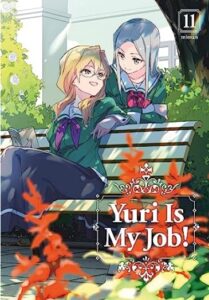
 To fully appreciate the wretched hive of scum and villainy Miman puts on display in Yuri is My Job!, Volume 11, I strongly recommend going back and re-reading volume 9 and volume 10, which begin this arc. If earlier volumes could be said to be a parody of Class S, then these volumes are a scathing attack on the concept.
Miman is putting on a masterclass of layers and blurred lines in this volume, and so, with my literary degree in one hand, a copy of Erica’s By Your Side: The First 100 Years of Yuri Anime and Manga in the other, and a Blu-ray of Maria Watches Over Us playing in the background, I want to go a little bit in depth on what’s going on in these volumes.
This necessitates spoilers, of course, so let me briefly describe what happens in this book:
Sumika (the gyaru) and Kanoko (the walking anxiety attack) are going out, but Sumika is ok with the two of them taking their time, not wanting to push Kanoko into anything she’s not ready for (I’d say Sumika is good at reading non-verbal communication, but Kanoko’s body language only knows the phrases ‘flinch’ and ‘look like someone just shot her dog’ whenever Sumika gets too close).
Nene (the cook) and Sumika used to be schwestern at Café Liebe, but grew apart after a falling out which we are shown in full detail, along with the two of them confronting their past in a particularly raw, honest chapter.
Meanwhile, we see to what extent former employee Yoko (who LARPs Class S outside of café hours playing, as she accurately says in Volume 10, the role of “Instigator”) is involved in all of the above.
All the while, rehearsals continue for the play that the characters of Liebe will be performing. That’s right: the characters in Yuri is My Job! are playing the roles of Liebe Academy students at the café, and those characters in turn are rehearsing for a play that they’ll perform for café patrons. The play itself is adapted from A Maiden’s Heart, which is what the Liebe Academy characters are based on, so I believe that performing the play will actually summon a giant Yuri ouroboros (Yuriboros for short) that will alchemically transform the world of Yuri is My Job! into our reality.
Actual queerness is touched on, we get to see Sumika’s fluffy and bubbly side as she’s excited to be Kanoko’s girlfriend, we get a lot of drama and even some resolution, and as an added bonus for some of you, Hime is only in this for 16 pages including splash illustrations and Afterwords. There is something extremely not right about Sumika’s and Kanoko’s relationship, however, and I imagine this will come to a head in the next volume.
Ratings:
Art – 9
Story – 9 Diana Taylor (translation) deserves a commendation for handling all the nuances of the multi-layered conversations and exchanges.
Characters – 9
Service – 4 A tiny bit of nudity with much implied, nothing shown
Yuri – 10
Overall – 9
Still here? Ok, grab your einnerung nachtisch with buchwelt, dig in, and remember, we’ll be spoiling plot points the way Yoko spoils joy. Let’s dish!
To put it simply, this whole story arc is about the negative repercussions that happen when you apply Class S tropes to real-life relationships.
We learn in Volume 10 that Yoko was already familiar with A Maiden’s Heart, the in-universe novel series on which Café Liebe is based. “I’ve always wanted to live in those sorts of settings,” she says, even choosing to base her character off of Therese, “who uses her wiles to rile other people up. Should be fun, right?”
True to her word, she soon starts dating Nene, “even if it’s just for fun.” Yoko never takes it very seriously, and in the spirit of Class S, ends things as soon as she ‘graduates’ from the pretend school (ie, quits Liebe after her “main employer found out that she was moonlighting”), leaving Nene feeling betrayed, and Nene’s relationship with Sumika quite damaged. (Yoko suggested going out with Nene in the first place to make Sumika jealous so she would realize her true feelings for Nene, but everything backfired spectacularly because that’s not how any of this works).
Nene and Sumika do eventually patch things up, but it’s significant that Nene is a cook at this point, no longer playing among the Class S sisterly roles of schwestern. Also significant is how this discussion takes place at the café with no customers or anyone else around; Sumika and Nene are both in plainclothes, not performing, outside of the ‘false’ world of Liebe.
As for the influence of Class S on Sumika and Kanoko’s relationship:
As Sumika slowly realizes that she’s caught feelings for Kanoko, she remains largely in denial about what her affections mean, telling herself “I do love Kanoko-chan . . . but that’s a sisterly love. I just want to protect my little sister.” She’s partially in denial because she’s always thought of herself as straight, and partially because she’s always viewed any kind of romance as a destructive force: “that stupid thing called romance that’s the real villain.” Sumika even describes the concept of schwestern to new hire Haruko as “if you took the romance out of a romantic relationship.” She’s confusing Class S concepts with real life; fittingly, she’s depicted practicing for the play-within-a-play while alone, taking that Class S lifestyle home with her. (Hime and Yano, for their part, are only ever shown rehearsing in-character and during work hours, suggesting they’ve learned to compartmentalize these concepts).
Sumika also rehearses the play with Kanoko at her place, which again reflects how Class S informs the way each of them views their relationship. Sumika is ok with dating Kanoko even knowing that Hime will always be Kanoko’s number one (which horrifies Nene when she finds out), similar to how Kanoko is ok with always being with Hime, even knowing that Hime will never have romantic feelings for her (which horrifies Sumika in turn). Both of these are ‘false,’ or at least ‘unmutual’ relationships based on the type of unrequited yearning that Class S would glamourize, but are, in reality, quite unhealthy and unfulfilling.
For her part, Kanoko only views her relationship with Sumika as yet another performance, just like her job at Liebe; she only went out with her at the suggestion of Yoko, who practically feeds her a script of what to do: go out with Sumika so she can have someone to talk to about Hime again (Sumika had cut her off at one point, you see). Kanoko even goes so far as to ask Nene how you’re supposed to behave in a relationship, but as Nene says, “no matter how ‘romantic’ an act seems . . . if your intent doesn’t align with theirs, then it’s not ‘romantic.’” Nene’s assurance that everything will work out as long as she and her girlfriend both love each other isn’t what Kanoko wants to hear, since she doesn’t actually love Sumika and is only looking for ways to help sell her performance.
In summary, the underlying message seems to be that Class S stories are well and good for entertainment, but the “S” may as well stand for “Septic” when applied to real life, especially when someone wants more than a Platonic love. The way this message is conveyed is entertaining, complex, and well thought out – Miman is employing a play-within-a-play-within-a-manga on a metatextual level that would make Hamlet’s head spin! I am very much looking forward to Volume 12 coming out in December to see if any of my theories about what happens next hold any water (including the summoning of the Yuriboros).

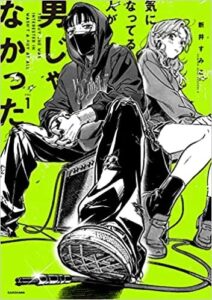 Aya is a high school student who loves music of the 90s-00s. She’s content to sit and listen to the Foo Fighters in her ear buds, but when she see an old CD shop, she pops in and is awestruck by the cool guy behind the counter. She keeps dropping by to see the cool “onii-san” who share his musical tastes with her, but she’s still pretty tongue-tied when trying to talk about anything with him.