Yuri Manga: Yuri Tengoku (and Strawberry Panic)

January 22nd, 2004

Something Old, Something New, Something Borrowed, Something Blue
Part 3

When one person has a good idea, it is inevitable that there will be a rush of copycats, trying to get their two cents in, too. Anime and manga are no different. It appears that the yaoi market has matured, so many manga publishers are rushing to get new yuri products to market as fast as they can. The second half of 2003 gave us more anime and manga with yuri elements than I’d ever seen before at one time, and 2004 is shaping up to be even more chock-full of lilies.
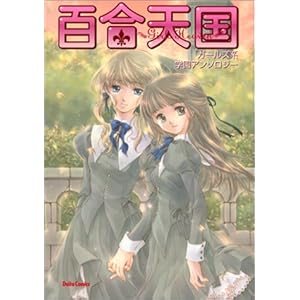
Today, I’ll briefly cover two publications that have been released that are *clearly* something borrowed. This past August, the first yuri manga magazine since Mist* went out of print, was released (not counting lesbian publications, Phryne, Anise and Carmilla, which aren’t specifically manga magazines – they cater(ed) to a more general lesbian population.) I’ll talk about Yuri Shimai later, in more detail. But almost immediately upon Yuri Shimai’s tail feathers came yet *another* Yuri magazine, this one cleverly and subtlely called Yuri Tengoku(Lily Heaven).

This is more of a slick, widely distributed doujinshi than a true magazine. It may be a one-shot, certainly there’s no advertisement inside for a second volume. The cover and the first few pages are nicely done color art of schoolgirl couples, but nothing suggestive in sight. The stories inside range from (IMHO) utterly mediocre fairly decent – but I am very not into moe art, of which there was a preponderance. Of the dozen or so stories, there were only about three or four where the characters actually looked to be the age they were supposed to be, and of those, only one that went beyond a confession followed by nothing much.

Call me unreasonable, but by the end, I *longed* for a story about a bored housewife and lesbian trucker. And I *am* being unreasonable, since Yuri Tengoku says right on the cover that it’s an anthology of stories of love connections between girls. So one shouldn’t expect more than a few kisses here and there. And that’s about what one gets. The stories are very sweet, I can’t fault that – and most of them end with at least the possibility of some further developments between the girls in the future (at least one hopes so!)

I will say this in favor of YT, it did not suffer from an overabundance of fanservice – just erred on the ootsey-cutesy side. Only one story really wandered into that particular field and, as it was played for laughs, it was actually pretty funny.

Interestingly, Yuri Tengoku suffers from a layout issue that plagued ALC Publishing’s first Yuri Monogatari. There’s no spacer art or splash pages between stories, so the transition from one to another is abrupt. Hopefully, if Daito Comics does another issue, they’ll be able to resolve that issue.

Is it Yuri? Indubitably. Is it worth it? That depends on whether you like sweet stories about girls in school uniforms. If that’s your thing, then it’s worth it.

I can’t really rate it, since, as an anthology it has a wide array of art style and story.

***

Another brand new “me-too” entry into the Yuri manga market is another loli-art-style entry,
Strawberry Panic, brought to us by Dengeki Comics, who also brought us the manga for Battle Athletes, Stellvia of the Universe (which I will review later on) and Azumanga Daioh…as you can see, Dengeki is our friend. ^_^

(Please look at the Strawberry Panic category for all my later reviews of the anime, the light novels and manga.)

Strawberry Panic is not only *another* Yuri story, but is strongly “me-too”ing the schoolgirl theme Marimite; i.e., girls’ relationships forming at private schools, only this time with a slightly more sexual twist. From what I can tell, the story revolves around three schools, all of whom draw their “little sisters” from among the younger students (ala the soeur system of Lillian.) When a girl is chosen, she is initiated into her school by an older student who “lilys” her. (I swear they used the word “lily” as a verb.) The relationship is defined in the write-up as being more than friendship and the word lily is sprinkled liberally throughout. As I haven’t seen any more than this website, I can only imagine what it all means. B

*Mist magazine was the coolest Yuri manga magazine ever. It was Yuri from beginning to end; mostly manga, some short stories and usually a “photo” story, which was really silly The stories were for a mature female audience, so they were essentially Yuri porn. I have two copies gifted to me by a friend and they are my prize possessions. If I ever find any more, you can be sure I’ll scoff those babies up!

If you’re looking for good Yuri manga and doujinshi, don’t forget to stop by the English and Japanese-language manga and doujinshi at the Yuricon Shop, where the girl always gets the girl and the Yuri is really decent stuff written by lesbians for a adult audience.


Yuri Manga: Free Soul

January 21st, 2004

Something Old, Something New, Something Borrowed, Something Blue

Part 2

I want to tell you today about something new.Very new. Very, very new. And because it’s a josei manga currently running in josei monthly magazine Feel Young Comics, I have never seen mention of it anywhere – but you *should* know about it.

Free Soul, by out lesbian mangaka Yamaji Ebine is, perhaps, the first mainstream lesbian manga running in a monthly comic magazine, with openly gay characters and fairly explicit lesbian sex. This is as yuri as shoujo yuri gets, by which I mean, its 100% yuri. No punches pulled, no holds barred. No encoding, no symbols, no subtext. This is a story about a lesbian, by a lesbian, with lesbian sex. You see why you need to know about it? :-)

Free Soul is the story of Keito, an  aspiring mangaka. At some point in her life, she met a woman called Angie – an African-American lesbian singer – who radically altered her life. In homage to Angie, Keito has been searching for people who knew her, to learn more about this woman who affected her so strongly. As she meets these people, she relates them and their stories to what she knows of Angie, collecting all these stories into a manga. As the story progresses, so does Keito’s manga.

In a sense, Free Soul is a meta-story, the story about the creation of a story.

As she researches Angie’s life, and interacts with the people who knew her, Keito finds herself attracted to more than a few of the women she meets. But it is Nikki, a mysterious and evasive, but incredibly sensual, woman who captures Keito’s heart. Nikki is the “free soul” of the title. She can’t be pinned down and, for all the time they spend together, Keito knows almost nothing about Nikki’s life or nature. Nikki’s open sexuality and desire for Keito make this one very hot manga series, but Keito’s reactions are very down-to-earth and realistic. I give this the very highest recommendation I can give to yuri fans – you *need* to get this manga. Not only will your purchase make a point (hey, publisher – this rocks!) but you’ll be supporting one of the few out lesbian mangaka in the business.

Yamaji Ebine’s characters are very real, their stories believable, their reactions make sense. Very few conventions of shoujo manga apply here, even her art style is pared-down and minimalist. You’ll never find bubbles in the background, but you will be given a strong background music track – Yamaji-sensei’s writing is bound to western jazz and lesbian/bi singers and artists. Musical artists and their albums appear
over and over in her writing, giving it a smooth, mellow sound (especially if you know the music.)

Free Soul is on-going, but the author favors pleasant – if occasionally ambiguous – endings, so it is unlikely to end tragically, another quality that sets her work apart from earlier yuri entries. Yamaji Ebine is a name you’ll see here quite often, so keep your eyes open for her work!

Ratings:

Art – 9
Story – 8
Characters – 9

Overall – 9 out of 10.


Yuri Anime: Aim for the Ace! / Ace wo Nerae!

January 20th, 2004

Something Old, Something New, Something Borrowed, Something Blue

Part 1

This week, I’ll be running over a few Yuri titles which are, as I say above, old, new, borrowed and blue. Call it a “theme week.”

First up, today, something old. And now I’m torn, which of the many, many old series that I’ve grown to love, do I review?

Let’s start with this one:
Ace wo Nerae!, (Aim for the Ace!), from 1973. This is probably one of the oldest truly *shoujo* anime out there.

Ace wo Nerae, adapted from the popular manga of the same name (another Margaret magazine Yuri classic!) is the story of Oka Hiromi, a first year student at Nishi High School. Hiromi, like many other girls in the school, deeply admires Ryuzaki Reika, known as “Ochoufujin,” the shining star of the girl’s tennis team. Ochoufujin, along wth the other upperclassmen, make up an unbeatable women’s tennis team which has attracted over 100 first-year newbies – including Hiromi and her friend Maki. Hiromi is happy as a clam to be near to her idol, Ochoufujin, and even get the occasional kind word from her, but everything changes the day the new coach shows up.

For some reason the new coach sees potential in Hiromi that no one, not even Hiromi herself, can fathom. He singles Hiromi out and begins working her mercilessly, even replacing one of the ace upperclassmen with a terrified and, subsequently, harrassed, Hiromi.

Ace wo Nerae will immediately remind viewers of another Margaret manga classic Oniisama E (Brother, Dear Brother) since the character designs and direction for the anime were done by the same people; and the plot is the usual shoujo fare of the seemingly average girl being catapulted into the rarified world of the great ones in her school. The biggest difference is that in Ace, Hiromi finds herself not only capable of handling the stress, but grows to be a very strong person and a very strong tennis player, as opposed to just growing up a little as a result of her experiences. We actually get to see her game improve over time and, as she matures and becomes the player the coach knew she could be, she steps into a position as one of the team aces.

In terms of Yuri, Ace definitely straddles the line between adoration and romance Because this manga and anime are from 1973, the Yuri is encoded in small, subtle things. You won’t see tearful confessions of love, much less a kiss or anything, but watch Hiromi carefully, as she dresses to bring flowers to Ochoufujin…or if you can find it, there’s a wonderful screencap from the Ace wo Nerae movie, as Hiromi and Ochoufujin head off to America together (a code in itself, really, as America is always seen in lesbian fiction as the place to escape to to be together.) Hiromi is wearing a three-piece white suit and tie, her hair has gone completely masculine. She looks about as butchy as someone could possibly have drawn a girl in the early 70’s.

As a representative of early Yuri, Ace wo Nerae is a spectacular example, but expect a fair dollop of cheesy-ness, as the character designs, music, art, etc are all over 30 years old. The op art graphics and laughable opening theme are delightfully retro now.The most important thing is that the characters are genuinely likeable and their motivations fathomable. I give this one a strong recommendation, if you want to see where many of the conventions of Yuri come from.

Ratings:

Art – tough to call, because it’s so dated. For its time, 7
Story – 9
Characters – 9
Character Design – 8
Music – Makes me giggle every time I hear it, 6
Yuri – 2 Negligible, but not not there.

Overall – 8

As always, for updates on Ace wo Nerae and other classic anime and manga, join us at the Yuricon Mailing List.


Yuri Anime: Things to Watch Out For

January 19th, 2004

From the “Vox Populi” in the second volume of Yuri Shimai, and the Yuri Kokoro blog, a Japanese language blog about yuri anime and manga, here are two new series with “yuri.” How much, I don’t know, but I’ll keep my eyes open for you, promise. :-)

Tokyo Underground Yuri Shimai says that Chelsea Rorec is gay, I can see that she’s at least protective of Ruri-sama. Only time will tell whether this series indeed has yuri.

Mezzo – The OVA for this series, Mezzo Forte was violent and full of fanservice, but still managed to be goofy and a little dumb. Yuri Kokoro tells us that the anime has yuri. It certainly has two girls. We’ll see whether that translates to anything other than akogare and fanservice.

Speaking of time will tell, the second episode of Maria-sama ga Miteru has been released and the verdict is in – the anime is not quite as satisfying to me as the manga (which, in turn, I’ve read on several Japanese sites, isn;t as good as the original novels.) Sachiko seems more self-absorbed and selfish in the anime. Nonetheless, if it travels along similar lines to the manga, it’ll still be good shoujoai. :-)


Yuri Anime? Kaleido Star

January 18th, 2004

Okay, okay, I take it back

I take it all back! Kaleido Star is definitely a yuri anime. Not only are Anna and Mia still sharing a bed (in an apartment that has plenty of room for them to sleep apart if they really wanted) but there’s this *thing* happening between Leila and Sora, which, while it isn’t love or physical attraction, is definitely an intimate connection. Watching them perform together is not all that different from watching a love scene.

The funny thing is, I read a review of Kaleido Star recently on a Japanese website, and was like, “Leila and Sora? Are they nuts?” Yeah, well – I was wrong, they were right. ^_^

Don’t get me wrong – this is still a superficial, silly, fluff-filled anime. There is no big story here…it’s just about people who have a vision and want to make that vision come true. The vision just happened to be about doing acrobatics. The first dozen or so episodes weren’t riveting, but the characters have a more realistic passion now and I actually care whether Sora and Leila develop the Maboroshi Oowaza, the Ultimate Trick. Don’t ask me why…I don’t know. ^_^

I’m upping the Yuri rating on Kaleido Star to about a 7 out of 10.