Archive for the Yuri Manga Category


Yuri Manga: First Love Sisters, Volume 1 (English)

January 30th, 2008

Thanks and gratitude go out to Eric P. who sponsored today’s review!

My first encounter with the character and story that would eventually become First Love Sisters, was about 4 years ago, when Yuri Shimai magazine put out the first Koi Shimai Drama CD. At the time, a “Yuri Drama CD” was a pretty rare get and for that alone, I was happy to have it. The story of that first Drama CD – which predates the manga – was, as I put it, “melodramatic and predictable.” But don’t get me wrong – it’s not at all bad. As I mentioned in my review (and history of the series, which had a slightly cubist origin) of the Japanese edition, Hatsukoi Shimai Volume 1, the story is a tad tame, but was still better than a lot of junk out there. :-)

First Love Sisters Volume 1 is pretty much Marimite with the romance made slightly more explicit and characters who are not nearly as 3-dimensional. But you know – it’s still a sweet enough story for what it is. The winner of the series in every version is Chika, for coming right out and saying that she loves Haruna, forcing Haruna’s whole worldview to change. As Yumi clones go, Chika’s a pretty good one. ^_^

Which brings us to the Seven Seas edition of First Love Sisters. As always, they do a fabulous job on translation and adaptation. Little things please me, like Akiko’s usage of “onee-sama” at school and “onee-chan” at home, and the fact that the school’s nickname, Tsunojyo, isn’t lost. (Because, let’s face it, Tsunokamizaka Jyoshikou is a mouthful. ^_^)

Color pages are reproduced in color – always a nice touch. The color is a little anemic and there’s some moire patterns in the background, but it still looks nice. Comparatively to the original Japanese edition, the background tones reproduce a little roughly – in particular, Akiho’s hair looks a little weird. But if you aren’t comparing with Hatsukoi Shimai, then you won’t have to worry. It looks plenty good.

The story is still another “schoolgirls in love” story, but there’s no doubt about the intensity or sincerity of the emotion. And going forward into the next volume, we’ll see that chaste embraces are not the end-all-be-all of this relationship, which is a tremendous relief. (The future volumes of this manga make my fanfic for the series obsolete, but I don’t care at all. ^_^)

The final pages of the book include some 4-panel comics, that were originally under the dustcover, a preview of volume 2 (Touko-sensei!) and a nice little preview of the English-language edition of Voiceful, another Yuri Hime collection.

Ratings:

Art – 7
Story – 7
Characters – 7
Yuri – 8
Series – 0

Overall – 7

As the first of Seven Seas’ adaptations of a Yuri Hime collection for their Strawberry imprint, and with their continued quality in translation and reproduction, I definitely recommend First Love Sisters for folks looking for decent Yuri.


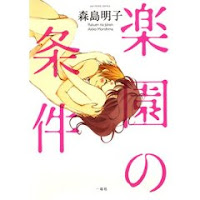
Yuri Manga: Rakuen no Jouken

January 29th, 2008

What happens when an lesbian mangaka draws Yuri manga for a female audience? Why, we have a winner, that’s what!

Morishima Akiko draws whimsically realistic, slightly angsty and decidedly delightful stories of love between women. Rakuen no Jouken is a collection of her stories from Yuri Hime magazine. This collection does not include her Yuri life illustrated column, just her manga.

Rakuen begins with the mini series about OL Sarina and her “friend with benefits,” freelance writer Sumika, as Sumi drops by unexpectedly. They immediately pick up where they left off, but Sarina realizes that she kind of likes having Sumi around. She asks Sumi to live with her, but you can’t cage a free bird, so Sumi returns the favor by asking Sarina to come with her on her next assignment to Malta.

This is followed by a story in which Sumi is unhappy because she has always loved Sarina, but knows that Sarina is more interested in getting a boyfriend. When Sarina breaks up with her current beau, she’s there to comfort her, but the relationship turns much more serious.

The next story picks up with them in Malta, enjoying living together, house and cat-sitting. Sarina angsts slightly over their relationship, because it seems like she’s getting more serious about Sumi than she expected. Since she forgets to use her inside voice, Sumi is able to hear it all and it’s too late to put the cat back in the bag so to speak. Sarina’s fallen in love with Sumi, too. Surrounded by light, love and cats, they look forward to a very happy future together.

The next two stories deal with a really cute couple, Keiko, a 30-year old art teacher and Emi, her 20-year old student. Emi asks Keiko out, and since she doesn’t have a boyfriend and Emi’s kinda cute, Keiko says yes. But Emi isn’t just cute – she’s young, perky, sparkly, bright-eyed, luminescent with life and youth and immediately, Keiko finds herself suffering a crisis. How could this prime example of youth and energy want her old, flabby aged body? (30 is old…. Yes, in 10000 BCE, 30 was old. Welcome to the 21st century, Japanese women! If you’re old at 30 – what do you do for the next 50 years? Sit around and moulder? Crichey.) Anyway, Keiko’s crisis is resolved when she realizes that her real problem is that she’s been in love with this girl since day one. This is followed by a night-over date, which is sadly on a very bad day for Emi. You know – *that* kind of bad day. Emi is full of wide-eyeness, so Keiko can barely take no for an answer. ^_^ I hope we get more of them – the age joke is exhausting, but I like them anyway.

Lalaa is a cosplay-wearing 29-year old loli and her 25-year old lover Shinobu is a editor and flute player. They’ve known each other – and pretty much been together – for 12 years, since they were young. The story revolves around Shinobu’s emotional breakdown in the rain, and Lalaa-sempai’s deep understanding and caring for Shinobu.

“Momo no aji” is a short story about a girl’s confession to an upperclassman and a response that involves a peach-flavored lolipop.

And the final story is a that of Sakura-hime and her guardian tree spirit Fubuki. The story is no less bittersweet than the original that ran in the magazine. A sort of classic melancholy, fitting for the historical setting.

Morishima is not afraid of service – she gleefully has her characters in various states of undress, costumes, and partial nudity for your viewing pleasure. But her art is so sweet and round and soft, and her characters so feminine, that it never feels like “service.” The sex tends to be on the snuggly side, with a blessed lack of gouting bodily fluids. Her humor tends to make me snort, rather than laugh, if you take my meaning. And her work is cute, cute, cute, all the way down.

If you’re looking for non-schoolgirl Yuri stories, especially ones that reflect actual women’s daily experiences, Rakuen no Jouken is just about perfect. (Even if there aren’t any lesbians in it.  ^_^)

Ratings:

Art – 9
Story – variable, averaging out at about 8
Characters – an almost universally likeable 9
Yuri – 9
Service – 4

Overall – 9

Of all the Yuri Hime collections, this is one of the very best so far. I look forward to seeing it in English one day. ^_^


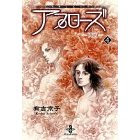
Yuri Manga: Applause, Volume 4

January 27th, 2008

Applause is, you may remember, an old-school Yuri manga from the 90s. I have reviewed volumes 1, 2 and 3 previously, so to catch up the story, go back and scan those.

As Applause Volume 4 opens, “Modern Dancer,” the hit Broadway show starring Shelle and Shara, is a mega-hit. With every performance, they pour their heart and emotions out onto the stage, captivating audiences. But afterwards, their relationship is building to a crisis. Shara cannot stand the double life that Shelle wants. Isn’t enough, Shelle asks, to have our life together in our house on the beach, and be the professionals everyone expects on stage? NO, Shara emphatically says.

Georges appears to “congratulate” Shara with a kiss, but is slapped and sent packing.

At the shore house, Shara asks a question of her own of Shelle – why can’t you just be the Junaque I fell in love with? But Shelle yells at her to shut up – she hates “that woman” and in her mind, the person who was Junaque is dead.

And every night, Shara and Shelle work out their emotions through their dance.

While Shelle’s mother shows up, invited by Georges, to pressure her to marry him, Shara talks to John about his lover Chris’s illness, which is clearly AIDS. Georges tries to force Shelle to sleep with him. She goes completely passive and refuses to look at him. He stops himself before it becomes rape and leaves Shelle, telling her that any next move has to come from her.

Shelle and her mother have a knockdown, dragout fight about her future. As Shelle wrestles with a complete breakdown, Shara appears. They embrace each other desperately in front of Shelle’s mother, who is not pleased at all when she realizes the truth. Shara tells everyone to get out of her way, then leads Shelle out of the house. Their performance that night is spectacular.

Alfie tries to reach Shara, but she and Shelle are spending the night in the shore house. They wake to find the sun rising, and they express their love for one another as the sun greets them. Later that day, Georges goes looking for them – they can’t be found anywhere. Terrified, he heads out to the marina where he takes a speedboat out to look for them. Sure enough, he finds his sailboat adrift on the water and neither Shara nor Shelle to be found anywhere.

Georges accepts the Tony Award on behalf of Shelle, and (though obviously in pain) tells the audience that the show will go on. He flies back to Belgium immediately.

Alfie and Fred attend Chris’s funeral and wonder what happened to Shara.

Our last image is that of a rowboat, with unattributed conversation around it. Shelle says that she has been waiting for Shara since graduation. Shara says that it would be nice to buy a little house, wouldn’t it? And Shelle says that would be lovely.

The volume is completed with two stories of Junaque and Shara as students. The first is a fascinating little ghost story about a dead student who is haunting a teacher. The teacher, when she was a student was in love with the girl who them subsequently died. As background to that story, we see Junaque’s tempestuous family relationships. The second story is a very shoujo and fluffy piece about Shara’s early days with Junaque.

So…the main story ends in the most ambiguous possible way. If you prefer it to be a tragic love, then drowning seems the most likely option. However, nothing in Shara’s personality has ever lead me to believe that she would accept death as a viable alternative to life. While Junaque/Shelle’s life has been one of avoidance and denial, Shara’s has been of acceptance and striving. Also, several times she has suggested that they simply leave Manhattan – run away and start a new life together. It seems obvious to me that the sailboat was a red herring and the two escaped what had become an intolerable situation.

And I can’t help but wonder if the ending would have been different at all, should the story have been written ten years later. Personally, I think not.

Was this a *good* series – yes, it definitely was.

It was certainly melodramatic, and soapy, full of tears and angst and beat-you-over-the-head intensity, but that was the story. I did think Shelle’s hatred of her younger self was much of a muchness, but she was pretty far gone into nervous breakdown-land then, and probably hardly knew what she was saying. In any case it was not inconsistent with her self-absorbed personality.

Would I suggest it? If you like romance, melodrama, stories about performers, josei or shoujo work that steps above and beyond the crowd, yes. If you are a moe fan, prefer your heroines to look six rather than twenty, really prefer action to drama, or can’t stand endings that are not overtly happy (which leaves you with darn little anime or manga that will satisfy you, really,) then no.

But as an example of an excellently drawn, well-written and captivating old-school Yuri, then I do definitely recommend Applause.

Ratings:

Art – 8
Story – 7
Characters – 7
Yuri – 8
Service – 3

Overall – 8

The art, especially, just got better and better as the volumes went on. Both Shelle and Shara come from a world of art that has just about completely disappeared these days, where characters looked their age and more ethereally beautiful than possible. It’s obvious that the current trend of youthifying and simplifying anime and manga art makes it easier to draw and easier to crank out, but I so much prefer this.


Yuri Manga: Strawberry Panic, Volume 1 (English)

January 21st, 2008

Strawberry Panic, Volume 1 was a fascinating example of translation and adaptation of a Japanese manga into English. Before I get into the details of why I say that, I’ll give you (and the folks at Seven Seas, for whom I have to thank for the review copy,) the sound bite – this was a very entertaining book. :-)

For an overview of the plot, please see my review of the Japanese edition of Volume 1 from June, 2006. This review will cover the adaptation and translation only.

There are a very few small differences in the Japanese and English versions physically – the English cover lacks the tagline “Girls School in Full Bloom” nor does it list the names of the main characters. And the art, both on the cover and the inside appears to have been scanned in from the original. (You would *think* that, when a company licenses a series the Japanese company would send original digital files to works from, but in my experience they don’t. That’s partially why the borders on English translations are often cut off, or have white space when the original pages don’t.) In this case, they opted for small additional white space edges across the whole book. It really doesn’t change anything – I just happened to notice it. And even though the English edition does not have a dust jacket, the original Japanese edition has the world’s most boring under-jacket cover ever, so we lose absolutely nothing by it.

The Seven Seas edition includes the color page, something I think really sets their volumes a step above Tokyopop’s. It’s not like this color page is especially *exciting* or anything, lol, it just looks nice.

Here’s the interesting bit, though. :-) The original Strawberry Panic manga was run in Dengeki’s G’s Magazine, a bishoujo gaming magazine. This is a pretty hardcore “otaku” audience. These are not people with social lives, or indeed skills. As a result, they tend to have little to no sense of humor about their passions. They take anime/manga/games and their obsessions with them *very* seriously. This latter quality is reflected in western fandom as well. And, as I’ve pointed out several times here, *no one* likes to think that the story they love is worthless trash or obviously a joke, when they themselves take it so seriously. (This applies to everyone about *something*. Whether it be sports maniacs, car crazies, people who obsess about the lives of celebrities or royals, whatever.)

So, when Strawberry Panic was first released, despite the obvious parody elements, people took the story at face value. That it involved sexual harrassment, evil psycho lesbians, total memory loss amnesia, former lover dying from an unnamed disease, openly stolen scenes, characters and symbols from more than a dozen other series, etc, etc, was irrelevant. This, I have been repeatedly told, is an awesome story.

*I* can see that it’s a parody. Many *other* people can see that it is a parody. Some people don’t care because they are not familiar with the series being parodied or, they just don’t care. But the majority of SP fans, both here and in Japan, take it quite seriously. They do not see that it is a parody and don’t like it when people, especially me, point out that it is.

Bear with me here – I do have a point. The point is this – Seven Seas knows SP was a parody and they *adapted* it like it was one. Sorry it took me so long to get there, but you have to appreciate the underlying issue. By adapting it the way they did, Seven Seas runs the risk of alienating the majority of their readership. HOWEVER, thanks to cognitive dissonance and the human ability to ignore all facts that don’t fit in with our preconceived notions, most of the people who might possibly be alienated will simply ignore the clues in the text and continue to take the story at face value. So phew for them.

Here’s what Seven Seas did. The first few chapters of Strawberry Panic utilize both italics and bold letters to subtly offer a few “wink, wink, nudge, nudge” moments in the text. It’s only in the first few chapters, then they back off. If it had continued it would have become annoying, but by laying the foundation in the beginning, anyone who *can* see it, is let in on the joke. It’s true that some of the worlds they emphasize are also emphasized in the Japanese text – but not all of them. I’m not sure why they did it, but I think it worked. ^_^

I have only two complaints about the translation itself – can someone explain to me why Hikari says “golly” instead of something more like “oh, no”? It does give her a bit of a provincial aspect, but I never really got that from the original. Maybe I just missed her accent?

Also, I am deeply disappointed in Yaya’s criminally smart “Amane wannbees” (with “wannabees” being the actual word she chose) changed to “Amane nuts.” This is small, but they missed two things by changing it. One, in the context of the story, they’ve missed that Yaya’s understanding of human nature is pretty sharp. But more importantly, they’re missing that it was meant to parody Tsutako’s equally sharp understanding of her fellow students by labeling them “Yoshino wannabees” in Maria-sama ga Miteru: Kibara Kakumei. Seven Seas gets one point off for that and another because the word “wannabees” is so fun, why would anyone ever chose a different one? lol

With those two teeny exceptions, Strawberry Panic is otherwise a very decent translation and adaptation.

Seven Seas regains one of the lost points above for doing something which was technically incorrect, but for which I thank them with all my might. In the original Japanese Nagisa, our preposterous heroine, refers to herself in third person. It was meant to accentuate her childlike naiveté and girlishness. It also made it nigh on impossible to like her. For whatever reason it was decided that she *not* do that in the English edition. And while it changes her personality, it does so for the better. Yes, it’s “wrong.” Thank the gods (woops, I mean Maria-sama,) it was done. Amen.

Ratings:

Art – 7 (too moe for my taste, but not *bad*)
Story – 7
Characters – 7 (Chikaru is rapidly becoming my hero. She really doesn’t care what happens, as long as it’s a good show with lots of fireworks.)
Yuri – 9
FanBoy – 7 FanGirl – a completely different 7

Overall – 8 (7, plus one point for the amusing adaption)

Regardless if you admit to (or even notice) the satirical emphases, Strawberry Panic is an amusing, brainless read full of groping and service among privileged female students. Clearly, something to be taken *very* seriously. ^_^


Yuri Manga: Yuri Hime S, Volume 3

January 13th, 2008

I was happy to pick up Yuri Hime S, Vol. 3 while I was in Tokyo and scan through it one evening at my hotel. Now, after a more thorough re-read, I have to say that it was a slightly mediocre issue. One of those issues between this one and that one, when plots are still developing and some of the stories are shortchanged as others get more page count – you know how it goes.

Iwami Shouko’s “Flower Flower” starts off the magazine with color pages and more of Princess Nina’s tsundere ways. Shuu continues to be sincere and lovable, and for a moment we think Nina’s thawing, but no, she’s just drunk. Hopefully this story will do something soon, because “I like you, no I don’t” doesn’t really count as a plot to me.

And *speaking* of twincest, “Himawari Saita,” by Kuromasa Shisei is a story drawn in that drippy-wet style, about twins. One twin, Himawari, is desired by an obnoxiously persistent sempai who will not take no for an answer. But Himawari does not want to be severed in any way from her beloved sister, Nasuna. Nasuna has a brain cell, however, and explains patiently to her older twin that its a good thing that she find someone else who loves her, differently than she can. Nasuna gives her blessing to Himawari to find love, and walks off thinking that she also ought to find a nice person for herself. This was quite possibly the first twincest story I’ve ever actually enjoyed, mostly because of Nasuna’s emotional maturity. The art all made them look wet, though.

Kurogane Kenn hit his stride with the completely characteristic “Konohana Link” which appears to be the first chapter of a series. Two stories parallel each other. In one, a student confesses to her sempai, in the other, new student Suzuki Chieri comes to the school. The two girls are kissing when Chieri sees them, as she walks around the school. But, as she watches them making out, she can’t help but notice that one of them is looking back at her! Kurogane does slick PWP work, but the salaciousness factor on his stuff is high. I wonder if he can manage to make his characters 3-D enough to satisfy a female audience….

“Cassiopeia Dolce” continues to be a typical Takagi Noboyuki story with lots of underwear, maid outfits, bathing, Yuri and doll-faced characters. His art has always left me cold and this chapter doesn’t move the story forward at all. In it, newbie Anna stresses about the many girl-girl kisses that are going on here at the store. Olga seems to be okay with all the kissing, but Elza seems to have selective memory – worse, Anna’s starting to fantasize a bit about Elza. And she does a day’s work, too.

Finally! A Hakamada Mera story I *liked*. It had to happen one day. “Kaichou and Fukukaichou” was cute. The Student Council President is gaga over her Vice President, but the feelings may or may not be returned. In the meantime, it’s up to the Fukukaichou to keep the flaky Kaichou on track. The characters almost looked their ages and for some reason, I just liked this story. ^_^

Koumei Keito’s “Hana no Yurina-gumi,” which is probably meant to spoof “Asuka no Hana-gumi,” I pretty much skipped. It’s one of those stories with a shrieking hysterical “cute” munchkin of a creature that dogs the steps of normal looking characters. I just couldn’t do it. I’ll never be able to.

“Tainai Kaiki” by Yoshitomi Akihito managed to be fetishy and still not suck. Two girls are in the school pool when it begins to rain. They end up in the curtains in the multipurpose room. Mayu had previously confessed to Akami, but had been rejected as a lover, although not as a friend. But for some reason, Akami is moved to kiss Mayu today as she sleeps. Mayu wakes up, asks if she was kissed and when she is told yes, takes control of the situation. They kiss until the heat inside the curtains is intolerable and when they go outside, the walk on the water in the schoolyard together.

“Nanami to Misuzu.” Another skip. Something about sleeping arrangements.

Kaori has fond memories of a girl she knew when she was younger – and she remembers the day she gave that girl a pair of earrings. Imagine her surprise when Ayabuki shows up at her school in Kurata Uso’s “Pierce.” On the night of the school festival, Ayabuki arrives at Kaori’s fortunetelling booth with a guy she likes and Kaori falls apart. But Ayabuki pursues her and at least they can be friends…and maybe more?

“Girls Love” by Morishima Akiko is a series of 4-panel comics about Hana-chan’s not at all secret crush on Kaori-chan. Every single person in her art class knows – including the very enabling teacher. Everyone except for the seemingly clueless Kaori. And of course Hana doesn’t have the guts to tell her.

There is nothing wrong with “Minus Literacy” per se. I just can’t figure out what the hell it’s about. But hey, I’m not alone, because Iinchou is still figuring it all out. If Matsudaira is the head of the household, why does it seem that her maid, Miharu runs the place? And what on earth is going on with the girl with mad miko skills? I’m kind of on Iinchou’s side on all of the madness.

“Gretel” by Sudou Kaoru opens with Yuu waking up to find herself sharing a bed with a provocatively clad Nagi and Mari and her brain full of memories of kissing them both deeply and fighting off monsters. Mari wakes to find Yuu in the middle of a puddle of nose blood, in front of Nagi’s prominent breasts. Then we shift scene to get some exposition about the Formika and magic use at the school. At which point our resident Goth-Loli girl shows up in cat paws and ears so thems as who likes that can squeal or whatever.

And finally, Tsubaki Asu’s “Honey Crush” is a few pages of reaffirming by Kyouko and the ghost that they think the girl they like is worth pursuing, even though she isn’t.

In retrospect, I’m not sure that the volume was really mediocre, just that I had hoped that “Gretel,” and Kurogane Kenn’s story would have been given more pages – I’m not loving “Flower Flower”. And I was disappointed that there was no “Otomeiro Stay Tune.” So let’s revise mediocre to vaguely dissatisfying. :-)

Ratings:

Overall – 6

The next post will be my 900th. Huh. How ’bout that. That’s a lot of anime and manga. And btw – 263 posts in 2007. That’s about two every three days.