Archive for the Yuri Manga Category


Yuri Manga: Yuri Monogatari 5 available for Pre-Order

August 5th, 2007

ALC Publishing, the world’s only all-Yuri publisher, is pleased to announce that “Yuri Monogatari 5” is now available for Pre-Order on the Yuricon Shop!


This fifth volume of ALC’s 100% Yuri anthology contains more Rica ‘tte Kanji!?, more Yuri from Eriko Tadeno, stories by fantastic Yuri doujinshi circles UKOZ and Sakuraike, and by artists and writers from Europe and North America. YM5 is 224 pages of Yuri, including a new story by Althea Keaton who was featured in Curve magzine.

Pre-order now and save 25% off the cover price. Get your copy of YM5 today: http://www.yuricon.org/shop/manga.html#YM5

Remember – for *every* book you purchase from ALC, 100% of the proceeds go directly to making more Yuri events and publications. Save some money, get yourself 100% Yuri and support Yuri in the west all at once!

ALC Publishing – where the girl always gets the girl.


Yuri Manga: Claudine

July 30th, 2007

In the late 1960’s, women began entering the manga industry in Japan with a vengeance. Until then manga – even manga for girls – was drawn by men. The women best known for making a splash in the manga market are known collectively as the Magnificent 49ers, because they were all born in the year 1949. The 49ers made a huge impact, and they are frequently credited with the creation of shoujo manga, that is, comics by women for girls.

In the early 1970’s many women experimented within this new genre – it is at this time that the first manga that would later be seen as the origins of today’s Boy’s Love (Tomas no Shinzou) and Yuri (Shiroi Heya no Futari) were drawn. Following these were many manga in which gender roles, crossdressing and same-sex love were dealt with. We now look at many of these stories as early examples of the Yuri genre.

Ikeda Riyoko, the author of two of those manga, Oniisama E and Rose of Versailles, was clearly fascinated with gender. In both of the above there is a main character who is a woman, but dresses and acts like a man. In both cases this character is seen as physically attractive to the women around her. Both Sainte-Juste and Oscar have tragic endings, but both die free from regret and in love – Oscar with her long time friend and lover Andre’ and Rei, known as Sainte-Juste, with the young girl Nanako, who had freed her from the bonds of an abusive relationship with her half-sister.

Ikeda wrote another series dealing with a women who dresses like a man, Claudine. It is quite possible to call this a manga about a transgender character, as much as it is a Yuri manga. There’s no way to know whether Claudine’s desire was to be able to love women freely and dress in the clothes of and have the prerogatives of a man – like many butch women of her time – or whether she truly wanted to become a man. Either way, this classic Yuri manga is a pretty amazing, but painful, character piece.

The manga begins as a doctor of psychiatry discusses the case of Claudine, a patient of his for many years. She was brought to him as a young child, when her proclivities for dressing and acting like a boy were already well established. The doctor is very sympathetic – he never really tries to “fix” her, instead providing her with a non-judgmental ear for her to vent to.

Claudine’s first love is a servant, Maya, who returns her love unconditionally. But they are discovered and Maya is sent away, leaving Claudine to begin to loathe herself and her attraction to women. As a young woman, Claudine heads to the city where she once again falls in love with a woman and is once again betrayed – this time by the girl herself. Claudine, who comes from a family of power and wealth longs only for love. But she will not find it and in the end, she can only see one way out. The doctor learns of her suicide on the phone and mourns the passing of the tormented girl.

It’s a very Well of Loneliness type story, in which the “moral” of the story appears to be that women who love women will die horrible deaths. An ending that was stock in the world of lesbian romance until … erm … okay, it’s still pretty stock. But for any women who were loving women in the middle of the sexual revolution of the 70’s, reading Claudine must have come as a “whoo-hoo!” moment. Think about it – what’s the one thing everyone wants from the universe? Everyone wants to see themselves reflected in some form of media. Whether it be TV, movies, song, manga, what have you – the one thing we all want is to see some sign that we *exist.* That’s why gays and lesbians trawl through media pointing out even the “are they or aren’t they?” characters. Because the more examples of our selves we can find, the more validated we feel.

And in the 70’s, in the middle of a burgeoning wave of manga for girls, to those women who had loved or did love another woman, something like Claudine would be a life-line of external validation.

No, it didn’t have a happy ending – manga rarely had happy endings in the 1970’s, regardless of the romance. Or at all until the 90’s really. And even now, the majority of anime and manga favor ambiguity and resets over actual happy endings with resolutions. (There’s all sorts of cultural reasons for this that I won’t get into here. Ask me about them some day when we meet.) The bottom line is, Claudine probably made a bunch of early otaku lesbian and transgender (or those who wished they could transition) folks very excited.

So, whether you perceive Claudine as a lesbian narrative or a transgender one, it’s a pretty significant manga. Personally, I like it. Like Well, with which it has so much in common, it holds a special place in my heart.

Ratings

Art – 8
Story – 6
Characters – 6
Yuri – 8
Service – 2

Overall – 7

I like to think that, when young Satou Sei was combing literature for reflections of her own feelings and she came across Well, she might have also come across Claudine and, like myself, rejected the tragedy, even as she acknowledged its place in her personal history…. Us Comp. Lit. majors must stick together after all. ^_^


Yuri Manga License Announcements from San Diego Comic Con

July 28th, 2007

Seven Seas has announced that they have licensed Hayate x Blade, which makes me happy for several reasons. A while back, they asked me to send a list of good Yuri titles and, while I said that it was not Yuri, I suggested that they look into this because it is so *good*. Based on their recent acquisitions of the Ichijinsha properties and now HxB, it looks like they really took my list quite seriously.

7S also announced licenses for Hakamada Mera’s Akatsuki-iro no Senpuku Majo, and two novels, Girls Love and Girls Revolution, neither of which I am familiar with. I’ll look into them.

(Now, can you guys at 7S send me the review copies you promised, so I can review your books, already?)

Tokyopop has announced the Kannazuki no Miko manga, which will give us a whole new generation of degenerates who think rape is sexy as long as it’s two women. The ending – not nearly as Yuri as the anime. I look forward to the mental gymnastics the end will cause in readers who inisist in Chikane and Himeko as a couple. :-)

Will be away all day, so more announcements tomorrow, if there’s any to be had.


Yuri Manga: Yuri Hime Selection, Volume 1

July 25th, 2007

First of all, welcome to everyone that comes to Okazu from Afterellen.com! I hope you’ll enjoy the reviews, the biting humor, the random mixture of internet and anime fandom slang. :-) I apologize for starting you off with a Japanese-language magazine – it was what I had slated to review today, since I expected the Afterellen article to run tomorrow. Woops. :-) I’ll try and put definitions after all the jargon for non-otaku (obsessive anime/manga fans.)

Today’s review is Yuri Hime Selection, Volume 1 the third all-Yuri quarterly publication from Japanese publisher Ichijinsha. Sister to Yuri Hime and Yuri Hime S, Yuri Hime Selection is a mix of stories originally published in the now-defunct Yuri Shimai magazine and new stories. Yuri Hime Selection is, for our new readers, a Japanese-language magazine.

One of my original complaints about the stories that ran in Yuri Shimai was that they were heavy on the schoolgirl crushes. While reading Yuri Hime Selection I was also reminded that many of them were about abortive schoolgirl crushes or were, in other ways, kind of annoying…

Case in point, the first story, “Under the Rose” about two half-sisters whose incestuous and abusive relationship got completely under my fingernails the first time around. Four years later, it is no less irksome. But the next two stories, also by Kita Konno, are much more interesting, if a little on the bland side.

This goes for many of the stories that follow – Girl A finds Girl B interesting, but don’t expect much more. Some lost opportunities, pleasant memories of school years gone by – even the ghost story is about a love lost. There’s a lot of that in this book. When one remembers that the audience for Yuri Shimai was straight women, this is not too surprising. This is not “Yuri” nearly so much as “memories of first crushes for women who went to girls’ schools.”

The second half of the book contains new stories. The first, by Hiyori Otsu, fits right in with the first half of the book. The second, by Morishima Akiko, stands out as being completely out of sync. About Sarina and Sumi (from Yuri Hime 8) the story is about adult women on the cusp of a new relationship, with only a short flashback to their school years.

This is followed by the 4-panel comic “Apple Day Dream” which, if you’ve ever read any of my previous Yuri Hime reviews, you know that I enjoy about as much as biting my own cheek. Kaoru and Mayu work at a fashion house. Kaoru still likes big breasts and Mayu still has them. Lots of passive-aggressive behavior and pretty clothes.

Following that is yet another story of children with absurdly large heads and awkward relationships, by Hakamada Mera. Less repulsive than the most recent Yuri Hime S story, it’s got that similar bitter unrequited love feeling as most of the stories in this magazine.

Next is more of the wacky 4-panel comic “Nanami and Misuzu” which remains impenetrable and unfunny as always. LOL (Why is it that comic strips are so exhausting to read? In English, they are the easiest to understand – in Japanese, I feel like I need an advanced degree to “get” them.)

The final story is a sketchily drawn, but entertaining sempai-kouhai (upper-/lower- classman) relationship by Aikawa Jinko. Still, in the end, there is nothing more than beautiful memories.

I can’t say that Yuri Hime Selection is my favorite of the YH magazines. Many of the older stories seemed pale in comparison with the likes of the currently running series. The newer stories fell into line with lots of unrequited love, lots of first loves, beautiful memories of love, etc, etc. Not at all to *my* taste but, if you’re a completist, or only started collecting after Yuri Shimai went out of print and want to have everything in the series, you’ll probably want to get Yuri Hime Selection too.


Yuri Manga: Applause, Volume 2

July 10th, 2007

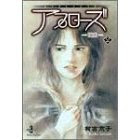
Applause, Volume 2 picks up just where we left off at the end of Volume 1, with Shara in New York studying dance and her “show business” friends trying to start up a new show.

While Shara glows with effort, our attention is turned to the hottest new producer on Broadway, one Georges Bejart. Yes, the very same Georges who was Shara’s old flame Junaque’s fiancee’. Small world, neh? Unbeknowst to Shara, Junaque and Georges have come to New York. Georges puts himself in Shara’s way. They reunite – somewhat ambiguously. Georges invites Shara to come out with him on his yacht. They reminisce about life in Belgium, talk about Junaque and in a weak moment, they kiss. Shara takes herself off alone after the date, obviously regretting that kiss.

Walking alone at night, we follow Shara’s long shadow as she returns home. Her steps slow down, stop, and we see her face in stunned horror. But what she is gazing on is not a stalker or rapist – we look past her shoulder to see huge posters of Broadway’s newest star, Shelle Bejart about whom we have heard so much. To Shara’s shock, there, staring down at her, is Junaque.

This was absolutely the BEST moment of the entire series. Great visual, great spin on what was a sort of tired scene. I recommend reading this volume just for this moment.

Shara returns to her apartment, surprising her friends with the statement that she will, after all, return to the stage. Immediately, their play, “Success,” becomes a success.

Georges is still being rebuffed by Junaque/Shelle, who has taken up drinking, as well as becoming unpalatably spoiled. But we can see that it’s all because of her breakup with Shara. Georges can too and it isn’t making him happy. He pays a visit to Shara after her show to give her flowers, but she’s more interested in what he can tell her of Junaque than in his good wishes.

Quite accidentally, Junaque learns of Shara’s “Success” and is just as shocked as Shara was to find that she is in New York. She goes on stage that night, acting with all her heart – not for the audience, but for her lost love. (One of the charming things about Applause is that we get to watch the actual plays. This becomes more important to the plot as time goes on.)

Georges talks to Shara’s friends Alfie and Gerald, about producing a play with Shara in it. Alfie is asked to write the script. Georges also starts putting pressure on Junaque/Shelle to marry him, since that was a condition of him bringing her to New York.

Now that she knows that Shelle, nee’ Junaque is in the city, Shara tries to see her and bring her flowers after her show, but she can’t face Junaque, so she runs away.

The next chapter opens up – as the next several will – with newspaper and magazine articles on the two women, to show their parallel path to stardom. So close, they all seem to say, but so far.

It has been decided, the two will star in a play together, produced by Georges. They are invited to be on a TV gala affair hosted by an incredibly talented and beloved older actress, Katherine Reed, (who apparently has been searching for a woman who is very important to her for many years.) As part of the show, they’re given a basic plot and a setting and asked to quick read a script, then ad lib the rest of the scene. The scene appears to be about two jealous lovers….their performance is unsettingly realistic. Everyone watching it flipped out – it’s like they *were* jealous lovers. But that can’t be – this is the first time Kisaragi Shara and Shelle Bejart have ever met!

The show ends with Reed singing a few songs and bidding show business goodbye. It’s a huge hit. Shara watches as Junaque and Georges drive off together. In the car, Junaque opens a book that Shara has given her – it’s the script from Manon Lescaut, the play they had performed together in school. Inside is a note…

Junaque tells the driver to stop then, despite Georges protests, gets out of the car and runs back and into Shara’s arms. Without a word to her friends, Shara and Junaque hop into a cab and take off. They run, as they did when they were young, to the shore. After many a confession, of love, of loss, of forgiveness, they spend the night together in a house by the ocean that Junaque has conveniently bought.

But. Georges finds them there, and tells Junaque to return with him, she has a show to do. Junaque writes Shara a note to wait for her and leaves. When she wakes up alone, Shara rejects the note – and with it, Junaque, vowing to never wait another second for her. Junaque calls the house, but no one answers. Shara is gone.

Meanwhile, the older actress who hosted the TV show, Katherine Reed, gets news of the woman she has been searching for for years, her beloved Maggie….who died three years ago.

The books ends with Broadway at 8PM, when fortunes and careers end and begin.

While not a happy little volume, this volume is *good*. Art, story, character, all good. It is admittedly a little high on the melodrama, but it’s a romance manga – it must be forgiven as a handwave. Can anyone say “soap opera?” ^_^ There’s also hardly any sign of the shoujo manga it had been. This manga is all josei. Everyone looks and acts all grown up. Seriously good art – that one scene with the posters is worth the price of admission right there, and Shara and Junaque get one blissful night together. IMHO, all quite excellent.

Ratings:

Art – 8
Story – 7
Characters – 7
Yuri – 9
Service – 3
Overall – 7

Don’t get too weepy yet, there’s even MORE melodrama to come! ^_^