Archive for the Yuri Manga Category


Yuri Manga: Yuri Hime, Volume 8 Part 2

June 12th, 2007

Jumping right in for the second half of today’s review of Yuri Hime, Volume 8.

After “Creo the Crimson Crises” comes the latest from Takahashi Mako. Apparently I wasn’t the only one who didn’t like the creepy kids in her stories, because her characters have now morphed into creepy teenagers instead. :-) The story begins with two girls meeting, seemingly by chance under a picturesque sakura tree. But there was less chance than originally appears. In fact, one of the girls is now going out with the boy that likes the other girl – and who she likes. This girl (we’ll call her “the blonde” and the other “the brunette”) starts to obsess about the girl her boyfriend liked, asking him questions about her. It seems that they two share some superficial similarities, which begins to bother the blonde. Using her boyfriend’s phone, she sets up another meeting with the brunette, who has no clue who the blonde is. The blonde reaches out and grabs the brunette’s breast and receives a hearty slap to the face. She only comments that, yeah, the other girl is bigger than she is. The final page is the blonde asking if she can sit by the brunette under the tree. The story reads a bit jerky and unconnected, but it’s decidedly less dysfunctional than most of Takahashi’s work, so no complaints from me.

Chi-Ran’s story “I won’t let myself love you” begins as Kako walks in on two girls engaged in a little play in the classroom. One of them introduces herself as Ageha and, shortly thereafter, announces to the whole school that she will take Kako as her next lover. Kako’s shocked and confused – this is a girl’s school! She’s informed by a helpfully expository classmate that Ageha is a notorious playgirl and has not yet failed to get a girl she set her sights upon. Kako’s determined to not fall. But Ageha’s cool, attractive, sexy, and more than that, kind and charming. As she woos Kako, Kako finds herself starting to slip, admitting that if Ageha were a guy, she would have indeed fallen already. The chapter ends with a conflicted Kako reminding herself of her vow to not fall for Ageha – but the next issue will tell us if she succeeds or not. Bets? :-)

Morishima Akiko’s Yuri Life column covers her adventures playing Yuri-themed games like Akaito and Katahane, complete with character descriptions and drooling. lol

“Ameiro Kouchakan Kandan,” by Fujieda Miyabi contains what passes for a gigantic conflict in this series – Sarasa is going away for three whole days on her school trip! She worries about how Seriho will manage without her. Seriho laughs at her, but will she, in fact, be okay for a full 72 hours without Sarasa? We’re not so sure. Meanwhile on the trip Sarasa’s moodiness is recognized right away by her classmates as the lovesickness that it is. This is followed by good-natured, but stressful “who is it?” third degree. The chapter ends with Seriho staring at the calendar in a lonely kind of way. Forget Sarasa, *I’m* worried about Seriho….

The next story in this volume has a long title about a house in a forest and is, by far and away, my least favorite. Two young girls one, an ojou-sama, one her servant are in a shady situation in which the rich girl appears to be being groomed for something grim, like high class prostitution or marriage, which is really the same thing depending on how you look at it. But this looks shadier than just marrying off the girl. It’s an unpleasant situation. The two girls are in love with one another, of course, and in a climactic moment, the rich girl pushes the other girl out the window to free her. Epilogue page shows us the servant, now an adult with a daughter of her own that she has named after her love.

This is followed by an interview with the voice actresses from Haru Natsu Aki Fuyu Drama CD. It contains all the usual questions like, “how was it to play girls in love?” but at this point all the VAs have voiced gay *so* often they’re answering “It’s a paycheck.” lol No, not really.

“Maple Love” by Hiyori Otsu, is probably my favorite story of the collection. Girl overhears boy confess to girl and be rejected. She wills them to go away, but is given away by her cel going off. Boy bails. Girl meets girl, says she likes girls and kisses girl – and gets slapped. Girl negotiates being friends with girl. Friendship ensues. It’s a nice, normal friendship, and girl gently pursues girl with no particular time frame or agenda. One night at an “ai-kon” (a group date sort of thing,) girl becomes feverish and girl, realizing something’s wrong takes her home and tucks her in to bed. Girl says she’s ready to consider a relationship with girl. The story ends with the lamest gag in the world about gee, what do women do in bed together? My response: “…” Please. It was so good until then. It’s still good, just not *as* good.

I’ve been pretty vociferous about my dislike of Hakamada Mera’s work and this story seals the deal. I loathed it. A cool, popular girl decides to rehabilitate a dirty, unpopular girl. With a mere change of clothes, a thorough bath and contacts, Eliza Doolitle is transformed and instantly eclipses her savior in popularity. Cue miserable sulking as Eliza goes off and leaves the girl who loved her when behind. I’m sorry but…bleah.

This issue’s column about key yuri series covers Yamaji Ebine’s Love My Life which I have written about here: Manga review; Movie Review.

Nanami and Misuzu continues to be about whatever it’s about. This time we get a new character who looks an awful lot like a kiddy Kouya from Loveless.

Wait, did I say “Maple Love” was my favorite? I take that back. I meant “The Paradise Incident” by Morishima Akiko, in which a freelance Sumi shows up at her friend with benefits’ house. Sari is thrilled to pieces to have Sumi there, and they pick up on their interrupted life together as if they had never been apart. Sari finds her feelings for Sumi becoming deeper and finally gives in and asks Sumi to live with her. Sumi respectfully declines – she’s off in the morning to foreign parts. But before Sari can be too sad, Sumi invites her along for the adventure – and she goes. I liked this story a lot. Adult women, with lives apart from just their couple-dom and a pleasant smile-inducing ending. Yay Akiko-san, my hero!

In any case…

Ratings:

Everything is variable according to taste, but overall – 8

In general, a good volume, with much less meh, except that one nasty Hakamada story. And while it’s still heavy on the schoolgirls, there’s a definite attempt at variety. However, I also feel like the magazine is shifting the focus away from stories for women to stories for guys. I really, really hope I’m wrong. Probably I just want more Hayashiya Shizuru and Morishima Akiko type stuff and less loli.

And look – reviewed the whole magazine in only two parts! yay!


Yuri Manga: Yuri Hime, Volume 8 Part 1

June 11th, 2007

Urk. I have like no time at all to review stuff today. So, please bear with me while I review Yuri Hime, Volume 8 in a zillion parts. :-) (Today’s review – Page 6!) Seriously, though, I should be a little more settled by next week, so if I’m erratic this week, just hold on. I’ll be back.

Yuri Hime, Volume 8 starts off with the first cover *not* done by Hibiki Reine. Instead, the cover was designed and illustrated by Eiki Eiki and Zaou Taishi. It looks pretty much like everything else they’ve ever done. (I know that they are incredibly popular, and I’m very glad that they are making money drawing Yuri, but I’m afraid that I am not their biggest fan.)

The color poster inside is a nice grown-up looking mistress/maid picture by Mizushiro Setona. It’s no more unique than anything else, but I like the color use and the story the picture tells is more to my taste than most of the color pages so far.

The first story, “Epitaph”, looks like every loli game ever. Two gothloli girls of unidentifiable age , but clearly in the range of pubescence, one in white, one in black, vow to one another: Eternity, Life, Death, Love. You know, the usual. Then the story starts. These two girls function as messengers between life and death, bringing letters from the dead to their living loved ones. It’s a snazzy premise and I’m fairly certain that had the characters not been twelve I would have really liked it. As it was, I thought it was a snazzy premise. I’ll reserve judgment until I get a few chapters in me.

Following on “Epitaph”s coolly distant story, we hop right into the new and always frenetic “Strawberry Shake Sweet” where Ran, having realized her feelings for Julia, now fears coming within twenty feet of her, certain she’ll be labeled a freak. Julia is concerned that Ran’s behavior means that she has discovered Julia’s feelings about her. Ran runs away only to find the photographer Sera, so they can once again discuss their mutual non-relationships. Ran’s candor gives rise to several funny spit-takes and similar gags on Sera’s part. I very much like how these two women are set against one another as foils. As the chapter ends, we see Yuriko looking out on the scene, making dire pronouncements about the future. No – it’s not actually Yuriko, but that’s basically how I see her, yeah. lol If it turns out to be an older pop idol, I’m calling her Yuriko anyway. :-)

“Mermaid Line” returns to the first chapter and the story of Megumi and Aoi, and the relationship that builds between them as they share the mermaid picture book. Only this time, when Aoi is teased about her “lesbian” relationship, she insists that *she* isn’t a lesbian, which causes a bout of gay-bashing against Megumi that drives a wedge between them. Megumi is moved to seek out one of the boys who likes her, and ask him out to prove that she also is not a lesbian. What will happen? Tune in next issue to find out.

Love is in the air in “Hatsukoi Shimai.” We get some serious quality time between Haruna and Chika, with some moments of downright sexy. All of their love-love serves to leave Akiho feeling disenfranchised – but not enough to run into the arms of Touko-sensei, dammit. Not that Touko-sensei doesn’t try. I’ll give her that. Akiho’s feelings are welcomed and mirrored by Teshigawara (Akiho,you clod, don’t tell her how lonely you are when she feels the same way because of you!) who runs into a mysterious younger girl on campus. Back in the main plot, Haruna invites Chika over for an overnight. Over tea and sweets, Chika finds a picture of Akiho and Haruna as little children and asks to see their photo album. Responding as if from a great distance, Haruna tells Chika no can do. The chapter ends with a cold feeling of mystery.

“Apple Day Dream” continues to be a series of 4-koma (4-panel) gags about two employees at a high-end GothLoli dress store. Kaoru still likes large breasts and Mayu still has large breasts and is totally passive-aggressive about Kaoru. (Tsundere is really just passive aggressive behavior. Not really cute in my book, appealing blush on the cheeks or not.)

Which brings us to “Creo the Crimson Crises”. Suou is an average high school girl, yadda yadda, complete with a best friend who appears to want her (aka “manga lesbian stereotype 1.”) She feels out of sorts for reasons she can’t explain, nor can she explain the clearly supernatural woman who keeps appearing and trying to possess her. Suou puts her life on the line to protect her friend from this creature, when she is scooped up by the woman in an embrace, with a somewhat shady explanation of their bond. Suou passes out and when she awakens, finds her “bond” to now be material, as the woman has clamped a collar around her neck. Joke’s on Suou now. ;-) I love the title of this story and the alliterative transliteration issue (say that three times fast!) just makes it that much better.

That takes us to halfway, so I’ll stop for today. Upon reflection, if I appear to sound dismissive of the stories in the volume, it was unintentional. I actually thought that the first half of the volume was pretty strong. :-)

To Be Continued in Part 2


Yuri Manga: Iono-sama Fanatics (English)

May 25th, 2007

Today’s review was brought to you by Infinity Studios, the publisher of the English-language adaptation of Iono-sama Fanatics.

I reviewed this book originally on November 11, 2005. For a discussion of the plot and characters, please read my original review. For today’s review I am going to focus solely on the adaptation to English.

Unusually for me, I’d like to start with some of the good things. I am exceptionally pleased with the general level of reproduction (although my review copy was a PDF and not an actual book, so I can’t tell you how it will look on paper.) Color pages have been retained, which pleases me no end. The notes for the story are mostly very decent. I particularly liked the glosses on the notes about the characters and the roles from Mito Koumon upon which they they were loosely based. That worked for me and I felt that the translators were doing a decent job of keeping us readers included in the in-jokes within the book.

On the other hand…other than the “-sama” for “Iono-sama” they left out honorifics (and we all know how I feel about that.) If you could leave in one honorific, I am at a loss as to why you wouldn’t just leave in the others? The names of the characters are transliterated, which works fine for me (except that Aruje will inevitably be pronounced ah-rooj instead of ar-gee, but oh well…) and I admited a certain amount of uncertainty about some of the names myself when I reviewed it originally. But…Frechet (name transliteration taken from the 2007 Fujieda Miyabi Calendar I got at Comike, so the author’s own choice) is transliterated to “Fletch.” That’s just…I dunno…yucky. Frechet-san just seems tons cooler than Ms. Fletch, doesn’t it?

2015 Update: I was wrong here, but so was Infinity, IMHO. Flèche is her name, and while “Fletch” is the English translation…we don’t usually translate names. Argent was not “Silver.” And we’re past that Victorian “Princess Jade Perfume” bullshittery.

In general, the translation is decent, but the one or two times it isn’t, it’s horribly, disturbingly jarring. The first time it is not the translator’s fault.

There is a scene, late in the book, when Frechet (yes, I am going to continue to use the author’s version of the name) and Arata are making googly eyes at one another – obviously enough that everyone else can see it. Iono-sama jarringly asks if they are on the “L Word” together. I took a look back at the original Japanese and honestly, that particular passage would have been a bear to translate without being, well, crude. The points I take away for mentioning a current (and copyrighted…what’s the chances that they got permission?) TV show I give back because the actual sentence…ugh.

The second horribly egregious translation will not go unnoticed, however. Inexplicably, in the author’s note comic in the back of the book, where the word “moe” was used, it was left untranslated, but the word “Yuri” was translated – as “girl on girl.” Thank you, Infinity, for rendering the genre I live and love into a porn term. I wrote them and let them know that it offended.

It’s always nice to *politely* let companies know that the word “Yuri” can remain untranslated as well as “moe” can or, if they insist on translating it, to please use something less connotative of a porn movie, perhaps something like “lesbian stories” or “girls in love”.

Begin digression/

And while we’re on the topic, let ADV Films know that it annoys you when THEY did that very same thing in Best Student Council, Volume 1. You can reach them here: http://www.advfilms.com/FILMScontact.asp

I encourage you all to explain – politely, please – that Yuri fandom is well established enough that there’s no need to be so crude.

I have already contacted both companies, of course, and asked folks on the Yuricon Mailing List to do so as well. ADV sent me an apology for having offended and said that they’d send my message along to the translators.

In both cases I have no doubt that they did not *mean* to offend, but seriously – Yuri fans are the main audience for Iono-sama. It was, as Fujieda says in his comic, originally created as a Yuri story. (Not surprising, as he does quite a lot of Yuri – click his name in the category sidebar to see some of the others. A fact that, apparently, most other reviewers somehow missed.) I just feel that the companies would never have translated “Yaoi” as “gayboy sex” or “gay porn” and realistically, “girl on girl” is a porn term, not a reasonable way to describe Yuri.

\End digression.

One last bad thing about the translated Iono-sama is that there was a rather large typo on one of the character bios. Not a book killer, but I was kind of surprised it got past the editors, since it was really obvious. And yes, I emailed them about that, as well.

So. What do I think of the English adaptation of Iono-sama? I think it’s a nice attempt, but it falls flat in some key places. I would still recommend the book to Yuri fans, because the characters and story shine through the roughness of the adaptation on their sheer force of wonderfulness. ^_^

Ratings:

Art – 8
Story – 8
Characters – 9
Yuri – 10
Sevirce – 2 (it is, indeed, moe))
English Adaptation – 6 (without the Yuri issue, it would have definitely been higher.)

Overall – 9

Dear English manga companies – Yuri fans really don’t like being condescended to. Please treat us with respect. This may mean that you have to police the FanBoyness of your own staff. “Yuri” means lesbian images and narratives – not just girl on girl action (which if it were a porn anime, would be completely understandable!) We’re not prudes, we’re just certain that Yuri is more than hot lesbo sex. Thanks, Erica

For a Yuri manga that treats Yuri fans with respect, try one of our 100% Yuri manga from ALC Publishing! All honorifics intact and no insults to your intelligence! Yuri Monogatari 4, 5 and 6 – on sale now!


Yuri Manga: Kashimashi ~Girl Meets Girl, Volume 2 (English)

May 18th, 2007

I would like to start this review with a sad face in the direction of Seven Seas, since they told me that I’d be receiving review copies of their Yuri, but have so far not. Boo on you, S7.

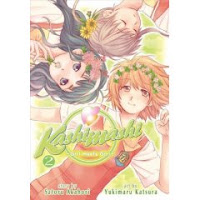
Kashimashi ~ Girl Meets Girl, Volume 2, is, as was the first volume, an excellent adaptation into English. It is *such* a relief to be able to just have the honorifics as is, instead of watching the contortions of language necessary to make translations work, or to have to ignore the implied relationships because they have been removed. I’m not sure if it’s more like having an itch scratched or the absence of a pain one was barely aware of. In any case, It’s nice. :-)

Volume 2 focuses mostly on the creation and solidification of the three-way romance between Hazumu, childhood friend Tomari and first love Yasuna. We also learn that Hazumu not only lacks critical decision-making skills, but is tortured with the inability to make even the simplest choices. And, in between, we watch Hazumu’s best friend, Asuta, nosebleed over any number of situations with his formerly male, now a cute female, best friend. There’s also an odd chapter that explains Ayuki’s apparent passivity in human relationships, something that will come back later as the story develops.

I just went back and re-read my review of the Japanese edition of Kashimashi Volume 2 and I had to laugh at my last line, “I’ll tag along until it gets unbearable or Hazumu turns back into a guy, whichever comes first.” (But I can’t tell you why, just yet. The series has ended in Japan, although the final volume is not yet out. I’ll review the end when that becomes available.)

There are a few things I do want to comment on. One, the translation and adaptation remain excellent. I know how HARD it is to make translated manga make sense sometimes, and depending on the publisher, the title, the team, sometimes the translation is sensible…and sometimes not. This story actually makes sense in English – not something that is easy to do. Tomari’s tsundere (for non-otaku-speak people, call it “passive aggressive”) personality is especially handled well. It’s not just her being tsundere for the sake thereof…her reasons for her behavior are presented and explained in a way that actually makes sense.

Secondly, as a “transgender” story it’s probably not too bad. As Hazumu says, it’s not like she’s not confused or concerned from time to time, but everyone is treating her the same as always. Maybe that’s idealistic, but – isn’t that the ideal? We’re told, repeatedly, that Hazumu was very girly, he was like a girl, and in this volume, that he wanted to be a bride when he was a child. It’s not a huge leap to say that he was a girl in a boy’s body – again, dredging up Serge’s line at the ACen Yuri Panel, that the aliens fixed what nature had broken. So, in a sense, it is a representation of the ideal situation. That the person gains their true gender and everyone still loves them (in this case, more people love her now.)

As a story of lesbian love, it’s also idealistic. Neither Tomari nor Yasuna are concerned at *all* that they have feelings for another girl. The issue is not “I’m in love with a girl” but “I’m in love with Hazumu” which as it should be in a perfect non-assholish world. And really, the issue is “I won’t lose to her” more than anything else.

Lastly, I really enjoyed Ayuki imploring Hazumu, in her heart at least, to slow down and take her time and just enjoy the three-way dynamic. When, in the end chapter, god appears to concur, it somehow made me happy. I still think that the three of them make the least implausible threesome I’ve ever seen (something that the next volume will explore to a small degree.)

While we the audience might perceive this story to be about gender, by the end of Volume 2, it is no longer. Hazumu’s gender is female. Period. But we still talk about it, don’t we?

So, here’s today’s question for comment: If Hazumu turns back into a boy, would it affect your enjoyment of the series? Do you perceive this series as a Yuri series, a Transgender series or none of the above? Inquiring minds want to know!

Ratings:

Art – 8
Character – 8
Story – 7
Yuri – 8
Service – 5

Overall – 8

The more time I spend with these characters, the less I find anything to dislike.


Yuri Manga: Kedamono Damono

May 17th, 2007

Through luck or agency, I happen to have a plate full of manga and books that deal with gender identity – or, more accurately, use gender identity and gender roles as a springboard for their plots. I thought it might be interesting to review all of these in a row in no particular order whatsoever. I’m not sure if there’s a point to any of this, but it might be a good way to foster conversation on the relative merit of each – or not. Let’s see. :-)

So, we’re going to start off with Kedamono Damono, a silly shoujo manga with little or no merit. ^_^

Konatsu is the manager of her school’s boy’s basketball team and in love with one of the upperclassmen on the team. When she tracks down troublemaker Haruki to drag him to basketball camp, she learns that Haruki’s reluctance was due to his secret – at night he becomes a girl, and is overcome with “perverse” desires. Pretty quickly, female Haruki devlops a relationship with Konatsu, who is happy enough to be doing such “perverse” things with her. In his male form Haruki is awkward and pathetic – he and Natsuo are always on one side or the other of a misunderstanding, but it’s fairly apparent that he loves her and vice versa. For her part, she wants him to say he loves her in his day form, since she’s already gotten that from his night form. He wants to do something super special and just keeps effing up for many and various complications which masquerade as the plot.

If one takes one’s brain away, this story is cute. There’s no doubt that Konatsu is happy with Haruki’s female form – she says as much, that she enjoys her relationship with Haruki as a girl, a lot. She just wants both sides of Haruki, which wouldn’t be asking too much if there was any sense to this story at all. ^_^

Haruki’s painful awkwardness sort of ruins what could be a sweet manga, because as a boy he’s a total spaz. He keeps finding himself in dumb situations because of his inability to communicate, something I term the “Jondalar syndrome, after the lead male of a Jean Auel book in which the *entire* plot was predicated upon the fact that Ayla and Jondalar simply never spoke to one another. And thus it is here. We know that Konatsu and Haruki are, indeed, spending nights together. In all that time apparently they cannot simply have a conversation. It mars what is otherwise a fairly enjoyable manga. Of course, should they actually *discuss* their feelings, the manga would have to end and all of shoujo manga would be reduced to “I like you” “I like you too, let’s go out.” “Okay.” And we simply cannot have that, can we?

The gender issue is handled as a gag. Haruki clearly perceives it as a curse and a secret to hide. This is not Hazumu of Kashimashi, where, as Serge puts it, the aliens fixed what nature broke. Haruki does not want to be, nor is he reconciled to being, a woman. I found it got tired pretty shortly after Konatsu made it clear that she didn’t care in the least. His continued mortification exhausted me. That he tried to hide his family from Konatsu because they too switch gender at night, was just stupid. Obviously, she was okay with it, doofus. Use your words and explain things. She’ll understand.

If I were smarter, I’d insert a clever comment here about how Haruki’s gender switching could represent his unconscious desire to connect with women which he does by becoming one. Or that, more probably, it represents his still immature sexual desire which, since it is not given as outlet as a male, is given leave to be expressed as a female – since we all know that sex between women isn’t “real” sex. But I’m not feeling that smart today. I encourage you all to theorize in the comments section. Why do *you* think Haruki turns into a girl? (Saying something obvious like, “It’s a plot complication to drive a mediocre shoujo romance manga” is forbidden. I will not accept a paucity of imagination in this. Be creative. Be more creative than the mangaka. “That shouldn’t be too hard,” says the wife.)

In any case, Haruki as a girl is significantly less dorky than Haruki as a boy (she is even drawn less dorky, with an emphasis on graceful and sexy curves, where boy Haruki is awkward angles and jerky motions) and gets more kisses too. There is a lesson in that, I have no doubt. ^_^ One of my justifications for calling this a Yuri manga is that what physical relationship we see is largely between the two girls. Another is that calling it a “sexual minority/gender identity manga” is clunky and calling it a transgender manga isn’t accurate – certainly no more than the Yuri label.

Whether this manga remains readable will have a lot to do with how the mangaka portrays Haruki dealing with his gender switching. If he just learns to deal, that would be nice. Konatsu and Haruki like each other, that’s not really in question. But will Haruki have to resolve the gender issue, or can he simply be who he is and still get the girl? My guess is that the next complication (since Konatsu already has another guy after her) will be that girl Haruki is pursued by a guy, with ensuing complications. I’m willing to wait it all out, if I could just be sure that the end wouldn’t suck. ^_^;

For a transgender story, I’d score it pretty low. Not something I’d give to someone who was trying to find themselves in our irritatingly rigid two-gender system. But Haruki makes a pretty good bisexual character, so maybe there is a silver lining in this particular cloud.

Ratings:

Art – 7
Characters – 5, with flashes of 7
Story – 6
Yuri – a bent sort of 7
Service – 5

Overall – 7

As withAkane from Ranma 1/2, I find myself hoping that Konatsu will be left alone to enjoy the best of both worlds. ^_^