Archive for the Yuri Manga Category


Yuri Manga: Kashimashi Girl Meets Girl, Volume 1 (English)

January 12th, 2007

I came to a conclusion today about yuri stories being “good” or “bad.” I was listening to the third Strawberry Panic Drama CD and I realized that, if Chikaru were a guy, most people would find him creepy and – in that particular scene – disgusting. And it dawned on me that that sort of defines what makes a story “good” or “bad”. If for instance, Chikane from Kannazuki no Miko had been a male character, would anyone *ever* attempt a rationalization of his behavior, much less openly declare it to be sexy? I think not.

So, going forward, when I comment that a series is “not good” you can take that to mean that, among other things, I think that if the characters were a hetero, rather than lesbian, couple the story would be boring, trite and/or vile. It’s a simpler criteria than trying to explain good writing all the time.

Ironically, none of that really applies to today’s review, as the character starts off as a boy. ^_^ I reviewed Kashimashi Girl Meets Girl, Volume 1 in Japanese back in May 2005. Because the story has not changed at all, I will not be re-reviewing the story itself. If you are not sure whether you want to read the story, by all means, please visit that first review. I rated the Volume an overall 7, if that helps.

What I do want to talk about today is the quality of the transition into English of this story. Which is, let me be honest, very, very good.

If you are a regular reader of Okazu, you know that I am constantly disappointed in English adaptations of manga and anime that remove honorifics and cultural references.

Based on that alone, it’s fair to say that this volume of Kashimashi may well be the single best adaptation of a manga into English that I have ever seen.

Every honorific – even the silly ones…especially the silly ones – are preserved. Notes are added that make sense of the puns and cultural relics, and the reading audience is assumed to have several functioning brain cells. It was the proverbial breath of fresh air to me, let me tell you. Overall, this may well be one of the best translation/adaptations I’ve ever seen. It was a seamless reading experience for this reader of the original version – my highest compliment for a translation.

The print quality is good, and although it did not bother me in any way, you should know that the sound effects are left completely untranslated. As I’ve mentioned many times, I don’t read s/fx, indeed I hardly notice them for myself (although I pay attention for review purposes.)

The story remains yuri, although with that edge of marginalization that exists in so many current Dengeki yuri series. It retains the service, the goofball plot complications, the sad wretch of a pervtastic father, and the “I’m a girl now, so I have to do abc…” and of course the aliens, that make it hard to judge this book harshly, since it’s so obviously ridiculous.

Still not my favorite example of “Yuri”, Kashimashi (which, btw, also means a loud or rambunctious sound) makes a decent enough entry into the Yuri market – and an exceptional showing for Seven Seas. Keep up the work, guys – and get some GOOD Yuri titles, please! Ask me, and I’ll be glad to offer some suggestions.

Ratings for the story:

Art – 8
Characters – 7
Story – 5
Yuri- 9

Overall – 7

Ratings for the adaptation:

Translation: 9
Print Quality: 8 (not at all easy to do…)

Overall: 9

I’ve never read a manga in English that I didn’t personally publish that felt more like reading the Japanese original. Kudos to Seven Seas.




Top Ten Yuri Manga of 2006

December 22nd, 2006

Okay, I admit it, I didn’t think anyone ever really read these lists. ^_^ So, thanks to everyone who commented on yesterday’s Top Ten Yuri Anime of 2006 list! I’ll try not to let it go to my head. ;-)

Because this year we finally have a body of translated manga that falls under my loosest interpretation of Yuri, I’m going to split the manga list into two Top Five lists, one for translations into English and one for untranslated Japanese manga. It’s sort of restrictive, only having five and five, but I don’t want to add things that are merely okay, just because they happen to be translated. That having been said, let’s go!

Top Five English-language Yuri Manga of 2006

5. Strawberry Marshmallow/Ichigo Mashimaro – Okay, even I’m beginning to get sick of this series now. LOL But the manga, like the anime, makes me laugh, Miu is whack-tastic and clearly an EPL (Evil Psycho Lesbian) in training, and it’s just freaking cute. Okay? Let’s never mention it again. LOL

4. Kashimashi Girl Meets Girl – I haven’t had a chance to review the Seven Seas translation yet, but on first glance it seems a solid transition to English. The story still has that not-quite-Yuri feel about it for the first volume but, like the anime, by the end the gender issue isn’t, and the story remains about three girls in a love triangle. My opinion might change when the manga ends (something that really ought to be soon…) but for the moment, this remains one of the top five.

3. WORKS – Imagine this. A lesbian artist, drawing beautiful art, with stories about lesbians, for a lesbian audience. No almost yuri here – in fact, this is the only title on this year’s list that can claim that. That’s why we call it “100%” yuri. Tadeno Eriko has a classic manga style, her stories have humor, and pathos and angst and love and sex – between adult women who look and act adult. Exactly the kind of thing *I’m* looking for in yuri. While this was originally published in 2004, this year’s revised edition had mainstream book and comic store distribution, so here it is at number 3.

2. Blue – The story is not earth shaking, but for sheer excellence in transition to an English edition, Nananan Kiriko’s Blue has got to make this list. By far and away, the *best* reproduction of a manga I’ve ever seen. The English-language edition is exact to the original in every way…except that I can read it alot faster. :-)

And this year’s winner:

1. Read or Dream, Volume 1 – Not the most yuri story, not the best reproduction, but overall, one of the most *fun* things to come out this year. This alternate ROD-verse has a little something for everyone, and double that for fans of the ROD The TV anime. This will definitely be one of my “go to” books for a quick hit of chuckles time and time again. I’m thrilled to have it in English and I can’t recommend it enough. A total win for anyone who doesn’t require angst for a story to be “good.”

Top Five Japanese-language Yuri Manga of 2006

5. Kotonoha no Miko to Kotodama no Majyo to – In the beginning, I did not like Fujieda Miyabi’s art. Seriously. As my regular readers know, I am not a fan of “cute.” But over time, both story and characters really began to grow on me. By the time the story ended, I was hooked. Of course, the fact that Letty and Tsumugi’s story has continued in Drama CD form only serves to keep me hooked. :-) In the mean time, like Fujieda’s Iono-sama series, I’ve re-read MikoMajyo multiple time already and enjoyed it more every time.

4. Yokohama Kaidashi Kikou – This series is in serious contention for my “Best manga series ever ever ever” award. And, although it ended this year, it will remain in my heart forever. Sounds goopy, I know, but it’s true. Art, story, characters, were all well-crafted with subtle, delicate strokes…a veritable masterwork of manga. It ended as beautifully as ever, with exactly the right touch of Yuri. I, and other fans of Alpha and Kokone, couldn’t ask for more.

3. Kuchibiru no Tameiki Sakurairo – I’m not the only Yuri manga fan to be sad that Morinaga Milk has decided to stop drawing for Yuri Hime magazine. Like most of the stories that began in Yuri Shimai and were continued in Yuri Hime, this began as a series of semi-related one-shots that developed into an actual story somewhere along the line. I’m sorry that we’ll never get to see Nana and Hitomi grow up, move in together and live happily ever after, but we do get to see them go from friends to lovers, with beautiful art. A pleasure to read – and again, a volume I’ve already re-read several times.

2. Hayate x Blade – Hayashiya Shizuru is surely angling for “Yuri mangaka of the year” this year. Her Hayate x Blade gets a little gayer with each chapter, a little crazier, a little cooler and a little win-er. The HxB Drama CD kept the Yuri and upped the wacky. And when, every month I pick up my copy of Dengeki Daioh, its Hayate x Blade that I save for last so I can savor every moment. Hitsugi x Shizuku, Momoko x Isuzu, Hayate x Ayana x Jun, and every other pair of shinyuu at Tenchi Gakuen make this series pure gold. If only an anime…

And this year’s new champion….

1. It’s a one-two punch for Hayashiya Shizuru-sensei, with her winning combination of Julia and Ran in Strawberry Shake Sweet! (You can’t be too surprised to find three of the Yuri Hime manga volumes on this list, right?) A Yuri mangaka, who has been doing comedy Yuri manga and doujinshi for just about *ever*, all of Hayishiya’s physical humor and goofiness come together in this strangely touching and strangely hysterical and plain old strange girls’ love series. There’s about two straight female characters in the whole series. And one of them is doomed. ^_^

***

And that’s it for 2006’s Top Ten Yuri Manga. Sometime before I leave next week, I will sum the whole year up in a giant Top Ten of Yuri, but until then, don’t forget two things: scanlations do not pay artist’s bills, and comments don’t pay mine. Rent, borrow, buy – don’t download. If you love Yuri, support it in a way that pays the bills. On behalf of Yuri publishers everywhere, thanks to everyone who *has* supported Yuri by buying it from ALC and/or through the Yuricon Shop!


Yuri Manga: Strawberry Marshmallow, Volume 2

December 20th, 2006

So, you see why I wanted Sean to get me that darn review already. ;-)

I’m an old Comparative Literature major (just like Satou Sei, lol) and I can’t help myself, so – for compare and contrast, here’s my review of the Japanese Ichigo Marshmallow Volume 2.

Because the content of Volume 2 remains the same, I don’t feel the need to go over the “what so much, but I do want to say a few things about the “how.”

The translation is…well, I’m not really sure what it is. There are moments of sheer brilliance, moments of complete incompetence, and in between I keep finding myself asking, “who is this translation for?” Let me attempt to explain:

None of the sound effects are translated, nor are there notes next to them. I don’t care personally – as I’ve said many times, I don’t see them, myself. And I can read them in Japanese, so it’s no loss to me. But I’ve been told that people *do* read them, and the standard these days is to either translate and replace them (which is a lot of work!) or to write translations next to or near them. Sometimes translated s/fx are put into a detailed glossary in the back. Doing none of the above assumes that *I* am the reading audience – people who can either read them, or who don’t care.

Second – Ana’s name. Her family name is the source of a large body of the gags in this volume. And nowhere is it explained *why* her name is such an issue. That seems really bizarre to me. (Ana Coppola in Japanese sounds really weird – something like ‘hole bone cave’. It’s not dirty, it’s just giggle-making strange.)

Third – about once a chapter Nobue turns British. Everytime it happens I do a double-take. “Dirty pool”? Who says that other than Gomez Adams?

And of course, nothing else is explained, either. Which, I like. Miu says Randolph instead of Rudolph, her Jinglish version of Randy Travis is transliterated, so it reads like Jinglish, and Ana, when she accidentally writes her name in Japanese on the blackboard reacts with a large Japanese hiragana “Da!”

But then, Sasazuka is told to stand in the corner, instead of the hall. Go figure.

In one sense, it’s maddeningly inconsistent. In another sense it fits right in with the sheer randomness of the story as a whole. I’d like to think they thought about it beforehand…but it seems unlikely.

As Sean said yesterday about Strawberry Marshmallow Volume 1, for us (that is, he and I) this series is really all about Miu and Nobue. I think the two scenes that encapsulate them – and their relationship are these: Miu, attempting to impress Nobue, does extreme stretching, then asks Nobue if that was amazing. Nobue responds, “Well, yeah…in a freak show kinda way.” Nobue hears how Miu told Ana’s class about her weird name. When questioned, Miu says, quite seriously that even *she* knows the difference between good and evil…and, she says happily, did it on purpose.

Ratings:

Art – Up from last volume – 6
Story – Crazed like a loon – 7
Characters – Ditto – 8
Yuri – Ditto – 4
Service – 6

Overall – 7

Ah, Evil Psychotic Lesbian-in-training Miu. You are the wind beneath my wings. ^_^


Yuri Manga: Strawberry Marshmallow, Volume 1

December 19th, 2006

It’s my great pleasure to offer you a review of the English translation of Strawberry Marshmallow, Volume 1 today by guest reviewer Sean Gaffney. And it only took me two solid weeks of nagging to get it!

For comparison’s sake, here is a link to my original review of the Japanese-language version of Ichigo Mashimaro, Volume 1.

In any case, take it away Sean!

The problem with the first volume of Ichigo Mashimaro is obvious right from the start; it kept its pilot episodes.

Basically, the artist had no idea this would be a continuing series, and the first three or four chapters have different designs (except for Chika) and different personalities (except for Chika). They’re almost proto-IM, and very odd indeed.

However, once the series proper gets started, you’ll know. You’ll know because there’s Miu. She was technically in the first few chapters, but not really. That was someone else with Miu’s name. True Miu…EVIL, INSANE Miu… arrives about the same time that Nobue stops being a bottle blonde and becomes the chain-smoking grump we know and love.

There are, technically, other characters. There’s Chika, who is the normal one. There’s Matsuri, who is the doormat by which all other anime doormats are measured. In a contest between Matsuri and Shinji, Matsuri would win hands down as being the most spineless.

But I honestly don’t gush over them at all. They add to the manga, but you don’t say ‘wow, was that Chika fun in that part!’. And why? Because Miu is insane, and Nobue’s reactions are wonderful. That’s why you read IM. Miu and Nobue. By the end of the volume, things are fully formed, and you realize how much of Miu’s life is devoted to making Nobue NOTICE HER, DAMMIT.

Yuri? Not anything explicit (not yet), and the design tends to make everyone look 5 rather than 12, but I think Miu has a crush on Nobue even this early, and one that grows larger as the manga wears on.

This is a funny, cute manga, and if you’d been avoiding it as it looked too loli, then grab a copy. Just be prepared for a slow, rocky start before you hit the paydirt.

Did I mention Miu? Cause, Miu.

Erica here: I say, amen to that, brother! And my thanks once again to Sean Gaffney, “guest reviewer of the gods.”

My own quick comments – in order to do get this review up, I had to reformat two older reviews and, as a result, I had a good chance to look at the new English-edition vs the Japanese edition side by side. For once, I actually like the translated edition cover better. The stark white background of the original is too unfluffy and uncute for this bastion of cuteness. The light red-an-white-plaid background on the Tokyopop edition hits just the right note of cute.

The translation wanders in and out of good to meh to excellent. It gets better as it goes on. Of course, no honorifics which, in this series, really fails, since the younger girls all call Nobue “Nobue-nee-san,” “Nobu-‘nee” just “‘nee-san”, or any number of other manipulations, depending on the character and the mood, something that is lost entirely. Matsuri-chan becomes, inexplicably, “Mats.” I will forever disapprove.

Ratings:

Art – this is totally personal, but for me – 5
Story – starts out weak, then gets going, as Sean said – 6
Characters – same as above – 7
Yuri – “Haruka-san, look at me!” – 2
Service – sigh…6

Overall – 6

When the ball gets rolling, it gets “wtf” funny. I still laugh out loud at it, which annoys me no end. ^_^


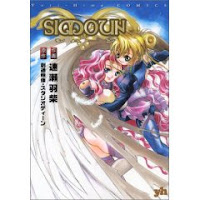
Yuri Manga: Simoun

December 12th, 2006

I spend a lot of time here at Okazu commenting on random slivers of Yuri lodged in the fingers of larger and un-yuri manga and anime series, so it’s nice, sometimes, to be able to review something that was actually created to appeal to the Yuri fandom, and yet not jam-packed with nothing but fanservice and lowest common denominator plot bunnies. Simoun, as it ran in Comic Yuri Hime is both those things. (In stark contrast to the evil twin Simoun manga, which runs in Megami magazine as a parody gag manga and deserves a review of its very own.)

Let me start with the biggest negative of this Simoun – it ended WAY too early, before the story even started, really. With this great, complex world, and all these characters to work with, the manga reads almost like a summary of the main relationship’s storyline from the anime. I can only imagine that there was a management decision involved in this. (And bizarrely, as I type these words, my iPod shuffle just started playing the Simoun anime opening song. The chances are 2:120 that I’d get a song related to Simoun. lol)

As the story begins, Aeru is a newcomer to the Chor, where she finds and confronts Chor Tempest’s Sibylla Aurea, Neviriru. Why aren’t you flying? she asks. And in doing so, she sets off a series of emotional confrontations. Her first confrontation is with Parietta, Neviriru’s close companion and self-proclaimed protector. Aeru then encounters Mamiina, Rodoreamon’s partner, who eventually challenges Aeru to a battle of will in the air, from which Aeru emerges triumphant.

We learn through flashbacks that at least in part, Neviriru is still grieving for her former partner and deceased lover, Amuria.

Also though narration and flashbacks we see that this is the same world as in the anime, a world in which all people are born female and must choose their gender. In the manga, they make their choice of gender at 15, not 17 as in the anime, but the choice is equally as fraught with…well, fraughtness. It’s THE choice they have to face. And Aeru quite openly shuns it. We also learn that the Chor are fighting a war, as they do in the anime, but the politics and pressures that affect them in the anime are absent here; as I said, the series was cruelly cut short before we could get into any of that.

Aeru’s success in breaking down Neviriru’s walls upsets Parietta, who now has to face her own feelings for Neviriru. On the cusp of forcing herself upon Neviriru – who may or may not welcome it – Parietta finds the strength in herself to give Neviriru up completely.

Free, Neviriru runs to find Aeru and vows to continue to fly with her. As priestesses, they pray together, and hear each other’s vow of loyalty and love. In a finale marred only by the fact that it comes too soon, they kiss.

A final chapter entitled “Intermission” follows devoted Rodreamon as she discusses her evil-eyebrowed, but good-hearted partner Mamiina with Aeru, then as she shows her devotion with a little emergency hair care and gentle words. Mamiina walks away, vexed that she cannot despise gentle Rodo’s affection. ^_^

The art throughout is solid, if not to my personal taste, with those little girl faces, a tendency to close-up in a decidely soap opera fashion, and clothes that quite frankly distress me in their design. LOL The color pages from Yuri Hime are reproduced, as they have been with all other Yuri Hime collections.

Honestly, the ONLY bad this about this story is that it’s over before it begins. I would have gladly read this for years and years to come. But oh well. There’s always fanfic.

Ratings:

Art – 7
Characters – 7
Story – 6
Yuri – 9
Service – 6 (Did I mention the distressing clothes?)

Overall – 7

Undoubtedly Yuri in every way, for a female audience, Simoun will probably make my “top ten” list for the year, but I just can’t stop thinking about what might have been….