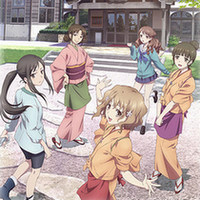
 I am pleased as punch to say that today we once again have a Guest Review by George R! If George is on a mission to convince me to reverse my lack of interest in Hanasaku Iroha (now streaming on Crunchyroll), then…well, you’ll see. (^_^) The floor is yours, George!
All stories are built around a difficulty for the protagonist, so Matsumae Ohana is well equipped to be one. Her mother is a single, irresponsible, freelance writer. Ohana comes home one evening to find their apartment filled with boxes. Her mother and her boyfriend are skipping town tonight to evade his creditors…and they’re not taking Ohana with them. Instead, she is going to her grandmother’s rural onsen ryokan (hot-springs inn) on the opposite side of the country. She knows nothing of the ryokan or her grandmother, as her mother and grandmother have not been on speaking terms for years. Ohana steps out to cool her head and tell her one real friend in Tokyo of this. Kouichi adds to her confusion by confessing his love, then running off before she can even reply. He doesn’t even come see her off at the train station. Thus, 8 minutes into the show, Ohana ends up by herself on the train from Tokyo to her new life and a chance to reinvent herself.
Ohana thinks the Ryokan wonderful, looking like it’s right out of a prewar movie. She even keeps her composure when Minko, her future roommate and coworker, greets her with the rough, “Die!” Grandmother is a strict old-school matron, telling Ohana she’ll be just another employee here; she disowned Ohana’s mother years ago. In spite of being put to menial cleaning tasks, on top of everything else, Ohana maintains her cheerful optimism. So begins Hanasaku Iroha.
One of the things that continues to draw me to Hanasaku Iroha is the setting and scenery porn. P.A. Works has done their homework well. The scenery matches the natural beauty out on the Noto peninsula, and the train is dead on for the Noto Railway there. Of course, they were able to take advantage of their headquarters being in Nanto, Toyama, just south of the peninsula. They’re also billing this as their 10th anniversary work, and it looks like they’ve taken extra care to make it a quality work befitting that anniversary. The setting is very nostalgic for me, as I spent a few days at a ryokan not very far from where Kissuisou likely is. I hope the producers are getting something from the local tourism organization, as this makes me want to go back there. Like Aoi Hana, this falls into the category of “anime that make me homesick.”
Onto the set of this lovely scenery walk a cast of characters I have come to like as well. The show revolves around Ohana. In some ways, she is the stereotypical Edokko [Tokyoite] come to the country; assertive, straightforward, cheerful, and easily moved to compassion. She’s not that good at reading people, and her mother taught her to rely only on herself, neither of which are that helpful in the high-context communal Japanese culture. Ohana has room to grow and learn, and to her credit, I believe that she recognizes both of these. I see her growth as being one of the major threads of this story. She is one of the blooming flowers of the title.
Grandmother will turn some people off with her behavior in the first episode, especially slapping Minko and Ohana. She runs the entire ryokan with a firm hand and an absolute customer focus. In many ways, she’s a product of her era, born during the war and likely raised in a traditional family. I believe that under her steely exterior, she has a loving heart, and I look forward to getting to know her better as Ohana does. Hopefully they will learn from each other. She offers a take on the strong, mature woman that well matches several such ladies I’ve known–and liked–in real life.
Minko is an interesting cypher, showing her standoffish nature with her first words to Ohana. Yet there is more to her than anger and cold beauty. She is a hard worker and takes Ohana’s words to heart, spending real effort to come up with an insult other than “die!” after Ohana explained why she shouldn’t use that one. She has a big crush on Touru, the assistant cook, even though he continuously berates her for every little mistake. Can Ohana’s earnest optimism break through the wall Minko’s built around herself? This wall may well be a byproduct of her crush on Touru and likely contributes to her troubles on that front. I’m looking forward to learning more what goes on behind her normally-cold eyes.
Tomoe and Nako, the head- and under- maids form an interesting contrast. Tomoe lives for gossip, perhaps valuing it over work, while Nako is almost terminally timid and shy. This combination ends up causing Ohana some problems initially, though that is not their intention. In spite of her shyness, Nako becomes Ohana’s first real friend at Kissuisou.
We finally meet Yuina, the last of our main cast, when she rescues Ohana from overly enthusiastic classmates on the first day of school. She goes to the same school as Ohana, Minko and Nako and is the spirited, carefree daughter of the rival ryokan, Fukuya. Rivalry goes beyond commercial, as there seems to be something between her and Touru.
Jiroumaru, the author staying at Kissuisou, provides more complications as well as the first Yuri in the series. How many series offer you lame slash fiction about the girls in it? In this case, it’s just a glimpse at an ero-novel featuring the girls together in the bath that Jiroumaru is writing to try to pay his bills. Some folks will find this a jarring turn-off, I just had to laugh at this way of showing his inadequacies. As Bruce McF said, the portrayal is quite droll, and the lameness is only “in universe,” as that is how the characters (especially Jiroumaru himself) see it. I think it well written (as I do the rest of the show). Jiroumaru’s personality is an interesting mix of arrogance and insecurity, and has plenty of room to grow, even though he’s an adult.
Four more guys fill out the cast at Kissuisou. Enishi is Ohana’s uncle, whom her mother bullied when they were young. We haven’t seen much more of him than when Ohana first ran into him. Touru is the assistant cook and Minko’s mentor. His main skills seem to be cooking and berating others. The head cook, Ren-san, looks tough and scary, but I have yet to see him act in that fashion. Denroku is the little old maintenance man, who’s worked at Kissuisou since it’s founding.
While the slash fiction was deliberately over-the-top, there are other scenes where I appreciated the director’s restraint. When Ohana is caught off balance–literally–by Kouichi’s confession, she does fall down the slide she’s standing on, but manages to catch herself and land on her feet, rather than collapsing into the expected heap of fanservice at the bottom. They also show a another bath scene in Episode 4, but this has a completely different feel than the Yuri ero-fantasy of the previous episode. Ohana and Minko’s conversation is set there, as such conversation can only take place with the lowered barriers in a shared bath. Of course, Fanboys will be happy to see girls bathing, regardless of reason.
While I normally don’t comment about translation, I found a couple spots in episode 3 jarring. In one, Grandmother comments about Ohana with a traditional saying, “Baka to hasami ha tsukai you”. Crunchyroll translates this, “Sticking goes not by strength but by guiding of the gully,” which seems too far off. It is literally, “Like using and idiot or scissors,” and implies that, just like dull scissors can be made to cut, so too can you get good work from a fool if you manage them well, or more succinctly, “Everything is handy when used right.” The second spot is Minko’s scribbling in her notebook to come up with a new insult. Here their “smelly and ugly” doesn’t map to Minko’s “HOnto ni BIkkuri suru hodo ni RONgai” as an expansion of hobiron [Balut.] While the dish is smelly and ugly, her words mean “truly, to a surprising degree, irrelevant.” But let me add that sayings like Grandmother’s are tough to translate, as they carry such a large cultural meaning associated with them, and Minko’s backronym is as tough as translating other linguistic gymnastics (not to mention also pulling Vietnamese into the language mix).
In related news, P.A. Works is also producing a Hanasaku Iroha manga as a franchise extender. Volume 1 covers the events of the first three episodes. I much prefer the anime over the manga, rating the manga at only about a 7 overall, lower than the anime on all fronts. To me, it feels like a pale echo of a very good original.
Ratings:
Art – 9
Story – 8
Characters – 9
Yuri – 2
Service – 3
Overall – 9
One always wonders whether a show will live up to the promise shown by its first episodes. So far, Hanasaku Iroha is living up to my expectations. I’m looking forward to more good character interaction and to seeing all of them them grow in this beautiful setting.
Erica here: Thanks again George for giving me a day off and providing me and all the readers here with something entertaining to read about something entertaining to watch. (^_^)