 By Christian LeBlanc, Staff Writer
Girls Made Pudding is an adventure game and visual novel from Kazuhide Oka and KAMITSUBAKI STUDIO, which just came out on April 10th for $9.99 US (but is currently 17% off until April 23rd). It is available on both Steam and on the Nintendo Switch Virtual Store; this review is of the Nintendo Switch version.
Joining the ranks of Japanese Yuri-adjacent media featuring girls riding around on bikes together (Super Cub) at the end of the world (Girls’ Last Tour), Girls Made Pudding is a soft, gentle game about the end of the world and the last few remaining humans in it. Also, it’s an exploration of intersubjectivity and shared realities. Also, it’s about pudding, made by girls.
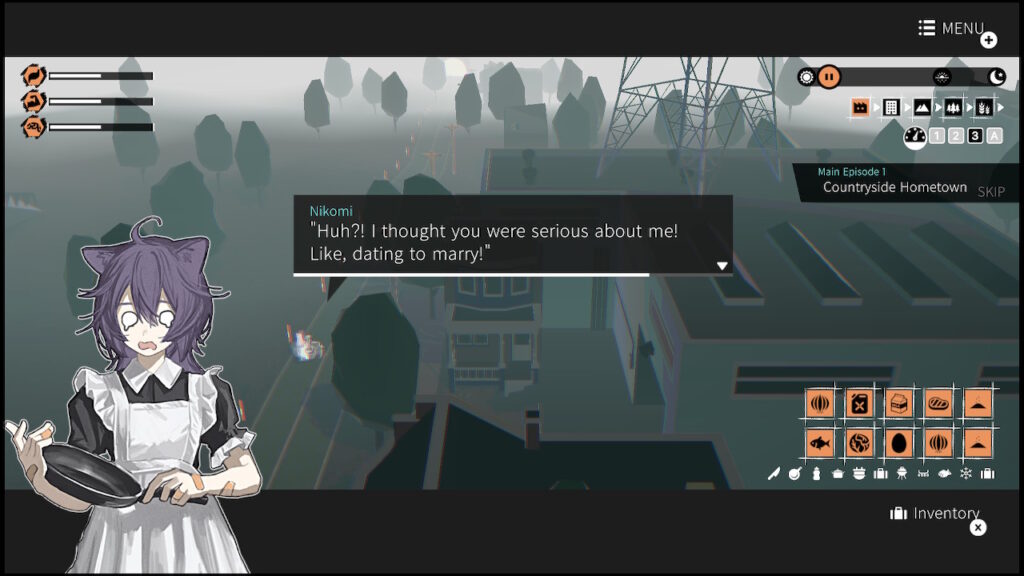
Aside from briefly showing you how to use the camera and move the characters, the game tells you little about how the game works (aside from some tips on loading screens), so for the first little while, you’ll be figuring out the mechanics as you go (muscle power and brain power both deplete as you accomplish certain tasks, while your hunger meter constantly ticks down, and you also have a time meter that marks morning to night).
Cooking two-or-three-ingredient meals not only replenishes your meters, but is also the way to unlock certain conversation topics. Girls Made Pudding is a visual novel, you see, but instead of passively clicking a button to advance the story, you’re riding around on a motorbike exploring deserted towns, collecting recipes and ingredients, finding places to spend the night, and dealing with obstacles in the road (including groups of cats you can pet to restore your brainpower). Zooming forward is what advances the conversation, so you’re always on the move.
When I first started playing I was worried about getting lost and whether I should be making maps, but it turns out you’re always in one of several types of locale (forest, countryside, city, seascape, factory area) that repeat. Houses with items replenish their stock when you return to an area later, so it is impossible to get lost or miss something important.
You can change the difficulty so that your meters don’t deplete, but it’s so low-stakes you may as well leave them on, just to make the game feel a little more like a game. One time I used up all my brainpower and the girls just decided to finish their day early, which meant I had to re-start a conversation I’d been in the middle of. No game over screens. I did reach a game over scenario once from a conversation path I wasn’t supposed to go down, but I was able to continue from a better spot and not lose any progress. I didn’t even have to worry about branching storylines or alternate endings; again, low stakes.
To accompany these low stake adventures and conversations had while zooming through deserted neighbourhoods, there’s a beautiful guitar score (with the odd math rock flourish) by Daijiro Nakagawa that, along with the lovely art and character models by Zumochi, gives the entire game a pleasantly cozy feel.
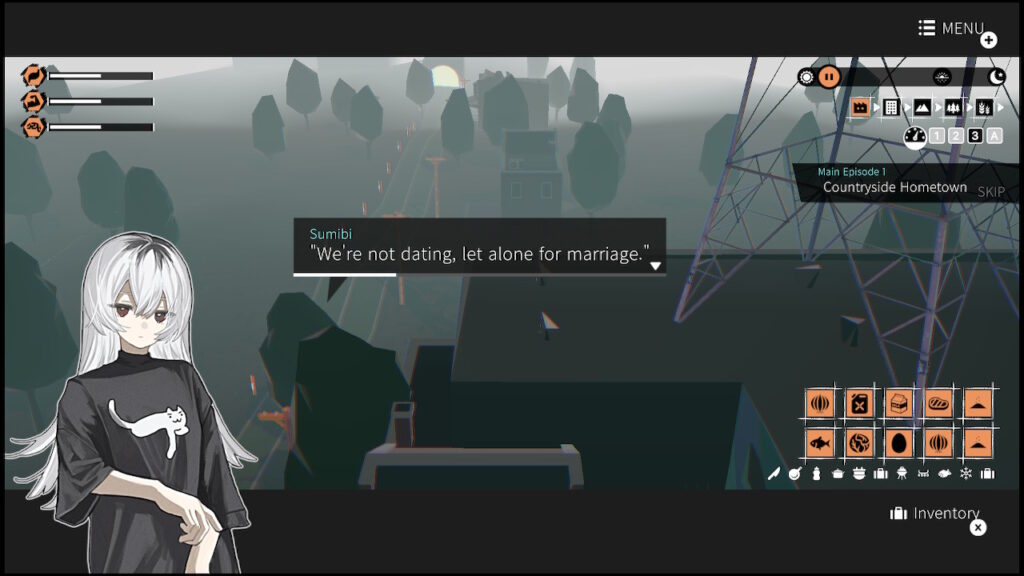
Which brings us to our characters: Nikomi is a cat-girl in a maid outfit who drives the motorcycle, cooks, and goes with the flow, and she is riding with no-nonsense, white-haired Sumibi. Very early into the game, Nikomi expresses how she thought the two of them were dating to marry, which Sumibi immediately shuts down; an exploration of what these two mean to each other takes place concurrently with the exploration of deserted locales and what happened to humanity.
And just what has happened to humanity? You’ll have fun puzzling this out as you go along, but all you’re given up front is that people just started disappearing. You do meet a couple of other characters during your travels who both shed light on what happened, and while the science behind the fiction may not always feel right, I recommend just going with it so as to catch the right feels from the social commentary that’s being made.
So, is this a Yuri game, you rightly ask? Yes, and no. But also yes. The game gives details about Nikomi and Sumibi and how they interact with each other, and I don’t wish to spoil any of that. I will say that the game definitely wants you to consider these two as a potential couple, and that a lot of cliches are refreshingly avoided as we observe how two people can be important to each other.
Girls Made Pudding does have a few rough spots: it can feel a little exposition-heavy near the end, and while the game does a decent job of giving you the right ingredients at the right time, you’ll occasionally find yourself driving longer than you should looking for an egg so you can cook some buchimgae on the side of the road so you can ask someone about a photograph (a common theme in Jack Kerouac’s On the Road, probably…I still haven’t read it). I’ve included instructions in the comments on how to beat one particular mini-game, because it is not at all intuitive. The translation also gets a little rough in places, especially in one late-game sequence where it labels the wrong character as talking, but for $10 you’re getting six to seven hours of entertainment, a mystery, some science fiction, some deep thoughts, delightful music and scenery, and some cozy Yuri content. And, a liminally wonderful lack of crowds.
There’s also a very cute and funny post-game sequence; be sure to play some more after you’ve beaten the game and then check through your inventory for something that wasn’t there previously, and that will trigger a hilariously self-aware conversation.
Art – 8
Graphics – 7
Story – 8
Sound – 9
Control – 7
Characters – 7
Service – none, unless just seeing a maid outfit does it for you. And/or cat ears.
Yuri – 6
Overall – 7
Get on the same wavelength as Girls Made Pudding, and you will find a fun Yuri game that gets you thinking about relationships and shared realities long after all the pudding has been finished.