Archive for the Live Action Category


Yuri Movie Her Kiss, My Libido Twinkles

September 23rd, 2026

Close-up of two girls in each other's intimate space, above a schoolroom scene in which the two, wearing school uniforms laugh and talk with each other.Earlier in 2026, manga artist Yorita Miyuki launched a Kickstarter for a big-budget film edition of her hit manga serialized in Galette, Kanojo no Kuchizuke Kansensuru Libido (彼女のくちづけ感染するリビドー). This manga had already gotten a short movie in 2022,  which is still available to watch on YouTube, and which I reviewed last year here on Okazu to get myself ready for this new project.  That short movie was a 40 minute three-part movie to tell the story of Sana and her first love, Akane. 

The 2026 project, yuri movie Her Kiss, My Libido Twinkles  was a more complete story, a full 2 hours to cover more of the manga, with new actresses and a full film cast and crew. As Kickstarter rewards, I also received a lovely full-color “program” book, with photos from filming and behind the scenes, notes from the Director and creator, as well as full cast and staff credits and postcards.

The story follows Sana (Watanabe Yui), a cheerful high school student. After an injury puts her in the hospital, she meets Akane (Ukawa Moeka), a girl with little facial affect, who seems to have a dark backstory. Akane teases Sana and is hard to understand, but the two of them are definitely attracted to one another.

Once they begin dating, Akane seems to have an idea that Sana is hers, and is possessive of her…and sulky when Sana mentions her friends. Sana’s friends are likewise distressed that she’s paying so much attention to Akane. 

The story here closely hews to the manga, and includes a scene that, no matter how many times I read or watch it, makes no sense to me. Sana invites Akane over with the intention of introducing her to Miharu, her closest friend. Mi-chan is unusually distressed by Akane’s presence in Sana’s life and we, an audience of adults watching this, can tell instantly that Miharu has feelings for Sana she has not admitted. But the scene is, in every iteration, awkward and icky. 

Overall, this movie is a very slick affair, but… and I don’t meant this to be harsh…it adds nothing to the short movie, except maybe a little more slowness to scenes that don’t need to be slower. Kiss scenes in JP media are already excruciatingly slow. We did not need them to take more time, I promise.

Another point to the short movie is that Sana’s actress here, while perfectly decent, did not encapsulate the bubbly cheerfulness of the character, as Tsuboi Nagisa managed to. 

I don’t regret backing this movie at all. I enjoyed it and all the well-put together rewards. But if you missed the Kickstarter, I’m going to suggest you watch that Youtube movie instead. This is very good, but that short movie, while low-budget , is somehow just as sincere.

Ratings: 

Cinematography – 7 Everything one expects in a JP media.
Acting – 8 Good job by a small cast who have to carry the entire story
Story – 8 First love, first desire, the usual

Overall – 8

This series is being published as English-language manga through Kickstarter, as well. Yorita-sensei is up to Volume 3, I believe.




Cage of Shadows

August 3rd, 2026

Okazu turns 24 this year! Help us keep you up to date on Yuri, Baihe and GL by supporting us on Patreon or Ko-fi.

On a white background, the Okazu mascots feed each other, while say "I love Yuri" in English and Japanese. Orange letters say "Become and Okazu Patreon today! https://www.patreon.com/Okazu

Looking for a little Baihe in your Wuxia? Let me recommend Cage of Shadows, which you can watch with English subtitles right now on Youtube.

Title image of Cage of Shadows. A woman in black and a woman in red, stand back to back, wielding swords. The story dumps you right into the middle of itself, and the official synopsis is uniquely unhelpful, so let me edit both into a more chronological format. 

Nan Yanzhi is a young woman whose mother has been imprisoned in the infamous Lingya Tower, where women are sentenced to participate in Life and Death contests for the pleasure of male customers. Those who lose may die in any number of ways. One of those ways is to be poisoned slowly so that one effectively becomes a statue occupied in a typical activity. When she was younger, Yanzhi encountered a martial artist by the name of Zhuang Wujiu, who takes her as a disciple. When Yanzhi learns that the antidote to her mother’s illness is in Lingya Tower as well, Yanzhi commits a crime to be setn there. 

There, among the other women forced to fight to the death in various rigged games, Yanzhi meets Dao Niang a former noble’s daughter, Jiang Man, a washerwoman whose husband sold their child to pay off his bets, so she killed him, and Tuya, a centurion of the Chilan, a fierce fighter. She also meets her old teacher, Wujiu, who appears to be working for the ruler of Lingya Tower. 

The entire story could not work if the men were not vile. Every man here is rapacious, a liar, betrayer and ultimately pathetic, stupid and weak. In fact, it’s basically a feminist tract that men cannot be trusted even if they appear to be decent, they are all bullshit when it comes down to it. That is certainly a position I did not expect in a Chinese period fantasy. But it is an inescapable position the story takes, and repeats over and over as we learn why women are here in Lingya Tower. Women who work for Lingya have been violated, sold as chattel to men, then given a chance to work for their captors to gain back a grain of their agency.

Of these stories, the hardest is that of a famous historian, who is set up and sold to Lingya where she is repeatedly sold to rapists before being given a chance to run a “school” that functions as one of the Life and Death contests. If you ever though that Joo Dee from Avatar the Last Airbender was a bit creepy, then this level of the Tower will creep you out fully. Both the acting and makeup make some hella convincing masks of the women’s faces.

At Episode 20 or so, we seem to be at our end. Having met Wujiu again, her former master confesses her own miserable story, and she and Yanzhi fight. Having failed her last contest, due to betrayal, Yanzhi and her sisters-in-arms are split. There doesn’t seem to anywhere to turn, but the final chapters bring us a great joining of all the women in the Tower who stand up against the men, successfully. 


Okazu Supporters and Patrons make it possible for us to bring you Yuri, Baihe, GL news and reviews from the global Yuri network!On a aqua blue background, the image of Sailor Uranus and Sailor Neptune themed cans of Ocean Bomb sparkling water with the words, "Buy Us A Senshi Sparkling Water." Sponsor Okazu on Ko-fi. https://ko-fi.com/okazuyuri

Yanzhi and Wujiu have a contentious, but intimate, relationship. As master and disciple, they are like parent and child. Let me digress for a moment. I spent many years studying Chinese martial arts and there were often discussions of the term Sifu (師父) for women, as the second character is that of “father.” In traditional MA, the master is respected at the level of a father, who imparts wisdom, guidance, and in some schools, (not mine) punishment. My teachers never seemed to want to be called Sifu, even when they were Chinese and, over the years, we all sort of developed an allergy to non-Chinese teachers who were called (or referred to themselves! ugh) with that honorific. During the decades I was actively training there was endless conversation about what to call masters who were women. It is unsurprising that we all defaulted to “It’s not “father”, it’s like wiser older person,” i.e, “male words are default” reasoning.

Here, Yanzhi uses Sifu for Wujiu, and their relationship is quite familial, although I might suggest Wujiu acts more like a big sister at times, and others like a lover in that comfortable pot-lust phase of a relationship. The most intimate moment between them comes before they head back into the Tower one last time. They eat and drink together, imagining their lives without Lingya Tower and the multitudes of betrayals by men. Yanzhi says to Wujiu, let us pretend this one night that there is no Tower, no betrayal, no Life or Death… just us. Then they go in and, after a few Uno reverses, lead a rebellion. It was solid stuff. ^_^

This scene is shown twice. The first time I was saying “say  ‘just us'” over and over, but the final words were translated as “just Master and disciple.” Which I thought fair. In the final episode, it was translated as “just us” and I cheered. ^_^

The opening and closing credits are basically the whole story in short, so I knew we’d get a few scenes of spinning with swords (which passes for foreplay in danmei so often ^_^). 

Overall, a fun series that was worth watching all the way through. Very light strokes of Baihe,  but I 100% loved that Yanzhi was never a shrinking flower and we had Tuya, a full-blown woman fighter. By the end, all the women are wielding weapons with some well-earned bloodlust and that worked fine for me.

Ratings: 

Cinematography – 7 solid, a little reuse of footage
Story – 7 Messy af, full of double-and triple crosses and rigged “contests”
Characters – Men-0, Women-9, coincidentally, bascially the same as the number of survivors. (Not, really, but yeah)
Service – 5 In that coy “we know what you mean way, lots of “hurh hurhurh” laughing and implication of torture and rape
Baihe – 5 mostly subtext, but still there

Overall – 8

Very pretty costumes and very fantasy weapon use, and a few looks full of emotion and longing. Cage of Shadows worked for me.


Japanese Girls at the Harbor (港の日本娘)

July 21st, 2026

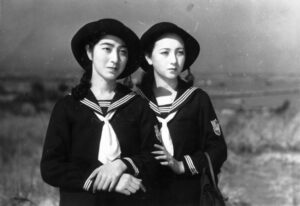
Minato no Nihon Musume, Japanese Girls at the Harbor is a 1933 silent black and white movie. Directed by  Shimizu Hiroshi, it is based on a novel by the same name, written by Kitabayashi Toma that same year. 

Sunako (Michiko Oikawa) and Dora (Yukiko Inoue) are bosom friends in the port city of Yokohama. They swear to never part and always be close to one another as they walk home from school. Both Sunako and Dora are mixed -race girls who attend a Catholic school. Yokohama at this time was a true melting pot of people and cultures. You can still see a very little bit of that in modern Yokohama, with it’s huge Chinatown and “westerner’s houses” as well as European construction that is disappearing a bit, but still exists.

Dora and Sunako, almost the moment they make their vow are torn apart by “Henry,” a young man who has adopted western ways. He’s flashy, playing with both girls separately, but its Dora who receives his attention more and they ride off together, setting Sunako into a spiral. Sunako has no other friends and resents Henry, while still desiring him. She learns that Henry has a third girl – and older girl named Yoko. Yoko pities Sunako, because she’s still a child. In response Sunako shoots Yoko in the school’s chapel. Yeah, not much symbolism there.

Sunako runs away, becoming a prostitute. Years later, when Henry comes into the bar where she works he’s excited and happy to see her, and asks her to visit. Even as she does, Sunako thinks of the former madam’s word about how she’ll be unwelcome forever. The movie then becomes a psychological drama as Dora and Henry, now married with a child, and Sunako can never truly reunite. Despite her own success as the madam of a bar, and as she works to build a real business with her money to claim the kind of respect she can never get as a madam, Sunako is both happy for and resentful of Henry and Dora, and the friendship that meant so much to her.

It is both easy and difficult to parse this as an early “queer” movie. Dora and Sunako’s love for one another is immediately, fatally, cast as an immature love, nothing more than girls’ friendships that it is so fragile it snaps over a man. (You may imagine me rolling my eyes.) But as the movie goes on, Sunako continues to be disgusted by Henry’s behavior, long after he’s a respectable married man, to focus on Dora. As with so many movies of the early twentieth century, Sunako sees herself as unclean, both for shooting Yoko and for becoming a prostitute. Even as Dora invites Sunako back into their lives, she is shook with the feeling that she can not, may not sully those lives. Dora misses the Sunako she knew and loved, but that girl is long gone. Sunako still longs for Dora, but that’s just not possible.

The biggest problem with the story is that Henry is, immediately and consistently, trash. He’s a two-bit criminal, which becomes apparent when Yoko enters the scene. She’s older than Dora and Sunako, knows what Henry does for money and expects to marry him. He’s useless in every scene he shows up in. 

What really stands out, even now, is the acting. Inoue’s Dora feels typical of portrayal of a teenager of the time, but Oikawa carries the movie as Sunako. She’s a fabulous actor, but sadly, her career was over early as she died at 26 from cancer after nearly 2 dozen movies and other works. Inoue went on to have a storied career, making her final acting appearance in 2004!

I would not claim this movie as a genius work of early queer cinema, but it is a very interesting look into the early 1930s in urban Japan, with it’s multi-cultural prosperity, something that was sacrificed a decade later for no good fucking reason. And it is actually an interesting movie, despite all the attempts to make it about two girls fighting over a guy. 
Ratings:
Cinematography – Pretty good, given some obvious limitations. Let’s say 8
Acting – 9
Story – 7
Yuri  – 5

Overall – 8

The whole movie is available with English subtitles on Youtube. It’s worth a watch.


Reverse 4 You, streaming on Netflix

March 25th, 2026

On a pink and blue background with a gold clockface design, two women in casual clothes sit not quite back to back. by Eric Potter, Guest Reviewer

In Reverse 4 You, 19-year-old Jattawa, or Wa for short, is studying to be a lawyer and working odd delivery jobs while living alone with her 15-year-old sister, Vivi. Rather than just being normal sisters supporting and looking out for each other, they also happen to have special powers. Wa can freeze time or even reverse it by as much as 10 minutes, which she often utilizes whenever an accident occurs or she made a mistake—but only once per day, and cannot use it to fix something major right after using it for something that was comparably minor. Vivi can see out-of-the-blue visions at out-of-the-blue times of the future, albeit mostly of Wa’s future—but has no personal control over the visions, with some being more vague than others. And she can never see her own future. This still comes in handy in its own way when it comes to knowing exactly when Wa will be home at the front door and what food she is bringing over.

Then one fateful day, Vivi declares to Wa that the Wa was going to meet her soulmate at the university. While Vivi only made out a silhouette of the mystery person, she otherwise relays a precise scenario that will take place so Wa could identify him. Both naturally assume they are talking about a guy at the start. Meanwhile, Wa misses a food delivery deadline by a couple minutes, and the receiving client—a delinquent-seeming, tough-talking no-nonsense type girl—rubs in her failure with zero empathy. Wa later finds out that this same girl, named Four, is known across campus for having an attitude and engaging in fights. And just when it started seeming to Wa that Vivi may have been wrong (despite it being established that she historically never is), all the pieces of her vision come together to the point where Wa finally realizes the only person it could be is, you’ve guessed it, Four.

Once revealed that the soulmate in question is another woman, both sisters interestingly skip past the usual routine of denial before coming around to the idea, and instead readily accept it and adjust their thinking accordingly. Vivi was driven to pair her sister with her destined boyfriend, but just as easily shifts her drive to pairing her with her destined girlfriend instead. And for Wa’s part, she is more awkward with Four being her soulmate given the non-best first impressions the two started with. But after Wa reverses time to save Four from an accident, they begin growing closer from that point forward. Four softens up, and Wa finds out how misunderstood Four is and that she is someone who just does not take crap from anyone, for herself as well as the people she cares about.

Much of the series just centers around Wa and Four’s relationship, with all the traditional high points, conflicts and your standard soapiness. Because Wa uses her power more sparingly by this point, it was almost easy to forget the story’s sci-fi angle, at least until it comes into major play in the third act. One of the real highlights of this series is Vivi herself, in which it simply cannot be denied what an adorable delight she is, which actress Natnicha Polsombat plays with such genuine naturalness. It succeeds in making viewers feel what they should once the story takes a dark turn toward the end, and Wa is forced to make a choice that will unearth eye-opening revelations that shed a whole new light on everything, and answer the riddle of whether or not love is a strong enough force to conquer fate.

There are really just two issues I have with this series, one far more major than the other. Starting with the bigger one, midway through Four drinks herself stupid due to a misunderstanding with Wa (of course), and Wa tries guiding her safely inside, and then Four engages getting intimate with Wa on the spot. To which Wa ultimately goes along with. All the way. I swear I remember a similar scene like this having happened in The Loyal Pin, and it makes me wonder a little—does Thailand have different standards on what constitutes a consensual state of mind, or is this considered “passable” due to it being a same-sex relationship and the assumption that viewers would give no thought to it? Either way, there was nothing “comfortable” about watching what was trying to pass off as a sweet moment, and it took me a while afterwards to get behind this series again as the story got back on track.

The more minor issue was the ending—not before the credits, where we receive a genuine payoff of a conclusion, but midway through said credits when we get a scene of an extra bit of character interaction (not between Wa and Four) that cemented bitterness. If that was supposed to be the final ending, it felt like capping the series off with an odd note from nowhere, which made me wonder if this was supposed to leave open for a season 2 that I find no information on.

Those problems aside, the eight-episode Reverse 4 You really turned out to be a pleasant surprise that made clever use of its sci-fi gimmicks in an otherwise traditional GL story that turned out more elaborate than one would have predicted. This was my first Thai live-action Yuri that did not star Freenbecky, and it really felt like a lucky find by chance on Netflix.

Ratings: 

Story—8 (would have been a 9 if not for that problematic middle, and your mileage may vary with the usual soapy drama)
Characters—9 (all the characters have their charm, but the score’s mostly for Vivi!
Service—2
Yuri—10

Overall—8 (same reason as the story grade)


ClaireBell

December 22nd, 2025

Promotion poster for the Thai series ClaireBell. It shows Claire and Bell in bed in their prison cell. Claire is in the upper bed and is handing a red rose to Bell, in the lower bed.by Frank Hecker, Staff Writer

Content warning: This series includes multiple scenes featuring blood, violence, and sexual assault.

Many of the key developments in Thai live-action yuri have been sparked by first-timers taking big chances on new productions. Idol Factory could not find sponsors for GAP: The Series, self-funded it, and then saw it become wildly successful, make stars of Freen Sarocha Chankimha and Rebecca Patricia Armstrong, and kick off a still-growing wave of Thai yuri series. Fan-created Nine Star Studios took a chance on thirty-something Faye Peraya Malisorn and saw her become a star in the age-gap romance Blank. Now actors and first-time producers Mai Davika Hoorne and her husband Ter Chantavit Dhanasevi have taken Thai yuri into new territory with the prison drama ClaireBell, airing uncut on the OneD streaming service and with significant edits on YouTube.

The Bell of ClaireBell is a naïve young woman who celebrates her university graduation at a nightclub with her boyfriend and their friends, has someone stash their drugs in her purse unbeknownst to her, is caught in a police raid, tried for drug dealing, and sent to prison. There she languishes, abandoned by her boyfriend, too ashamed to reach out to her terminally-ill father, and brutalized by the reigning prison gang. She then slowly falls into the orbit of “rabid dog” Claire, a seemingly-psychopathic inmate convicted of the savage murder of a schoolteacher, and finds protection and (ultimately) love in her arms. Meanwhile around them others live out their own lives in prison: Claire’s elderly cellmate sliding into dementia, a corrupt warden and his upright son whom he hires as a guard at his wife’s urging, the “3D” gang of two sisters and a cousin who control the prison’s black market, and Bell’s cellmate, who offers friendship but may want something more.

The first thing to be said about ClaireBell is that it looks and sounds fantastic: Made on a relative shoestring budget of 30-40 million baht (about $1 million US), it has set design, cinematography, and music and sound design comparable to those of “prestige TV” from services like Netflix, HBO Max, or Apple TV. It also has a high level of acting. Newcomers Pangjie Paphavarin Sawasdiwech as Bell and Mable Siriwalee Siriwibool as Claire are joined by a company of veteran Thai actors, some of whom (including Davika and Ter themselves) have been stars and award-winners or nominees in other productions. I’d especially single out Noon Siraphan Wattanajinda as “3D” leader Dao and Belle Kemisara Paladesh as Bell’s cellmate Kae; their struggles for dominance over the inmate hierarchy amid their own personal troubles drive some of the most compelling subplots in the series.

Those who go looking will find various things to critique in ClaireBell: A few of the plot elements, most notably the circumstances behind Claire’s imprisonment, strain credulity. The 8-episode runtime somewhat rushes the development of Claire and Bell’s relationship. Yuri purists may object to the inclusion of heterosexual couplings (including one scene jarringly intercut with a love scene between Claire and Bell.) And, most amusingly, the product placements that helped fund the series cause the action to occasionally pause as Claire and Bell feed each other slices of bread out of a prominently-displayed loaf, enthusiastically consume yogurt or instant ramen, or comment on the softness of each other’s bras.

But quibbles aside, ClaireBell is top-tier television. Among Thai series I’ve watched I would put it next to The Loyal Pin in terms of overall quality, and I think it almost as significant for the continued development of Thai yuri as was the original GAP. Idol Factory has now imploded in an orgy of financial mismanagement and executive and cast resignations, with Freen and Becky leaving to pursue their own paths. Nine Star is struggling for relevance after Faye’s departure under controversial circumstances (did she jump or was she pushed?). In contrast, Davika and Ter seem to be as competent producers as they were actors. I hope their Mine Media production company builds on the success of ClaireBell to create further yuri series whose quality convinces other Thai production houses to up their game.

Ratings:

Story – 8
Characters – 9
Production – 9
Service – 6
Yuri – 10
Overall – 9

ClaireBell offers a touching romance, compelling performances, and interesting stories, all combined in a high-quality production. It‘s strongly recommended for anyone looking for alternatives to the all-too-common fluff or melodrama of many Thai yuri series.

Extra fun fact: Mable Siriwalee Siriwibool, the “Ble” in “Blejie”, has a masters degree in cellular and molecular science for biomedical applications and is the co-author of several scientific papers.