
Archive for May, 2024


Yuri Network News – (百合ネットワークニュース) – May 11, 2024

May 11th, 2024

Standing next to large blue block letters that read 'YNN', in blue silhouette, two women face each other. One wears a fedora and masculine-styled attire, one is in a dress and heels. Their body language is obscure - they may be dancing, or laughing or fighting. Art by Mari Kurisato for Okazu Yuri Manga in English

Big week on the Yuricon Store. We have someone cleaning up the old entries, so I can focus on getting new ones in. ^_^

This Monster Wants To Eat Me, Volume 1 is headed our way next month from Yen! I have been following this in Japanese, reviews of Vols. 1-7 are here on Okazu and Watashi o Tabetai, Hito de Nashi, Volume 8 (私を喰べたい、ひとでなし) is out in Japan.

She Loves To Cook and She Loves To Eat, Volume 4 is headed our way shortly!

I just reviewed this yesterday. The Moon on a Rainy Night, Volume 4 is another amazing volume of Kuzushiro’s manga about disability, queerness and friendship.

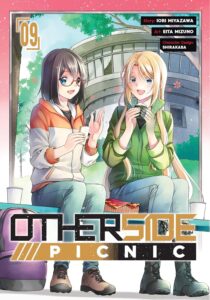
Sandy F reviewed Otherside Picnic manga, Volume 9 this week for us – there’s a lot of big feelings in this one.

Cheerful Amnesia, Volume 3 by Tamamushi Oku is headed our way next month.

Futaribeya: A Room for Two, Volume 4 is still available in digital format.

Becoming a Princess Knight and Working at a Yuri Brothel,  Vol. 1 was released in February. If anyone has read it and wants to talk about it here, drop me a line!


Help us give raises to our Staff and Guest writers!
Become an Okazu Patron today!

Yuri Manga in Japanese

Ai no Kotoba (愛のことば) by Inui Ayu, is a collection of her shorts from the Galette MEETS doujinshi.

Speaking of Galette magazine, I’m a few issues behind, so Galette, No. 27 (ガレットNo.27) and Galette, No. 28 (ガレットNo.28) are up! 29 and 30 to come.

Fans of The Moon On A Rainy Night might want to read Kuzushiro’s “historical” comedy, Kimi no Tamaenara Shineru. Volume 10 (姫のためなら死ねる)

Fans of outdoor cooking, food and gentle Yuri will want to get Osoto Gohan wo go-issho ni, Volume 2 (おそとごはんをご一緒に) as Fuka learns to love eating outdoors with her neighbor, Yomogi.


Yuri Light Novel News

The Adachi and Shimamura Light Novels series will not end with Volume 12, according to author Iruma Hitoma as originally planned. ANN’s Anita Tai has the details.


Support Yuri journalism on Ko-fi!

Yuri Anime


Shimura Takako, creator of Sweet Blue Flowers and Even Though We’re Adults, has another anime credit under her belt. According to ANN’s Rafael Antonio Pineda, her Awajima Hyakkei, stories about students at an musical revue troupe school is getting an anime. I reviewed Volume 1 and 2 here on Okazu.

Via YNN Correspondent m and the blue bird,  The entire Revue Starlight Rondo Rondo Rondo (「少女☆歌劇 レヴュースタァライト ロンド・ロンド・ロンド) compilation anime is available in Japanese, without subtitles, on YouTube for a limited time..

ANN’s Alex Mateo notes that anime film adaptation of Chainsaw Man creator Fujimoto Tatsuki’s Look Back will screen at the Annecy Film Festival.

Still have no idea if it is even Yuri-adjacent, but on the chance that it is, check out Rafael Antonio Pineda’s report on ANN that Momentary Lily will be premiering at Anime Expo.


Yuri Visual Novels

Via ebi-hime on Bluesky, their upcoming “cute yuri VN,” Clear Skye Thinking trailer is up on Steam.

Studio Élan has announced new merchandise for their VNs.


Yuri Live-Action

Via the Sasayakuyouni Koi wo Utau official X account, Sasayakuyouni Koi wo Utau is getting a stage play! Jonana Cayana has the details on ANN.


LGBTQ Media

Seven Seas has announced an audiobook edition of a memoir of by Ryousuke Nanasaki, Until I Meet My Husband, the story of the first same-sex marriage officially recognized by a Japanese religion.


If you’d like to support Yuri journalism and research, Patreon and Ko-Fi are where we currently accept subscriptions and tips.  Our goal now, into 2024, is to raise our guest writers’ wages to above industry standard, which are too low!

Your support goes straight to paying for Guest Reviews, folks helping with videos, site maintenance, managing the Yuricon Store and directly supporting other Yuri creators. Just $5/month makes a huge impact! Become part of the Okazu family!

Become a part of the Yuri Network, by being a YNN Correspondent: Contact Us with any Yuri-related news you want to share with us.





The Moon On A Rainy Night, Volume 4

May 10th, 2024

Two young women play-wrestle on a sofa, both laugh uproariously as they share a moment of pure joy. In Volume 3, Saki found herself seen in ways that were both complicatedly affirming and deeply confusing. Now that she knows Kanon’s history, her one comment is that barriers are meant to be blown away completely – a line that changes everything for Kanon.

Think about a moment when you believed you could do – something, anything – before someone told you, you could not take flying lessons, or whatever that thing might have been. Kanon, whose whole life was pretty much striving in musical endeavor, had a life change that made her think she could never have that back. She won’t be able to regain what she had, but now she can see that she can create something new.

In The Moon On A Rainy Night, Volume 4, Kanon decides to reclaim that feeling for herself,

To an American audience, the song that Saki ends up choosing for her class may seem simple, cheesy, banal even, but the text here explicitly asks you to consider the meaning behind the song – what it was originally mean to represent and how it can mean even more in this specific context. I ask you to consider who Stevie Wonder is, as well  – a man blind from birth who has shaped global music in innumerable ways, and Paul McCartney, a man from humble beginnings who also changed music on a global scale. So, yes, we may hear “Ebony and Ivory,” and think of it as a bland pop song – but, in this context, it means so much.

“You shouldn’t have to get over any barriers! They should be knocked down to begin with!”  Saki’s words have not stopped resonating with me since I first read this volume in Japanese in 2022. In every way I can, I am committed to removing barriers.

Ratings:

Art – 8
Story – 9
Characters – 9
Service – 0
Yuri – 4, LGBTQ – 6

Overall – 9

This year we have a bounty of charming, empowering and delightful Yuri – we have been seen – and it feels great.


Otherside Picnic Manga, Volume 9, Guest Review by Sandy F

May 8th, 2024

Two women sit on a bench outside a dilapidated building, eating. The blonde holds a rise ball in both hands one of which is transparent, the brunette with one blue eye and one brown eye holds a sandwich, as she speaks animatedly, smiling.Recently, to much excitement, the cover for the ninth novel of Otherside Picnic was revealed. What I noticed was how it was a neat reminder of the importance of food and drink in this series.

And food is certainly a theme in Otherside Picnic manga, Volume 9.

We have already witnessed the importance of food and drink as a way for Toriko and Sorawo as a way to recover from the trauma of the Otherside. In the conclusion to ‘The Little Birds in the Box’ Toriko and Sorawo are joined by Kozakura for a meal. A meal that leads to a conversation where Kozakura struggles to understand the hold that the Otherside has over Toriko and Sorawo despite their best efforts to explain it.

And then, with Yamanoke Presence, we have the main event! In volume 3 of the novel series, we finally had the picnic that the title promised us, and now we have it in the manga series.

It is a fun moment, with just a dash of weirdness. But in Yamanoke Presence we are reminded of what I find to be one of the compelling strengths of Otherside Picnic; its ability to shift from a cozy slice of life moment to encounters with horrors that will haunt your dreams with a dash of ‘what the heck is going on?’ conversations. For example, one of my favourite moments is watching an absolutely clueless Sorawo trying to understand Toriko’s family solution.

In this volume we also witness moments of Sorawo and Toriko’s vulnerability, particularly in the aftermath of The Little Birds in the Box. I was struck by the sight of Sorawo without her glasses, lying in a hospital bed hand in hand with Toriko. For me this moment was a reminder that Sorawo and Toriko are young women who may be strong enough to face the terrors of the Otherside, yet at the same time are struggling to connect with themselves and one another.

One of the many things I appreciate about Otherside Picnic is how Iori Miyazawa uses dialogue to make observations about larger issues. For example, Toriko’s response to Sorawo’s description of the Yamanoke critter possessing women and Toriko responds with a compelling question, “why do so many of these things go after women?” One aspect of the artwork I found very compelling is how successfully conveys Sorawo’s struggles with the Yamanoke as it possesses her. We definitely get the sense of the Otherside seeping into Sorawo’s consciousness.

Remembering that the entities of the Otherside take forms shaped by folklore and urban legends created by people, creating stories where women are all too often the victims.

We also have the first chapter of Sannuki and the Karate Kid, and A Daytime Guest which gives us Kozakura’s perspective on ‘Karate Kid’.

I confess that I enjoy watching Sorawo in full panic mode as she tries to figure out how Akari Seto found out about Kozakura’s place, and then more panic as she faces being dragged into someone else’s problem. The mention of Satsuki Uruma doesn’t help the situation, especially as her baleful presence has been noticed by Sorawo throughout the volume. Sorawo wonders what does Satsuki want, and how much of a threat is she to this unfamiliar sense, for Sorawo, of being happy? Through conversations and reflection we gain more insights into Sorawo and Toriko that reveal their unique path towards being in relationship with one another as they learn more about themselves.

Another great volume in this series.

Ratings:

Story – 9|
Artwork – 9
Character – 8|
Service – 6
Yuri – 8

The mutual nature of their relationship is growing as Sorawo muses on how much she enjoys sharing the Otherside with Toriko. But for a brief moment I do have to give a 0 rating with Sorawo’s complete befuddlement over Toriko’s parents!

Overall – 9


Whisper Me A Love Song, Volume 7 and Volume 8

May 7th, 2024

Shiho has what we used to call a “difficult” personality. She appears to make decisions that work against her best interests more often than not. Should you happen to point it out to her, you become the problem. In Whisper Me A Love Song,  Volume 7 and Volume 8, Himari finally helps Shiho to see that the problem is that Shiho has piled every one of her issues up to form a barrier between her and Aki…and, really, she likes Aki, it’s just that all that stuff has kept her from admitting it. With the high tension of the school festival filling the air, will Shiho break permanently with her former bandmate, or open a new chapter between them?

When we learn, finally, what Shiho’s issue is – it is a perfect moment. Yes, of course, his would affect her and yes, of course, someone as high-strung and “difficult” as she iswould retreat into herself, finding fault with everyone around her, rather than taking a look at herself. But Shiho also comes off as selfish and willful here. When the penny finally drops and she sees what she is doing, it is very satisfying. We (and Himari) are immediately hopeful that Shiho will figure out how to build a healthier relationship with Aki.

In the mean time, back in mostly-functional relationship land, Himari and Yori enjoy their first school festival together with all the little joys and moritifcations that brings.

And then the Battle of the Bands begin and Lauraley comes out swinging. Who will win is not nearly as important as what will happen after that, but our little angel, Himari has shepherded her sempai into a situation that is much more likely to be win-win. Good on her.

These volumes are perfect high school drama. Just a teeny little bit of real world drama, and a lot of adorable love-love, unencumbered by concerns of growing up in a hostile world, centering on good friends, and having fun playing music. It’s the perfect recipe for fulfilling high school years.

Thanks to the team at Kodansha for doing a top-notch job with the character voices, so that when we hear them speaking in the anime – streaming now on HIDIVE – they really sound exactly the way we imagined they would. ^_^

Ratings:

Art – 9
Story – 8
Characters – 9
Service – 0
Yuri – 8

Overall – 9


Girls’ Love: The Development History of Lily Fan Culture in Taiwan’s ACG Industry 2023 Revised Edition (少女之愛:台灣ACG界百合迷文化發展史 2023增修版)

May 5th, 2024

On a dark pink background, two light pink girls are shown intimately close. One with long black hair has her eyes closed as she presses close to a light-haired girl, who looks out at us. Large white letter superimposed upon them read 少女之愛 Girls' Love.Girls’ Love: The Development History of Lily Fan Culture in Taiwan’s ACG Industry 2023 Revised Edition (少女之愛:台灣ACG界百合迷文化發展史 2023增修版) is, as far as I know, only the second book on Yuri fan culture that exists in the world, so of course, I wanted to read it. Thanks to James Welker, who was in Taiwan and picked up a copy for me, I am able to tell you all about it today.

This book is by the popular pseudononymous Baihe novelist 楊雙子 Yáng Shuāngzǐ (a name that means “The  Yáng twins”). This is the nom de plume of author 楊若慈 Yáng Ruòcuī and her late twin sister, fan studies scholar and historian,  楊若暉離 Yáng Ruòhuī. Yáng Ruòcuī, using the shared pseudonym, has written several popular Baihe books and, in 2022, ran a successful crowdfunding campaign for Kitanhana Monogatari (綺譚花物語) a Taiwanese historical, supernatural Yuri manga to be translated into Japanese. I’m reading that now, and will review when I am done, of course, but I had set it aside to read this book first.

Before I begin, I have a few notes: For the purposes of this review I will be referring to fan culture as “Lily culture” as opposed to Baihe or Yuri, so I don’t keep bouncing back and forth between terms, as my translation tool did. ^_^ I do not read Chinese, and know very little of fan culture in Taiwan, only what I understand from this book, so If I make any substantive mistakes, I apologize up front.

This book is the fourth iteration of itself, and includes the initial article on Taiwanese Lily Culture and the revised version as appendices. The graduate thesis Yáng Ruòhuī wrote is not included, but I imagine it is available in Chinese-language thesis sources, as we have English-language ones. This, then is the fourth iteration of that work, with new research completed after Yáng Ruòhuī’s death in 2015 from cancer.

Where my book, By Your Side: The First 100 Year of Yuri Anime and Manga (which gets one line of a mention here, as Yáng notes that there is one Lily history book, in English) aims to tell the story of Yuri history in Japan and how it spread globally, Yáng’s book is very focused on Taiwanese Lily culture. So for the purposes of this book, Lily culture began in Taiwan in late 2003, into 2004. Although there was lesbian literature before that, when Maria-sama ga Miteru fandom began to form a Lily Forum online, was the functional beginning of Taiwanese Lily Culture. Much of this book is analysis of the Lily Forum’s activities in translation and dissemination, discussion of nomenclature  – which continues to be a thriving topic of conversation among Lily fans everywhere!

Because Yáng says she has little experience with Japanese Lily culture directly, the focus of the work is, instead on the activities of Lily fans in Taiwan (translation, doujinshi events, forum discussion) and the influences into Lily culture from China, from ACG (Anime, Comics, Game) culture and industry at large and from the consumed media. There is an essay about why Magical Girl anime is so synonymous with Lily, to the point that non-Lily magical girl anime, like many of the obviously heterosexual PreCure are still so popular with Lily fans.  There were a few points in that essay I’d like to revisit and maybe expand upon one day.

One of my favorite takeaways is  a discussion of what Yáng calls “Lily-reading.” Of course our fandom is hypersensitive to subtext – arguably, seeing where it is not, but Yáng talks about this as an active trait of fans, the lilyfying, if you will, of non-subtextual text. By engaging in Lily reading, Lily culture fans take characters who may even be overtly in a non-same-sex relationship in the text, and turn that character and another female character into a couple. To use Sailor Moon as an example, Usagi is explicitly paired with a male counterpart and yet, fan artists and writers have no qualms about pairing her romantically or sexually with her Senshi in story or art. This is what Yáng refers to as “Lily reading.” I like that and will use it going forward.

A large part of all the essays is a discussion of the assumption that “Lily is for men,” an assumption that historically underpins fandom discourse. From the very first essay, Yáng sees that this has never been true in Chinese fandom, any more than it is in any other fandom. Our Okazu Global Yuri Fandom Survey turned up slightly less than a quarter of Yuri fandom identifies as men. Yáng found approximately a 1:6 ratio of men to women in Taiwanese fandom.

Another interesting learning was the source of the relatively recent argument that GL means “real women in relationships,” where “Yuri” is a term about fantasy lesbianism.  When it popped up a few years ago, I had no idea where it had come from. And the fandom proposing it was so angry for some reason that they twisted the history of GL and Yuri up, so they were claiming Yuri was a publisher term and GL the fan term – which is the opposite of the truth. To respond I wrote Why We Call It “Yuri” for Anime Feminist. It was odd, because that interpretation had popped up so suddenly and with such virulence that I could not understand where it came from. (TBH, I kind of just mentally assumed Tumblr, because fandom there is weirdly angry and judgy ALL THE TIME.)

It turns out that source of that naming may well be Chinese fandom. Yáng talks about the shifting interpretations of GL, lesbian and Lily and how the arguments about what they *mean* became heated, as humans are always looking for definitive and fixed meanings for words that, by their very nature, have none. In part, Yáng attributes this to both social and legal taboo of discussing homosexuality when the Lily Club Forum began. Any discussion of lesbianism as such was shut down, for fear of censorship. That may well have lingered long past the need, as fandom everywhere tends to be conservative by nature.

In the conclusion, Yáng proposes these three simplified “definitions,” for the terms “lesbian,” “GL” and “Baihe/Yuri/Lily” works of popular culture.

“Lesbian” would refer to stories of real life people and their real-life issues. This might be same-sex marriage (which Taiwan became the first East Asian country to make legal in 2019, thus removing that from the list of “issues.”)

“GL” is pop culture (ACG)-related materials that focus on romance, for entertainment. I.e, there might be overlap with lesbian media, but that is not the main goal.

“Baihe/Yuri/Lily” works are any  works (even overlapping with the above two categories) that does not include awareness or mention of lesbian identity. In, other words, Yáng is saying what I have always said here, “lesbian content without lesbian identity.” ^_^

Yáng ends the book with a repeated appeal that Taiwan has, up through the publication of this book, not had a strong native Lily creative industry. Most of the work is translated from Japanese or imported from Japan, China, Korea. With the relaxing of that taboo, Yáng hopes to see more native Lily flourish. And, of course, so do I.

Ratings:

Overall – 10

Anyone researching Yuri will want to get a copy of this book for sure. It was a fantastic look at a part of fandom I had not really looked at before.