Archive for the Shimura Takako Category


A Hundred Scenes of Awajima, streaming on Crunchyroll

June 17th, 2026

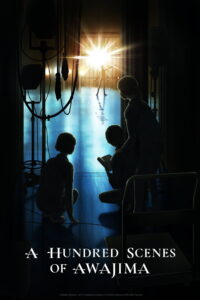
From a dark backstage, three girls look out upon a brightly lit stage where a young woman acts as a male character, blindingly bright as she lifts her arm.Are you comfortable? Have a drink, maybe a snack? Good, because this review is going to be 95% exposition and 5% review. Okay, maybe 85/15. But still. 

To understand A Hundred Scenes of Awajima, let us begin with a rather famous book called Fugaku Hyakkei, (富嶽百景) One Hundred Scenes of Mt Fuji, by the rather famous artist Hokusai. And, the equally famous Meisho Edo Hyakkei (名所江戸百景) the One Hundred Famous Views of Edo by the equally famous Hiroshige. From these titles, we see that hyakkei (百景) means “one hundred views.” This is clearly a trope. One understands that this word means “various perspectives from various angles.”  Hachiko used this trope in their Yuri Hyakkei (百合百景) volume in 2017.

Awajima Hyakkei, the manga series for which today’s subject is an anime adaptation, began in 2015.  I reviewed Volume 1 and Volume 2 here on Okazu and, although I kept reading I did not review other volumes. Yuri, while a part of this manga, is not a major part.  But it is a fundamental part, as we shall see.  The story is set in the preparatory school for girls who want to perform with the all-female famous Awajima Revue. 

Some of you will have understood immediately that this is mean to represent a fictionalized version of the second cultural relic in this series…a very famous, very real, all-female Revue Troupe school.  In a long ago post, scholar Rachel Thorn did a breakdown on the many visual, cultural, linguistic, geographical and organizational similarities between Awajima Revue and the real school. There are also other similarities, as well.

One of the similarities of the Awajima Musical Revue School and the school upon which is is based, is the constant refrain of bullying and power harassment within the organization. This is a real, and very front-facing issue in the story, but it has a sad truth to it. Unfortunately both the school and the troupes themselves have a history of power harassment against junior students and members, likely stemming from the para-military organization of the student body. This bullying is alluded to in the documentary Dream Girls, where one can visibly see actresses struggling as they remember their “strict” seniors at the school. So, as we watch our characters move from first to second year in the anime, speaking of being better seniors to their underclassman, we understand that the bullying was significant. 

Another similarity is the intense, intimate and sometimes romantic relationships formed by the students. Jennifer Robertson’s 1998 book Takarazuka: Sexual Politics and Popular Culture in Modern Japan, touched on this topic and, for her efforts, she was banned from the organization’s archive. The organization has still avoided any formal recognition of lesbian performers, bun there is a less rigid perspective in fandom where queer readings and female intimacy are more acceptable. (Nobuko Anan’s “Performing Female Intimacy in Japan’s Takarazuka Revue” and “Transcultural Desires and Lesbian Fandom: Takarazuka Revue in Taiwan” by Lucetta Y.L. Kam are interesting in that regard.) In that old and lost (and if you find it anywhere, DO NOT POST A LINK, this was deleted by Thorn and should remain lost out of respect. I have the original, but I will not share it, nor should you) post, Thorn noted that the real school was not at all comfortable with the idea that any of their girls form pairs, despite at least one well-known out lesbian who was a member. You may remember Higashi, who was one of the women whose marriage at Tokyo Disneyland caused the resort to change their policies. 

The manga, written and drawn by Takako Shimura, is available from Yen Press in English as Scenes From Awajima. This title is, in part, why I take time to explain the meaning of “One Hundred Scenes”. Sure you could read the book without understanding the whole thing behind “hyakkei” but if you know what it means and where we know it from, the series makes more sense. Knowing is half the battle. ^_^

All of which brings us, finally, to A Hundred Scenes of Awajima, streaming on Crunchyroll, the anime adaptation of the manga. The manga suffered a bit, as Shimura had not yet quite matured into the storyteller we saw in Even Though We’re Adults. This anime adaptation is the best adaptation of a Shimura work to date. 

Artistically, the animation captures her watercolor pen art in a way that feels true to her work and also somehow feels realistic. Each episode begins with a “scene” that moves into a story that is multi-layered. First-year students, their parents, the teachers, and predecessors all move through the school in one time or another. Shadows from prior years’ successes and failures, loves and losses are all presented as they impact the present. The present, however is treated differently. Students, current and former, try to heal wounds, and change the culture for the future. We see girls who were loved and hated, girls whose family was supportive, and those who were not.

The story begins and ends with a girl who was bullied into leaving the school and ultimately taking her own life. It’s a sad story made sadder when you see how strong she was, and how good she might have been. That shadow lingers into many other of the stories, even when the girls in them don’t know that. 

These are the “one hundred scenes” of Awajima. A place, a person, a story may look different when seen from another angle, but Awajima, like it’s real-world analog, is still there. Still dealing with the good and the bad.

Ratings
Art – 9
Story – 8 
Characters – 8
Service – 0
Yuri – 2?

Overall – 9

I would never suggest this story for someone new to anime, but if non-linearity and beautiful art is enough to interest you, I especially recommend watching the anime before reading the manga. It’s easier to follow for having been simplified a bit.  One Hundred Scenes From Awajima is streaming now, on Crunchyroll.


Scenes From Awajima, Volume 1

February 12th, 2026

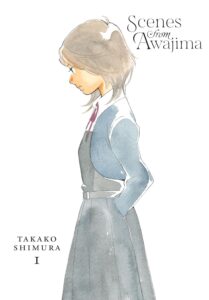
A young woman with collar-length brown hair wearing a blue-grey smock dress style old-fashioned Japanese school uniform, stares down at the ground pensively, hands in her dress pockets.Takako Shimura is a polarizing name around these parts. Shimura’s work spends a lot of time delving into the lives of queer people, addressing real and fictional issues, without the author even identifying as queer. Does that Matter (TM)? Yes…and no, of course. It matters that Shimura-sensei takes nuanced and thoughtful looks at queer life. For some years and in some series, the use of stereotypes was more common and some portrayals rankled among the queer community, both in Japan and elsewhere. I have expressed some of these concerns myself.

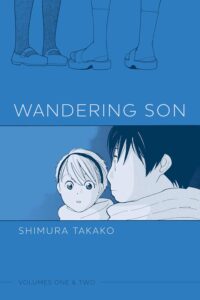
Then there is Shimura’s narrative style. In early works it was often difficult to follow a story, as characters looped in and out of experiences in ways that felt repetitive, or even traumatic. This was particularly true in Wandering Son. But what has taken shape, through years of tying vignettes and ensemble stories together, is a unique style that takes some getting used to, but is rewarding in the end. Even Though We’re Adults is Shimura’s best and most fully realized narrative and characters, so if you are not familiar with the earlier, more haphazard style, it might be a bit confusing to get into an older work.

I say that, because it did take me a few volumes of Awajima Hyakkei to realize what, exactly I was reading. I reviewed Volume 1 and Volume 2 here on Okazu and read, though did not review, through Volume 4. Now we have Scenes From Awajima, Volume 1 in English, from Yen Press, and all my previous feelings about Shimura’s work come rushing back in a flood.

Awajima, in this instance, is the name of a very famous all-female musical revue troupe school. This story is ten years old now, and follows Shimura’s more meandering pathways, with vignettes about girls in the school now and in the past. These vignettes intertwine, as the current classes deal with the weight of expectations from mothers, aunts and grandmothers, even teachers, who once walked the hallways they do now.  The story is heavy at times, and does include the kinds of institutionalized bullying a real all-female musical revue troupe is infamous for, as well as personal slights of many kinds. The series will address many uncomfortable topics, from eating disorders to abuse. It also is about the hopes and dreams of young women…and adult women when they live in, or leave, that world.

I was just commenting today on the Okazu Discord, that I have come to dislike the neologism “shoujosei.” It elides the perspective of adult women, lumping them in with the needs, desires and perspectives of children. Scenes From Awajima is about students, but it is not a Shoujo manga. I cannot imagine a child reading this (or Journal With Witch, or Even Though We’re Adults or any other Jousei work) with any understanding – or interest – in what is going on.  Shoujo and Jousei are different and lumping them together infantilizes adult women. At Okazu, at the very least, we’ll remain aware that adult women deserve their own place in the world. A genre of our own was important for Yuri. It is equally important for adult women for many of the same reasons.

Scenes From Awajima does include some Yuri, as one might expect. In that environment, with girls literally training to perform gender and romance, it cannot be surprising that intimacy and romance develops between students sometimes. And sometimes it has lasting repercussions. 

For the best reading experience, go into Scenes From Awajima gently, letting the stories play out around you, moving through time and space, while you just watch and listen. As characters become more developed names and situations will stick in your mind and you’ll find that things tie together in some ways and and in other ways have horrible messy loose ends. Much like life. ^_^

Ratings:

Art – 8
Story – Variable
Characters – 7
Yuri – 3
Service – 1 on principle

Overall – 7, but will improve with time

An anime adaptation is on the way in April, trailers are already available. I think the story will be tidied up a bit for the anime.

Thanks to Yen Press for the review copy, via ANN, where I reviewed this for the Winter Manga Guide, as well. ^_^


Otona ni Nattemo, Volume 10 (おとなになっても)

February 28th, 2025

Two adult women, painted in watercolor style, embrace as they smile brightly. One, with long dark hair wears a blue and white striped sweater and white slacks. The other has short blunt-cut red/orange hair, wears a green blouse, and red skirt. There are a lot of lose strings to tie up here at Shimura Takako’s Otona ni Nattemo, Volume 10 (おとなになっても). And, while the final bow is a bit messy, everything is tied up even if it means tucking in the aglets wherever there is space.

The story began with Ayano and Wataru married. Here they will, maybe for the first and only time in their lives, speak to each other like equal adults unencumbered by expectations. They can move on freely. Wataru’s mother has a long-needed awakening. There’s no way to know if it will be good or bad for her in the long run, but as a narrative choice, it was crucial. Eri’s story goes slightly pear-shaped, but it leaves Eri out of it. She deserves an epilogue of her own.

Ayano and Akari are fine. They move through this volume lightly, almost as second thought, meeting up with other characters, collecting and tying up all those loose ends.

I don’t know how to talk about the most interesting and weirdest piece of this volume without spoilers, so consider this a warning. Our three middle-schoolers have finally, fully resolved their concerns. When it turns out one of them has written a story about all the characters in the story, the other two jump in to help. What happens is a weird bending of the story itself as they narrate the various pieces of the story…even bits they could not know. 

Was all of this always a narrative told by these three girls? I actually hope so.

I have said this very often, but Shimura’s work is always a little problematic for me. Even beyond the specific kinks/fetishes/issues/whatever,  Shimura mines queer lives for drama, but does not identify as a gender or sexual minority. Does that make the work exploitative? It kind of does, but also, there is clearly a sense of telling genuine stories that heal and promote queer joy, so maybe exploitation is not the right word. Maybe Shimura is closeted, maybe something else, but the body of Shimura-sensei’s work is pretty neck deep in queerness, which seems odd for a person who is not queer. I always want to assume the best, and just hope that this is all a desire to find interesting characters and tell uplifting stories that include queer folk.

This story is queer in a real way. Akari continues to be a lesbian role model, Ayano becomes more comfortable talking about being bisexual, or perhaps always lesbian, but sucked into societal norms. And in the end, pretty much everyone gets the ending they deserve. Whatever the motivation, in both art and story, Otona ni Nattemo has been the best work I’ve seen from Shimura-sensei and the ending being a little bendy at the end, did not disappoint.

Ratings:

Art – 8
Story – 8
Characters – 8
Service – 0
LGBTQ+ – 10

Overall – 8


Otona ni Nattemo, Volume 9 (おとなになっても)

June 13th, 2024

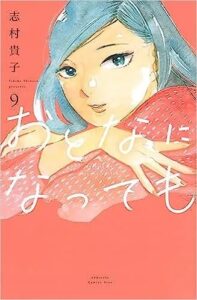
On an orange background, a woman with long blue hair, leaning on her arms, wearing an orange knit or patterned blouse, looks at us with a slight smile.I am currently reading two Japanese series about adults in complicated relationships. Both series are, in equal part, compelling and interesting and annoying as heck. Today we’re looking at Otona ni Nattemo, Volume 9 (おとなになっても) by Shimura Takako.

This story follows a (now-formerly) marries woman, Ayako, and a lesbian, Akari, as they meet, fall in love and come together again, as all the cracks in Ayako’s life come apart. In my review of Volume 8 is commented, “This continues to be such a low-key adult life Yuri that one can hardly think of it as barrelling down on the conclusion of the series…and yet, that is where we are. ” As Otona ni Nattemo, Volume 9 (おとなになっても) progresses, I’m constantly reminded of the other series, which is equally as complicated, but so much less “adult” somehow. I’ll talk about that one tomorrow.

Akari and Ayako are living together, at last. Things are good, or might be, as soon as they negotiate what any of this means to them. They haven’t really dated, and they know that. Did they do this too soon? Maybe, and they know that too, but are really going to try and make it work.

In the mean time, Ayako’s former students have gone from being children to tweens, in the way that children do. Two of them come to visit their former teacher, and marvel at her relationship with another woman. Ayako’s still uncomfortable answering questions, but Akari much less so.

Slowly, steadily, life goes on here. Things change, people change. Wataru has, maybe a new girlfriend, his mother visits the salon to see all these bit players who have completely shaken up her life. And Akari and Ayako find some quiet joy in the idea that they now can actually get to know one another. At last. Until next volume. ^_^

Ratings:

Art – 8
Story – 8
Characters – 8
Service – 0
LGBTQ+ – 8, as Akari tries to be a good role-model for young women who may well need one.

Overall – 8

Volume 8 of Even Though We’re Adults is out in English and Otona ni Nattemo, Volume 10 is out in Japanese!


Otona ni Nattemo, Volume 8 (おとなになっても)

September 11th, 2023

On a pale green background, a lone woman with reddish hair cut to her chin, is leaning forward as if on laying her head a desk, looking directly at us.Akari and Ayano have moved in together. This fact fills this book with all sorts of tensions, both positive and negative. Sure, they have been through ” a lot,” but so little of it is about them, together, as a couple. Will thins relationship, which has been mere embers since it was lit, get a chance to burst into life?

We…don’t know. Yet.

Ayano is planning on moving school, as rumors of infidelity plague her. The kids in her class are apologetic about it, not really understanding what the parents have against it, as, frankly, neither do I. Busybosdies gonna busybody, I guess. As difficult a situation as it is, it appears that Ayano’s students nd peers seem to be on her side. Nonetheless, she is leaving at graduation to start at a new school. In a fitful climax for the classroom drama, Nitta returns to school just in time to graduate. She finally has it out with her former friend, but whether they will be able to patch things up, we may not actually learn.

Akari encounters the salon manager’s wife who really seems less concerned that he’s having an affair (with Eri, Akari reminds herself) than with him being a dolt. And Wataru is navigating having the woman he is interested in, openly ask him out, now that she too is divorced.

This continues to be such a low-key adult life Yuri that one can hardly think of it as barrelling down on the conclusion of the series…and yet, that is where we are. Volume 9 was released in June and Volume 10 will conclude the series. It’s been an interesting read and I definitely wonder where everyone will end up.

The final chapters were about having bathroom accidents in second-grade and you know what? I didn’t need that. Thanks Shimura-sensei for having a weird insistance on add that to your Yuri stories. Sigh.

Ratings:

Art – 8
Story – 8
Characters – 8
Service – 0
LGBTQ+ – Let’s give this a 7, as Akarai and Ayano start negotiating boundaries and intimacy.

Overall – 8