 Are you comfortable? Have a drink, maybe a snack? Good, because this review is going to be 95% exposition and 5% review. Okay, maybe 85/15. But still.
To understand A Hundred Scenes of Awajima, let us begin with a rather famous book called Fugaku Hyakkei, (富嶽百景) One Hundred Scenes of Mt Fuji, by the rather famous artist Hokusai. And, the equally famous Meisho Edo Hyakkei (名所江戸百景) the One Hundred Famous Views of Edo by the equally famous Hiroshige. From these titles, we see that hyakkei (百景) means “one hundred views.” This is clearly a trope. One understands that this word means “various perspectives from various angles.” Hachiko used this trope in their Yuri Hyakkei (百合百景) volume in 2017.
Awajima Hyakkei, the manga series for which today’s subject is an anime adaptation, began in 2015. I reviewed Volume 1 and Volume 2 here on Okazu and, although I kept reading I did not review other volumes. Yuri, while a part of this manga, is not a major part. But it is a fundamental part, as we shall see. The story is set in the preparatory school for girls who want to perform with the all-female famous Awajima Revue.
Some of you will have understood immediately that this is mean to represent a fictionalized version of the second cultural relic in this series…a very famous, very real, all-female Revue Troupe school. In a long ago post, scholar Rachel Thorn did a breakdown on the many visual, cultural, linguistic, geographical and organizational similarities between Awajima Revue and the real school. There are also other similarities, as well.
One of the similarities of the Awajima Musical Revue School and the school upon which is is based, is the constant refrain of bullying and power harassment within the organization. This is a real, and very front-facing issue in the story, but it has a sad truth to it. Unfortunately both the school and the troupes themselves have a history of power harassment against junior students and members, likely stemming from the para-military organization of the student body. This bullying is alluded to in the documentary Dream Girls, where one can visibly see actresses struggling as they remember their “strict” seniors at the school. So, as we watch our characters move from first to second year in the anime, speaking of being better seniors to their underclassman, we understand that the bullying was significant.
Another similarity is the intense, intimate and sometimes romantic relationships formed by the students. Jennifer Robertson’s 1998 book Takarazuka: Sexual Politics and Popular Culture in Modern Japan, touched on this topic and, for her efforts, she was banned from the organization’s archive. The organization has still avoided any formal recognition of lesbian performers, bun there is a less rigid perspective in fandom where queer readings and female intimacy are more acceptable. (Nobuko Anan’s “Performing Female Intimacy in Japan’s Takarazuka Revue” and “Transcultural Desires and Lesbian Fandom: Takarazuka Revue in Taiwan” by Lucetta Y.L. Kam are interesting in that regard.) In that old and lost (and if you find it anywhere, DO NOT POST A LINK, this was deleted by Thorn and should remain lost out of respect. I have the original, but I will not share it, nor should you) post, Thorn noted that the real school was not at all comfortable with the idea that any of their girls form pairs, despite at least one well-known out lesbian who was a member. You may remember Higashi, who was one of the women whose marriage at Tokyo Disneyland caused the resort to change their policies.
The manga, written and drawn by Takako Shimura, is available from Yen Press in English as Scenes From Awajima. This title is, in part, why I take time to explain the meaning of “One Hundred Scenes”. Sure you could read the book without understanding the whole thing behind “hyakkei” but if you know what it means and where we know it from, the series makes more sense. Knowing is half the battle. ^_^
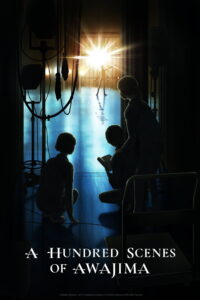
All of which brings us, finally, to A Hundred Scenes of Awajima, streaming on Crunchyroll, the anime adaptation of the manga. The manga suffered a bit, as Shimura had not yet quite matured into the storyteller we saw in Even Though We’re Adults. This anime adaptation is the best adaptation of a Shimura work to date.
Artistically, the animation captures her watercolor pen art in a way that feels true to her work and also somehow feels realistic. Each episode begins with a “scene” that moves into a story that is multi-layered. First-year students, their parents, the teachers, and predecessors all move through the school in one time or another. Shadows from prior years’ successes and failures, loves and losses are all presented as they impact the present. The present, however is treated differently. Students, current and former, try to heal wounds, and change the culture for the future. We see girls who were loved and hated, girls whose family was supportive, and those who were not.
The story begins and ends with a girl who was bullied into leaving the school and ultimately taking her own life. It’s a sad story made sadder when you see how strong she was, and how good she might have been. That shadow lingers into many other of the stories, even when the girls in them don’t know that.
These are the “one hundred scenes” of Awajima. A place, a person, a story may look different when seen from another angle, but Awajima, like it’s real-world analog, is still there. Still dealing with the good and the bad.
Ratings
Art – 9
Story – 8
Characters – 8
Service – 0
Yuri – 2?
Overall – 9
I would never suggest this story for someone new to anime, but if non-linearity and beautiful art is enough to interest you, I especially recommend watching the anime before reading the manga. It’s easier to follow for having been simplified a bit. One Hundred Scenes From Awajima is streaming now, on Crunchyroll.