 by Burkely Hermann, Guest Reviewer
In this 87-minute mature sci-fi fantasy film, with space opera, comedic, and romantic elements, an introverted princess, Saira (voiced by Shabana Azeez), goes out of her comfort zone of safety and shelter. She leaves her home planet of Clitopolis and travels outside the confines of protected Gay Space so she can save a woman that means everything to her.
This Australian film, Lesbian Space Princess, is more than a fun ride, that can be comedic and heartfelt at times, involving Saira confronting her anxieties. At first, I was drawn toward this film through the media that influenced it. On social media, it was noted that the film was directly inspired by six animated films and three live-action films. This includes Steven Universe: The Movie and Revolutionary Girl Utena: The Movie(otherwise known as Adolescence of Utena). The film’s directors, Emma Hough Hobbs and Leela Varghese, praised the first film for its emotional truths and space lesbians (Garnet and Pearl for one). They said that the second is a “great reference” for queer anime that hits hard emotionally, while “not taking itself too seriously, and…[is] really clever with its budget.”
They further listed the film Blue is the Warmest Colour, which is briefly referenced in the film, and an adaption of a comic by Jul Maroh, as an inspiration. In their view, although that film does not have the best lesbian representation, it has remained influential to many queer people. They note that Lesbian Space Princess is, in contrast, “a more authentic and positive take on queer culture.” Although the Steven Universe film is only a few years away from being eligible for the National Film Registry (it will be eligible starting in 2029), it remains a cultural touchstone in many ways, not just for fans, but for queer representation as a whole.
In a Q&A with Hobbs and Varghese, they further described the film’s world, and character design, as influenced by Sailor Moon, Utena, Invader Zim, and Adventure Time, adding that “LGBTQIA+ flag colour schemes” are shown throughout the film. Both directors stated that they were inspired by French lesbian filmmaker Céline Sciamma, Canadian screenwriter Emma Seligman, and gay Korean-American screenwriter Andrew Ahn. Sciamma is known for, among other works, her acclaimed and majestic historical drama film, in 2019, entitled Portrait of a Lady on Fire (Portrait de la jeune fille en feu). Seligman is a queer filmmaker known most recently for the satirical black comedy, Bottoms. Ahn, on the other hand, had his directorial feature debut with a crowdfunded film, Spa Night, set in Los Angeles’s Koreatown, about a closeted, gay, and Korean-American teenager named David.
The queer themes start from the get-go. The film begins with Saira’s scrapbook for her girlfriend, Kiki (voiced by Bernie Van Tiel), who have only been together for two weeks. She notes her struggle with getting attention since people are obsessed with her two moms, Queens Leanne and Anne, voiced by Jordan Raskopoulos and Madeleine Sami respectfully. These queens are the rulers of the lesbian planet of Clitopolis. The on-the-nose name makes me think of C.L.I.T. (Center for Lesbian Information & Technology), a collective lesbian archive in the 1996 classic queer film, The Watermelon Woman. Saira is determined to not be single, even though she is scared to go anywhere, or do anything, while Kiki is an adventuring bounty hunter. Her girlfriend cannot take this anymore, not liking how clingy she is and for openly expressing her emotions (mainly through crying and apologizing), while admitting that Saira is “good with her hands” in bed.
Kiki leaves despite Saira’s pleas. It turns out that this is happening on an open stage that anyone can observe. It’s part of her parents’ birthday celebration for her, parents who forget how old she is. Saira is the lesbian space princess in the film’s title. The crowd and her parents pressure her to summon her labrys, a lesbian feminist symbol referring to self-sufficiency and strength, the same symbol which Marceline’s ax bass likely resembled in Adventure Time. However, when Saira is unable to summon the labrys, everyone declares that she is useless and worthless, including her own parents.
Following this disastrous celebration, the film’s main conflict begins. While Saira is feeling sorry for herself, falling into despair, her now-ex-girlfriend, Kiki, is kidnapped by a group of three beings, Known as the Straight White Malians, and voiced by Mark Bonanno, Zachary Ruane, and Broden Kelly respectfully, they kill the three women she is having sex with. These beings have been ostracized in the galaxy. They have one goal: to have her as bait so they can use Saira’s royal labrys to draw in women to their “chick magnet.” These characters are not only the film’s villains but are supposed to resemble boring and awful straight White men, particularly male podcasters. Although the film could have been written differently without them, their presence drives forward the story.
Due to their threat, Saira is forced to rescue Kiki. She leaves her protected surroundings and rolls into a “problematic ship” (rather than a perfect one) that is male-centered, sexist, and racist, and voiced by Richard Roxburgh. Her galactic adventure begins. After she exits the Safety Bubble (voiced by Reuben Kaye) surrounding of Gay Space, she crash-lands on a planet. Soon thereafter, she meets Willow (voiced by Gemma Chua-Tran), a bisexual free-spirited goth girl, songwriter, and musician, who uses they/them pronouns.
Willow’s entrance makes the film more exciting, rather than a sad adventure, especially when Willow and Saira begin flirting with one another and enjoying one another’s company. Willow sometimes sings her heart out, often playing her guitar, almost akin to Marceline the Vampire Queen in some ways, but different in many other ways. Willow and Saira bond in a deep way, especially after Willow explains that she escaped the horrifying prison of gay pop and went indie instead. This part of the film’s exploration of allosexuality.
Willow serves as a positive influence on Saira, who falsely believes that she is nothing without Kiki. She even begins a makeover montage, which pales in comparison to the montage involving Adora, Glimmer, Catra, and Scorpia in the “Princess Prom” episode of She-Ra and the Princesses of Power. Afterward, Saira and Willow enter S Club, that is run by a drag queen named Blade (voiced by Kween Kong). At first, Saira is terrified, especially after Willow leaves her side when they enter the club.
I liked how the film depicts her as confronting her inner demons, manifested as a dark version of herself, continue to haunt her, telling her she isn’t good enough. This includes her moms, who hate single people. This first comes to a head when she helps DNM Girl (voiced by Demi Lardner), with her words about loving someone ringing true to how she feels about Kiki. Blade, a drag queen whose real passion is weapons, declares that you have to empower yourself. She tells her that she is not broken, encouraging her to begin mediation.
Thus begins one of the film’s best sequences, when she enters her mindspace, overcoming her strong mental barriers that are holding her back, with trauma from bad friends, abandonment, and parents which are neglectful and arguably emotionally abusive. She is able to unlock her labrys, that is chained and locked inside this mental space. A ball of light comes from between her legs and in Utena-like fashion, the labrys comes out of her lower body as she leans back, moaning in ecstasy. At that moment, when she feels that she won, Blade reveals her true goal. She yanks away this special weapon, almost equivalent to a heart-sword in Utena, from her hands.
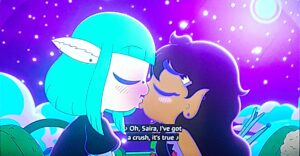
After a battle, in which Willow saves her with a pineapple, she ends up beheading Blade, who had tried to kill her. Later on, back on the ship, Willow sings the obvious in a song about her having a crush on Saira. They end up kissing, a scene shown at the beginning of this review, and have sex with one another, after clicking the incognito button, so the ship can’t judge them. This relationship does not last. The lesbophobic Malians, in their man cave, continue to hold Kiki hostage, dangling above an acidic, toxic brew, with terrible jokes and accidentally killing a thespian, with one Malian falsely thinks is a lesbian, followed by a discussion of The L Word. They plan to killing Kiki sooner, since she keeps arguing them and calling them out, as she begins to slowly lose it, with many failed attempts to escape. In a heartbreaking scene, Saira dumps Willow, friend-zoning her, believing that she can get back with Kiki.
In the film’s final part, Saira saves Kiki at the last second, with the ship inspiring her to go forward. In the process, she destroys a phallic ship which resembles male genitalia. She gives up a personal part of herself, her labrys, in order to save Kiki. Despite this, and the fact she has changed on this journey, Kiki falsely declares nothing has changed. She leaves the man cave like a jerk, remaining emotionally unavailable. She is barely even thankful she was saved nor does she recognize the journey Saira had ensure in order to get there. As a result, her labrys fades away. Doubts and mental blocks cause it disappear. While Saira’s inner insecurities take over at first, she soon defeats them, realizing that her parents are bad and that Kiki is a “narcissistic asshole.”
Using her inner power, she transforms, in a somewhat magical girlesque way. Her crown moves to another part of her head and she summons her labrys once more. She leaves the suffering Malians on their own, especially after their “chick magnet” ends up killing a woman. She proposes they date one another and they take up her suggestion, beginning a polyamorous throuple. What follows is one of the best scenes of the film: she leaves behind Kiki, despite her ex-girlfriend’s continued claims that she is still in love with her, declaring that she can’t be with her anymore. The film ends happily: there’s family therapy, Willow writing a hit album about her, and Saira beginning new adventures with Ship, which is now an ally. She has no partner but is confident in herself instead.
Even before the film released in the U.S., the queer themes were evident. The film’s directors described their film as a queer love story, championing queer voices and people of color, seeing it as a step forward for “queer voices in adult animation,” and describing the film’s characters as epitomizing queer fashion trends, with a focus on self-love and self-acceptance. They hoped that the film would become an example for queer art to be seen “as more commercial and valuable” than in the past, particularly in animation. The film’s directors were committed to continue telling funny queer animated stories which provide a “safe space for the community,” including a possible sequel, perhaps in a game format. More than that, the film’s message is unique.
Many films like Lesbian Space Princess would have Saira begin a romantic relationship with someone, either involving, in this film’s world, Saira resuming a relationship with her controlling ex-girlfriend (Kiki) or with her free-spirited rebound (Willow). Whether reviewers picked it up or not, the film has the message that you can be confident by yourself, with self-love, rather than having to be with someone. Similar themes of self-empowerment are a key part of Steven Universe, while anime series, particularly A Place Further than the Universe, Wandering Son, and Skip & Loafer, focus on self-discovery.
Furthermore, the film’s diversity is reflected in the voice cast, which is primarily composed of Australian actors, and a few New Zealanders like Madeleine Sami. Specifically, drag queen Kween Kong, lesbian actress Madeleine Sami, trans lesbian comedian Jordan Raskopoulos, bisexual comedian Demi Lardner, and drag artist Reuben Kaye voice characters. This film was the first film voice role for Raskopoulos and Sami. Both had voiced characters in animated series before. Sami voiced characters in multiple episodes of Bro’Town, which featured a faʻafāfine school principal. Raskopoulos provided voices in the animated series The Team. For Lardner and Kaye, this film serves as their first-ever voice roles. This was also the case for Shabana Azeez, who is of Fujian and Indian heritage.
– Ratings
Art: 8
Story: 7
Characters: 8
Service: 4 or 5 (some occasional nudity at certain points in the film)
Yuri: 7 (there’s at least two sex scenes shown off screen, plus multiple kisses, blushing, etc.)
Music: 8
Overall: 8
Postings on social media have indicated that this film may be continued in some form. If it is continued, I’m not sure what storyline will be followed, since all the conflicts were already resolved in this film. I wouldn’t say that Lesbian Space Princess could ever become a “cult classic” as some have claimed. Nor would I say it is a “serious arthouse drama,’ is “peak queer comfort cinema,” or simply delightful, splendid, and unapologetically queer. Some might say it “behind the curve” by echoing Adventure Time, Steven Universe, Twilight, BoJack Horseman, Futurama, and Rick and Morty, or that it is designed for those once involved fan discussions on AO3 or Tumblr. Those discourses are not to be simply sneered at and pushed away as some would like to do. Lesbian Space Princess is worthwhile queer film in its own right, with its own charm and overt queerness, even if it is irreverent at times, or clunky at others.
Lesbian Space Princess is presently available, for purchase or rent, on PrimeVideo, AppleTV, Google Play, and Fandango at Home, and streaming on Fandor. The film’s Blu-ray can be pre-ordered from Umbrella Entertainment, with a collectors edition also available for pre-order.
Burkely Hermann is a writer, researcher, and former metadata librarian. His reviews can be read on Pop Culture Maniacs or his personal WordPress blog. He can be followed on Instagram, Bluesky, or on Mastadon communities such as library.love, glammr.us, genealysis.social, and historians.social.