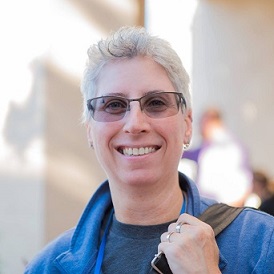
by Eleanor Walker, Okazu Staff Writer.
Erica is away, so the staff get to play and I’d like to introduce you all to the story of Marie Maitland, Scotland’s 16th century Sappho.
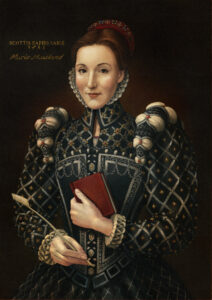
I first learned of Marie a few years ago when I discovered that the National Portrait Gallery of Scotland in Edinburgh was displaying an imagined portrait of her, commisioned by historian and translator Ashley Douglas. Ashley discovered Marie’s lesbian love poetry hidden in the depths of a manuscript long attributed to her father, known as “The Maitland Quarto.” This manuscript is a collection of poetry published in the Scots language (N.B. Scots is a related but separate language from Scottish English, the dialect of English spoken here in Scotland. Both English and Scots are West Germanic languages, unlike Gaelic which is in a completely separate family and very different to both English and Scots. It’s most closely related to Irish and Manx, and then more distantly to Welsh, Cornish and Breton.) Scholars have debated over the years who actually authored the poems in the manuscript, with Marie generally considered to be the scribe for the majority of the manuscript. It wasn’t till much later that Marie’s potential authorship was examined, although one scholar who published many of the poems in 1786 suggested that Marie had at least some involvement in writing the poems, not just transcribing them. Naturally of course other male scholars disputed that a woman could possibly have actually written any of the poems.
Scotland in the 16th century was not a kind place for women of any social class. This is the time of the Protestant Reformation, spearheaded by John Knox, the author of the magnificently titled and utterly misogynistic, even for the era, screed “The First Blast of The Trumpet Against The Monstrous Regiment of Women.” If you were lucky enough to make it out of childhood alive, your best hope if you were middle to upper class was to be married off to a man who would treat you even a little kindly. After that, your job was to get pregnant and produce a male heir. This is the destiny which awaited Marie Maitland too, until fate intervened. The youngest of her sisters, she watched her sisters be married off one by one and no doubt had consigned herself to the same fate, until her father went blind and required a scribe. This afforded Marie a degree of independence and self sufficiency almost unheard of for women in this era, and allowed her to pen her remarkable poetry. Poem 49 in particular was almost certainly written by Marie, and reads as follows (Original Scots language followed by English translation):
And thoucht adversitie ws vex
Yit be our freindschip salbe sein
Thair is mair constancie in our sex
Than evir amang men hes bein
And though adversity us vex
Yet by our freindship shall be seen
There is more constancy in our sex
Than ever among men has been.
If that’s not written from a lesbian point of view, I don’t know what is.
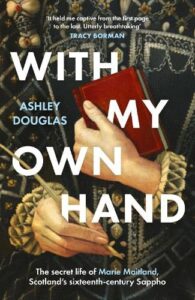
Fast forward to summer 2026, and Ashley’s book is finally available. It’s been one of my most anticipated books of the year and I’m delighted to say that it was as enjoyable as I hoped it would be. Ashley herself is a lesbian and in my opinion, the perfect person to bring this tale to a 21st century audience. Queer people and queer love have always existed, and Marie’s story is a remarkable one of resilience and trying to fit into a world which was not made for her in the slightest. Earlier in the 21st century, Scotland was the first country in the world to introduce an LGBT+ inclusive school curriculum, which includes Marie and other queer figures from Scotland’s history. Her life is an important part of our history, and I’m very pleased that I’m now able to share her story with Okazu readers all around the world. You can order your own copy of “With My Own Hand” from bookshop.org
The only known copy of the Maitland Quarto is in the Samuel Pepys collection at the University of Cambridge. I’d love to see it come home to Scotland one day.
Online sources:
https://www.nationalgalleries.org/art-and-artists/features/marie-maitland-scotlands-16th-century-sappho
https://en.wikipedia.org/wiki/Marie_Maitland