 Content note — this manga deals with serious subjects, including: suicide, depression, transphobia, and domestic abuse.
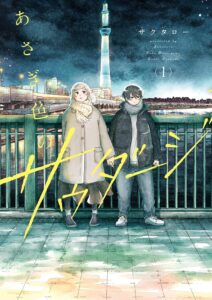
My name is Lily Fauna, I’m 44, gender fluid, pan, poly, and plural, and I write about anime, manga, and yuri at Deer In The Lilies, as well as on my Bluesky. I often enjoy browsing Japanese bookstores and blogs for new yuri titles to discover. I’m teaching myself Japanese so that I can find titles that don’t — and may not ever — see an English release. I was immediately drawn in by the sharp lines and watercolor tones of the cover art, and was only more intrigued when I read the story summary that hinted at darker subject matters, which I’ve been finding myself drawn to more and more recently. I’m extremely glad I lucked across Sakutarou’s Asagiiro no Saudade (Pale Blue-Green Color Saudade), because I might have missed out on a manga that proved to be very meaningful to me otherwise.
The title comes from a Portuguese word for a profoundly nostalgic longing for something beloved yet absent, and that’s the feeling that pervades the beginning of this book. Fujisawa Ren, who moved from a small country town to Tokyo in hopes of being able to blend in with the crowd — to escape the feelings of not belonging, of isolation, of needing to fit into society’s neat little boxes — find themselves on the railing of a bridge. Before they can jump, though, they get tackled by Matsuri, a friend who Ren hasn’t spoken to since their last year of middle school and a fight that drove them apart.
Taking Ren to her apartment, Matsuri provides food and warmth and company and they reminisce about the last thirteen years. Matsuri reveals that she’s divorced and has been forcibly separated from her daughter back home. Realizing that the last time she felt any purpose in life was when creating a manga together in middle school, she suggests that they try to revive that goal.
And, if they don’t succeed within a year, then they should die, together.
This sword of Damocles hangs over the head of the protagonists as they move in together, grow closer, and support one another. The time limit adds a sense of urgency, but doesn’t overwhelm the tone of the story. Despite its dark start, this manga is actually full of hope and kindness and love.
Sakutarou’s bold line work and intricately detailed backgrounds are some of the best I’ve ever seen. They breathe life into the characters and make you feel like you’re on the streets of Tokyo with them. Expert use of composition also viscerally captures the characters’ emotions; as an example, a large panel features two bathroom entrances in a convention hall, monolith-like and imposing, with Ren facing the impossible decision of which one to use. Earlier, in a two-page spread, the air around Ren is full of words, thick and black and choking. Labels, slurs, harmful remarks and well-intended questions race around in their head — until, on the next page, it’s all dispelled by a hand on the shoulder and kind word from Matsuri. This is Sakutarou’s first major work, though they have a second manga currently in serialization, but their art blows me away with every panel.
Which brings me to one of the things that I love most about this manga — Ren is explicitly and textually nonbinary (At one point they admit that they “have the mind of both a boy and a girl.”). It’s extremely rare to see trans representation in anime and manga, let alone deep, well-developed characters like Ren who are outside the gender binary, so it being so plainly stated feels refreshing. Ren’s queerness drives much of the story, but it’s s not what the story is really about. Self-realization, found family, and the power of creation are the themes that Asagiiro no Saudade is filled with. It’s a story about finding hope — and love — in unlikely places, and it really resonated with me for that.
Asagiiro no Saudade has become one of my all-time favorite manga. It’s beautifully drawn, full of heartwarming moments and twists that had me in tears, and is acutely queer. I hope someday it will see an English release so more people can experience this masterpiece.
Art – 10
Story – 9
Characters – 9
Service (level of salaciousness) – 3 (what nude scenes there are almost feel more like body horror)
Yuri – does it count if one of the couple is nonbinary? if so, then like a 6
Queerness – 9
Overall – 10