Archive for the Artists Category


Yuri Manga: Kanojyo no Sekai (彼女の世界)

March 29th, 2012

Well this book was kind of a surprise. You know how I’m always ragging on Hakamada Mera-sensei for writing the same old Story A and never really getting past that? Well, in Kanojyo no Sekai (彼女の世界) she does and, um, I kinda wish she hadn’t. (OMG, Erica, you are never satisfied!) ^_^;

Konno Natsuki has a run-in with Hikawa Hidari on the roof – that is, they actually collide with one another. They untangle notebooks and knees and return to their classroom, where Natsuki realizes she has one of Hidari’s notebooks. No big thing, really, except that the notebook contains an erotic novel. Natsuki can’t stop reading the novel so, when the teacher calls on her to stop reading and takes the notebook away, she’s worried that the teacher will read it…and Hidari is worried that Natsuki will throw her under the bus. Natsuki retrieves the notebook, never mentioning Hidari and waits on the roof to return it to the other girl. She won’t say anything, Natsuki promises, on the condition that Hidari continues to write the novel. And so they meet most days, up on the roof.

Hidari is not a well-liked girl. Her name is weird (who names their kid “Left”?) and she’s not personable or outgoing. Natsuki has friends, but she begins to blow them off to go to the roof and read Hidari’s work. She find the story stimulating, but also wants to know a bit more about the author. To make matters worse, Natsuki starts to have sexual fantasies about Hidari, but when she finally acts on one of them and kisses the other girl, she is rebuffed.

The novel changes, too. Now, not only is the protagonist thrown into a variety of sexual situations, a second character has appeared. Hidari confirms that it’s love between the two.

The class trip arrives, just in time to make things awkward for Natsuki and Hidari. Natsuki invites Hidari to join her group, but her friends nix the idea. Hidari goes off with another group and Natsuki can’t even manage to sit with the other girl for the trip. Natsuki sees Hidari from afar on the trip, having fun with her group, she’s overcome with jealousy and starts to cry. When she looks up to see Hidari sitting there, she confesses that she likes her. Hidari says nothing but, quite unusually, she smiles. That night, when all the other girls have gone  to another room to have pillow fights and hang out, Hidari and Natsuki make love.

Although, Natsuki confides in us at the end, Hidari has never said she loves her back, she’s content to join the other girl in their world up on the roof.

It’s a strange, but not insane story, made uncomfortable only really by the fact that it’s set in high school and that it’s by Hakamada-sensei, whose art is not really well suited to more explicit scenes in my head. There’s nothing super explicit, and the characters are not drawn in a way that is inconsistent with her art or with their age or anything that might otherwise make one cringe.  In every other way, it’s a pretty good doujinshi-like story.

Ratings:

Art – 6 on general appeal, but for Hakamada’s art 8
Story – 7
Characters – 7
Yuri – 10
Service – 7

Overall – 7

The heads aren’t even huge anymore. It’s just that…it’s Hakamada-sensei’s art and the idea of sex in her work seems so…odd.  ^_^


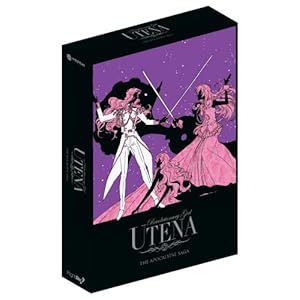
Revolutionary Girl Utena The Movie Anime Dub Review (English)

March 23rd, 2012

Happy Guest Review Day! I know I have not yet reviewed the third box set of Revolutionary Girl Utena, much less the movie, but I will. I’ve just been a tad busy. In the meantime, here is a special Guest Review from Okazu Superhero Eric P. on, specifically, the dub of the Revolutionary Girl Utena The Movie, since as you know, I do not watch dubs.

I hope you’ll all extend a welcoming hand to Eric, as always. Enjoy the review!

In my review for the Revolutionary Girl Utena TV series’ dub, I pretty much summed it up as a dated mixed bag at best. I would so far as say that Nozomi/RightStuf should’ve made the 5.1 Japanese the DVD’s default language, as they’ve done with most of their bilingual releases, rather than having to go to ‘Setup’ to make it so. However, and most fortunately, the same would not be said for the movie’s dub. Even though it is the exact same cast as the TV series, the Revolutionary Girl Utena The Moviedub production is a considerably vast improvement.

A variety of reasons comes into play here. It may have had to do with the animation having more vibrant life to it, and thus there’s more vibrant life to the acting since there was more to play off of. They had an ADR director for the movie who was not the same as the guy who did the TV series, so no doubt that was a huge help. Perhaps it  helped even more that Kunihiko Ikuhara himself came to the studio and offered his feedback and personal direction on some key scenes.

One of the key reasons was that all the weak-link actors trimmed either to just a brief few lines or just brief mute appearances. For instance, the flat-voiced English Nanami just cameos as a short-lived moo-ing cow, so nothing grating there. But for those with high expectations, there can still be some nitpicks. Saionji’s voice can be considered the least good performance. And Miki still sounds older for his age for anyone who finds that bothersome, but the acting itself still isn’t bad and, since he’s supposed to be mature for his age it still works in its own way.

In the end, for all the TV series dub’s weaknesses, by comparison the dub for the movie is a much more solid effort. The overall cast complements and adds to the surrealistic atmosphere of the story, and the actors convey all the necessary feelings through their characters as much as they should. One of the best examples is the scene where Utena and Anthy are in bed together—I thought the mood was really right for that moment, and it’s consistently reflected in all their scenes together. All things considered, it still stands well today, and I would so far as believe it’s interchangeable with the Japanese track; I can watch this amazing and excellent movie in either language and still appreciate it on the same level. So, if you’re a dub fan or are at least open to dubs but shied away from watching the movie in English due to the TV dub’s mediocrity, there’s nothing to be afraid of here. Give it a try if you’re inclined.

Ratings:

Overall – Well done if not so far as being totally perfect. To heck with it, I give it a 9.5

Thank you Eric for the review. Well folks who’ve seen both -what do you think? Does the dub hold up as well as the original track? All opinions welcome in the comments.


Oniisama E…Licensed.

March 20th, 2012

I cannot believe I am about to type this.

This is not rumor and I have done some due diligence, and this appears to be actually legit: Oniisama E, (Dear Brother) Ryoko Ikeda’s classic high school drama…has been licensed by streaming site ViKi. You can find it here: http://www.viki.com/channels/5849-dear-brother The license is global except Italy and Japan. Rose of Versailles has not been licensed by ViKi and they were told it is not available.

I will say four words about this: Sainte Juste. At last.

The ViKi CEO has added a few words about their licenses to their blog. If you, like me, had some questions, check it out.


Yuri Manga: Seasons (シーズンズ)

February 12th, 2012

At the end of last year, I voted a trio of Takemiya Jin-sensei’s works in as the #1 manga of the year. Of those three, Seasons (シーソンズ) is quite possibly my favorite.

Like so many of my favorite manga artists, Takemiya-sensei started her career as a doujinshi artist. There are several ways in which a doujinshi artist can transition into a professional career, but the one that seems to be the most effective is this – draw original work. Manga publishers are less likely to want to publish look-alikes than, say, US book publishers, who so often are running after the latest trend, rather than creating the next one. Artists I first encountered as doujinshi artists include Hayashiya Shizuru, Morishima Akiko, Morinaga Milk, Nanzaki Iku, Nishi UKO, Mitou Kana and Kitao Taiki and many, many others. There’s only one, in fact that I haven’t seen make the transition to pro that I expected to, and weirdly, he’s gone the other way, from really well-conceived derivative serials to kind of crappy porn. Oh well.

So when I saw Takemiya Jin, who I have been following for years as Junk Lab, take the leap into the pro world, I was thrilled. For her – and for us, the readers. She’s got great short-story ability, honed by years of standalone doujinshi and can carry off a series with some chops.

Seasons is a collection of several doujinshi…a few of which I have. It gives the collection a feeling of meeting old friends and making new ones in one book. ^_^

The first few chapters follow Shirai-san and Kurozawa-san as they do the usual fall in love, be incoherent about it, not get together and get together in the end. Nothing ground-breaking here. What I found especially good about this series is Shirai-san’s friend, Asaki, who (maybe) inadvertently causes a massive crisis between the two main players. Asaki, it turns out, has a female lover and a whole life that Shirai-san is unaware of. And, Asaki is clearly part of the lesbian culture in Japan, as she and her lover both use slang in their conversations. Asaki gave it away to us, the readers, when she tells Shirai-san that Kurozawa-san is “nonke” (i.e., straight.) At that point, my slangdar pinged. Straight people do not refer to each other as “nonke.”

Let’s back up for a sec. I believe I’ve referred to this before, but here’s the deal about “nonke.” When a person is part of a culture in Japan, they are referred to as being whatever”ke” or “ka”, for instance a person who does Judo is a “Judoka.” You may remember we discussed the implication of “Kocchi no ke” in relationship to “Honey Mustard,” Morishima Akiko-sensei’s story for Yuri Hime that was collected into Ruri-iro Yume. “Kocchi no ke” is pretty much analogous to an American gay person saying “that person is ‘family.'” (The “ke” kanji is similar, where “ke” or “ka” 家 – as in mangaka 漫画家- means “house” as in the “House of Windsor.”)

So, “nonke” (ノンケ) is non-“ke,” i.e., “not one of us.” It’s use always implies that the user is, by default, “one of us.” So, when Asaki calls Kurozawa “nonke,” it’s pretty much saying that she is ke.

Asaki and her lover also use reba, neko and tachi, all slang words. For definitions, feel free to check out my Okazu Glossary of Terms. (I just added “nonke” there, as well.)

Following this story are a number of shorts, one- and two-shots that deal with a variety of “Story A” scenarios, and a few stories of couples dealing with a crisis in their relationship. A multi-part story about a girl falling in love with her class representative is a pile of well-used tropes (dress them up, then get jealous of them, the group date gone bad, misunderstood feelings, etc) that was nonetheless charming.

Almost the entire second half of the book is a look at a high school girl and a middle school girl who meet on the train (when a pervert starts to harass the younger girl) and their relationship over the next year. Unsurprisingly, the younger of the two is relatively immature, and causes no end of difficulties, but ultimately, there is a happy end that allows for the presumption of a happy future.

As I said in my write up of Takemiya-sensei’s work for the Top Ten list, the inclusion of gay slang in this book is one of the qualities that catapults her work to the top for me. Anyone can write a Yuri story, but it’s still pretty rare when we get a Yuri story with visible ties to Japanese lesbian community.

Ratings:

Art – I’ve always liked her art, so for me, 8, but your mileage may vary
Story – Variable, we’ll round it to 7
Characters – In most cases, I would invite them over for lunch – 8
Lesbian – 10
Service – 2, there’s some nudity and presumption of sex

Overall – More than the sum of its parts, Takemiya-sensei’s Seasons is a 9.

I’m so happy she’s gone pro. Here’s to more great work from her!


Fate Zero Anime, First Season

January 29th, 2012

There’s Fate Zero, then there’s the Fate Zero in my mind.

Fate Zero is a prequel to the Fate/Stay Night Visual Novel about which I know and care nothing. I only care insofar as the Fate Zero anime was mostly introduction and exposition at this point, and I’m hoping it holds together as a series on its own.

The story is, relatively speaking, simple – 7 great heroes/evildoers of the past are reincarnated with even greater powers than they actually had when they were merely men who achieved notable things, and they each have a master who wishes to find the Holy Grail to achieve some goal, selfish or otherwise. Who the heroes are, is the most interesting part of the series to me, and how their myths are rewritten to determine their powers.

I was asked some weeks ago about my interest in the reincarnated heroes, as I’ve mentioned here in the past that myths are typically a good hook for me. Since these heroes aren’t really connected to their past incarnations in any meaningful way, these are clever and some good fun, but I don’t actually feel a connection between one and the other. Nonetheless, I enjoyed the heck out of this series – even when large chunks of episodes were merely expository conversation.

Let’s start from the top – the heroes themselves.

Lancer was a hoot for me, it’s not often I get to see Fionn mac Cumhaill in an anime. Or, ever. When people think of Irish heroes, they always default to Cuchulain. I liked how he was noble, but his master is a prick. A story from his perspective would be much different than the one from Saber’s.

Rider‘s really the hero here. I’m pretty sure that Alexander the Great didn’t look anything like that great huge mountain of a man, but I loved the interpretation of “Great” as meaning looming large in every way. Rider’s what you think of when you think “Age of Heroes;” great huge muscular men, laughing as they fight, drink and die. (Except for Cuchulain, I think he’d be a mope no matter what he was doing.) Rider’s master is weak, but not bad, and having Rider as a servant will man him up pretty fast, so if he survives, it’ll be good for him. Poor bastard needs it, with the name Waver Velvet.

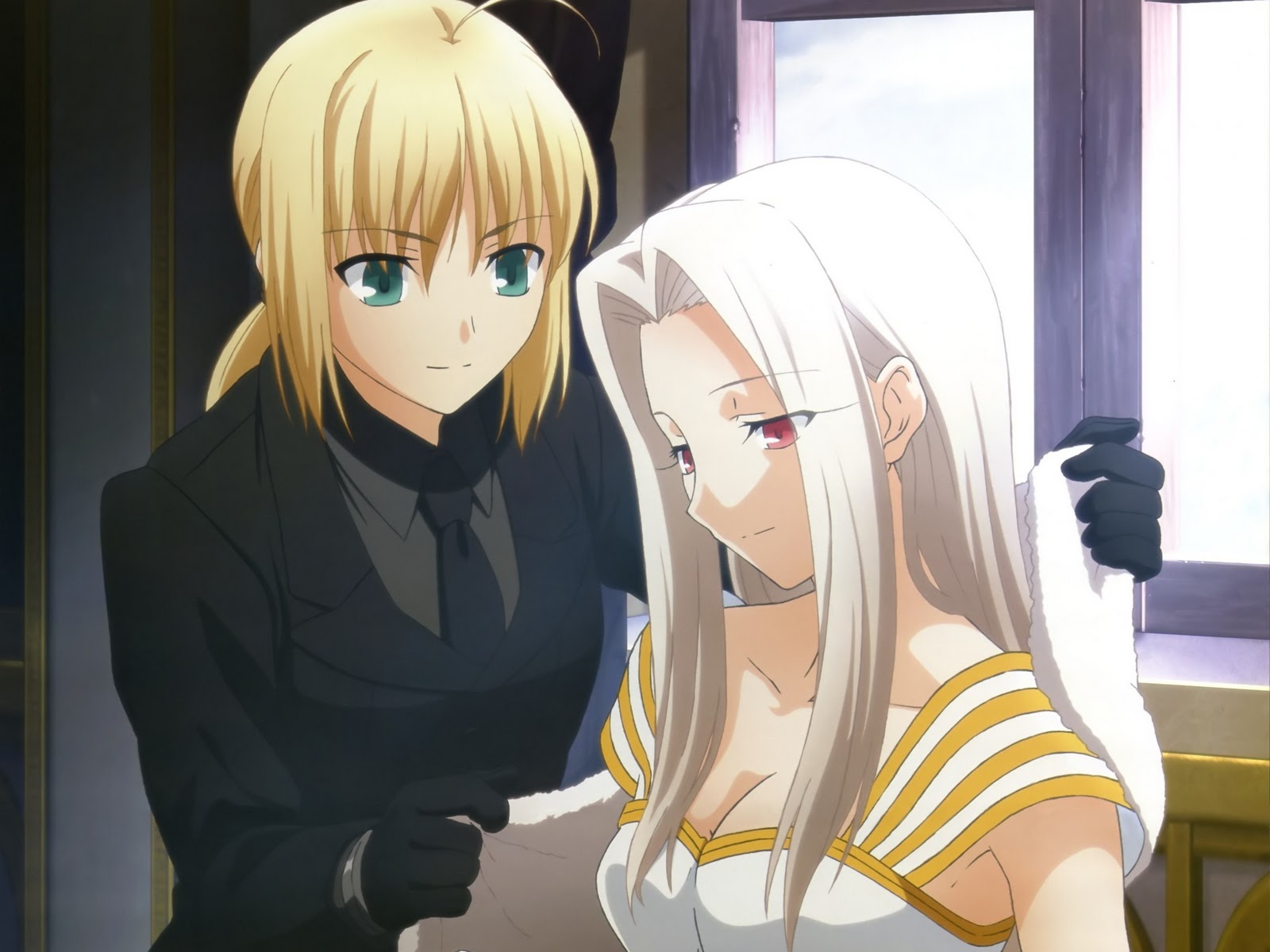
Oh Saber. Who can’t love the idea of a conflicted, tortured King Arthur? Everyone tortures Arthur differently. Whether you force him to deal with a wife who is having an affair, or make him have an affair himself, or turn him into a woman who had to hide his gender, or even turn him into Sailor Moon, Arthur is a splendid tabula rasa on which to draw. He’s timeless. Even though Saber’s master is the utterly dull Kiritsugu, we’re supplied with a Guinevere for him to adore in the person of Irisviel. I have no doubt that most of you were writing little stories in your head about Saber and Irisviel, as I was.

Caster is half of the best comedy team I’ve ever seen. He and his master, voiced absolutely deliciously by Ishida Akira, were perfect. Gilles de Rais is the name of a man so loathed, so envenomed by the ages that I’m kind of inclined to think he probably didn’t do any of the things he was accused of doing. You all know Bluebeard, right? Well, you should. I have to tell you, I *loved* his speech about “What do I have to do to be punished by god?!?” That was almost as good as Saber on her bike for me.

Beserker is Lancelot? Well, that’s just dumb. Lancelot was no beserker, I can tell you. They should have picked someone Norse. It doesn’t make any sense to have a Berserker Lancelot. Gawd. Now I’m just depressed. ( I retract this. Berserk Lancelot does make sense. And it caused a fraught conversation in the second season between Saber and Berserker.)  But Berserker isn’t the interesting half of this story anyway. Kariya, his master, is the most pathetic of all the masters. (Pathetic in the sense of inviting pathos.) You really have to root for him, because if you don’t you are consigning at least one, possibly two little girls to a eternity of foulness, which means you’re a heartless wretch. Fooey on you.

Gilgamesh is Archer and a delightfully wtf interpretation of the myth. I have no idea how they got that trash-talking asshole from the legend of Gilgamesh, but I look forward to his destruction. Kotomine is a snooze – I was so happy Gilgamesh thought so too. What a BORE.

If you don’t grok Assassin the moment they mention them, you fail in your study of legends, myths and secret societies.

The animation is stunning – we expect no less from Type Moon. The characters are well drawn, well-acted and so far, at least, really well written. The only complaint I have is that the first season ends where the plot begins and if they don’t actually give me a story to hold on to, I’ll be peeved, since I have no intention of ever playing any game/reading any Visual Novel.

Since I don’t care about the Visual Novel, or the series as a whole, I’ve cheerfully rewritten the story in my head. Of course Irisviel and Saber get to be together, duh.

Ratings:

Art – 10
Story – 6 It’s been all character all the time, which has had moments, and also been a lot of blah blah blah.
Characters – 9
Yuri – 0, but in my head, it’s more like 7
Service – 1 on principle

Overall – 7

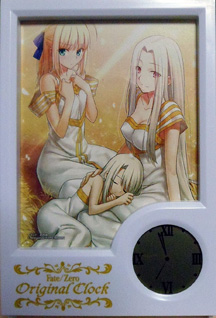
I await Season Two with the faint hope that Kiritsugu dies, Saber survives the war with Irisviel, and they live happily ever after, just like on this clock I got from Young Ace magazine.

Also, I wonder what the fallout of the absurdly priced Blu-Ray release will be. I can’t imagine too many American fans coughing up that usurious a price for what amounts to light entertainment.