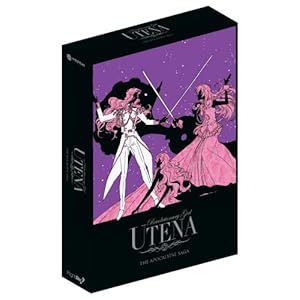
 Included with the third Revoutionary Girl Utena box set from Nozomi/RightStuf is the Revolutionary Girl Utena Movie: Adolescence Of Utena.
I credit this movie, specifically, with being the beginning of my “career” as a spokesperson for Yuri. Because of my interest in the movie, my discovery of a Yoshiya Nobuko reference in the movie manga, and my interest in the literary and artistic references drawn upon for the series, I ended up being invited to present this movie at the Frameline Film Festival in San Francisco, the British LGBTQ Film Festival and the Tampa LGBTQ Film Festival back in the early 2000s. I was able to meet and interview Ikuhara Kunihiko at Big Apple Anime Festival and because of this movie, CPM was an early sponsor for Yuricon events. I have a lot to thank this movie for. Not least of which is for being a fantastic movie.
It is a fantastic movie, with extraordinary visuals, and two of the most spectacular scenes I have ever seen on a screen – the dance on the dueling ground, and the castle car. As much as I consider the TV series a more subtle and sophisticated creation, its the movie I watch more often.
I find I have never once published the intro I gave this movie a decade ago when it first came out in English, so rather than explain to you what I said, here is the actual intro I gave the film, in front of hundreds of people who liked anime and the series…and thousands of people who had no idea what the hell they were getting in to.
In 1994, on Sundays at 7 PM, the Shinjuku Ni-chome, Tokyo’s gay and lesbian district would come to a screeching halt. Why? Because for the first time ever, Japan was watching a lesbian couple on their TVs, as part of the popular animated series, Sailor Moon These characters, Sailor Uranus and Sailor Neptune, were very clearly portrayed as a couple – with personal issues to work out, as well as greater ethical dilemmas – all within a framework of defeating the Monster of the Day as sailor-suited magical heroines.
The director of that pivotal season of Sailor Moon had instructed the voice actresses to play the characters as if they were a married couple. In 1997, that same director Ikuhara Kunihiko, along with veteran comic artist Chiho Saito and the creative team at Be-papas, turned their sights once again to the “magical girl” genre of Japanese animation. The result of their collaboration was the wildly popular series Revolutionary Girl Utena.
This 39-episode television series utilized symbolism from earlier popular shoujoai or, “girls love” series – character designs and settings, were inspired by pioneer of shoujoai, Ryoko Ikeda’s Rose of Versailles and Brother, Dear Brother. Ikeda herself had incorporated imagery into her works that were established at the beginning of the twentieth century, by lesbian author Yoshiya Nobuko. Yoshiya’s Flower Tales set the standard for girls’ literature, and ultimately girls’ comics and animation, as well. Yoshiya was also responsible for the creation of the “shoujoai” genre with her story Two Girls in the Attic, another story whose themes and imagery echo strongly throughout the Utena series.
What you are about to see is the movie based upon the earlier television series. It was not meant to be a resolution of the series, it was meant to be a reflection of it – the same story as seen through a slightly distorted lens. The movie highlights the conventions of Japanese animation, even taking them to extremes. The subtle surrealism of the television series has been left behind and replaced with overtly surreal elements, a non-linear narrative and perhaps most confusing, scenes that are wholly dependent upon knowledge of the television series. What does this mean to you, the viewing audience? Well, it means that the best way to view this movie is to simply let it wash over you, like the roses over the dueling ground.
What significance does this movie, this cartoon, have for gays and lesbians? Many Japanese – as do many Americans – see comics and animation as being just for kids. But as we know, as we breathlessly waited for Willow and Tara to kiss on Buffy, the Vampire Slayer; every image, in any media, is progress. And with gay and lesbian youth, images that appear on television or in the movies have an even greater impact. This movie, like the television show it is based upon, adds one more positive image to the library.
In the United States, Yaoicon was formed to increase awareness of the portrayal of gay men in Japanese comics and animation, while at Yuricon, we’re focusing on our own line of translated and original comics, and next year will be holding a ground-breaking event in Tokyo to celebrate lesbian stories in Japanese animation and comics with their creators. We at Yuricon firmly believe that our support, our creativity and our energy will bridge the enormous gap between fans here in the West and in Japan, and feed back into Japanese lesbians’ and gays’ efforts at being recognized openly.
And with that hopeful thought, I’d like to present to you, Revolutionary Girl Utena: The Movie.
***
We did hold that event, and we have continued to bridge that gap. I’ve traveled the world, spoken on several continents about Yuri, presented movies and manga and anime to people in hundreds of countries through this blog.
As I watched the movie this weekend – again – I’m reminded that in many ways, it did give us the power to Revolutionize the World. How cool is that? ^_^
Ratings:
Overall – 10

 The third and final volume of GUNJO (羣青 下) is no easier to read than the previous two volumes. In fact, there are several moments that still manage to shock and appall, even with all we’ve been through.