Archive for the Artists Category


Fate Zero Anime, First Season

January 29th, 2012

There’s Fate Zero, then there’s the Fate Zero in my mind.

Fate Zero is a prequel to the Fate/Stay Night Visual Novel about which I know and care nothing. I only care insofar as the Fate Zero anime was mostly introduction and exposition at this point, and I’m hoping it holds together as a series on its own.

The story is, relatively speaking, simple – 7 great heroes/evildoers of the past are reincarnated with even greater powers than they actually had when they were merely men who achieved notable things, and they each have a master who wishes to find the Holy Grail to achieve some goal, selfish or otherwise. Who the heroes are, is the most interesting part of the series to me, and how their myths are rewritten to determine their powers.

I was asked some weeks ago about my interest in the reincarnated heroes, as I’ve mentioned here in the past that myths are typically a good hook for me. Since these heroes aren’t really connected to their past incarnations in any meaningful way, these are clever and some good fun, but I don’t actually feel a connection between one and the other. Nonetheless, I enjoyed the heck out of this series – even when large chunks of episodes were merely expository conversation.

Let’s start from the top – the heroes themselves.

Lancer was a hoot for me, it’s not often I get to see Fionn mac Cumhaill in an anime. Or, ever. When people think of Irish heroes, they always default to Cuchulain. I liked how he was noble, but his master is a prick. A story from his perspective would be much different than the one from Saber’s.

Rider‘s really the hero here. I’m pretty sure that Alexander the Great didn’t look anything like that great huge mountain of a man, but I loved the interpretation of “Great” as meaning looming large in every way. Rider’s what you think of when you think “Age of Heroes;” great huge muscular men, laughing as they fight, drink and die. (Except for Cuchulain, I think he’d be a mope no matter what he was doing.) Rider’s master is weak, but not bad, and having Rider as a servant will man him up pretty fast, so if he survives, it’ll be good for him. Poor bastard needs it, with the name Waver Velvet.

Oh Saber. Who can’t love the idea of a conflicted, tortured King Arthur? Everyone tortures Arthur differently. Whether you force him to deal with a wife who is having an affair, or make him have an affair himself, or turn him into a woman who had to hide his gender, or even turn him into Sailor Moon, Arthur is a splendid tabula rasa on which to draw. He’s timeless. Even though Saber’s master is the utterly dull Kiritsugu, we’re supplied with a Guinevere for him to adore in the person of Irisviel. I have no doubt that most of you were writing little stories in your head about Saber and Irisviel, as I was.

Caster is half of the best comedy team I’ve ever seen. He and his master, voiced absolutely deliciously by Ishida Akira, were perfect. Gilles de Rais is the name of a man so loathed, so envenomed by the ages that I’m kind of inclined to think he probably didn’t do any of the things he was accused of doing. You all know Bluebeard, right? Well, you should. I have to tell you, I *loved* his speech about “What do I have to do to be punished by god?!?” That was almost as good as Saber on her bike for me.

Beserker is Lancelot? Well, that’s just dumb. Lancelot was no beserker, I can tell you. They should have picked someone Norse. It doesn’t make any sense to have a Berserker Lancelot. Gawd. Now I’m just depressed. ( I retract this. Berserk Lancelot does make sense. And it caused a fraught conversation in the second season between Saber and Berserker.)  But Berserker isn’t the interesting half of this story anyway. Kariya, his master, is the most pathetic of all the masters. (Pathetic in the sense of inviting pathos.) You really have to root for him, because if you don’t you are consigning at least one, possibly two little girls to a eternity of foulness, which means you’re a heartless wretch. Fooey on you.

Gilgamesh is Archer and a delightfully wtf interpretation of the myth. I have no idea how they got that trash-talking asshole from the legend of Gilgamesh, but I look forward to his destruction. Kotomine is a snooze – I was so happy Gilgamesh thought so too. What a BORE.

If you don’t grok Assassin the moment they mention them, you fail in your study of legends, myths and secret societies.

The animation is stunning – we expect no less from Type Moon. The characters are well drawn, well-acted and so far, at least, really well written. The only complaint I have is that the first season ends where the plot begins and if they don’t actually give me a story to hold on to, I’ll be peeved, since I have no intention of ever playing any game/reading any Visual Novel.

Since I don’t care about the Visual Novel, or the series as a whole, I’ve cheerfully rewritten the story in my head. Of course Irisviel and Saber get to be together, duh.

Ratings:

Art – 10
Story – 6 It’s been all character all the time, which has had moments, and also been a lot of blah blah blah.
Characters – 9
Yuri – 0, but in my head, it’s more like 7
Service – 1 on principle

Overall – 7

I await Season Two with the faint hope that Kiritsugu dies, Saber survives the war with Irisviel, and they live happily ever after, just like on this clock I got from Young Ace magazine.

Also, I wonder what the fallout of the absurdly priced Blu-Ray release will be. I can’t imagine too many American fans coughing up that usurious a price for what amounts to light entertainment.


Yuri Manga: Ame-iro Kouchakan Kandan, Volume 2 (あめ色紅茶館歓談)

January 27th, 2012

In Ame-iro Kouchakan Kandan, Volume 2 (あめ色紅茶館歓談) Sarasa and Seriho have been working together for a while now, and have settled into a routine. They kind of know that they really like one another and they are kinda sure the other feels the same way, but neither has actually broached the topic with the other.

When Seriho’s old friend Sumire arrives, this changes. Sumire likes to tease Seriho, and does not like women who are meant to be together to be kept apart by their own obtuseness, so she sets them up on a date. They have a wonderful date. Sarasa has shown up a little early (2 hours or so) and has scoped out the best places to eat and shop. But it’s Seriho that finally does what has never been done – she buys herself a ring and a matching ring for Sarasa and says, “I mean it ‘that way.'” (Sumire-san – good job!)

Having been asked – well as much as one can expect from this delicately-spoken series – Sarasa now has to decide if she will accept that ring. She asks Seriho to sit and be her customer as she prepares tea and scones, and, in as much as she’ll ever come right out and say anything, accepts. They embrace, only to find out that all their customers and friends are watching from the window, and cheering them both on.

Things that are this cute start to hurt.

The chapters of Otome-iro Stay Tuned are collected here, so we can be reminded where we first heard of the St. Lotecia novels.

This volume ends a with Sarasa and Seriho some time in their future, talking about the impermanence of things, and the permanence of their relationship. And, we are told on the final page, that we have a new series in that future to watch for – Ame-iro-Kouchakan Kandan ~ Golden and Silver Tips, which is a damnably clever name; if you’re a tea drinker, you know why.

Ratings:

Art – 8
Story – There still is no “story” per se, but as an evolution of a relationship, it’s great – 8
Characters – 9
Yuri – 9
Service – 2
Fujieda Fan – 9

Overall – 9

I’m sitting here, finishing up a cup of Darjeeling (Twinings, which used to be good, but has now become harsh and cheap and requires both milk and sugar to make it drinkable, bleah,) and thinking how there can never be enough of this series. If we chained Miyabi-sensei to his chair, he could never, ever write enough to satisfy me. This series had a light flavor, cheery body, and a satisfying mellow, ever-so-slightly bitter finish. A good afternoon read, with a good tea, (maybe a Keemun?) that calms and refreshes my spirit. Too bad we finished off the scones the wife made. Oh well, next time I want to revisit the Amber Teahouse, maybe she’ll make me more and I can brew some tea for us. ^_^

The picture above is for the deluxe edition that comes with the Drama CD Blue Christmas and one of the bonus CDs. For the non-deluxe edition, use this link.


Hayate x Blade Manga, Volume 15 (はやてxブレード)

January 23rd, 2012

So, Volume 14 came and with it, the greatest fight ever seen at Tenchi Academy. Sae and Shizuku, out of the fight and only Hitsugi and Akira left to battle it out. Students and guests were on the edge of their seats and so were readers, I can assure you.Well, at least this reader was.

The battle ended as it had to. Bloodied, on one knee, but unbowed and unwilling to give up, Hitsugi defeated Akira. Phew, because if Akira won, Tenchi would have been disbanded. And here, in Hayate x Blade, Volume 15, (はやてxブレード) we finally learn why.

We know that Akira’s father is a bastard – we’ve known that for a long time. We know he favors that prig Ryouichi and treats Akira like dirt, merely because she is a girl. And we learn why, exactly he let her come to Tenchi Gakuen – to destroy the Amachi family and the school. Having won the battle, Hitsugi cheerfully pronounces Akira’s punishment – to take over the school as chair. Akira now holds in her hands exactly what she was sent to get, and she runs off to give it to her father, and maybe, finally, get approval from the old man. But…Akira has undergone a transformation, and so has Sae, and together they walk away from what they were told would be their fates, in the quirkiest way possible. I won’t spoil it, but I will tell you that it involves a plastic bag from a convenience store (this time, the late, much lamented AM/PM) cut into a mask.

And so Akira and Sae return to school to find that nothing has changed – except everything has changed. The new trimester has begun and Tenchi Academy is moving! But before that, there’s new uniforms. And more epic battles between “randomly” chosen opponents who are so unrandom that everyone in the audience questions Hitsugi’s honesty. Ayana is once again paired with Yukari; Yuho returns, and Hayate meets (as in “meets in battle”) Nagi’s shinyuu-to-be, Kanai and lots of stupid shit happens.

I was recently discussing Hayate x Blade with Bruce and I said that generally I really dislike physical comedy. Hayate x Blade has a ton of physical comedy  – that makes me laugh out loud. The story that wraps the comedy is so smart-dumb that it’s impossible not to laugh. In my imagination, Hayashiya-sensei is Hitsugi, pulling strings and manipulating characters, just to get the best damn story she can out of them. Which, she does.

Ratings:

Art – 9
Story – 10
Characters – 10
Yuri – 1
Series – 1

Overall – 10

Once again, Hayate x Blade is the manga I wait with greatest anticipation for monthly issue and tankoubon alike. I pray daily that this manga becomes the longest-running story ever, because I cannot imagine my life without it and I expect to live a long time.


Wandering Son Manga, Volume 2 (English) Guest Review by Kayden L

January 19th, 2012

Welcome back, I hope you enjoyed yesterday’s blackout. As you may have guessed from my many years of writing about it here, freedom of expression is pretty much the one issue I consider to be the single *most* important issue there is. Obviously, as I discuss copyrighted materials here, and post covers and the like, it’s critical to me that no one decides that my blog or any of its content must be blocked. Framing SOPA and PIPA as saving American jobs is especially nasty, as it is those very same corporations that supported these bills who have systematically undervalued, underpaid and outsourced the creative efforts of the people who make the material they lay claim to. Of course I support creators’ rights and their copyright, but SOPA and PIPA have no stronger provisions for creators.

As with LGBTQ content and purges to supposedly “save the children,” I feel as if we must be extra vigilant with any designs to block Internet access. Thus, the blackout. Thank you for bearing with me.

In any case, today we come back with a bang! A brand new Guest Reviewer, Kayden L, is joining our ranks. When I reviewed Wandering Son, Volume 1, Kayden made some great points in the comments about the spectrum of transgender and genderqueer life, and so I requested Kayden review Volume 2. And here we are. ^_^ Please welcome Kayden and enjoy this guest review!

Ahoy, everyone. My name is Kayden and I identify as a trans/genderqueer individual, and here’s my review of Wandering Son

Time seems to be moving quickly in Volume 2 of Wandering Son. Already, Shuichi is heading into the 6th grade, but as the characters soon learn, age comes with increased social and gender pressures.

When Yamazaki-sensei tells the class to write an essay on what their dreams are, we find that Shuichi experiences “censor’s block” (rather than writer’s block). After struggling with the assignment for several nights, Shuichi submits a paper that says, “I don’t know yet. I’m sorry”. As readers, we know that Shuichi has a dream – “to be a beautiful woman” – but the portrayal of Shu’s self-policing is one of many examples of Shimura-sensei’s excellent storytelling skill. Through Shuichi, readers are able to get a glimpse of the closet in which many LGBTQI people hide. Seemingly irrelevant day-to-day decisions, such as the simple task of writing about one’s hopes and dreams for the future, become difficult for many closeted individuals who feel like they may be ostracized, ridiculed, or harassed for having personal wants, needs, preferences, and/or goals that deviate from social norms.

Luckily, Shuichi is able to find full acceptance with Takatsuki-kun (Yoshino) and Chiba-san (Saori), and it is within this the tiny community of friends that Shuichi develops a positive outlook on identity. That community is slightly expanded when Shuichi and Yoshino, dressed as a girl and a boy respectively, go out on one of their excursions and befriend Yuki (the woman who flirted with Yoshino in Volume 1). Initially, Yuki believes that Shuichi is a girl and that Yoshino is a boy, but she eventually learns the truth and becomes a sort of mentor, along with her boyfriend, Shii, to both kids by offering emotional support; adult approval of who they are; and a safe physical space in her apartment,  where they can be themselves. Perhaps most importantly, Yuki tells the kids to have pride in their own selves: “You must never become discouraged or afraid… you two are just too good for that”. When a classmate harasses and calls Shuichi a faggot during a school trip, it is Yuki’s words that inspire Shuichi to find the strength to stand up against the bully.

Shimura Takako’s Wandering Son is a beautifully drawn and skillfully executed story about being different and how people struggle with being alone. It is an excellent springboard for LGBTQI discussion, and I believe that its universal themes (eg. finding your identity, being bullied, growing apart from friends) can appeal to everyone, rather than just LGBTQI audience.

Naturally, the story does not reflect all trans/queer experiences, but when I read this series, I get nostalgic because I see my younger self in Yoshino and Shuichi; I remember doing, feeling, and thinking the exact same things. I take my hat off to Shimura-sensei for capturing a trans/queer experience that feels genuine and honest.

For any of you who are interesting in reading Volume 2, I tried not to reveal too many things… so if you want to know Yuki’s secret, or find out how a family member reacts when Shuichi’s secret is discovered, you should give Wandering Son a try. Also, there’s an essay, written by manga scholar Matt Thorn, at the end of the book that’s titled “Transgendered in Japan” that may be of interest to some of you.

Ratings:

Art: 8
Story: 8
Character: 9
LGBTQI: 9
Service: 1 for Yuki’s “cradle robbing”… and for what her boyfriend did in the elevator

Overall – 8

Thank you Kayden for another perspective on what I agree is a stellar series!


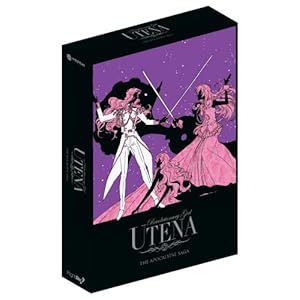
Revolutionary Girl Utena Anime Box Set – Volume 2, Disk 3 (English)

January 12th, 2012

Revolutionary Girl Utena, Volume 2, Disk 3 provides a whole lot of food for thought, doesn’t it?

So, first of all, let look at the final of the puppet duelists for the Black Rose, Nanami’s henchchick, Keiko. Like Wakaba, Keiko’s story hurts. It hurts, because she’s not one of the beautiful people and not one of the chosen. She’s a real person, with big gaping flaws, but we can’t quite hate her, or dismiss her, as we might Tsuwabuki, precisely because, like Wakaba, her dreams are so mundane. Anyone might wish for a moment alone with their idol. It’s a dream that is dull as dirt. As a result, when Nanami is horrible to Keiko, we feel it. When Yuuko and Aiko are horrible to her, it’s especially unforgivable.

And, at last, we reach the core of the Black Rose story, and the illusions with which Mikage has wrapped himself. The story, however one looks at it, is at best, creepy and self-serving. At worst, it’s possible the single most depressing illusion in the entirety of the series. There was a young, sickly boy, Mamiya and his sister Tokiko and Mikage became obsessed with their memory…but it’s not Mikage at the center of the manipulation, we learn incontrovertibly. It’s not just Akio, as we might have suspected. For whatever reason  – and at this point I’m inclined to think that Anthy’s line about lying to one’s self for love is the first honest thing she’s said in this series – Anthy is involved. In the first arc, we thought to ourselves, “She is merely being used.” But when Akio tells us that Anthy does not exists at the school, we have to wonder how much of everything is her doing. Akio has social engineering skills and he apparently wields the power, but then, we have to ask ourselves now…what is Anthy?

At the end of the arc, we get a completely different kind of clip episode, highlighting Nanami’s duplicity and ego. It’s very hard to like her at the end of this arc. It’s important to remember, yet again, that Nanami is about 13. She may pretend to be grownup, but…it’s clear now and will become even clearer later, that she’s basically clueless about people. This will also become very, very important towards the end.

Here at the end of the Black Rose Arc, we’re no closer to understanding any of what’s going on, or are we? We know several things; Akio is manipulating the situation, even as far as Utena and Anthy’s relationship. We know that he has all but abandoned the Student Council, except as tools, and we know that whatever is going on, Anthy is the center of it, in one way or another.

And we know, although she truly does not yet understand this, that Utena is the only sword that can cut through this Gordian knot.

The third and final arc is on our plate and I find myself tense about watching it. In fact, I’ve been kind of avoiding it for the last few years.

In the extras Ikuhara gives us some answers as to why there is an apparent strain of lesbianism in the series. His answer is cogent – for him, making Utena and Anthy “lesbians” is a visual symbol of otherness. But that only explains some of what’s going on, really, the stories of incest and male homosexuality that are either hinted at, or explicitly stated. I’ve said for years that Utena is a series that is exactly like any other high school, on steroids, and in this case the sexuality is stand-in for all the many things that make us different. For once I think Ikuhara did a good job of answering really crappy fanboy question. Dudes, there were *way* more than just lesbians in the series.

Ratings:

Art – 9
Story – 10
Character – 9
Yuri – 3
Service – 3

Overall – 9