Archive for the Artists Category


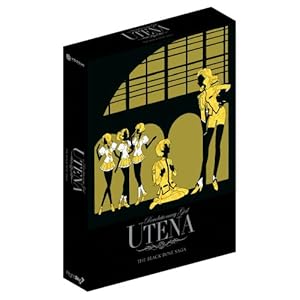
Revolutionary Girl Utena Anime Box Set – Volume 2, Disk 2 (English)

December 13th, 2011

Revolutionary Girl Utena, Volume 2, Disk 2.

This is where it gets really good.

Up to this point, the Black Rose arc has seemed superficially similar to the first arc. Kanae’s rage against Anthy seems overreacting, but we really don’t know much about Kanae or Anthy, and hey, we’re all creeped out by the portrayal of psychoanalysis in the form of Mikage’s Freudian elevator. And Kozue…we’ve written her off multiple times already. She’s not jealous of Anthy, just of her brother. Bro-con, ho hum.

But. Now. Shiori is here. Shiori, who sought to hurt Juri, to tarnish her shine, because she was too perfect, too shining. Oh yeah, fandom loves to hate Shiori.

But look at it from her side for a moment. Haven’t we all had a friend who is popular, talented, attractive and haven’t we all wanted, just once, to be better than them in something? Remember this particular moment of jealousy and pain. It will be back. In the meantime, we suffer as Juri tortures herself over feelings that one day won’t be so torturous. We all want desperately to be the one to tell her it’s okay.

Tsuwabuki’s episode is probably sadder than the others. Nanami is so very immature and yet, to Tsuwabuki, she is a mature, alluring adult. He’s right on that awkward cusp of maturity when at least some of the girls around him already “get” it, and there he is, flailing to figure out what “it” is. I was talking to a high school teacher just recently – we were discussing how at 14 or 15, you meet a teen and you just know, instantly, if they will ever fully mature. Some people don’t. Tsuwabuki will be 20, then 30, then 40, etc and he’ll always wonder what he’s not getting, until he convinces himself that everyone else around is just a snob, or a jerk or something. He’ll grow up attractive, have girlfriends and talk about he “doesn’t get women.” I always feel bad for Tsuwabuki.

And then we come to Wakaba. Remember Shiori’s jealousy? We don’t care about it. We don’t like her. We think she’s a petty jerk and can go to hell. Wakaba suffers from the exact same thing. But we like Wakaba. She was Utena’s first rescued princess. When we learn that her joy comes from something other than herself it’s hard, to learn that it comes from…him…is intolerable. When she stands before Utena on the dueling ground, undoubtedly we have the same stricken look on our faces as Utena does on hers. This isn’t an enemy, or some tangential person…this is Wakaba, a friend. It’s worth noting that this is the first time Anthy begs Utena to take the sword from her and this is the first time that Utena does not. She defeats Wakaba with the sword she wields…with his sword. And it is notable that Wakaba is the first of the Black Rose arc duelists to actually attack Anthy, despite their statements that they would kill the Rose Bride.

I love this duel more than any other duel in the series. Wakaba says everything we always wanted to say to that shining, perfect friend. How nice for you, we so desperately want to say, the way the world always gives a crap about you. But I’m not like that. I have to remain average and no matter what I do I will never be special. We may hate Shiori, but we can’t hate Wakaba.

And we hate that self-absorbed, moron Saionji. In the first episode he was presented as cool, popular and powerful. Now, he’s a fool, as Mikage says and we loathe him for it.

The hierarchy has changed, irreparably. Touga, supplanted by Akio, Nanami, Miki and Juri, half-heartedly holding the center, Saionji at the bottom of the pile. Where do Utena and Anthy fit on the grid? Keep watching to find out.

Ratings:

Art – 9
Story – 10
Character – 9
Yuri – 6
Service – 3

Overall – 9

I will insert a note here referencing Alan Harnum’s Flesh Eaters for Shiori page, because if I don’t, both Alan and Sean Gaffney will try to explain it in the comments and you’ll be confused and probably distressed. This has got to be the oldest still-living Utena injoke on the Internet.






Yuri Manga: Renai Joshika (レンアイ女子課), Volume 2

December 11th, 2011

joshika2In Volume 1 of Renai Joshika (レンアイ 女子課) we were introduced to Arisu and Saki, two women who work at a bridal services company. Arisu and Saki fall in love, as one of the two major plots in the first volume.

In Volume 2, they are still going out, and things are looking very rosy for them both. Until Saki’s former girlfriend comes back into her life. Kimiko is a manga artist and, so overwhelmed was she by deadlines, she simply stopped communicating. Now that her project is done, she’s ready to pick up where she and Saki left off. Only Saki, after hearing nothing from Kimiko for so long, has moved on.

In the middle of the book, we turn to a side story about two other staff members – Ai and Sae. I really liked Ai, because she was the most genuinely grumpy, ill-tempered character I’d ever read in a manga. But then she falls in love with Hato-chan and got less grumpy and less interesting.

We then turn back to Saki and Arisu. Arisu offers Saki the option of seeing both of them, but Saki decides that the girl who is kind to her is better than the girl who forgets to call her for months at a time and decides that she wants Arisu after all.

The love stories were sweet, but the most interesting thing about the volume in my opinion, is the discussion about same-sex marriages, from the perspective of “How cool, we’d be able to design and sell two wedding dresses!” I thought that a pleasantly commercial perspective, rather than focusing on non-existent rights, let’s just talk money!

As with all of Morishima Akiko-sensei’s work, everyone is utterly adorable, even in their darkest moments. She captures the rosy-cheeked innocence beloved by so many of the Yuri audience right now, but, her characters are definitely adult. As a result, I’m kinda hoping that her work is on the table for an anime next. Yes, not schoolgirls, but look, so cute!

Anyway.

I love the discussion of same-sex marriage, sans political or social ramifications. I like the characters. I’m not personally moved to flights of fancy about weddings or wedding dresses, but I love that the story is out there for people who are.

Ratings:

Art – Cute! 8
Stories- Fun and Cute! 9
Characters – Adult and Cute! 9
Yuri – Sexy and Cute! 10
Service – Cute fanservice only! 2

This is how Yuri advances the cause of same-sex relationships, one hideously adorable chapter after another. Good job, Morishima-sensei!


Yuri Manga: Fu~Fu (ふ~ふ), Volume 1

December 2nd, 2011

If Yuri Danshi was written to give Yuri Fanboys a taste of what it feels like to have one’s emotions parsed uncomfortably closely, then Minamoto Hisanari’s Fu~Fu (ふ~ふ) was clearly written to explain important things about lesbian relationships to those same Fanboys in the cutest possible manner.

We are introduced to Kinana and Sumi, who have just begun living together after having been a couple for some time. Now that they are living together, they talk about what to call each other, since “lover” no longer is enough. Kinana asks if she can be Sumi’s bride, but that doesn’t feel right either (although Sumi does use “hanayome” 花嫁 later in the chapter.) Eventually Kina suggests a homonym for the word fuufu, which represents husband and wife, 夫婦. Since they are both wives, they should be called fufu, 婦婦. (So, technically a neologism and not really a homonym, since fuu and fu aren’t pronounced the same, but I don’t suppose that anyone but me cares about that.)

The second chapter of this volume is by far and away my favorite. If you are a regular reader, you know how much I long to read stories that focus on domestic life of an established couple. And, perhaps,  you know about my fondness for my big pluffy bed. So to have a chapter in which Su-chan and Kina go out to buy a pluffy bed of their own makes me happy beyond words. The fact that it’s a brutally adorable chapter helps.

Sumi and Kina go on a honeymoon, we meet Kina’s big gay sister Kanana, and their equally gay neighbors Hayase and Komugi. Every chapter is filled to the brim with appallingly cute lesbians.Of course no one uses the “l” word, but Hayase and Komugi do state plainly that they are lovers. Close enough.

The final two chapters are stories that ran in ES-Eternal Sisters, Volume 1 and Volume 2, from back in 2004 and 2005.

What I said in my original comments on Fu~Fu stands – this manga is important. Using moe art and adorable characters, this series quietly, cutely teaches Yuri Danshi what a lesbian relationship looks like, what is important to us, what daily life is like.

My personal favorite scene is the beginning of chapter 3, when Sumi announces work is over, and Kina points out how patient she’s been. They both stare at each other and throw their arms up…and give each other a great big hug. I mean, really. How cute/real is that? That kind of thing totally happens in my house nearly every day. (No, that is not sarcasm. I mean it.)

So, if no one I know was pining for a glimpse into the inner life of a Yuri Fanboy, almost everyone I know has been waiting with anticipation for a series like this, in which a lesbian couple is portrayed with honesty, affection and healthy dollop of cute.

Ratings:

Art – 8
Story – 9
Character – 10
Lesbian – 10
Service – 5

Overall – 9

Fu~Fu  is *so* close to perfect, Minamoto-sensei deserves heaps of praise. I’d like more of this please!


Revolutionary Girl Utena Anime Box Set – Volume 2, Disk 1 (English)

November 29th, 2011

The first episode of the first disk of Revolutionary Girl Utena, Volume 2, or what is commonly referred to as the Black Rose Arc, is that staple of long-running anime, the clip episode. Clip episodes became so common around the turn of the century, that in some infamous series, clip episodes were practically more common than actual story episodes.

In this case, the clip episode is welcome. Not only does it highlight each duel from the Student Council Arc, (which gives us a chance to relive the duels and their wonderful background music) but it provides an apparently objective perspective of each duel, allowing us to understand the motivation behind the duel, behind any discussion of the End of the World, a World Egg or Revolutionizing the World or other important-sounding nonsense.

The story of Nemuro Hall and the Mikage Seminar is set up, and we are quite suddenly dropped into a new, even more obscure arc than the last. Where the Student Council fights to possess Anthy, these new, derivative, duelists, seek to remove her completely from the game.

It’s not often I find myself incapable of half-watching an anime. Most of the time I watch something while simultaneously reading or writing. I wander off do a chore, come back and pick up the story wherever it’s taken me… it’s easy enough to do this if one doesn’t much care about the exposition. When Utena is on the screen, I do nothing else. There’s too much happening, too many symbols (both substantive and imaginary) and above all, there’s Anthy. This is the third or fourth I’ve watched this series and this time, I find myself watching Anthy intently. The joke is on me, because she rarely does anything. So every little nuance I perceive is me making it up in my head. ^_^

Of the many important things that happen on this disk, I consider most important the involvement of Kozue. It appears to us that her relationship with Miki and his with her are significantly dissimilar. Her Black Rose duel to me says that they are not, actually, that dissimilar at all. It’s simply that in those relationships, each holds a slightly different place in the other’s relatively similar world view. For Kozue, Miki holds the place of sibling, sempai and beloved, where for Miki, these are three separate positions. (I’ve always imagined that, post-series, it is Kozue who has the highest chance of becoming the next Rose Bride, despite it being a meaningless position by then.)

Also important is Nanami’s episode. These appear to always be the comedic relief episodes, but it’s important to remember that both Miki and Nanami are younger than Utena, and are working even harder to build a world that makes sense, with the fractured people around them. Miki appears to be the most innocent, but if we understand that innocence functions in part as a block to be carved, it’s instantly apparent that Nanami is the most innocent character in the series.

Two duels in to this arc and we still have no idea, really, what Mikage is after. However, if you’re adept at reading the signals here, you can see where at least two things are headed. Several key symbols have been introduced -the pointing fingers, the planetarium machine (which could spawn an essay all by itself) the pupa/moths (which return in the movie with a vengeance) and the elevators, both up and down, which Ikuhara uses again in Mawaru Penguindrum.

Two duels in and already the relationship between Utena and Anthy has radically altered. Anthy is something else to someone else and Utena begins to not note the obvious, in the most obvious manner. If Miki is clearly turning a blind eye to Kozue, how much more is Utena shuttering her eyes and ears?

The Black Rose Arc has always been my favorite. It is apparent to me that what Ikuhara does best is create tension. Scenes here are so fraught, so tightly wound, that we spend the episode watching wildly, waiting for the first blow. I described it recently as if, when we watch an Ikuhara production, we are standing in the middle of a ring of people with slingshots drawn, ready to shoot, not knowing where the first shot will come from, but knowing it will come. This tension makes us read into every comment, every scene, every background, whether there was something there to be read into or not. Every episode we’re standing on pins and needles, and Dios inhabiting Utena to win the duel fills us with the relief of predictability.

DVD extras are a pleasant addition for those who like production art, and the pamphlet this time is perhaps less distressing that the one that came with the first collection. Ikuhara’s episode commentary, and the discussion of the creation of Be-Papas and the anime and manga for Utena are equally full of pretension and insight. There is some discussion of the scene in which the sword is drawn from the Rose Bride’s chest and how the instructions were to make it look like a love scene, something that I think has stood the test of time. Of particular interest to me was the comment by one of the creators discussing the brief thought of redoing this anime, and realizing that it stood up so well and was so unique that there was no need. I agree completely. More than 10 years have passed since this series first aired and it still has the power to compel and enchant. Most series upon rewatching seem a little dated, maybe a little sentimental…not this one. I watch with the same creeping sense of…something… this time as I did the very first time. This series was one that I had on my personal top ten, but I presume, always, that nothing is as good as you remember it to be. This series is. Possibly even better.

Ratings:

Art – 9
Story – 10
Character – 9
Yuri – 3
Service – 3

Overall – 9

Stay tuned – we’re going to have a contest to win the second Box Set from Nozomi/RightStuf shortly! ^_^


Seven Seas announces a GIRL FRIENDS Omnibus

November 22nd, 2011

To continue the licensing frenzy of Morinaga Milk’s GIRL FRIENDS, Seven Seas has just announced that they will be releasing GIRL FRIENDS in Omnibus form.

The first volume is slated to ship in October 2012.