Archive for the Artists Category


Yuri Manga; Hanjuku Joshi, Volume 2

October 14th, 2009

Ladies and Gentlemen – we have a winner.
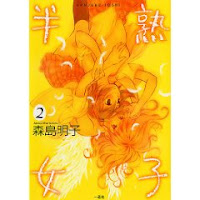
I never doubted for a second that Morishima Akiko-sensei would be the one. I had faith in her, in her ability to gently nudge the boundaries of “Yuri” until they started to blur the lines into “lesbian.” I’ve commented that several of her stories have started to shift in that direction. Notably, her story about the two office workers with a crush on the grease truck chef, and the unprecedented use of the phrase “Kocchi no ke.”

In Hanjuku Joshi, Volume 2 (半熟女子), Morishima has actually written a story that covers that last little piece – the gap between lesbian content and lesbian identity. Let me be very clear here – I do not meant that the characters identify as “lesbians.” I do mean that they acknowledge the challenge that loving another woman brings, and they struggle with the idea of loving that other woman in public. THIS is what I mean when I give Morishima the “Golden Lily” prize.

It’s not like Hanjuku Joshi is the first book ever to cover this area. It’s the first “mainstream Yuri” (if you will allow that) to do so in many years.

Because other reviewers will focus on the sex, let me sum that up in a line: there is sex in Hanjuku Joshi. It’s not actually the point of the story. It’s the icing on the cake.

The point of the story is acceptance – of one’s self, of one’s love, of one’s desire to live a normal, happy life with the person one loves…who just happens to also be female. And the point of the story is that it takes a LOT to get to the point where you can accept that, much less be fearless about expressing it in public. *That* is the point of this book. If you didn’t notice, because you were obsessing about the fuzzy handcuffs, that’s okay. The other point is that Morishima has integrated the main point seamlessly into a smut-filled story, for people just like you. ^_^

Ratings:

Art – 8
Story – 8
Characters – 9
Yuri – 9
Service – 7

Overall – 9

Hanjuku Joshi turned out to be a pretty interesting series. I prefer Mari x Ran to Chitose x Yae, but some really critical conversations happen in this book and those were definitely worth the price of admission.


Watashi no Taisetsuna Tomodachi Manga, Volume 1

October 13th, 2009

You all know the phrase “my important friend,” right? It’s an indicator that the relationship is more than friends, even if it’s less than lovers.

So when I heard about Watashi no Taisetsuna Tomodachi (わたしの大切なともだち), by Hakamada Mera, I thought, *at last!* we’re finally going to get something with some meat. Well..yes, and no. More than anything, we get an entirely new riff on the same-old, tired “best friend” plot.

Ebisawa Shouko (Ebi-chan) has failed to get into the art college of her choice. On her way home, she consoles herself by buying some doujinshi. She runs into an old friend, Tachibana, who’s hanging with cool-girl friends from high school. When Ebi-chan’s otaku hobby is revealed, Tachibana lies and says they barely know each other. In tears, Ebi-chan sits alone in a local park, as a shining light passes across the sky. We see that – whatever it was – has hit Tachibana on the head and knocked her unconscious.

Ebi-chan decides to go to a trade school for design while waiting to retake the exam. She is utterly freaked out when one of her classmates turns out to be none other than Tachibana…who has completely lost her memory. So much so, that she keeps a dictionary around to look up words she doesn’t remember.

Ebi-chan lies and says that they were best friends – which is a lie, but also not, as they were very close in elementary and middle school. It’s just that as an otaku, she didn’t run anywhwere near Tachibana’s cool-girl circle in high school.

Now that she’s said they were best friends, Ebi-chan feels responsible for Tachibana. But Tachibana’s not invalid, just has no memory. If anything, her physical skills are unbelievable and it is she who saves Ebi-chan when they are on their class orienteering trip. (The idea that the design school does an orienteering trip hurts my head, I don’t know about you. ^_^)

When Tachibana collapses from overexertion, Ebi-chan has an epiphany. Up until now, she’s been trying to help Tachibana get her memories back. But – what if she hates Ebi-chan for lying about their relationship? Now Ebi-chan is full of doubt, but Tachibana’s new food-obssessed personality is really too cute to resist and she decides to just live in denial about everything.

I don’t even know what to say about this book. It was odd, and kind of cute, but also kind of annoying, but not so much.

It’s obvious that Ebi-chan feels that she wants Tachibana to be her “important friend,” but what Tachibana feels is utterly obscure, except where it related to food. She really, really, really likes food. Whatever one may think of the story, it absolutely, positively is a totally different riff on the mopey best friend story.

Ratings:

Art – 6 It’s Hakamada Mera, darlings.
Characters – 7
Story – 7
Yuri – 1
Service – 0

Overall – 7

The characters are a lot older than the typical Hakamada manga, too, but pretty much look the same, just taller.


Yuri Manga: Sasamekikoto, Volume 5 (ささめきこと)

October 6th, 2009

In Volume 4, we left Ushio and Sumika not actually saying anything important to one another. Now, in Volume 5 of Sasamekikoto (ささめきこと), the walls between them are not getting any easier to get past.

In fact, it’s safe to say that this entire volume follows two young women who have something *incredibly* important to say to one another, who both find a myriad of ways to not say anything at all.

They smile at one another, and pretend that there’s nothing wrong, but they both hate it. They hate what it’s doing to them. Even more – they hate what it is doing to the other. They can *see* that the other one is suffering, but they are completely paralyzed and unable to say anything that needs to be said. They each hate the fake smiles and brave face the other wears. Most importantly, they each blame themselves for the other’s unhappiness.

Most fans will find this volume frustrating, but it serves two distinct purposes. The first, and most reality-based, is that it indicates that the series is in for a longer haul. No longer is this the goofy love-comedy of two girls in love but who can’t figure it out. Now it is a longer series, full of do-ra-ma, about two girls who are in love but can’t figure it out. Since we’ve made it to 5 volumes, I’d expect at least a few more tear-soaked volumes before it all gets settled.

The second purpose is that the story has, in effect, to be rewritten. The first three volumes were silly. They set up a bunch of untenable Yuri tropes that, one at a time, have been set aside for the more realistic, more dramatic “real” story line. In this volume “Akemi”s modeling career comes to an end, and all the characters but a few – including the actual lesbian couple, who can see the problem easily enough – seem to shift back slightly to allow room for the full-on misery of Ushio and Sumi simply not talking about what’s on their mind.

In the middle of throngs of people, even standing right next to one another, Ushio and Sumi are lonely. Right now they are struggling to find who they themselves are and if they can do that, then they might be able to find one another. Or, well, that’s what I’d do if I were writing this manga.

This series is becoming better on the one side, because it’s dealing with the real gap between knowing what you want and being able to accept that that is what you want, in a world that does not approve of such things. On the other, it’s really annoying because I hate mopey characters. ^_^;

However, I’m more than willing to give Ushio and Sumi some time to get over themselves. I eagerly look forward to the next volume in which I think a *terrible crisis* will rear it’s ugly head. ^_^

Ratings:

Art – 7
Characters – 8
Story – 8
Yuri – 7
Service – 1

Overall – 8

More volumes means more teenaged moping.


Sasamekikoto Anime on Crunchyroll

October 6th, 2009

I’m pleased to report that Crunchyroll has obtained the license (limited to US and Oceania this time… don’t blame them, blame stupid country licensing issues) to Yuri anime Sasamekikoto. Here’s hoping that the anime captures the book’s zaniness without losing the solid emotional story in the back and vice versa, that it doesn’t wallow without the comedy to temper it.

In honor of the news, I’ll review Volume 5 later today. :-)

I just love their press release that says this series is “one of the most famed yuri manga of all time in Japan.” LOL I’m thinking not so much, really. But, yay for Yuri fans anyway. :-)

So, what do you think is the “most famed Yuri manga of all time”?


Fleurs Bleues, Volume 1 (French)

September 23rd, 2009

Why yes, it is Wednesday.

It is my very great pleasure to introduce our newest Okazu Guest Reviewer, Marc. Marc emailed to say that he had just gotten a copy of the French language edition of Aoi Hana, sensibly titled Fleurs Bleues. Of course I was thrilled to have both a new guest reviewer and a look at a French-language Yuri title. So, please welcome Marc and enjoy his review!

The first thing I thought when I picked up my copy of Fleurs Bleues was, “Man, it’s tiny!”, but more on that later.

Editions Asuka has put out the first volume of Aoi Hana (Sweet Blue Flowers) in French as Fleurs Bleues. It compromises the first seven chapters of the story and the author’s comments.

For those of you who aren’t aware of this manga (where have you been?), it’s the story of Fumi Manjome who returns to her hometown after ten years away. Fumi was a bit of a crybaby in her youth and still hasn’t really grown out of it. Due to the kind of coincidences that seem to happen a lot in manga, she meets up with her childhood friend Akira Okudaira, who also hasn’t changed much over the ten years. She’s still as feisty as ever, and is entering high school at the prestigious all-girl Lycée Fujigaya. Fumi is attending the less prestigious all-girl Lycée Matsuoka. In their respective schools the girls each make friends and involve themselves in school activities. Akira becomes fast friends with Kyoko Ikumi, and they join the drama club. Fumi has just ended a relationship with her female cousin, and being in a somewhat vulnerable state, meets and forms a relationship with upperclassman Yasuko Sugimoto. The manga deals with the ups and downs of these relationships as well as with Fumi coming out to Akira.

I love these types of manga. No big explosions, no giant robots or girls, or giant robot girls (if you’re into that sort of thing). This is a story about relationships and their development. Fumi’s insecurities, Akira’s wanting to protect and support her friend despite not having seen her in ten years, Kyoko’s unrequited love, and Yasuko’s teasing make them feel real.

The art is simple but beautifully drawn, which is exactly what you need when you want to focus on the story. The characters are engaging and not too stereotypical for this type of manga. (Though I must say, Akira’s brother’s sister complex creeps me out.)

The translation is well done. It is in very proper French, which lends itself well to the characters and story. It gives it a sort of poetic feel, which I feel enhances the drama. Like Erica, one of my pet peeves is when sound effects or background dialogue is not translated. Thankfully, Asuka did translate all these little bits.

But that isn’t to say there aren’t any problems.

When it comes to the suffixes (-san, -chan, -kun), my philosophy is either don’t use them at all, or use them all the time. For reasons I can’t explain, the translators removed all the suffixes except for two. Yasuko is still called Sugimoto-sempai, and Akira’s original Japanese nickname of Ah-chan was changed to Aki-chan. Go figure. I think I’d have preferred if they’d dropped them all. (Not that I’m suggesting you shouldn’t buy the book because of that. How big a Fanboy do you think I am?)

Then there’s the size. As I said at the beginning, it’s smaller than the manga I tend to see published in book form. At 6.5 x 4.5 inches, it is much smaller than the average 7.5 x 5 inch English ones. It literally is a pocket book (it fit in my jeans pocket just fine). It is considerably smaller than the Japanese version (8 x 6 inches), and it sort of reminded me of a Harlequin romance paperback. I don’t think that was unintentional. However, the small size was a little off-putting for me but didn’t impact my reading enjoyment.

The Japanese cover was lovingly recreated in beautiful pastels and the left to right reading was kept in place. The reproduction of the content was crisp and clear, and the font choice made reading (even for a bifocal-wearing old man like me) easy. Nothing mimeographed here.

Ratings:

Art – 8
Story – 8
Characters – 9
Yuri – 9
Service – 1 (mostly the creepy brother)

Overall – 9

Reproduction – 9

All in all, this is a great read for yuri fans. I found myself smiling a lot while reading it. If you can read French I suggest you pick this up for your collection. I can’t wait for the next one.

Thank you so much Marc for a terrific look at another edition of this fabulous manga. I hope one day to be able to include an English-language review on the list. And please take note European Yuri fans – if you have an edition of any Yuri series in a language other than English or Japanese, please do email me – we’d love to have a review!