Archive for the Artists Category


Hello, Melancholic!, Volume 3 (ハロー、メランコリック!)

June 2nd, 2021

When we last saw them, Minato had just blurted out that she liked Hibiki. As we begin Hello, Melancholic!, Volume 3 (ハロー、メランコリック!) everything between them is so normal it’s making them both uncomfortable. The pressure is going to build and the rest of the band is just waiting for it to blow. In the mean time, new first-years have joined and Minato is now a sempai

But, we’re not done yet, because Hibiki’s online posts opens an opportunity for Minato that she is absolutely not at all ready to take. A local band of adults – one that has a reputation for a high level of musical proficiency – has invited Minato to try out for a position as backup, a high honor. Minato’s good enough, but she is emotionally still so scarred from her previous experience in trying out for a band position that she rejects the chance. Even when Hibiki helps her to confront her fears, Minato continues to retreat into herself, eventually lashing out at Hibiki.

This too comes to a head, after Minato asks the only other second year in the group for advice. Luckily for her, Emma is a good advice giver and in a moment of clarity, Minato realizes that she’s never had a friend to ask advice from – and it takes her breath away. Finally everything comes down to a confrontation, and as the rest of the band eavesdrop outside the door, Hibiki and Minato say some things that they need to say. Minato works through last lingering doubts about Hibiki going off to college with help from the ever-chill Sachiko and Chika.  The book ends with Minato (sporting a new look) and Hibiki meeting up again on a spring day a year later.

The extra chapter delves into Emma’s secret life with an older woman.

Okay, you’re probably looking at this and wondering why I picked *this* story for day two of Pride Month, since I’m usually so intentional about my choices? (I hope you notice that I’m intentional.) Well for a couple of reasons – things that happen in this series that I think are very relevant to right now.

One – this is a story about a kid who had been bullied and it is not a miraculous story of redemption or perseverance. Minato slowly, carefully sheds some of the baggage she was burdened with, but it’s not without risk to her and to survive it, she just grows. The whole school isn’t applauding her, she isn’t made prom queen, this isn’t a Hollywood story. Minato finds some people who help her grow up and grow beyond the damage – I honestly wish this was a narrative that we got more often. Most of us who were bullied don’t get a reckoning, we just get old and the things that weighed us down, don’t anymore. I was in college when one of the kids who had bullied me as as a tween was sitting in a class I walked into. She saw me and said something rude and I just…laughed at her. I mean, really? Was I supposed to care what she thought? It was too ridiculous to imagine.

Two – and this made me cheer out loud. Minato, all upset at losing Hibiki to college, assumes Chika and Sachiko will be going to school together. As it turns out, Chika’s going to trade school to be a dental hygenist, Sachiko’s going on to a private school. Minato, shocked, asked if they aren’t upset at never seeing each other and they stare at her like she’s turned purple. Why? Because they have cell phones, for pity’s sake. Cell phones and days off and maybe they’ll move in together, but really – there is no reason that high school is the end of it allTM. Why wouldn’t they keep seeing each other?

Three – yesterday was pretty heavy going with The Rose of Versailles and tomorrow is pretty heavy going and I wanted something light and fun and a story about a girl meeting and falling in love with her sempai in band is about as close to an autobiography as I’ll ever get in a manga. ^_^

Ratings:

Art – 9
Story – 9 More conflict in this volume is a good thing, as Minato becomes less passive
Characters – 9
Service – 1
Yuri – 9

Overall – 9

Thank you Ohsawa-sensei for this utterly delightful story.


The Rose of Versailles, Volume 4

June 1st, 2021

What better way is there to start off Pride Month than to begin with revolution, with a fight against the status quo and respectability? What better thing can we do in 2021 than to remember why we celebrate this month, than to tear down systemic oppression and fight for our freedoms?

Sit yourself down, make yourself some tea, maybe a crepe, and buckle in, because we’re about to get historical. The Rose of Versailles, Volume 4 will cover the last days of the French Revolution, and of Oscar François de Jarjeyes’ life in noble service to the undeserving ancien régime of France. The parallels to right now are once again uncanny and distressing.

As the book opens, Oscar and Andre’ finally confront the one thing they have never discussed in a lifetime of friendship – their feelings for one another. They consummate what little of their marriage they will ever have.

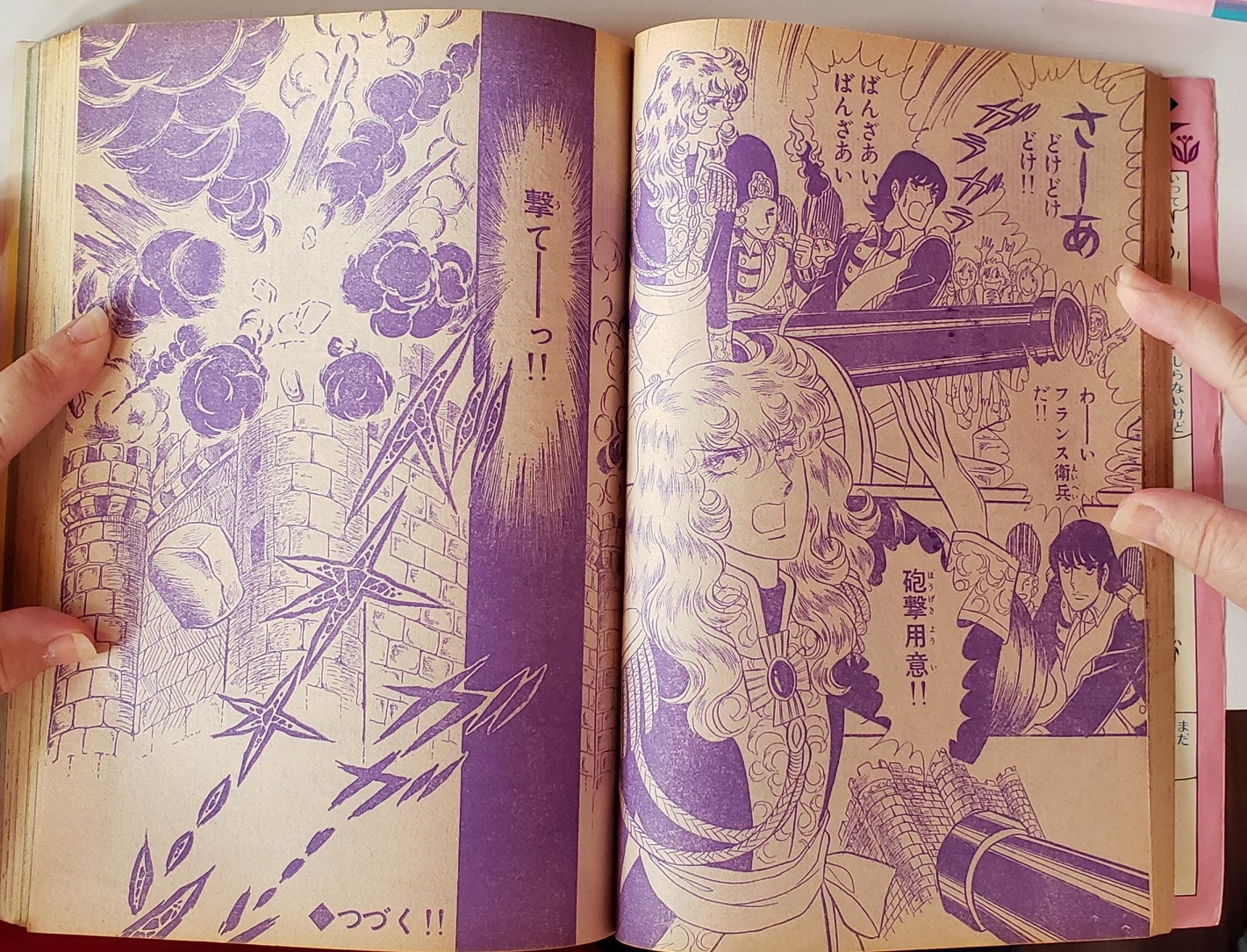
The next morning, committed to the cause of the people, Oscar leads her troops to one of the most resonant moments of the Revolution – the day the canons of the Bastille were turned, not upon the prison, but upon the town. This scene makes me tremble, to be honest. In recent years, in cities all over the US, the canons were indeed turned upon the people…and it has come very close to making a difference, but never quite close enough. Even in 18th century France, the Revolution, while it ushered in new ideals, failed to bring the kind of change the commoners were fighting for – food, justice, the right to live without harassment.

We are asked to watch as the characters we learned about face the guillotine, the mob, or are cut down in battle. It’s never an easy story, but one we need to be able to get to the end of. With Fersen’s death, which was slightly more complicated than the narration makes it seem, the story as such, is over.

We take a deep breath, because the neither the series nor the story is truly over. Instead we are plunged from the real horrors of history into a gothic horror, complete with a virgin-killing, blood-bathing protagonist, a murderous creepy doll, and Oscar’s niece Lulu. Get used to Lulu, she’ll be back. This final story gives us some predatory lesbian behavior from the Marquise de Montclair, which I find somehow refreshing, after the guillotine and the spectre of an uncaring elite staring at children dying without interest.

And so, the main narrative of The Rose of Versailles comes to an end, as the République Française begins. But wait! There’s more! More evil women, more mysterious disappearances, more predatory lesbians and more Lulu on the way in The Rose of Versailles, Volume 5! (Which is the part I worked on first, oddly, with translator Mari Morimoto.)

Ratings:

Art – 9 Honestly fantastic
Story – 9 A lot happens, good and bad
Characters – 9 We’re going to do some rethinking about people here
Service – Not visually, but there is some in Montclair’s behavior
Yuri – Same as above

Overall – 9

My hat is off to Jocelyne for the fine translation and Jeannie Lee for the great lettering. Andy Tsang’s cover design is amazing. Again, my thanks to the UDON team for making this a pleasure to work on. Gonna say…I’m still blown away that I was able to help out.

All I have to say this pride month is Vive la Révolution! There’s still so much yet to fight for. Let’s get out there and fight for every last queer kid, so in 30 years they can be clueless gobs about us on the neural network. ^_^


The Rose of Versailles, Volume 3

May 21st, 2021

As I sat down to write today’s review, it dawned on me that I had never covered Volume 3 of The Rose of Versailles. So today, we will nod towards it, as we stride past headed for the last volume to deal with the Revolution and it’s aftermath.

In Volume 3 of The Rose of Versailles, Oscar’s choices come piling down upon her head. In a complete reversal of everything she had been asked to do with her life, her father barters her hand in marriage to her rival since she was young, Captain de Girodelle. Unsurprisingly, this puts Oscar into a very uncomfortable place. Of course she does not want to be married off without her consent, and also she believed that acting as a son, her father would not just treat her as collateral. To find that she had accomplished so much, only to have it be treated as irrelevant is, obviously, enraging. To young feminists of the 1970s this would reflect the exact situation they were – and, let’s be real, still are –  facing in the workplace.

Oscar has a new uniform made for herself, and at last attends the balls of Paris, to seduce women and show herself supremely uninterested in Girodelle or marriage. Meanwhile, Andre’s eyesight is deteriorating and Oscar begins to think of him more as a man, rather than a servant. Andre tries to force himself on her, but they withdraw from one another. Pushed to her limits, Oscar dedicates her life to war, and leaves to visit the Queen one last time.

The story, then, becomes a kind of slow avalanche of horrible decisions made in the worst way for the worst reasons. The Dauphin dies and Marie holes up in the Petit Trianon, refusing to deal with the people of France at all. The commons try to meet and are locked out of the building, the army starts to split at the seams and Oscar sides with the common people. She learns the truth about her Gardes members, how family and friends are being killed or starved and she becomes enraged, demanding answers of people who don’t care. Alain and the Gardes help Andre cover his failing sight, but they all know that death is waiting, Andre ends the book wishing that Oscar and he might be lovers, even knowing that his wish cannot come true.

There are a lot of tears. We’re given more space here to sympathize with Marie Antoinette than we have before, but it’s still hard to see her as  a victim of anything except her own selfishness. Oscar will stress for many pages about her gender and sex. Had she been a man, Rosalie would have ended the conversation, but she is not and she is neither transgender nor a lesbian. She’s embraced her fate to live a man’s life as a woman, but in the end her father never respected that, even though it was his wish that she do so.

Ratings:

Art –  Sublime and Oscar in bell-bottoms.
Story –  Grim, but magnificent
Character – Everyone has a moment when it is impossible to like them.
Yuri – One almost feels bad for any woman Oscar pretends to seduces to show up Girodelle
Service – Shirtless Andre, attempted rape, Oscar in new uniform

Overall  – Hard to read, but absolutely compelling

If I were going to sum up this volume with one emotion, I’d say “anger.” It’s not a righteous anger, not yet, but the signs are all there.  In a sense it’s good that the end is on the way in the next volume. After the last few years of anger and inequality and the same kinds of violence and deadly economics as we see in this story, reading this volume feels too much like reading the news sometimes. Something has to break, and we all hope like hell that it’s not us.

Kudos to UDON for another glorious volume of this epic story. It was my very sincere pleasure to be part of that team.

Volume 4 and Volume 5 are now available for you to read and experience!


My Alcoholic Escape from Reality by Nagata Kabi

May 14th, 2021

Right now the first Virtual Toronto Comic Arts Festival is underway on Youtube and this week we had the pleasure of watching Deb Aoki doing a pre-recorded interview with Nagata Kabi, the creator of comic essay My Lesbian Experience With Loneliness, and its sequels. This interview will be available online until May 21, so definitely watch it while its available – its not often we North Americans get a chance to see our favorite manga artists.

This month also saw the release of Nagata-sensei’s newest work in English, My Alcoholic Escape From Reality, detailing her bout with alcohol-induced pancreatitis. As with her previous works, this book covers a number of personal details, physical and emotional. She made it very clear in the interview that she has regrets about the way she talked about her family in previous books and she addresses that in the book, as well.

In my review of this book in Japanese, I said, “We’ve watched Nagata-sensei struggle with food, with alcohol, with depression, and now with her pancreas. It’s all very heavy going, but as a reader I don’t feel like I have the luxury of wallowing since, for any bleak feelings I might have, I have to believe that it’s harder for her. To some extent, the only thing we can do is be distant, abstract cheerleaders on the sidelines of the parts of her life she chooses to share with us. We have to know were not getting the whole story – and we have to be okay with that. So we mentally pull for her and send good thoughts.”

And, indeed, we do mentally pull for her and send her good thoughts and she could see that in the interview chat, if she was interested. Especially now that we’ve put a face to the name, I imagine fans will care about her even more. Which makes this book harder to read, not easier, honestly! But there are two things I want to note – one, the second half of the book is less about her struggle with her physical body and more about the creative struggle…which I interpret as a very positive thing. The creative struggle, while no less real, is also much more abstract and requires the ability to think about something other than the pain in one’s abdomen. I’m sure we can all identify with how difficult it is to work when we don’t feel good. It’s a testament to her strength of will that she could work in such circumstances.

The second thing I noted in my review of the Japanese volume was that she’s back with East Press for this book. They aren’t the biggest publisher she’s worked with, but I’m kind of happy that she’s with them again. They are a very pro LGBTQ content company. Her newest book series is with Futabasha, another company that has been really positive for queer manga creators and content, so I’m very much looking forward to seeing what they do together!

Following this all up, Seven Seas announced the license of her next book, Meisou Senshi・Nagata Kabi(迷走戦士・永田カビ) as My Wandering Warrior Existence. You can read this online in Japanese on Web Action. This has a projected release date in English of March 2022. But wait, Nagata-sensei is working on *another* series now, Meisou Senshi・Nagata Kabi Gourmet De GO!  (迷走戦士・永田カビ グルメでGO!) the first chapter is also available on Web Action in Japanese. This is the story she alludes to in this volume – a food manga. I am really looking forward to this, as it’s an audacious and amazing concept having a food manga written by a woman with eating disorder and a contentious relationship with food. It should be fascinating.

Ratings:

Art – 8 Her style has really grown and visibly become more confident
Story – 8, by which I mean it can be gut-wrenching
Character – 9 ^_^;
Service – ? There’s some details in there.
LGBTQ – N/A, but wait. The next book is about her gender and sexuality

Overall – 8

Watch her TCAF interview and then take a look at this book translated ably by Jocelyn Allen. I also want to nod in the direction of the lettering and retouch folks, Karis Page and Gwen Silver, since Nagata’s pretty heavy on the in-art sound effects here. Thanks to the entire Seven Seas Team for their work on this book, and to TCAF staff, Jocelyne Allen for her delightful translation and interpretation and Deb Aoki for another great interview.


Touma-kun (冬馬くん)

May 10th, 2021

Last week I talked about an objectively problematic book from Galette Works, by an artist I quite like, The Rain and the Other Side of You. This week, we’re going to look at  book that is objectively also problematic, but subjectively, I really like it anyway. Today we’re talking about Amano Shuninta’s Touma-kun (冬馬くん), also from Galette Works, a collection of her series from Galette magazine.

“Everybody’s boyfriend” Touma-kun is a girl in a girl’s school who thinks all the girls are very pretty and wants everyone to be even prettier. Touma’s not good at studies, but she is a genius with hair and makeup and loves nothing better than to make the girls around her even prettier. Each chapter of the story follows one of the girls or women of the school as this uncarved block, Touma-kun, reaches into their hearts and brings out their inner beauty, then loves that beauty with her heart soul both physically and psychically.

In one chapter, we see Touma do the hair and definitely seduce one of the teachers…when the teacher is called into the principal’s office, the principal nails it in one that she’s been to see Touma-kun….which, along with the fact that Touma-kun tells one of the students that the principal made the salon space for her makes the principal kind of suspect.

Why is this problematic? Well, one could say that Touma-kun seduces the girls as she does their hair and makeup. Touma’s not manipulative in the sense  of using the power she wields over the girls around her. She’s happy to make them prettier, however she can and she gives of herself freely, as well. She won’t be tied down, no matter how many girls want her for themselves…and a few of them do. Touma’s a student and the teacher’s first reaction, upon waking up naked next to her is to scream “What am I doing?” Again, we even suspect that the principal has also sat in that chair. So there’s all of that as well. But intent goes a long way here. Touma’s likeable and not at all creepy, maybe even a little overly simple.

After graduation, Touma’s schoolmates get together hoping that they get one more moment with everyone’s boyfriend, but Touma never shows. Obviously, Touma is not moving on to university, but we do see she’s gotten a job as a hair and makeup stylist, and continues to make the women she works with prettier by whatever means she can.

So…depending on your definitions, maybe problematic, maybe not. From my perspective, while I can see potential problem areas, I found Touma so sincere and honest a person, that it was impossible for me to resent her actions. Your mileage may well vary. ^_^

I adore Amano Shuninta’s art always, and the loose lines of faces and hair in this volume absolutely are in the gold for me.

Ratings:

Art – 9
Story – 8
Characters – 9
Service – 2 implied, mostly
Yuri – 10

Overall – 9

Amano Shuninta’s Touma-kun (冬馬くん) is a beautifully designed and executed story, by a talented Yuri artist.

In my head, Touma-kun is voiced by Paku Romi, specifically using her voice from the Hatsu/Koi Shimai drama CDs where she played Hiiragi Touko. ^_^