Archive for the Artists Category


Even Though We’re Adults, Volume 1

February 4th, 2021

Takako Shimura’s Even Though We’re Adults, Volume 1 is a very strong opening to a series I still have no idea in what direction it is going. Ayano, a teacher, meets Akari when she stops by a place for a drink. They end up sleeping together. Both Ayano and Akari want to see each other again, but when Ayano does come to the restaurant Akari works at, she’s accompanied by her husband.

Ayano tells her husband that she’s interested in Akari and he basically has no idea what to do with that information. He’s in love with his wife, and he’d like a child with her, but thinks (fears?) that she’s slipping away. Ayano isn’t sure what she wants, except that she is sure she wants to see more of Akari. Akari is in a worse spot; with a history of failed relationships, the last thing she needs is to be falling for a married woman…but that is definitely what is happening.

Quite a lot of manga people I know who are also queer, including myself, have very ambivalent relationships with Shimura’s work. She does seem to focus quite a lot on gender and sexual minorities, with varying degrees of verisimilitude. In my personal opinion, this story feels equal parts solid and kind of icky. It may also be that I’m not particularly thrilled to have either another “messy relationship with a married woman story” or a story that makes the lesbian performatively self-loathy. At the same time, there are elements here that keep bringing me back to this story, which is at Volume 4 now in Japanese.

One of the best things about the series so far is the art. There are moments, especially when Shimura-sensei is using the watercolor style she often relies on for covers and color art, when she really shines. I talked about this a little in my review of Volume 2 in the Japanese, as well.

As always, the team at Seven Seas has done a great job. Shimura-sensei is great with *moments,* but has a harder time sustaining conversations over a scene. Translator Jocelyne Allen and adapter Casey Lucas allow the conversations to flow naturally. Everything about this book – the lettering and design, as well as the writing and art – is given room to get out of the way of the characters and let them tell their story. I’m  not at all sure where that story is heading, but I guess I’m here for the ride!

Ratings:

Art – 8
Character – A not-sure-yet 7
Story – Same 7
Yuri – 8
Service – 1 Hardly any, in fact. The 1 is mostly on principle

Overall – 7

Thanks very much to Seven Seas for the review copy! Volume 2 is slated for a summer release. I’m definitely going to have to bump up Volume 3 in Japanese on the to-read pile and see what happens.


Watashi no Oshi ha Akuyaku Reijou. Volume 3 (私の推しは悪役令嬢。)

January 25th, 2021

I don’t really know how to review this book. ^_^;  There’s so much to tell you and so little I can say!

In Volume 1, we met former office worker Oohashi Rei, who wakes up one day in the world of her favorite otome game, “Revolution,” as the protagonist Rae Taylor. As Rae, she opts out of the usual romance routes and instead focuses all of her acumen and knowledge of the game on her actual interest, the villainess Claire François. Then the revolution comes crashing down over the two of them.

In Volume 2, Claire and Rae, now a couple, work together to create a better world for themselves, their friends, their country, and…

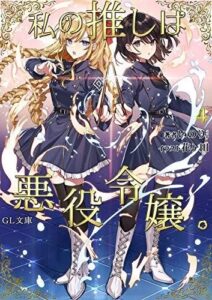
spoiler warning/ Because both these books are available from Seven Seas in English, I am going to assume you have read them. If you have not read them, this review will contain inevitable spoilers, starting with the cover, because it is right here next to these words and I can’t hide that. If you haven’t read the first two volumes, this review may be largely incoherent and there are even MORE spoilers ahead. Don’t keep reading if you want to avoid spoilers. Do go read Volume 2, then come back. ^_^ /spoiler warning
So, going back to my previous statement.

Claire and Rae work together to create a better world for themselves, their friends, their country, and…their children.

Watashi no Oshi ha Akuyaku Reijou. Volume 3 (私の推しは悪役令嬢。), which I read on US Kindle in Japanese*, begins a year after the revolution. Claire, Rae, and their children Aleah and Mei**, the orphans they adopted in the tear-jearker epilogue to volume 2, are a happy family who are dealing with some major issues that are clearly foreshadowing future plots. Rae and Claire are teachers at the Academy they formerly attended as students, when they are approached by the government with a life-changing request: Diplomatic relationships with the Bauer Kingdom’s former (possibly current?) enemy, the Nur Empire is being established. A team of exchange students are being shared between the two countries. Several students from the Academy are going…and so are Claire and Rae, who decide to take Aleah and Mei with them.

We’ve already established that all norms are off the table in this series, so the plot here is a little bit of everything – school drama, romance, socio-political drama, and some other things and then the demons arrive. From this point on the book is spinning plates and juggling balls and then an axe or two on a high-wire.  And it all works, except I have about 300 questions. ^_^  I’ll just hope that some of that is clarified in future chapters and, eventually, volume 4.  I was worried through the entire first half of the book about two things that were never the problems I thought they’d be. But…what? Why? How? I’m not unsatisfied, I just want more!

I’m going to be really impatient until all of you have read it, too, so I can scream all my questions at you! ^_^

The second half of this volume are a series of deeply schmaltzy and satisfyingly goopy extra chapters that cover a number of celebratory events in Rae and Claire’s life, like birthdays and Christmas and their wedding. Rae and Claire get more and more touchy as the story goes on. Apparently Inori-sensei has offered up the bed scenes as an extra on her Pixiv Fanbox (which I think is a terrific idea and admit, I’m tempted. For the record, her Fanbox is being translated into English and Korean, so don’t be afraid to support her.) Rae and Claire’s wedding is a very pointed commentary on modern Japanese life and laws and an incredibly sweet scene. For a second time, the final scene of the book had me reaching for the tissues. How far Claire and Rae have come in a year is laid bare for all for us to see. (happy tears)

But, Erica! I hope you are flailing your hands at me in an attempt to get my attention. Did you say Rae and Claire’s wedding?!? Yes. And that is not the only wonderfully gay bit – nor is it arguably, the most important gay thing in this book. There are at least three other incredibly important conversations that I hope like heck have made a difference for someone, somewhere. And Rae and Claire are VERY clear about what they are to one another to the people around them in so many words.  They are physically affectionate with each other and with the twins, as well. I honestly loved that affectionate kisses and hugs and touching were just normalized in this story.

Ratings:

Art – 8
Story – 9
Characters – 10
Service – Kind of? You’ll have to trust me that its fine, really.
Yuri – 10
Queer – 10

Overall – 10

Absolutely fantastic, but I have so many questions.

What about <spoiler>? What did they do?
What is the deal with <spoiler and spoiler>?
Were the <spoiler> there for shits and giggles?
What is going to happen with <spoiler>????
Why on earth is <spoiler>?????????

*The one thing I do honestly like about using Kindle for Japanese-language books is the translation function. It’s not perfect, but it helps not having to do more than highlight a term once the JP dictionary has been downloaded.

** In case it is not obvious, Aleah rhymes with Claire in Japanese and Mei rhymes with Rae.


Go Nagai’s DevilMan Lady, Disk 2

January 17th, 2021

Things fall apart rapidly in the second half of Go Nagai’s DevilMan Lady.The center was never meant to hold.

Jun advocates for the humanity of those people who show signs of the Devilbeast Progress, while the humans that are creating the afflicted – then dehumanizing them and hurting them – become less and less human themselves.

Having saved and lost Kazumi several times and only for one brief night allowed to acknowledge their love – Jun becomes despondent, then ultimately enraged, as society crumbles. As Asuka pushes Jun to her limits, Jun finds some strength at last.

In a deeply dark and violent ending, Asuka, who is intersex, rapes Jun, then forces her into a hell of Asuka’s making. There Kazumi is able to speak with Jun one last time and Jun sheds the very last of her inhibitions to become the Devilman Lady that defeats Asuka’s distorted form of godhead, saving what is left of humanity.

Through the final arc, as Asuka’s past comes to light, I was reminded so very much of Apos in Rin: Daughters of Mnemosyne. Also portrayed as a evil “hermaphrodite” (a word that has had a long road, from tragic Greek figure to slur,) Apos and Asuka also share megalomania and disinterest in humanity other than as tool for their own ambitions. I now wonder how much Apos was influenced by Asuka…and how much Rin: Daughters of Menmosyne was influenced by Go Nagai Devilman franchise. The Devilman himself, Akira, makes a cameo appearance here, and where the rest of this series is very 1990’s, he is purest 1980s.

This series remains a dark, violent and often depressing look at humanity’s inability to treat others well, very similar to Devilman Crybaby. Sure the monsters are scary, but armed men with guns threatening innocent children is far more terrifying  because it is something we all actually see on a daily basis. But. Unlike Devilman Crybaby, it has hope. It is true that Jun does not have a happy ending with Kazumi, but because of her, Jun is finally able to accept herself. The world is not destroyed. Children play, humans evolve after all, despite themselves. There is hope for the future, for Jun…and for us.

Ratings:

Art – 9
Story – 9 Horror in every form.
Characters – 9
Service – 8 Yes, very. This is Go Nagai we are talking about.
Yuri – 9

Overall – 9

As I have said elsewhere, “All of the Devilman franchise seem to be about humanity’s complicity in its own destruction. By that standards, Devilman Lady has a happy ending as Jun only loses everyone she’s ever met, and both arms, but Tokyo/Earth survives.”


I’m in Love With the Villainess, Volume 2

January 8th, 2021

Remember how amazed we were in Volume 1, when the characters of Claire, Misha and Rae had a frank discussion of sexuality? Well, I’m In Love With The Villainesss, Volume 2 has looked at Volume 1 and said, “Hold my mead”….

Rae Taylor is an extraordinary young woman, because in fact, she is not a young woman. She is a corporate drone from our world who has found herself in the world of her favorite otome game as the player character. Instead of romancing the princes, however, Rae has opted for a new route; one in which she is romancing the villainess, the aristocratic and strong-willed Claire François. Here in Volume 2, the holodeck controls are off and Rae and Claire run full speed towards a resolution that even Rae with her knowledge of the game can not predict.

As a reader and as a writer, I ascribe to what we called at the Fanfic Revolution called the “one-handwave” theory. This theory allows every world is allowed one massive, ridiculous, inexplicable thing that must be accepted at face value and cannot be questioned. This volume of I’m in Love With the Villainess, *immediately* blew that theory to hell in the most hilarious way I have ever seen. And then it did it again. And again. The rules? They are for some other story. This story could not have cared less what rules say. Massively important plot points were handled with literal magical handwaves, while actual time and attention were given to discussions of same-sex attraction, gender dysphoria, and, of course, the social impact of income inequality and political upheaval. It was compelling to say the least. It was a little too on the nose for this week, in particular.

This volume is significantly larger than volume 1. Given the resolution there’s only one thing the author left undealt with so Volume 3, when we get it, ought to address that.

In the meantime, this was an amazing read. Whatever benchmark might have been set by Volume 1, was shattered with sound-of speed waves as this volume goes blasting by it. It got exponentially queerer as the story went on. Final tally – 6 queer characters among the main cast, and a happy ending for our principles. And an epilogue that made me ugly cry at 2AM.

I give it my strongest recommendation. If you have not read this series, I hope you will. I know isekai isn’t everyone’s thing, but this is a shining example of exactly what I was talking about in my essay about queer representation Author Inori doesn’t consider that the limits of the worlds that previously existed are the limits of what the worlds could be. They’ve taken an already played-out plot driver and used it to explore very real-world situations in fantasy cosplay and come up with a different resolution. Rather than just assuming what was is what has to be, this series models a new ideal.  I feel even more confident that this was the right choice for my Top Yuri of the year for 2020, and it is going to be very, very hard to beat for 2021. But you know….I really hope something does beat it, because that would be something. ^_^


Ratings:

Art – 7 Okay. I’m still angry we didn’t get a picture of Claire in the tux in V1.
Story – 10 Perfection
Characters – 10
Service – 3 Yes, but…somehow this time didn’t bother me at all.
Yuri – 10
Queer – 10

Overall – 10

“Miss Claire, watch over me now.” I am slayed.


Bloom Into You Regarding Saeki Sayaka, Volume 3

December 24th, 2020

Capping this weird, and horrible and amazing year off is the volume that I have been waiting for since April, when I raved about the Japanese edition. At last I can share with you, the joyousness of Bloom Into You Regarding Saeki Sayaka, Volume 3!

Saeki Sayaka, a girl who tends overthink most things, is confronted by a situation that requires faith in the future.

I almost don’t want to tell you anything about it, because I want you to enjoy the whole thing on your own, without my prompts. I’m also tempted to just quote huge chunks of my initial review at you, since the things I loved about the book in Japanese hold up beautifully in English, thanks to the deft translation by Jan Cash and Vincent Castaneda and Jenny McKeon’s adaptation. They captured Sayaka’s cool, reflective, outside voice and the increasing turmoil inside her head beautifully.

The humor fit perfectly, even the one thing I *felt* but wasn’t entirely sure was real, was communicated well. Everything here is as polished as it needed to be, with the result that I picked this long-waited volume up after dinner and did not put it down until I had finished it.

The Regarding Saeki Sayaka series was an unexpected bonus for this reader of Bloom Into You. Sayaka was the reason I kept tuning in. This novel reminded us again of the importance of Miyako as an older role model for Sayaka. How much angst and loneliness might she have to struggle with without someone to just talk to? Instead, this series had carefully, cleanly laid the path out for us to see Sayaka become a person who understands she likes women and feels neither shame nor confusion about it. Having cleared the way of negativity, we are allowed to watch Sayaka become interested in someone for their own sake, for the first time in her life. And, so, we can fully enjoy that moment, alone in her room, when Sayaka says, “I have a girlfriend.” out loud, to her own amazement. ^_^

I tip my hat to Hitoma Iruma whose work here – which included a brief conversation about gaydar, as well – is some of the best they’ve done.  I am so very much looking forward to Iruma and Nakatani’s next collaboration. With this book, Bloom Into You is over, but we have End Blue (エンドブルー) to look forward to.  They really seemed to bring out the best in each other, and here we are, able to reap the benefits. Even if you weren’t a huge Bloom Into You fan, I recommend this LN series.

My sincerest thanks to the folks at Seven Seas for their work on this series. Clay Garderner’s interior design was lovely, Nicky Lam’s cover, as well. And thank you Seven Seas for crediting *everyone* who worked on the book. It’s a pleasure to see the team get their due.

Ratings:

Art – 10
Story – 9
Character – 10
Service – 3
Yuri – 9

Overall – 9

Spending time watching Sayaka bloom into herself is absolutely worth your time.