Archive for the Artists Category


Yuri Light Novel: Yagate Kimi ni Naru Saeki Sayaka ni Tsuite (やがて君になる 佐伯沙弥香について)

January 20th, 2019

Yagate Kimi ni Naru Saeki Sayaka ni Tsuite (やがて君になる 佐伯沙弥香について) has radically changed my opinion of this whole series. For the better. But it was a radical change. 

When we begin this book – presuming we have read the Yagate Kimi ni Naru / Bloom Into You manga or have seen the anime – we already know most of this story. Sayaka has told us most of what will happen. So none of it will come as much surprise. The narrative follows Saeki Sayaka from elementary school through high school. 

In the first section of the book, we learn about a girl she went to swimming lessons with who was – clearly, from our point of view, much less clearly from hers – infatuated with her. 

This is followed by a more detailed retelling of her first relationship with her sempai from choir, an upperclassman who asks her out and later breaks up with her after leaving for high school.

These two sections are marked by some brilliant tone of voice. I’ve said that I don’t much care for Iruma’s writing (I recently finished another novel by them and will not be reviewing it here, unless I get desperate,) but Nakatani-sensei’s touch in Sayaka’s voice and the illustrations by her makes me think she was intimately involved in this work. The Sayaka we know (and whose narrative voice we are familiar with) from the manga is captured perfectly in the exploration of human relationships by an interested, but mostly uninvolved, outsider….a tone that I am 10000% sure I will not be alone in recognizing as similar to my own internal thoughts as a young person.  Sayaka can see that someone else is interested in her; she is equally interested in and confounded by this. Her internal monologue seeks to make sense of the feelings she receives and those she does – and does not – feel in return. 

The volume ends when she enters a new high school and meets Nanami Touko and utterly, completely, falls for her. 

So, since we knew all this, how did it radically change my perception of the series? Let’s begin with the title. In Japanese the title is “Yagate Kimi ni Naru,” which I, as a typical American, translated from the first person – “In the end, I will become you.” The transliteration “Bloom Into You” is not much of a help, since again, as a westerner, I presumed a first person subject. 

I was wrong.  As I read this novel, I realized how wrong I was. The subject is not first person…it is second person. “In the end, you will become you(rself).” And with that realization, I saw what I had never seen before – there is only one plot in the manga, but that plot applies equally to every character. Every character is in the process of becoming themselves. In retrospect that seems kind of “duh” for this series, but when you realize how it all is being handled by Nakatani Nio-sensei, it suddenly becomes really rather extraordinary. We are of course watching these children become themselves, but holy shit we are watching an intentional narrative of these children becoming who they are and learning to verbalize and accept themselves and…wow. The same plot applies as much to Sayaka as it does for Touko and Yuu. And Maki. And Miyako. And everyone else.

I said from early on in the series, that I was giving Nakatani-sensei the benefit of the doubt. I have no doubts left; whatever happens from this point on, this novel has proved to me that she deserves my trust.

Ratings:

Art – 10 well, since the creator of the original did the illustrations, that stands to reason
Story – In and of itself, not riveting, but since Sayaka is the reason I follow the series…8
Character – 10
Service – 3 bathing suits and changing rooms
Yuri – Well, now…this is hard. I’m calling it a 5 because it’s so complictated

Overall – 9

I’m being asked if this will be licensed. A few years ago I would have rolled my eyes and said no way. Nothing happens, But, depending on how well Bloom Into You is doing for Seven Seas, they might want to consider it. These days, all I can say is “I guess we’ll have to wait and see.” I will say that this was an easy read and much less plodding than Iruma’s original works I have read.





Devilman Crybaby Anime (English)

January 13th, 2019

Too much cute happy stuff this week for you? Are you just raring to get your hands on demons slaughtering people in grotesque ways? Well awesome, because this week we’re talking a look at Go Nagai’s Devilman Crybaby, the newest – and possibly, the best – entry in the Devilman universe. Currently streaming on Netflix, this series was so good I binge-watched it in two days and only had to have two sleepless nights full of terrible dreams of people being devoured by demons. So that was good. ^_^

We don’t often cover the Devilman side of Nagai’s work, with the exception of Devilman Lady, so here’s a quick synopsis of this iteration. Puny little Akira’s inner demon is awoken so that he becomes the Devilman. Overnight scrawny crybaby Akira becomes a hunk, but he’s still a crybaby, even as he’s destroying the demons who have taken to attacking humanity. 

Akira lives with fellow student and track star Miki. Miki’s rival at school is also named Miki but is nicknamed Miko. Miki likes Miko as a friend, but it’s pretty obvious that Miko resents Miki and is struggling with a love-hate relationship.

To begin with, Masaaki Yuasa’s animation has never before been so exquisite. The style in the series slowly morphs as the story becomes darker. The first few episodes are positively pastel and cheerful, with cartoonish character designs. As the series progresses, the color palette shifts, the art style sharpens. It’s brilliant and perfect. 

Devilman Crybaby is also the second-gayest entry in the Devilman mythos. (Devilman Lady still wins, but this comes close.) During the course of the story we meet another champion runner, Koda, who has become a demon. Koda has, as a result of his demonization, killed and devoured his gay lover. We’re able to see that they truly loved one another and Koda is grieving deeply.

At the end of the series,  a demonized Miko confronts Miki – and while I will not tell you what happens, because that’s the climax of the series, I will tell you Miko confesses she’s always liked Miki. 

That said, it’s not Miko’s feelings that are the best scene, although it comes close. The best scene is when a random guy who likes Miko raps his feelings to her and both she and I welled up with tears. It was a magnificent scene.

I want to reiterate that this is a very, very, violent story. Demons decapitate and render people limb from limb, Devilman pulls demons apart,and humans respond to all this with very base, violent and tiresome but predictable mob behavior.  As we so frequently find at the end of a Nagai story, everything is destroyed. If you object to Nagai’s violence or the existential angst of a Yuasa series, you will definitely wish to give this series a hard pass. 

Ratings:

Art – 10, no, 11
Story – 10
Characters – 10
Service –  9 There always is in both Nagai and Yuasa’s respective works
Queer – 7 It’s not really Yuri and not quite LGBTQ

Overall – 10
 

I thought Devilman Crybaby to be an honest-to-god work of genius by two creators who are in their own right geniuses. I’m actually glad that I was able to see it. Sleepless nights and all.


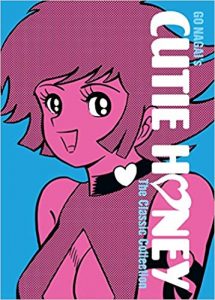
Cutie Honey: The Classic Collection (English)

January 10th, 2019

Many years ago, I was given the 1985 reprint of the 1973 manga Cutie Honey.  When she gave it to me, artist Rica Takashima mentioned that this was the very first magical heroine who didn’t need a man to help her (and the men actually get in her way more than once.) I’m a huge Go Nagai fan, so was thrilled to read this tale of death and destruction, breasts and body-shifting. It was, as I expected, horrible in the best possible way. I never expected to see it translated into English. 

Here it is, translated into English! By my bud, Zack Davisson! Cutie Honey: The Classic Collection is a must-get for, well, pretty much, either everyone or no one, depending on what you like to read. ^_^ 

In this original story (well told once again in the Cute Honey Universe anime last year) Kisaragi Honey learns she is an android with supernatural abilities, and is pursued by the Panther Claw gang, led by the odious Sister Jill, her boss Panther Nora, and an Island of Dr. Moreau‘s worth of creepy animal-human hybrids.

In attempting to hide from Panther Claw, Honey enrolls in Saint Chapel Girl’s School (which itself is the ur-ridiculous-girl’s-school-name in Yuri) and meets Natsuko, Na-chan, who falls hard for Honey on sight. Natsuko isn’t alone in this, Honey is the object of desire for students and teachers alike. She also ends up being the object of  desire for the obscene Junpei and Danpei Hayami, as well as being admired  and supported by journalist Seiji Hayami – who ends up being damseled for his efforts. Aside from that, there is a little bit of ugly lesbian sex in the form of two of the teachers at Saint Chapel, and a bit of non-consensual BDSM, as well.

Honey is not successful in hiding out at Saint Chapel, instead bring danger upon the school. With many casualties. As I said when I reviewed the Japanese edition, “The end of the main part of the story is violent with a capital “Oh my god!” Which was made truly appalling by the light-hearted romp that was the final chapter in which Honey destroys Sister Jill and sings her own musical theme.” 

I love Go Nagai. Have I mentioned that? Well I do. I love that he layers cute and awful here to make a mille-feuille of WTF.  This manga is brilliant and horrific at the same time and, not despite the horror – but because of it. 

Ratings: 

Art – Godawful except when its not
Story – Violent and weird, except for the cute bits
Characters – Creepy, unless/until they aren’t
Service – 100%
Yuri – 15%

Overall – Brilliant

I am beside myself with joy that you, too, are able to read this manga, and I hope you will. Much of my inspiration as a Yuri fanatic is because of Nagai’s work. This is a piece of our history, kept in a softcore scrapbook made by creepy Uncle Go.


Live Action: Rose of Versailles Digital Remaster Blu-ray (ベルサイユのばら デジタルリマスター版)

December 24th, 2018

What better way is there to celebrate a holiday, than to watch Lady Oscar, the French live action movie with English cast and audio, Japanese subtitles, based on a Japanese manga about the French Revolution that is being translated into English?

Rose of Versailles Digital Remaster (ベルサイユのばら デジタルリマスター版) is Schrodinger’s movie – not bad, not good, not inaccurate, not accurate. I think I like it but I cannot be sure. ^_^

On second thought, I think I like it.

As a live-action version of the manga classic, it’s really not bad. It follows the key pieces of the story in a condensed fashion. The Affair of the Necklace has a chunk of the story and the end rush to tragedy plays out at increasing speed. 

The major changes are in the characterizations. 

Andre is a freedom fighter and tends to chide Oscar, demanding she be one, too. He’s not lovelorn, he’s vexed that his woman is so gosh-darn delusional. He’s kind of a mix of Bernard and Andre.

Girodel is another changed character, but at least he is in purple, which I thought was funny. Instead of being a self-proclaimed rival, Girodel is a jerk, but his marriage offer provides us with a scene in which Oscar strides into Versailles in white and silver and cape and dances with one of the court ladies, then kisses her, so I am not complaining. ^_^

General de Jarjayes is not nice to either Oscar nor Andre, which is a shame. I much preferred the General of the anime.

Jeanne and Rosalie are exactly as we remember them, although we don’t get to spend too much time with them. (I also feel that the actresses were too old for the roles by about 25 years, but that might be me.)

Marie Antoinette is overblown and likewise delusional right to the very end. They do a fine job of making her unrepentant through the final moments. 

And finally, there’s Oscar. Catriona MacColl plays the role exactly as it is written and does a fine job of it. 

I also want to shout out Granny, who is the only sane character in the movie. When Fersen is praising Oscar as a fine young man, Granny looks at him like he’s an idiot and says, “How could anyone see Oscar and not realize she’s a woman?” Thank you Granny. Oscar could not have passed for a man if she were trying.  In fact, the issue of her sex and gender presentation is a running thread throughout the story and is one of the reasons General de Jarjayes comes off as such an asshole. For a man who called Oscar his son for two decades, he marries his daughter off pretty quickly. It was a vexing moment.

The movie ends with a nice little scene of Oscar and Andre shouting each other’s names, but fades on Oscar unable to find Andre, who has been killed. She does not die at the storming as she did in the manga and anime. It kills some of the epic feel of the story.

Ratings:

Overall – Not bad

I wouldn’t probably recommend this movie to someone who isn’t already a fan of the story, but if you are, how could you pass up this chance to see this classic manga as a live-action movie?


Yuri Manga: Kiss & White Lily for My Dearest Girl, Volume 7 (English), Guest Review by Christian LeBlanc

November 28th, 2018

Hello and welcome to Guest Review Wednesday on Okazu! Yay! Today we welcome Christian LeBlanc of 3Dcomics.weebly.com to our loving embrace. Or, was that deadly clutches…I can never remember. ^_^ In any case please give Christian your full attention…as we head out together on today’s review.

By Volume 7 of Kiss & White Lily for My Dearest Girl by Canno, (translation by Leighann Harvey, letters by Alexis Eckerman) we’ve firmly settled into the template for a K&WL book: several chapters will showcase the new characters shown on the cover, and the remainder will focus on a ‘legacy couple’ (more than likely Ayaka Shiramine and Yurine Kurosawa, as is the case in this volume).

Our newest cast members are piano-playing junior-high student Haine Aoi (who has recently joined the gardening club so she can get closer to Yurine), and her supportive aunt Aika Yukimura, a senior at Seiran. (scratchy noise of a record skipping) Yes, I did say aunt, so let’s address this elephant in the room right away before it knocks over something valuable.

Canno portrays many different types of relationships in her work. Countless micro-stories fill the “Kiss Theater” bonus pages at the end of each chapter. Her story in Éclair: A Girls’ Love Anthology That Resonates in Your Heart follows a 28-year-old rogue and the 16-year-old girl who pursues her, and she’s even explored monster girls in a MONSTAR doujinshi (along with circle mates Nega and Kawauchi).

Non-romantic friendships are also valid story fodder, as we’ve seen in Volume 4 with Kaoru, Kohagi and Momiji. Here, then, Canno continues exploring different relationships between women by focusing on an aunt and niece, close in age, who were brought up as siblings. Canno even makes it explicit in one scene that they will never be paired romantically, when one character momentarily considers the possibility and is put off by it. I think Canno felt this was necessary given the expectations of romance set up by the cover (and genre) (and by contemporary stories such as Citrus, coughcough), but it still feels a little strange that they consider it at all. The alternative, I guess, is to not show this scene, and leave the reader with a seed of doubt: “but . . . are we supposed to think of them as a couple?” Better to just nip that question in the bud.

This all being said, Haine and her aunt Aika end up being a delightful pair to read about.  Their affection for each other is sincere and touching, rendered even more so by Leighann Harvey’s thoughtful and expressive translation. They both suffer anxiety over the idea that siblings are supposed to drift apart to some degree in adulthood, but Aika receives advice from a returning character on this. There’s also some tension between the two early on concerning piano skills (something they once bonded over nearly drives them apart!) and Haine needing her space and independence (I know she’s just at that age, but oh boy does she act like a brat!), so in all, we still get our ‘romantic conflict’ for our cover stars to work through.

As for our returning players, we see some major growth in effortless-genius Yurine and her relationship with hard-working honors-student Ayaka. We’ve already seen hints throughout the series that Yurine’s advantages over her classmates have caused her some alienation. This comes to a head when Haine triggers a depressive episode in Yurine by telling her she has an empty life for failing to find a passion for anything. Ayaka gamely tries to help her recover, still grateful for Yurine’s help back in Volume 5 when Ayaka was at her lowest.

Contrasted with this, however, is Ayaka’s negative reaction when Yurine later suggests throwing the exams to let Ayaka take back first place. Ayaka has always been comically tsundere before, but there’s nothing funny about her reaction this time – her words are cold and mean, with no underlying hint of “but I really like you!” at all. It feels especially shocking given how much Ayaka was earnestly trying to help Yurine in this book, and speaks volumes about her unresolved hang-ups concerning perfection.

This is also the first volume to end on a cliff-hanger, incidentally: as their relationship evolves, Yurine feels something different after one of her many kisses she’s forced on Ayaka, and it freaks her out – the next volume is about her sorting through what these new feelings mean, so stay tuned! Volume 8 is currently scheduled to be published by Yen Press on March 19, 2019.

Art – 7 Significant improvements: hair is given a lot more definition and shading, and there are more efforts to visually distinguish Yurine from Ayaka (their height difference feels more pronounced, for example). However, I have to knock two points off the English edition for being printed with significantly thicker blacks than the Japanese version, which destroys a great deal of subtlety in the tones and shading; scenes set in the dark particularly suffer from this. Additionally, Yen Press routinely trims off a fair bit of bleed art, and it was frustrating to see Ayaka’s and Yurine’s test results get cut off as well.
Story – 9 Again, Leighann Harvey has done a wonderful job translating this.
Characters – 9
Yuri – 5
Service – 3 My wife may or may not have uttered “Holy Bazongas!” when she happened to glance over my shoulder at the bath scene, and if you have a thing for Santa dresses, Canno’s got you covered with the introduction to the closing chapter.

Overall – 9

I really enjoyed this volume. There are many returning characters, giving the book a welcome ensemble feel for the first time, reinforced by four bonus chapters at the end. The two main stories connect quite seamlessly, and the Christmas backdrop leads to some very pretty scenery (the cover, with its snow-flecked poinsettia, pinecone and holly border sitting above a starry-looking field of snowflakes, is my favorite of the series for this reason). It’s also refreshing to see Yurine struggling for once – she’s come a long way from her one-dimensionally super-human portrayal in Volume 1.

Erica here: Thank you so much for your insight, Christian. If I wasn’t already reading this series, your enthusiasm and affection for it would surely convince me to pick it up! Thank you again for a wonderful review. ^_^