Archive for the Artists Category


Yuri Artbook: Miyabi Fujieda’s Color Illustration Collection 2000-2006

June 8th, 2012

In 2010, you may remember that Kazami Akira-san was very kind to let me know of an art show in Akihabara, featuring the work of one of my favorite artists, Fujieda Miyabi (who sketches live sometimes on his Ustream channel.) We happened to be free that day, and were delighted to be able to see the art we love so much live and in person.

That day I picked up a copy of Fujieda-sensei’s first color artbook collection, 千紅万紫, which would probably translate to A Thousand Reds, Ten Thousand Purples, but it beats me how it might be transliterated, Senbeni Manmurasaki? I have no idea. The title is not the point, so I won’t belabor it.

The book is page after page of delight for the eyes and, to some extent, it’s my own history in Yuri, illustrated. From the covers of ES~Eternal Sisters, the second one of which featured Sarasa and Seriho,  to his costume designs for Himitsu no Angelis, an Iono-sama picture, art for Twinkle Saber Nova and a ton of derivative work from series like Fate/Stay Night, Mai Otome and pages of Maria-sama ga Miteru among others. Not every picture is Yuri, of course, but there’s quite a few that are and others that are simply a delight to see.

Unfortunately, I do not see any legitimate ways of purchasing this artbook outside of Japan, and I’m not going to scan it in, but of all my Yuri artbooks, this one is the top contender for first place. It never fails to make me smile.

Overall – 10


Yuri Anime: Revolutionary Girl Utena Movie/Adolescence Of Utena (English)

May 28th, 2012

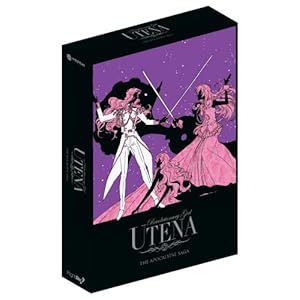
Included with the third Revoutionary Girl Utena box set from Nozomi/RightStuf is the Revolutionary Girl Utena Movie: Adolescence Of Utena.

I credit this movie, specifically, with being the beginning of my “career” as a spokesperson for Yuri. Because of my interest in the movie, my discovery of a Yoshiya Nobuko reference in the movie manga, and my interest in the literary and artistic references drawn upon for the series, I ended up being invited to present this movie at the Frameline Film Festival in San Francisco, the British LGBTQ Film Festival and the Tampa LGBTQ Film Festival back in the early 2000s. I was able to meet and interview Ikuhara Kunihiko at Big Apple Anime Festival and because of this movie, CPM was an early sponsor for Yuricon events. I have a lot to thank this movie for. Not least of which is for being a fantastic movie.

It is a fantastic movie, with extraordinary visuals, and two of the most spectacular scenes I have ever seen on a screen – the dance on the dueling ground, and the castle car. As much as I consider the TV series a more subtle and sophisticated creation, its the movie I watch more often.

I find I have never once published the intro I gave this movie a decade ago when it first came out in English, so rather than explain to you what I said, here is the actual intro I gave the film, in front of hundreds of people who liked anime and the series…and thousands of people who had no idea what the hell they were getting in to.

In 1994, on Sundays at 7 PM, the Shinjuku Ni-chome, Tokyo’s gay and lesbian district would come to a screeching halt. Why? Because for the first time ever, Japan was watching a lesbian couple on their TVs, as part of the popular animated series, Sailor Moon These characters, Sailor Uranus and Sailor Neptune, were very clearly portrayed as a couple – with personal issues to work out, as well as greater ethical dilemmas – all within a framework of defeating the Monster of the Day as sailor-suited magical heroines.

The director of that pivotal season of Sailor Moon had instructed the voice actresses to play the characters as if they were a married couple. In 1997, that same director Ikuhara Kunihiko, along with veteran comic artist Chiho Saito and the creative team at Be-papas, turned their sights once again to the “magical girl” genre of Japanese animation. The result of their collaboration was the wildly popular series Revolutionary Girl Utena.

This 39-episode television series utilized symbolism from earlier popular shoujoai or, “girls love” series – character designs and settings, were inspired by pioneer of shoujoai, Ryoko Ikeda’s Rose of Versailles and Brother, Dear Brother. Ikeda herself had incorporated imagery into her works that were established at the beginning of the twentieth century, by lesbian author Yoshiya Nobuko. Yoshiya’s Flower Tales set the standard for girls’ literature, and ultimately girls’ comics and animation, as well. Yoshiya was also responsible for the creation of the “shoujoai” genre with her story Two Girls in the Attic, another story whose themes and imagery echo strongly throughout the Utena series.

What you are about to see is the movie based upon the earlier television series. It was not meant to be a resolution of the series, it was meant to be a reflection of it – the same story as seen through a slightly distorted lens. The movie highlights the conventions of Japanese animation, even taking them to extremes. The subtle surrealism of the television series has been left behind and replaced with overtly surreal elements, a non-linear narrative and perhaps most confusing, scenes that are wholly dependent upon knowledge of the television series. What does this mean to you, the viewing audience? Well, it means that the best way to view this movie is to simply let it wash over you, like the roses over the dueling ground.

What significance does this movie, this cartoon, have for gays and lesbians? Many Japanese – as do many Americans – see comics and animation as being just for kids. But as we know, as we breathlessly waited for Willow and Tara to kiss on Buffy, the Vampire Slayer; every image, in any media, is progress. And with gay and lesbian youth, images that appear on television or in the movies have an even greater impact. This movie, like the television show it is based upon, adds one more positive image to the library.

In the United States, Yaoicon was formed to increase awareness of the portrayal of gay men in Japanese comics and animation, while at Yuricon, we’re focusing on our own line of translated and original comics, and next year will be holding a ground-breaking event in Tokyo to celebrate lesbian stories in Japanese animation and comics with their creators. We at Yuricon firmly believe that our support, our creativity and our energy will bridge the enormous gap between fans here in the West and in Japan, and feed back into Japanese lesbians’ and gays’ efforts at being recognized openly.

And with that hopeful thought, I’d like to present to you, Revolutionary Girl Utena: The Movie.

***

We did hold that event, and we have continued to bridge that gap. I’ve traveled the world, spoken on several continents about Yuri, presented movies and manga and anime to people in hundreds of countries through this blog.

As I watched the movie this weekend – again – I’m reminded that in many ways, it did give us the power to Revolutionize the World. How cool is that? ^_^

Ratings:

Overall – 10


Girls Jump Manga 2012 ( ガールズジャンプ)

May 8th, 2012

Back in 2011, I reviewed the first volume of Girls Jump magazine. I loved it instantly. It was full of talented female creators, drawing without any apparent limits on story or art.

I loved the variety, the sheer talent and the wtf-ness of so many of the stories. Now, over a year later, I’ve gotten my paws on the 2012 volume of Girls Jump ( ガールズジャンプ) and it’s just as wonderful.

The second story, “Hatsukoi Guardian” by Aiki Haruko, was perhaps the very best. It follows a  female wrestler in high school as she deals with falling in love with an attractive male upperclassman in her school. She and her friend were both drawn as beefy, masculine looking girls – not as caricatures, just short-haired and strong, the way an actual wrestler should look. Although it did not have a happy ending, I loved it for the atypical female characters.

The short, tragic and battle-filled lives of bees are sung in the paean “Vespa” by Nakamura Ching. One bee, reaching out to save the other from drowning in a jar was absolutely epic. “short, but seems long time of their life” is a most fitting tagline.

Est Em has contributed a story about a shoe salesman, “IPPO.”

There was a unsubtle timeliness in “Damatte Sumi-chan” about a woman who incessantly Twitters. Maki Hirochi really nails the real-fake tone so many people adopt on the social platform. ^_^;

Hirao Auri gives us “Supernova” about a schoolgirl and the space girl she befriends…and their decision to face a future together, even as the planet faces destruction.

The magazine wraps up with old school, overdressed, vaguely European Vampires in “Darkness Blood” by Yukito. I have no idea what happened, I was too busy looking at the hot vampire woman in knee boots, velvet jacket and corset to read the story. ^_^

Ratings:

Overall – 8

As with the last volume, this brief overview does nothing to really explain the assortment and ability of the creators. Honestly, I really hope you’ll all get this annual volume and enjoy the hell out of it, as I have.


Yuri Manga: Sasamekikoto, (ささめきこと) Volume 9

April 16th, 2012

Just about a year ago, I reviewed Octave, Volume 6. It was the final volume and of it I said, “Octave is the story I have always wanted to read.”

I say this once again, this time about Sasamekikoto, Volume 9 (ささめきこと).

The series began as a comedy, a ramshackle combination of Yuri tropes, all played for laughs and a little bittersweet drama. Slowly, but surely, it became a real story, a story that hits right in the heart of what lesbian Yuri readers want to see. What we want to see is not always about “coming out,” it’s about “becoming whole.”

And here, in the final volume, Sumi and Ushio become whole. It was a remarkable, fantastic, magnificent ending. I did not expect an ending of this caliber – I never even hoped for it. I would have been content with a “happily ever after” where we see Ushio and Sumika walk off, without having yet faced their community, their friends and their family, and we all pretend it will be all right.

I didn’t get that ending at all. Instead, miraculously, I got an ending where Ushio and Sumi face their community, their friends and their family head on and tell them that they are lovers. Good heavens, really? And still – it was funny. It was still a comedy, less bittersweet than we ever could have imagined. This is the decade Yuri has changed, irrevocably. This is the decade where Yuri becomes “any manga, anime (or related media) that shows intense emotional connection, romantic love or physical desire between women.” Just like we wanted.

I am flabbergasted. I rejoice. I celebrate.

Congratulations Sumi and Ushio – we love you.

Couldn’t have said it better myself.

***

Subcribe with Patreon Enjoy today’s post? Subscribe to Okazu with Patreon!

***

Ratings:

Art – 9
Story – 10
Characters – 10
Yuri – 10
Service – 1

Overall – 10

I can already see that 2012’s #1 slot for Yuri Manga is going to be a tough race. Awesome. ^_^

What a great ending.


Magic Knight Rayearth Anime Second Season, Disk 4 (English)

April 14th, 2012

I pride myself in watching anime without expectation and my ability to clearly, concisely separate my delusions and desires from what is actually happening on the screen. We all choose to interpret what we see differently, but sometimes the information we’re give is clearer than others. Sometimes the holes are so huge, it’s impossible for me to ignore them, regardless of what I want to be happening.

Which brings us, in an oblique way, to Magic Knight Rayearth, Volume 4 of the Second Season Complete Box Set.

In this volume Nova put a full-on passive-aggressive seduction of Hikaru because, as she says, she loves Hikaru. Well, okay, but a second earlier she told Hikaru that the reason she hated her was because Hikaru hates herself. So, having been given that piece of information, we have to conclude then that Hikaru also wants herself in a sexual way. Or, we can presume that Nova is making it up (and being inconsistent about it) or – and this is my best guess – no one told CLAMP that that made no sense.

In any case, Hiakru remembers for the 17,000th time all the people who are counting on her and manages to get her sword back and call Rayearth for the first time in a few volumes.

More interestingly Fuu defeats Princess Asuka by being calm and cool and smart and unflappable. Standing her ground when Asuka attempts to renege on a deal was a beautiful moment – as was the emotional reunion with Ferio.

Umi’s relegated to a back seat for this volume.

We do get a few moment’s with Eagle, but it looks Lantis is out of the question for him, now that we’ve been told so many times that Hikaru and Lantis are an item. Snoooze. And Debonair-sama laughs evilly for a bit.

Now that we’ve had the Nova gay moment, I doubt that I’ll review the last two volumes individually, but I’ll probably do a single wrap-up for the series as a whole. I really don’t dislike it, but it was dragging there a bit. If we can get back to the plot, I’ll be happier.

Ratings:

Art – 6
Story – 4
Characters – 6
Yuri – 5, but bleah
LoserFanBoy – 3

Overall – 7