Archive for the Western Cartoons Category


Q-Force on Netflix

October 10th, 2021

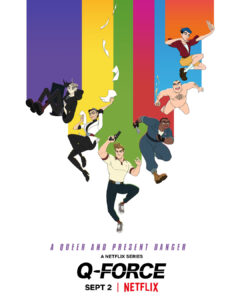
Q-Force is about the first Queer superspy team in AIA (ahem) history. Shunted aside by homophobic commanders, top spy of his class, Steve Maryweather (voiced by Sean Hayes, who was the first gay ever for a lot of American households, by way of Will & Grace,) is shunted to boring duty in West Hollywood*, where his team is an apparent bunch of underfunded and ignored misfits, who are berated constantly by their homophobe commander. Given the premise, it could be easy to dislike this series before it gets off the ground. But, while this is no Steven Universe, I would argue that Q-Force is actually worth watching.

Let’s start with the problems with this series, before we get on to why it does, honestly, exceed its limitations.

The homophobia is…not great storytelling. In fact, the first episode really bogs down as the prejudice of the people around “Agent Mary,” as they take to calling Steve, is given primacy over literally every other aspect of the story. In the early scenes, it is tiring, as Steve is pushed aside by and for wildly incompetent toxic straight men. Worse, it hits a nadir, when 10 years have gone by, and we know that our Federal agencies may still have homophobes in positions of power, but also know they are not allowed by law and policy to be…this. So, it’s a story written by/for people with paltry imagination who cannot imagine that the world, organizations or any individuals within them can move past the trauma of their past. Honestly, this continues to be a problem throughout the story, and occasionally really gets stuck in this viewer’s craw. When homophobic jerk Buck (voiced by Rick Harbour) is assigned to the team, it makes no sense, as he had been promoted to top spy. In a real story, it would be a subplot that he is being punished, but here, he is assigned there to torture Steve, which makes no sense and just is a stereotype of every jock bully ever. It doesn’t create depth, it robs it….until the last few episodes, where the story finally finds a place to use Buck cleverly.

Despite that, the story works.

For one thing the team is great, full stop. Each individual voice actor was excellent in their role and the stereotypes were treated with love and genuine humor. So, Deb the lesbian, voiced brilliantly by comedian Wanda Sykes, whose wife thinks she works at Pep Boys (does the rest of the country know Pep Boys? I thought it was a NJ/Philly thing,) is actually a great mechanic whose car is named SubaRue McLanahan. ^_^ That’s several in-jokes right there.

Stat the hacker (Patti Harrison), and drag queen Twink (Matt Rogers), make up the rest of the agents in Q-Force. For both these, their various obsessions and fandoms are given room to show up as not only acceptable, but come in handy. How many otaku dream of their favorite show being actually relevant to something they need to know right now? Everyone’s quirks are presented as skills that come in handy, from Twink’s Ariana Grande impersonation to Stat’s encyclopedic knowledge of a fictitious in-show show, Cobblestones. I am endlessly fascinated with in-media, and deeply enjoy it when it becomes part of the story.

Coming as no surprise to anyone who has ever read a review here, is my favorite character, team leader V. Voiced by Laurie Metcalf (probably best known as Roseanne Barr’s sister, Jackie  in Roseanne.) V is given a lot of depth and a whole arc of her own. An arc that, while it was ultimately more “homophobia bad, gay good,” had some surprising and funny moments.

Where the story works is, like all good ensemble casts, when they start working together. It becomes a minor triumph when they realize that they are actually a team. Having been raised on anime, I expect the story to happen at that point…and it does! The story is utterly absurd and joyously ridiculous from that point on to the end…and it all works. Every stupid sex joke, and reference to unreal media influencers, a company called, brilliantly, “Honestly?”…it all works. Like the first season of beloved media franchises, the first few episodes have to be endured so the rest of the season can develop.

At the moment, Netflix has not greenlit this for a second season…I can’t really decide if that’s a good thing or not. As a short one-season goof, Q-Force is fun. As a longer show? I don’t know how it would hold up. But because it is so short, I can recommend you watch it if you can and just let it happen. Don’t take it too seriously, don’t look for lessons beyond “We’re Q-Force! Yay!” Which made for a fun evening’s binge watching.

Ratings:

Art – Not entirely bad, with some very good moments
Story – Gays are funny, homophobes are bad, and anyone can be evil or a hero
Characters – Stereotypes, but when they flesh out, they work
Service – Yes. There are a fair amount of sex jokes, mostly male and some nudity, mostly male, but yes, service. Not all of it played for laughs
Queer – 10

Overall – 7

It had a rough start, but it quickly grows into itself and has some fun on the way.

Props to Fortune Feimster as Desk. A great supporting role that she was perfect in. I’d like to see a short with her as lead. Maybe team her and Caryn up, writers!

*Who would ever complain about being assigned to West Hollywood? I don’t do gay scene things ever, and if someone paid me to live there, I’d suck it up. Sheesh.



Steven Universe the Movie and Steven Universe Future

June 28th, 2020

2013 seems a lifetime ago now, doesn’t it? Steven Universe was created in a whole different era, practically. The series’ message of hope and growth and love has resonated widely…possibly even more so, as our future turned less hopeful and more dystopic. I’ve reviewed all of the “seasons” as they came out on Amazon Prime, so the numbering is vastly different than the seasons on disk or by CN’s reckoning.

If you aren’t familiar with the show or why I think it’s worth watching, here are my previous reviews:
Season 1 | Season 2 | Season 3 | Season 4 | Season 5 | Season 6 | Season 7

Steven Universe is ultimately a story about personal growth, and it includes arcs about love and acceptance, about parenting, about working through dysfunctional family dynamic and toxic and abusive relationships. It includes a queer wedding and some very catchy music.

In a year, we went from a government that finally accepted our relationship, and was working towards broader inclusivity, to a nightmare dystopia. In 2016, my wife and I started to watch an episode or two every night before bed, as a kind of anti-anxiety medicine. Not gonna lie…it worked. We still do “take” two episodes most nights. We reach the end, then start over.

Mild spoilers and major links to music videos to follow. ^_^

In Steven Universe the Movie, Steven and the Gems have a similar experience. The future looks very bright for them and the possibilities are endless…until yet another relic from Pink Diamond’s past pops up and takes revenge for how she was treated. It is, maybe, a little too on the money for those of us in 2020, thinking back with nostalgia, but it’s not nostalgia that saves them, it’s acknowledging the sins of the past, and repairing the hurt, so everyone can grow. Still, way too close for comfort, but critically important to remember.

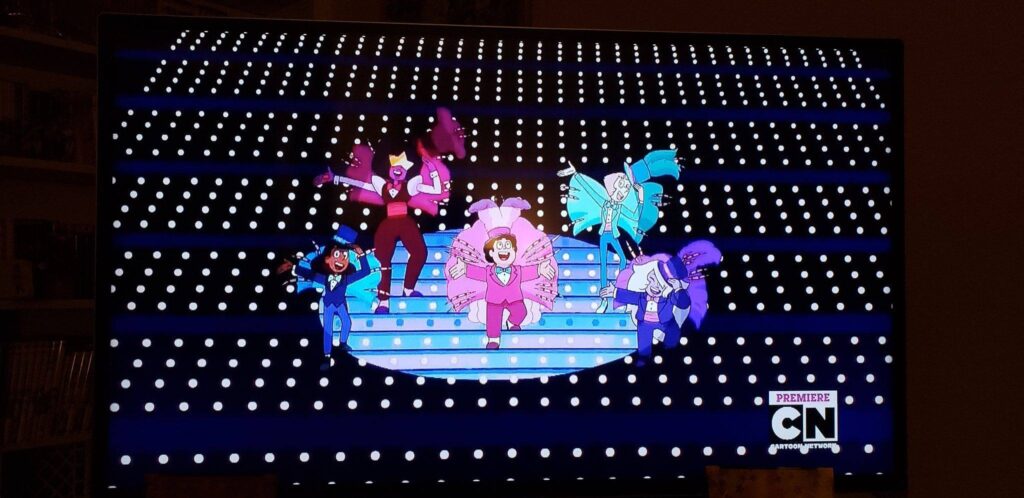
The music in this movie is both incredibly catchy, ridiculously sticky and in several cases, deeply painful. What made this movie worth watching is that once again, we are reminded that Steven Universe was never a story about a magical boy fighting monsters, it was always a story about personal growth. Watching the Gems recalling who they had been and how they became who they are, was masterfully done. With a musical bonus. The fusion Opal was voiced by Aimee Mann (whose hit song as ‘Til Tuesday, Voices Carry I remember playing – and watching on MTV – on a loop as a teen). I was delighted that she and her musical partner, Ted Leo, get a powerful song during a climactic scene here.

One of the overall themes of Steven Universe as a series has been that choices have consequences…and if you’re not dealing with the consequences of your choices…then someone else is.

The end of the movie is the most spectacular Takarazuka reference. We literally screamed our lungs out when we saw it the first time. Just…..wowowowow, holy crow wow.


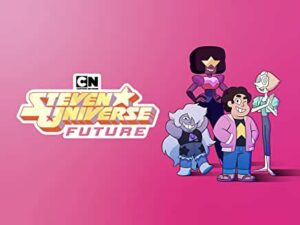
Steven Universe Future is about what happens when you keep pushing off the consequences of your decisions.

The entire season is focused on Steven coming to grips with a future that he helped build, but which may not actually include him. Like every hero returning from their journey to the underworld, he’s paid a price and like all the heroes before him, that price is normality. Or…is it? Sure Frodo couldn’t stay in Hobbiton, but…he was oozing out of that place long before he left. We all do. I liked the community I grew up in, but I’ve never wanted to return. Part of growing up in the USA has traditionally been leaving your home behind. And just because you’ve returned from the heroes journey doesn’t have to mean you’re done.  Maybe journeying is what you’ll always be doing, and maybe a hero could make an amazing psychopomp because they’ve been there and done that.
Future has one last Utena reference for us and it’s a doozy, so get your roses out and get ready to duel. ^_^ (Also a side-eye to Sailor Moon.)

We cannot fix the past by ignoring it. We can only admit the truth, be the best possible people we are now and allow people to find their own way forward. It’s not an idealist vision of the future, it’s a realist’s vision. The future may or may not look bright, but we’ve still got to put the work in, no matter what.

Once more I want to thank Rebecca Sugar and all the folks on the SU team, with my eternal gratitude for the amazing writing, animation, music and voice acting. I am endlessly surprised by this series, no matter how many times I watch it. And I’ve watched it a lot of times.

Ratings:

Overall – 10

Steven Universe has given us a process by which we may move forward towards the future. It’s up to us to build the future we want.


She-Ra and the Princesses of Power, Final Season

June 8th, 2020

It seems a million years ago, when She-Ra and the Princesses of the Power began, but no. ^_^

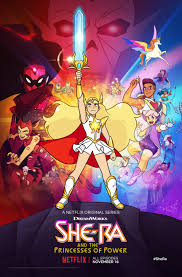
Through 5 seasons on Netflix, we’ve watch Adora and her friends form an alliance with the other Princesses of Etheria to combat the evil Horde, which sounds exactly like what one might have expected of a series called She-Ra and the Princesses of Power…but there was so much more than that baked into the story.

Teamwork and Leadership. Obviously, we expect that from a kid’s cartoon, even now…maybe especially now, after decades of anime that focuses on the power of many over one. This cartoon delves into how hard it is to keep a team working, how a good team leader really needs to understand the skills their team members bring to the plate and find a way to utilize them. Hordak isn’t actually a bad leader…especially Hordak Prime, who fully understood that the way to build a team is to make people feel included.

Trauma. That Hordak’s rule was not so much a team as a cult made it pretty clear that there is a fine line for cults of personality/celebrity, and it takes some strength to break free. For my money, Wrong Hordak (along with Peridot and Lapis) is some of the best writing in the last few years – not everyone joins the resistance for the right reasons and even if they do, they sometimes need to work through a lot for a long time. Trauma is real and healing is ongoing. You just know Wrong Hordak will wake up screaming some nights and Catra will have a hard time every once in a while. Mara’s story is a story of trauma. Bereavement is a repeated theme which makes a lot of sense for a series centered around a war.

Betrayal. Scorpia’s whole story is one of betrayal. Her grandfather capitulated to the Horde, and betrayed their family. Catra treated Scorpia with contempt and left her behind. Entrapta was betrayed – she thought – by the Princesses, and she betrayed Wrong Hordak. Adora was betrayed by Lighthope, Glimmer felt jealousy and betrayed by Bow…. and Bow was unable to address his fear of betraying his fathers. And so on.

Representation. I commented on Twitter that, in the post She-Ra and Steven Universe world (for which I still owe you a wrap up review,) all children’s cartoons are going to have to just be amazing. Never again can a network argue with a straight face that representation “doesn’t sell.”Along with racial diversity in characters, there was age, and sexuality and gender diversity, varying body types and sizes. Which is not to say it was perfect. Upon reflection, we can’t think of a disabled character in She-Ra. (Yes, I know that other cartoons have some…I’m reviewing this cartoon right now. If I’ve forgotten someone in this cartoon, please do jump in. I’ll be glad to be wrong. ^_^)

In terms of queer representation, the creative team pulled out the stops. Netossa and Spinerella are already an established couple when we meet them and they are really cute about it. Bow’s dads are a dignified middl-aged couple, as well. Double Trouble is notably non-binary, voiced by non-binary voice actor Jacob Tobia. And of course, there’s Catra and Adora’s 5-season long gavotte around their feelings.

And in all this, characters deal with many other emotional states, both positive and negative. When I wrote my initial review, I found some of the Princesses annoying…as we were lead to. As their stories unfolded, their characters filled out and developed into some great characters.  Some of these story lines work well, others are occasionally  facile, but generally it had some remarkable scenes. Excellent characters who were complex and nuanced, rather than bad OR good. Overall a very good series.

My only – really only – complaint about the series is the shadows that were drawn across their faces. It often looked as if they were wearing a mask. It reminded me very much of the band of light in the characters’ hair in Vision of Escaflowne, which I also found horribly distracting. I shouldn’t be seeing one artistic quirk constantly in every scene to the point of not being able to not notice it.

Ratings:

Art – 7 That face thing is a point off
Story – 8 Twisty and good, avoiding childish morality
Characters – 9 Full developed, often funny
Service – 1 I mean, everyone looks good dressed up, but that dress on Scorpia and the untied tie on Catra were on point. ^_^
LGBTQ – “perfect world” 10, in which people just are and that’s not the issue ever

Overall – 9

I do wish, though, that there had been a post-series Princess Prom episode. ^_^


She-Ra and the Princesses of Power, Season 1

December 9th, 2018

Okay, okay! I went and signed up for Netflix, fine. Sheesh. For the last couple of years I have been hearing about dozens of series that didn’t make me want at all to subscribe, but finally there’s one series that motivated me to sign-up. 

That series was She-Ra and the Princesses of the Power. With Noelle Stevenson (co-creator of Lumberjanes) as showrunner, and a promise of wholesome queerness, how could I not want to see it?

In this iteration of the story, Adora is an orphan who has been raised by Hordak on Fightmoon to be a leader of his armies, known as “the Horde” as one might expect. (Put a pin in this naming scheme). Her best friend Katra and she vie to be the next group captain, but when Adora discovers a mysterious sword, she learns that she is meant to be the next She-Ra and fight the Horde. She’s taken to Brightmoon by the leaders of the restance and finds everything she grew up believing is a lie. As she grows more convinced that the Horde is evil, she’s put into the position of  facing Katra as an enemy, a situation that is not resolved by the end of Season 1.

In this season, we meet the other Princesses of countries being attacked by the Horde. Their powers are primarily elemental and their personalities aren’t always good or kind. Most of them float in a range of being quite annoying in one way or another, in fact. Except for Entrapta. Pull that pin out of the naming scheme. “Entrapta” does not sound like a good-guy name. And, indeed, while the resistance Princesses have elemental (i.e., “natural”) powers, Entrapta’s powers are in mechanical design and makership. Her creations are often evil and she doesn’t seem to much care what they do as long as they work. When she find herself left behind because her friends think she is dead, Katra welcomes her with open arms and, frankly, Entrapta, with her evil name, chaotic evil creations and disinterest in people, finally finds a home, Frankly, I was kind of relieved for her. The resistance Princesses are, well, kind of jerks to her. Good for Entrapta – the Horde suits her much better.

Adora, Princess Glimmer and Bow manage to unite the Princesses despite obstacles and Adora learns a bit more about the title of She-Ra before the season wraps up. 

The story itself is simple, allegorical and adheres very closely to the kinds of writing I am used to in American Cartoons For Kids TM. In fact, this was my main complaint about the series. I wrote on Facebook, “It’s got all the problems of conventional cartoons, in which basically every single plot is “no one says what they have to to the person they have to say it to.”

The characters were the weakest point for me. The only character I genuinely like is Scorpia. She’s an absolute delight. Everyone else I find annoying in one way or another. I find several of the Princesses intolerable.

I was also quite confused about the queerness, as many of my friends were singing paeans to how queer it was…and I was not seeing it at all. Yes, in the Princess Ball episode, Katra came off all butch and she and Adora have a friendship/rivalry sprinkled lightly with some romantic tension, but this was not even as gay as the first season of Sailor Moon. In the final few episodes, we are at last introduced to Princesses Nettossa and Spinnerella, who are very overtly a couple. So yes, there is queerness, and it is absolutely suitable for a small child, which hits the brief this cartoon had. 

There was controversy about the character design, but only if you count the grunting of animals as something to be commented upon. I do not. This was, from the first, a cartoon designed explicitly for children, with a focus on girls. I mention all of this only to note that if you are over 12 years old and have some complaint about the art or character designs, you’re welcome to make a fool of yourself in the comments, but you will be making a fool of yourself. ^_^ I’m not saying you can’t dislike the art, just that if you want it to be sexier, it is explicitly designed to not be for you. ^_^ It gets good marks from me for body type, race, gender and romantic diversity. 

As an adult watching She-Ra and the Princesses of Power, I was not as blown away by the series as I am regularly by Steven Universe, but for what it is – which is to say, for children 50 years younger than I am – it is a pleasant cartoon. 

Ratings:

Art – 8 Honestly, I like it. 
Characters – 4 Scorpia ftw
Story – 6
Service – 0
Yuri – 6

Overall – 6

I am 100% supportive of the effort to bring empowering characters, body and race diversity and complex emotions into children’s cartoons so I’ll keep watching new episodes, but not on a loop, the way I watch Steven Universe


Adventure Time Ends With a Kiss

September 5th, 2018

This week saw the end of Adventure Time‘s 10-year run. In a special finale, we finally got confirmation of the the ‘ship we all knew existed. Heck, they even knew it in Japan where I saw this tote bag back in 2016:

And now, as the series ends, everyone knows that PB and Marceline are a couple. Well, we knew that all along, but now folks who spend their energy denying the obvious will have one more couple they have to check off their “we’re not sure yet, need more proof” list. ^_^

Take a a look at this tweet and remember that, despite all the bad things happening right now, there is good in the world- and an awful lot of that good is in the form of comics and cartoons.


And that, as they say is that.