Archive for the Classic Yuri Category


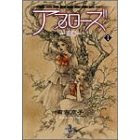
Yuri Manga: Applause, Volume 1

June 25th, 2007

This is a title that has been on my “meaning to read” list for *ever*. Last month, completely by coincidence, as I was leaving that haven for used, obscure and hard-to-find manga, Book-Off, the title caught my eye from a shelf I never look at. Lo and behold! They had the complete set in reprint. So today’s review is dedicated to Wendy, who kept ragging on me to read it.

And here we are, at the first volume of classic Yuri manga Applause by Ariyoshi Kyouko. which is still in print and available over at Amazon JP. If you’re really into shoujo manga, you may recognize the mangaka’s name as the author of Swan, which is now out in an English-language edition.

Applause begins at St. Maria’s, a private Catholic school in Belgium. The two stars of the school are Junaque, a relative of the Belgian royal family and Shara, a Japanese transfer student. Shara is tall, athletic, boyish; while Junaque, two years her elder, is sensual and attractive. Both are tops in their classes in studies and both are a little bit mischievous. They are roommates despite the differences in their ages and it is widely known that they share a bed much of the time. They are also about to star in the school play which is supposed to be the typical annual Christmas pageant, but in secret (along with all the rest of the girls) they have been preparing another, scandalously racy play. It is the tragic love story of Manon Lescaut. It’s a pretty shocking play and all of the school, sans the teachers who are out of the loop, is excited and titillated about the kiss scenes between the two school stars.

Early on, their relationship comes under fire; from jealous schoolmates, teachers and administration. When challenged to kiss in front of everyone, Junaque launches into her lines as Manon and she and Shara, as the Chevalier Grieux, kiss. But where for Junaque it appears to be all in a day’s work, for Shara, it is clearly more.

The story, which is VERY detailed and long and which I am cruelly synopsising here, follows the two as the play approaches. We can see that Shara is very in love with Junaque, and it appears that her feelings are returned but, even though they do have a very close relationship and do share a bed, they never approach the matter that lays so heavily between them. We also learn that Junaque is affianced to her cousin Georges, who we instantly dislike because of his condescending body language, snarky comments and smoking habit.

On the day of the pageant, in front of teachers, administrators, relatives, alumna, they perform the play. Of course there is an immediate outcry, but somehow they are allowed to continue. During the performance, they rewrite the lines to more closely reflect their own true feelings of love, something that thrills and shocks the audience no end. When the play is over, Junaque approaches Shara, confesses her love and kisses her, for the first time as herself. Shara, horrified by her own feelings, rejects Junaque, shutting her friend out completely. It isn’t until Junaque withdraws into herself and stops talking to Shara that she realizes what a horrible mistake she’s made. But it is too late – Junaque won’t talk to her and Shara knows that she’s done something terrible to both of them. Junaque leaves school, and Shara, without a word. Shara sees her beloved play a concert, but can’t approach her. She collapses into hysterics.

To escape from herself and from Junaque’s absence, Shara leaves upon graduation and goes to New York City where she will become a famous dancer. (I have to admit, that seemed really weird to me – she played tennis and acted…you’d think…anyway….)

In New York she ends up with a troupe full of “colorful” people, as they say, complete with gay men Gerald and Alfie, who run a theater. Shara is attending college and dance lessons, but steadfastly refuses to join the actors, even when the leading lady goes missing and they BEG her to. She refuses flatly and the show has to refund the ticket costs and close. At one point, as they beg, she shouts that she’ll never go on stage again! – which comes a total shock to all her friends, who had no idea that she ever acted in the first place. In between many passages where Shara is mistaken for a gay boy, it turns out that someone in the audience claimed that they they didn’t refund the ticket price and the police show up. Gerald resists, and Shara punches a cop which lands them both in jail. She admits that she was on stage previously, but doesn’t tell Gerald why she won’t act anymore.

Because of bail, and the show closing, the theater loses their space and has all their equipment repossessed. They need 5000 dollars to pay it all back. 5000 dollars!?! End of volume

Okay, so bottom line – there’s two completely different stories here. One, the school arc, which ends tragically. The arc that begins in New York is like a completely different manga, with a different art style and a totally different tone. But don’t worry, the two arcs intersect again later. I admit that, when I finished the volume I was bit “huh?” and went back to see if I had missed something. Also, at this point, I was a bit apprehensive that I’d find myself wrapped up in a Claudine-like story, in which Shara goes through tragic affair after tragic affair with women. But no worries on that account – which isn’t to say that there aren’t any worries coming up. ^_^

In terms of art, I think the story suffers a bit from being shoved into A4 format. It’s really too small to make out some of the details and all the dialogue gets squished together on the page. It just tires one’s eyes out. The art is *very* classic shoujo manga, with all that entails, like “shock!!” eyes. Shara is drawn adult, masculine, girly, young, as the scene requires and Junaque is mostly drawn with Miya-sama-esque bearing and expressions. My favorite pieces of art are when they are both drawn like the young women that they are supposed to be. When we reach the end of the school arc, Shara is consistently shown as more grown up, and also more masculine, although she never once tries to “pass.” Nonetheless, as they are clearly in the Village, she ends up being mistaken for a boy all the time. Which pretty much freaks her out every time it happens. You’d think she’d get used to it.

Did I like it? Yeah, I think so. I was concerned that the story would be unremitting tragedy, without the over-the-topness that made Maya’s Funeral Procession work for me, but the story really matures as it goes along. It starts off with that oh-so-stereotypical hothouse of the Catholic school, but moves off after we hit New York into something much hipper, much more adult and more whimsical without losing the sense of drama. This series has enough angst for the emo-est of teens, but also has some moments of genuine fun – and shows some glimpses of good writing from time to time. Unlike Wendy, I don’t consider classic shoujo to be the only worthy genre, but Applause makes a much-appreciated break from the shounen fare I’ve been watching and reading recently.

Ratings:

Art – *so* shoujo – 7
Story – 7
Characters – 6
Yuri – 9
Service – 3
Overall – 7

This story is full of the usual tropes of shoujo and josei storylines and characters. It’s not original (not even for it’s time) but it is a very decent example of the breed.





Yuri Anime: Project A-ko

February 14th, 2007

Here’s why, until recently, I had never seen Project A-ko. ^_^

In the dawn of time, MTV was carrying extremely late night anime, (they were dubbed, and mostly old-school. This was long enough ago now that the current anime/manga boom could not have even been predicted as a possibility,) and I was working three jobs: a full-time day job, teaching martial arts at night, and on the weekends, selling swords at a RenFaire. I’d get home Saturday night at about midnight and be completely fried. The wife was working two jobs (day job, and doing henna in Soho in NYC on the weekends) and while waiting for her to come home, I’d stare at TV.

I watched Urusei Yatsura: Beautiful Dreamer, which was so screwed up it put me off the series for years, until I watched some of the TV series for review purposes years later, which put me off it forever.

And I saw one teeny, tiny, wee bit of Project A-ko. The dub voices sliced through my exhausted nerve endings, leaving me shaking. I turned off the TV and never again even tried to watch A-ko. I should have tried again, of course. I mean, history, and all that. But the dub left such an unpleasant impression, that I’ve just sort of skirted the issue all these years.

And that’s where it might have stayed, except for a recent barrage of cajoling and wheedling by members of the Yuricon Mailing List, which culminated in Jen hoisting me with a quote of my own, from my Kekkou Kamen anime review, praising the voice acting skills of Shinohara Emi. Well, Jen won. I caved. I watched.

It is an apparently well known fact that A-ko was originally supposed to be part of the Cream Lemon hentai series, but was not, in the end, included. It has much of the same kind of art, and a great deal of fanservice. It also has a strange edginess that I find hard to explain. It’s not desperation, it’s almost…like the voice actresses found the story so bizarre and laughable that they just decided to go ahead and do it as over-the-top as they could.

I’m kind of glad I watched it when I did, because I was sick and heavily medicated, which made it more enjoyable, I’m sure. ^_^ Seriously, it was…inexpressibly bad, in that totally kitschy funny way. The writers clearly knew what they were spoofing, and why, and did it in a way that *just* rode the line between being godawful and hysterically funny.

B-ko, voiced by Shinohara Emi is, as many people pointed out to me in their campaign to entice me to watch it, a very Evil, very Psychotic Lesbian. As EPLs go, B-ko provides an exquisite example for the young EPLs-in training of the world, like Miu from Ichigo Mashimaro – except for her execrable taste in women, as C-ko is quite possibly the most annoying creature to ever grace any anime ever.

A-ko, ironically, was voiced by a young Itou Miki. She and Shinohara Emi have recently been working together again as part of an anime you may have heard of – Maria-sama ga Miteru.  Is there a less likely pairing for Youko and Sachiko’s voices than B-ko and A-ko? It’s almost surreal to imagine.

Which leads me to this comment I made on the YCML, “My last thought was that the dub must have been pretty good, since the level of nerve shredding in the voice acting was consistent with what I remembered from that aborted late-night attempt at watching it.”  How’s *that* for a compliment? ^_^

The music is also quite excruciating, even surpassing the oh-so-80s music from the original Bubblegum Crisis for cringe making.

If you already are a fan and don’t already own it, the box set, pictured and linked above, is a genuinely good deal (2022 Update: The new link goes to the Diskotek Perfect Edition with remastered animation and extras. The edition I reviewed here is long out of print.).

Ratings:

Art – 4
Story – 4 realistically, but 7 for crackheadeness
Characters – B-ko – 8, everyone else – 6, C-ko owes me points
Yuri – 6
Service – 8

Overall – can you even do an overall for this kind of crap? Let’s say 6

You know, A-ko wrong in so many ways, that we had to show it at Yuricon’s 2007 “Yurisai” event. ^_^


Yuri Manga: Himitsu no Kaidan, Volume 2

December 8th, 2006

So, we come to the end of “Schoolgirls week” here on Okazu, with another – neither the last nor the least- of the seemingly endless supply of manga about girls in private school, Himitsu no Kaidan, Volume 2.

For the fan of Yuri, Himitsu no Kaidan can easily be seen as a tease. There are so many characters that *could* be paired, and many good stories that could be written with them, but everyone remains persistently and irritatingly realistic…which is to say, largely straight. There’s a few moments here and there that, with finely tuned yuri goggles, one could make some yuri stone soup from, but its still rocks there at the bottom of the pot.

Unlike the three previous series I’ve reveiwed this week, Himitsu no Kaidan does have one very much superior quality – the girls all look like girls really do at the age they are supposed to be. Again, I know I’m in a minority on this, but I’ll always prefer the more realistic body shape of a Himitsu no Kaidan or Aoi Hana character to the grotesque cutifying of the current style.

Volume 1 begins when Na-chan enters her room to find a boy asleep in Marie’s (btw, that’s pronounced Mah-ree-eh) bed. The boy, it turns out, is Marie’s cousin and has run away for a very silly reason, but his pride is keeping him from going back. Na-chan – and eventually several other members of her dorm – manage to keep his presence there a not so secre secret. By the time Marie comes to collect him, Na-chan and “Daniel,” as he called himself, are good friends.

The second chapter is a little backstory of cool Takarazuka Top Star-like Mimasaka Hanano. Orignally she had long hair that was much admired by the other students. After repeated threats to do so, she has it all hacked off…but still remains a much-admired sempai. At the end of the chapter, the “April Angel” appears in the form of flower petals wafting through the inside of the dorm.

Grumpy Mishima-sempai and Na-chan are out doing errands, when a pretty girl suddenly appears from nowhere, half fainting. The girl turns out to be another of the memory/dream spirits that inhabit the school. In thanks for her kindness, the girl invites Na-chan to a tea party in an empty room, which is suddenly full of spirits – including the beautiful inner self of Mishima-sempai, a graceful, long-haired girl who resembles the boyish, unmannered actual Mishima not at all. The spirit girl brings Na-chan to her magic garden, where we learn the sad story of Yuriko’s first love. Sorry kids, it was a guy.

Miyuki pays Aya-chan (another one of the sempai, one of my favorite characters) a visit to tell her tale of woe – one of her characters from her novel has gone missing! Seriously. The character is completely AWOL and Miyuki can’t find her. Miyuki sees a light and suddenly runs off after what she thinks is her character (who turns out to be a girl we met in the first volume of the manga) but doesn’t catch her. When she suddenly sits up, Miyuki thinks she must have fallen asleep, but her character and her inspiration have returned. I think this chapter is incredibly charming, but that’s probably because I’m a writer. ^_^

Marie has a cold. She wanders around the school in a daze and runs into grumpy ole Mishima-sempai. But she also discovers a picture of a not at all grumpy younger Mishima. Marie stops by Mishima’s room to deliver an apple before returning to her own, even sicker than before. Mishima appears to visit her (an unheard of occurence) and Marie finds herself being given an apple in return.

Saeki-san is a distant, somewhat cold upperclassman, but somehow, through a series of events that include falling down that darn hidden staircase, Na-chan warms Saeki right up. I’m pretty sure I’ve seen fan art for these two, too. ^_^

Last up, Na-chan, dressed in that oft-repeated fairy costume, slams into an attractive male visitor. They converse and Na-chan uses her wand to make him disappear in the hallway. The book, and the series ends, as we see the same young man, now a teacher at the school, waiting patiently in the same hall for a woman to join him, As the pages come to a close, we see an attractive woman going to meet him and he calls out to her in greeting “Na-chan.”

I have to wonder, as I read this series, how anyone gets anything done in the school, when the people you have in your club may be half phantasms and half time traveling memories….  ^_^

So, no raging hormones, sexual harrassment, open desire or declarations of love. At all. And yet, of the four books this week, my favorite.

Ratings:

Art – 8
Story – 7
Characters – 7
Yuri – 1
Service – 1

Overall – 7

I notice that the books I reviewed this week were: boy series, girl series, boy series, girl series. There’s no significance to it. I just wanted to point it out. ^_^


Yuri Manga: Himitsu no Kaidan, Volume 1

November 10th, 2006

Of the very many Yuri anime and manga series from which the Strawberry Panic anime series “borrowed,” Himitsu no Kaidan, (The Secret Staircase), is the one least likely to be familar to western Yuri fans. So, I thought I’d introduce you to the series. (And my thanks to Erin for originally pointing out the stolen meme!)

I know you will be absolutely *shocked* to learn that Himitsu no Kaidan takes place in a private girls’ school. Where the girls all live in dormitories. I know, I know, revolutionary, isn’t it? But, as with so many other things new fans don’t realize, this *particular* meme began, not with Strawberry Panic (Maria-sama ga Miteru doesn’t count here, btw, the girls there mostly live at home) nor did it begin with say, Revolutionary Girl Utena, which for most Yuri fans is stretching back into ancient history. The history of this meme goes even earlier than Shiroi Heya no Futari, the manga that is one of the earliest example of the Yuri. No, this meme goes back at least as far as Yoshiya Nobuko’s Yaneura no Nishojo, a novel that established so many of the tropes of not only later yuri works, but the entire shoujo genre that it’s quite remarkable. The novel takes place in a girl’s school dorm. I don’t know that it was the first one to ever do that, but for our Yuri genealogy, it’s fairly significant.

In any case, Himitsu no Kaidan are random tales of life, friendship, jealousy, joy and ghosts in a really old dorm. The title is not symbolic – there is an actual ghost stairway that occasionally pops up in the dorm hallway, tumbling students down itself. Ghost students then help the current students out, disappearing when they reach a certain part of the hallway.

The first volume introduces us to several denizens of the dormitories, all of whom appear to be fun-loving pleasant young ladies. The dorms all appears to be “no high drama” zones, because the stories contain little conflict.

One notable exception is Marie, a student who had transferred because her aunt wanted her to – and she hates it. She rudely rebuffs all attempts to include her in activities, meals, study, – you know, “school life” – and writes her aunt about how nasty and unfriendly the other girls are. Her isolation continues until one day she enters her classroom to find it *completely* empty. This goes on for days. She goes back to grump in her room only to find it occupied by a cheerful group of girls having a tea party. This wouldn’t be so odd, but she had just closed the door on the empty room a second ago. The ghosts invite her in for tea. A magic fairy helps Marie find happiness…but the fairy turns out to be a future dorm-mate dressed for a play. Eerie.

(Oh and by the way – they are not really ghosts, we learn, they are the memories of “dorm life” left behind by the residents. Yeah…but that doesn’t explain the stairway, does it? )

More eerie – possibly the freakiest moment of the book to me, was when Na-chan (if there’s a protagonist of the series as a whole, it is Na-chan) and some other students see themselves walking down a hallway. Clearly the hallway enjoyed the happy moment, and was replaying it for its own hallway enjoyment.

Despite all this otherworldliness, the story is really quite light-hearted, fun and tension-free. Well, the there *is* the moment Na-chan and her friends are grounded because Na-chan climbs out of the window to sneak in some fried chicken, falls out of the tree and gets caught…but that’s about how tense it gets.

In a story towards the end, we see some mild bullying, as well, but in general, it’s nothing like the physical, verbal and emotional abuse of say, Oniisama E.

So…Yuri. Not much, but enough that with good Yuri goggles you can see it. The president of the “Mystery” club, (of which Na-chan is a…maybe the only…member) Maki definitely has a soft spot for Na-chan. (I’ve seen some fan art of them by UKOZ which is one of the first things that ever interested me in the series, in fact.) Also our beautiful, yet initially morose Marie, reads Yuri in a way I can only define as “wishful thinking.” And a sempai named Hanano is a boyish girl who is, to her great annoyance, often the subject of underclassman adoration. (One of the best lines of the book, as students compete to give Hanano lunches and things is a student guiding a new transfer around the dorm. She points out the interaction, labeling that kind of thing the “Takarazuka-world” part of dorm life.)

The *only* and I mean *only* problem I have with this series is that I have a hard time telling all the characters apart, even after reading it twice through. However, I have just found a nice page with the character names and info, like which dorm they are in, what clubs, grade, etc. This ought to set me (and you) straight.

In every other way, Himitsu no Kaidan, with its eerie dorms, ghosts of happy memories and midnight tea parties is a very pleasant read.

Ratings:

Art – 7
Story – 6
Characters – 7
Yuri – 3 (enough to ping, enough to base fan work on, but nothing really real)
Service – 1 (Girls! Dorms! Uniforms! They must all be lesbian…)

Overall – 7

As a Yuri fan, it is clearly your duty to become familiar with the source of every single stolen meme from Strawberry Panic. Add this to the list soon.


Yaoi Manga: Lover’s Kiss

August 24th, 2006

I’ve been holding on to the classic manga, Lover’s Kiss, for a while, meaning to review it eventually. After reviewing Audition, I thought it might fit in nicely this week. :-)

Written by Yoshida Akimi in 1999, Lover’s Kiss is best known as a Boys Love high school drama. (Yoshida is probably best known here in the west for Banana Fish.) But towards the end of the story is a Yuri narrative that is not without interest.

The narrative as a whole involves six students at one high school in a complex love polygon, which I will attempt to summarize. (I do so under protest…I tried to find a good synopsis to steal quote, but no one has written one that I could find in 45 seconds of searching. So here we go:

In a seaside town, Rikako (female) has fallen in love with Tomoaki (male). Tomoaki is also the object of desire for Sagizawa (male), who is the object of Oosaka’s (male) desire. Oosaka is best friends with Eriko (female) who is in love with her sister Rikako’s best friend Miki (female)…who is in love with Rikako. You got all that? That’s only the “love” part of the equation – the “hate” part just complicates things. :-)

One of my favorite moments in the manga is when Eriko draws a little mental relationship chart in her head and wonders “What’s *with* this school?” ^_^

Just over half the story focuses on the awkard relationships between the guys in segments refered to as “Boy Meets Boy” and just under a half covers Eriko’s story in “Girl Meets Girl.”

In order to do this review I sat down yesterday and re-read chunks of the manga and you know, it’s pretty damn good. There’s just about no histrionics or hysterical denials in the BL arc – very unlike the typical BL story, from my perspective. The art lacks many of the more annoying qualities of Yaoi manga, as well. It’s much more just guys trying to deal with various difficult relationships, while still functioning in their school and in society. TheYuri arc reads much the same – a perfectly natural set of crushes and unrequited loves that don’t come with more shrieking than necessary.

Eriko’s love for Miki becomes painful when she realizes that Miki is in love with her older sister, a sister that she herself cannot stand. Eriko’s confession, rejection and ultimate understanding of both Miki and Rikako make good drama – while almost completely lacking in melodrama. In other words – it’s a damn good story.

Ratings:

Art – Classic, but you know, I don’t really like it – 5

Story – Realistic, tense without being annoying – 7

Characters – Soap opera-esque interconnections, but that’s the handwave – 7

Yuri – None of the girls get the girl, but I don’t think any of the boys get the boy, either. And the one girl doesn’t get the guy, so it’s evenly distributed misery. ^_^ – 6

Service – None. Nada. The kisses are staid and age-appropriate. 0

Overall – 7

In 2003 a live-action film version was made of Lover’s Kiss. It apparently keeps to the manga pretty closely, with a slight emphasis on Eriko’s story over the boys’ (Because it’s easier to sell movies where girls kiss than boys?) I have not had a chance to watch it, but you can be sure that if I do, I will report back.