Archive for the Western Comic/Comix Category


Digital Comic: Bandette

January 13th, 2013

Recently I had one of those “why have I never heard of this before?” moments when I learned that Colleen Coover and Paul Tobin were collaborating on a YA comic with a female lead called Bandette.

Well, it just so happens that this year I had hoped to discuss more YA (Young Adult) indie comics with female leads. Let me first discuss the concept of “strong female lead” as I define it:
On Quora I defined a “strong woman” as “Women in control of their circumstances rather than just bearing up well in bad circumstances. Anyone might find themselves able to fight to the last breath in desperation, but the best make sure they never have to.

Here on Okazu, I have elaborated, “Women who are perfectly capable living in a world populated by men and women; women who can take command of both men and women and be respected as leaders – and who are not judged by a set of standards that are skewed so they can only ever fail. Women who can find their own solutions to issues, not to have to excel at men’s thinking or men’s skills to be considered a success.

Most action genre media portrays a “strong female lead” as a woman, pushed to the point of having nothing left to lose (i.e., already in circumstances out of their control), doing things more properly expected of male leads like fighting (i.e., excelling at “men’s skills.)

In Bandette, we see a story constructed within both the criteria I lay out for a strong female lead. Bandette is perfectly in control of her circumstances. Money is, clearly, not an object (much as it is not for, say, Tony Stark.) She is surrounded by friends and colleagues, whose respect and loyalty she commands through the use of respect and loyalty. When her “urchins” perform their roles beautifully, she calls them up to tell them so. How perfectly girly is that? ^_^

Bandette inhabits a world in which both Raffles and Saint Tail would be comfortable – inhabited by wealthy collectors, and invaluable art, Bandette’s world also includes city kids playing in the street and women in dance class. To add the dash of derring-do we all expect in a gentlewoman thief/artful dodger story, Bandette works with a grumpy, grumbly, allegorically foul-mouthed detective who could have stepped out of a Pink Panther movie, and rival/mentor Monsieur, who is the embodiment of all gentlemen thieves.

There are many things to like about Bandette. Right out of the gate, it makes no attempt to “realisticize” itself. This is a fantasy world, just kick back and enjoy. And never, not in a single panel, is the series condescending or trying to prove what does not need proving. This series is post-“girls can be heroes too!” in the exactly right way. A girl is the hero. Yep. And then…a great story happens! No wallowing in the circumstances that forced Bandette to become… nope, just a girl having a hell of a lot of fun doing what she’s doing. (Again, reminiscent of Saint Tail.)

Bandette is not a sexpot…oh my goodness what a relief. I’m never forced to stare at crotch or breast, or anything but her big grin. Her body is simply not part of the equation. Her mind, which is the proverbial steel trap, is.

I *love* that the character intros are also the “Story So Far,” and I really like that we’ve joined the story after the mythos of Bandette is already established in the participants’ minds. This no origin story, Bandette is well-known and liked/loathed by the people in the story. We learn she has previous adventures and previous relationships with the characters.

The potential love interest is also set up with conscious deliberation. The attractive delivery boy is completely loyal to Bandette, and she treats him like a valuable member of the team – and as an attractive boy. In fact, she jokes about that easily, “This attractive young lad will…” without uncomfortable sexual tension or creepy “brain goes duh when attracted to male” that is still far too often the norm for female leads. He works with Bandette just as easily. No out of place blushiness, no nosebleeds. You know that he’s part of the team because he wants to be part of the team. If they get together, I’m confident that Coover and Tobin will craft a good arc around it and I won’t roll my eyes at all.

As a YA comic, the story holds up as sheer “fun.” No adult condescension, just young people being bad-on-the-side-of-good which is always a winning setup, and decent characters who are having fun being characters, no life-draining angst need apply. I even enjoyed the fanfic-y use of random French words, which gives the story that early 20th-century Lupin-esque flavor it deserves.

Monkeybrain Comics has released Bandette as digital only, through Comixology. I gotta tell you, my tablet was made for reading this comic, really. It’s the perfect size, the color pages look fabulous. It’s 99 cents an issue and worth every penny.

Ratings:

Overall – 9

I’d easily recommend Bandette to any comic reader, female, male, young or old.


American Comic: Womanthology Heroic (English)

June 13th, 2012

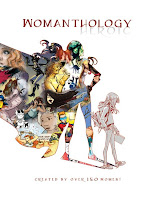
By now, I hope all of you have heard of Womanthology Heroic, the anthology created by over 150 women comic creators. It had an amazingly successful Kickstarter (to which I contributed, so in the back, among the many, many names of supporters you’ll find mine ^_^) and is quite possibly the most beautiful book I have ever seen in my entire life.

The project came about on Twitter, where a number of female comic creators finally just lost their bacon at the industry trope of “women don’t x comics” (where x can stand for “like,” “read,” “draw,” “make” etc.,) despite the masses of evidence to the contrary.  It’s pretty apparent that there were plenty of folks – women and men –  who were very ready to read something just like this.

Womanthology is…a book of treasures. I’m not going to single out a story or three. It’s not for me to tell you which are the best stories in a collection of good stories. Buy the book, open it up and begin to read. Art and stories are variable, but none of them are less than excellent. You’ll like some better than others, some will touch you more deeply, but those particular gemstones are for you to find in this box of treasures.

Womanthology is…inspirational. Yes, some of the stories are about empowerment, but really not. What they are about sometimes is what it takes to grasp the power in ourselves. But that is so beside the point, because the underlying presumption in this collection is that we already have power, and we can use it any damn way we like. Some stories are just plain creepy, or sad, or silly. Some stories work with stereotypes, others bash them gleefully. There is love of the female form and psyche and not one person tries to “fix” that.

Womanthology is…luscious. Full color pictures, stories that run up to 6 pages, but many that are a chunky page or two. Some have morals, some have plots, some have messages, some are just explorations of “wtf can I draw today?” The paper is thick, the cover is beautiful and my first words upon getting this copy was, “There is no way I’m giving my Library this. I’ll get them a separate copy.”

Womanthology is…educational! I love the Pro Tips that run throughout the book, with real advice about art, writing, networking, getting and making jobs. For that alone I’d say every female who wants to be part of the comic industry needs to get this book. If I taught an art class, I’d make this my text book.

Womanthology is…layered. Read it through for the shorts, then again for the bios and info about the creators, then again for Stacie Ponder’s comic strip that runs through the entire book on the page bottoms, then again for the Pro Tips. You’d find something to love all over again every time you do. It’s too much of everything to take in one reading. Read it as you might eat a box of delicious chocolates, a few pages at a time.

Womanthology Heroic is about, by and for, women and girls who create, read and love comics. If you buy one book this year, it should be this one (especially if you’re buying for a library.)

Ratings:

Overall – 10 (But really way more than that.)

The really cool thing about this book is that so many of the creators are on Twitter, and many of them have their websites listed on their bios, and you can talk to them directly to tell them how much you love this book. And, of course you can always shout out to @Womanthology. I’m sure they’d love to hear from you.


Lesbian Comic: The Legend of Bold Riley (English)

May 17th, 2012

lobr1She has hunted the wildest game and dallied with countless beautiful girls, but still longs to know the world beyond the city wall. Princess Rilavashana SanParite, called Bold Riley, leaves behind her station and sets out to travel through distant lands and find forgotten ruins, fearsome enemies, inscrutable gods, and tragic love.

I was brought up on Robert E. Howard’s Conan stories. They were so stereotypical – fierce, strong, heavily muscular barbarian swordsman, confronting evil priests and bizarre monsters and bedding wenches of all kinds, that kind of thing. I loved “that kind of thing.”

I have basically been waiting my entire adult life for someone to write “that kind of thing” starring a lesbian Princess who leaves her home to find adventure, because she can’t stop herself, and who confronts gods, creatures, demons and the like. And, of course, beds wenches.

Leia Weathington’s The Legend of Bold Riley, is, at last, that story.

The feeling of “yes, this, this is exactly it” I had while reading the new collected volume of Weathington’s Bold Riley stories, was endlessly repeated. It was like finding a treasured book from my youth and loving it all over again.

This collection gathers all the chapters from the Bold Riley stories, with full-color pages, story by Leia Weathington, and art by Vanessa Lynn, Jason Thompson, Konstantin Pogorelov, and Kelly McKlellan. The different artists for each chapter gives the reader a chance to re-meet and re-learn to love Princess Rilavashana over and over again.

The different artists also means that, realistically, you might not love the art for each chapter. One chapter might appeal to you more than another, but I kind of admit to finding the wildly different styles charming. Each story was told to me by a different story-teller, each a different adventure. It was a full day’s worth of entertainment. (And heaven help me, I want to write a Bold Riley story so badly now that I can taste it….)

Ratings:

Art – Variable
Story – Awesome
Characters – Doubly Awesome
Yuri – Triple-y Awesome
Service – There is nudity

Overall – Really, really awesome

Anyway, I don’t think I need to tell you what to do, do I? Obviously, go buy this book. ^_^ I have already pre-ordered my copy.

“She’s a hero, you’re a reader. You were made for each other.”  – Jane Espenson, from the Foreword.

Thanks to Leia (who will be interviewed sometime soonish here, as soon as I get my lazy ass in gear) for the preview PDF copy. I cannot *wait* to have the real thing in my hands.


Lesbian Comic: she said (English)

May 14th, 2012

Readers of Okazu frequently see me request more “After the happily-ever-after” manga; stories in which the girl, having gotten the girl, proceeds to make a life with her.  Well, there’s a good reason why we don’t get that so much. For the presumed male audience who is really only interested in Yuri as fantasy, there’s relatively little interest in the building of a real relationship. Take Shizuma and Nagisa out of Miator and their relationship, which is doomed to fail once it hits the real world, is a bore.

But, if there’s one thing that keeps people from exploring the after the happily-ever-after moment in comics, it’s the harsh reality that after happily-ever-after comes, sometimes, not happily, and not ever-after.

When the Prince rides off with the Princess, we fade out so we don’t have to listen to the Princess wondering why his friends are such losers, or listen to them screaming at their kids. Obviously.

Equally, when the girl gets the girl, we often fade out because its really hard on reader and writer to have to wade through the period after 6 months or so, when the fires of lust burn less hotly and people are trying to figure out where they fit in to each other’s lives. One of the ways to do this is to create a death off-screen, and have the character deal with it, as in June Kim’s 12 Days. This kind extreme crisis, what I call “hand of god” writing, is not easy to do well, but it makes the situation fait accompli for readers. We deal with the situation as it was presented to us. (June did it very well, btw.)

What is significantly harder is a deft handling of the end of a relationship. One of the finest I’ve ever read is “Your Hair” by Niki Smith, which we included in the Yuri Monogatari 5 collection. It’s tense and frank and uncomfortable and sad. Absolutely stellar work.

Up until now, I have never read a story that covered the beginning, middle and end of a relationship in a way that was worth recommending. Today I say to you, run, do not walk over to Lulu and buy she said by Kris Dresen.

This story starts with the beginning of a relationship, goes through the flirting and the getting together, the being together, the discomfort of a growing rift, and the final throes of a parting all in few words. Each page has single spoken line, at most two. Nonetheless the story is rendered in depth with terrific facial expressions and evocative body language. (I’m a sucker for this especially, as shockingly few comic artists do more than pose their characters. One day I will show you Nishi Uko’s “Collectors” and you’ll all cry at what you’ve been thinking is good art.)

The most interesting thing about this story is the piece that’s left out. By the end of the book, we have no idea what, really, split them up. Although one can hazard a guess, that’s not the point. The point is that this story is every relationship cliché stitched up together to tell a story we’ve all heard a thousand times. But never once like this.

One of the things I like best about Tsubomi magazine right now is their willingness to deal with the not-so-beautiful parts of lesbian relationships. Abuse, both physical and emotional, and even overt homophobia, never grace the pages of other Yuri tales, but these are the realities that real women face.  If we want our stories to evolve, it’s necessary to face the whole thing and not stay stuck in childhood fairy tales. (Now that I think of it, we sort of got that backwards, with lesbian literature so focused on the end in early stories, then tentatively adding in happy endings, and now going back to face those endings more realistically and honestly. Less knife fights and predatory lesbians.)

Kris Dresen tells us a fable about the before, during and after happily ever after. It may not be happy, but it’s damn good.

Ratings:

Because all my ratings are really geared for Yuri manga, I’m going to stick with an overall for this one.

Overall – 8

My very sincere thanks to Kris who inscribed my copy with something inspiring and who inspires me to do more. ^_^

Quick disclaimer – although she inscribed it, I bought my own copy of this book. Don’t want you to think I’m sucking up to her! ^_^


Yuri Webcomic: Girly, Volume 4 (English)

January 15th, 2012

girlyset-caseThe last volume of Josh Lesnick’s Girly series, Girly Forever, is a testimony to passion. Passion for cartooning, first and foremost, but also the obvious, laudable, passion Otra and Winter have for one another.

Having established Winter and Otra as a couple in previous volumes, Josh felt comfortable splitting them up for a good chunk of this story. But, before we get there, in Volume 3, there’s a number of flashbacks and story building leads that we need to get through, then a few digressions and premature story starts and stops and then, suddenly, in Volume 4, the plot is a gigantic ball of story elements moving downhill and gathering complications like a webcomic version of Katamari Damacy.

When I was reading the chapters that would become the last volume as a webcomic, it was maddening. I would save up a few months of strips at a time, in order to feel like something was happening. Reading it as a volume, I found it worked much better than the previous volumes in terms of narrative. In effect, this was the closest Josh comes to a “graphic novel” rather than a comic strip collection.

The story as a whole has a pretty Yuri-riffic ending, in which Love saves the day – and is suitably rewarded with Sex, which is as it should be. And the things that made no sense still make no sense, which is also as it should be.

Ratings:

Art – 8
Story – 7
Characters – 8
Yuri – 9
Service – 5

Overall – 8

I’m kind of sorry that Girly is over. Reading these volumes (or re-reading the strips, however you look at it,) has made me miss it. Girly was the only webcomic I ever really followed. Nothing else has been consistent enough, cohesive enough and wacky enough to hold my attention for any length of time. I seriously want to thank Josh for Girly, it cheered me up on many a day that I needed a smile (since shooting someone into space was not an option) and congratulate him on this complete collection. I’m proud to have helped contribute to the Kickstarter and hope he’ll do another series some day that I can follow at irregular intervals and still enjoy.