Archive for the Western Comic/Comix Category


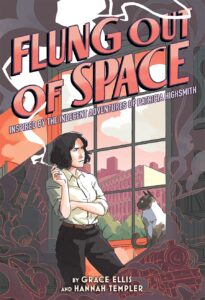
Flung Out of Space: Inspired by the Indecent Adventures of Patricia Highsmith

June 6th, 2022

Rarely have I read a more captivating biography and rarely have I read so beautiful a comic. Flung Out of Space: Inspired by the Indecent Adventures of Patricia Highsmith by Grace Ellis and Hannah Templer is  a magnificent work about a deeply flawed and complex person….a person who would likely have loathed this book about herself.

Patricia Highsmith is a name well-known in older lesbian circles as the real name of Claire Morgan, the author of the first lesbian novel with a happy ending published in the United States. That novel, The Price of Salt, was one of my foundational novels as a young lesbian, as it has been for many others. It was made into the fabulously well-done movie Carol, which I have reviewed here. But to the rest of the world she is far, far more famous as the author of suspense novels, the first of which, Strangers on a Train, was made into a rather famous movie by Alfred Hitchcock.

That said, Patricia Highsmith is not the hero we need. Even if we take away the obvious stress of being a lesbian in a time where that was understood to be a form of mental illness, Highsmith was an unpleasant person; anti-Semitic, racist, and often extremely nasty to the few people around her she could call friends. Ellis addresses this in the foreword, but the script isn’t nearly vulgar enough to have any impact. One can see that they were juggling the idea of making her a bigoted harridan and a semi-sympathetic protagonist, but failed. There’s really no way to sugar-coat hatred and give it any impact, sadly. 

What did have impact was Templer’s art. Templer portrayed Highsmith’s life in three different templates, using one style for the day-to-day experiences, a second for the comic book scenarios Highsmith was cooking up for her job with Timely Comics, while struggling with her sexuality and her writing career. Her suspense novels are given a third style, and they and comics alternately fill Highsmith’s head as she balances all of these things with an increasingly difficult life as a lesbian.

Ellis and Templer’s portrayal of Highsmith is, simply, outstanding. We are left with a very heartfelt portrait of a miserable person who did little to many anyone else happier than she. Highsmith would have hated this book, which is why I love it to much. It’s more sympathetic to her than she ever was to anyone, including herself.

Ratings: 

Art – 10
Story – 10
Writing – 9 Balancing the shittiness of a shitty person with making a books people want to read is hard. 
LGBTQ+  – 9 Highsmith might have been happier if she was alive now…or she might not

Overall – 10

If you’re looking for an excellent Pride month read in comic form, I’m going to strongly recommend you reach for this comic. It’s only weakness is that it is just slightly too kind for the real Patricia Highsmith, which works just fine.


Invisible Kingdom, Volumes 1, 2 & 3

March 27th, 2022

One of my goals for 2022, was the get over to my local library and read more comics out of their diverse GN section. Long story short, I arranged for the YA Graphic Novel section to be located immediately as one walks into the main room. The adult GN section was moved to the adult fiction area, but it is at least right on the edge of the stacks as one walks down the row. The point is, that my library has a pretty solid Graphic Novel, comics and manga section and I donate stuff from time to time, so even if the budget isn’t there, it still grows.

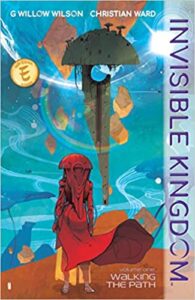
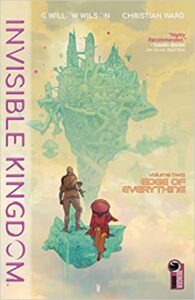
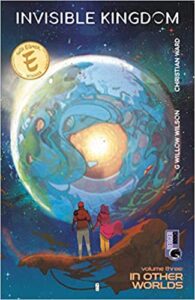
Which brings me to my last visit. I caught sight of The Invisible Kingdom, Volume 1, written by G. Willow Wilson, illustrated by Christian Ward. In Volume 1, we learn about a system in space, which is being torn apart by late-stage Capitalism. Lux, a massive corporation, keeps everyone in thrall with consumer goods, tracking their purchases, actions and desires and using that power to influence governments. The only path out of working for Lux or it’s vassal governments is to renounce everything and become a None.

We meet Grix, a captain of a delivery ship and her crew, and Vess, who has left her family and her destiny to be a breeder of children, to enter the path to the Invisible Kingdom as a None. Grix is being screwed by Lux and is on the run from them, and Vess discovers a secret about the Nones that puts her in peril.

In Volume 2, Grix and Vess are working together, but things are not going well. Well…actually things between Grix and Vess are going well and it’s confusing the heck out of both of them. Complicating things, Grix’s ex is a Lux representative who has to decide where her loyalties lie.

When the only independent government abandons them and they are captured by a bunch of (apparently) unaffiliated salvagers, things look very bad for Grix and Vess.  To save Grix, Vess bonds with her in a way that terrifies the young renunciate…

Volume 3, find Vess having run away again, this time to a sect that opposes the main branch of the Nones. Grix is desperate to find her, and in doing so, stumbles upon the truth that Vess learned. Now two religious orders, one with a deadly weapon, and a massive conglomerate are after Grix. But she, and Vess, have allies they didn’t know about. Will a small delivery crew be able to destroy the largest powers in the system?

Well, yes, obviously. It’s not like it’s really ever in doubt. honestly. The “what” is not why you’ll want to read this comic. ^_^

You’ll want to read this comic for the art, as goofy as that sounds. The palette is astounding. Both on-planet and in-space scenes are gorgeous. I would gladly own any page of this comic as a piece of art. 

You’ll also want to read this comic because it is actually the gruff space captain, uber-naive young traveler thing we’ve seen 10000000000 times, but with two alien women,  fighting the  huge powers that be in an impossible war that can’t be won…and it works. Are there a few handwaves? Sure. But not so many that the story doesn’t hang together. It was a solid read and, again, beautifully illustrated. The girl gets the girl, the baddies are hoist by their own petard and the explosion was magnificent.

Just to wrap up the larger story here, my library system had Volume 1, but not 2 or 3. So I bought them and gave them to the library, so they had the whole set. This way I know you can Interlibrary Loan the whole series. ^_^ If you haven’t checked to see if your library has Graphic Novels in their system, you should! A lot of library systems have GNs as part of their ebook lending as well. It’s a great way to discover stuff you didn’t know about and read stuff you might not otherwise make time for . (I checked out Tokyo Ghoul today, as it happens. Not bad, but Red Garden was better.)

Ratings:

Art – 10
Story – 8 Solid, well-told, but tread no new ground
Characters – 7 The good guys were as expected, the bad guys utterly carbon copy
Service – Alien humanoid sexuality parsed in a few ways, some meant to be harassing
Queer – 8 See above, but our protags are both female as we see it

Overall – 8

A good space action fairy tale, with great art. Definitely worth a look.


Your Magic is in Another City – Arcane: League of Legends on Netflix

December 5th, 2021

Promotional poster for Arcane: League of legends, Season 2. A girl with blue hair looks at us from the bottom of the poster, Her read-haired sister looks to the left from the top of a cast of characters.Today’s post is thanks to Ted the Awesome, who made an impassioned pitch for me to watch Arcane. And so I have. As you know, I do not play games very often, but had of course heard of League of Legends. Without knowing anything about the world, I guessed that this cartoon was meant to function as a kind of prequel, but this review will address it as a standalone story in its own right.

Arcane: League of Legends tells the story of two sisters brought up in the corrupt squalor of the slums of Zaun, and two idealist young scientists from the prosperous city across the bridge, Piltover. Vi and her sister Powder live hand to hand – as, it is implied, everyone in Zaun does. Zaun has various criminal organizations vying for superiority, but the syndicate run by Silco gets an advantage and Silco functionally takes over Zaun. Jayce is a privileged young man in Piltover who creates Magical “Hextech” gems, along with his partner Viktor. As the story progresses, they find that dreams and reality don’t match.

Now, let me say right up front that I did not enjoy Arcane for itself, but I did think it interesting. It gave me a lot to think about in terms of how stories are constructed and the shortcuts taken with popular culture writing like games and comics that people take for granted as providing depth without actually doing so.

To begin with part of the pitch for this series, was “how the systems of government (and lack there of) worked and how our heroes try to cope with wanting a better life and dealing with what life actually gives them. It’s not cookie cutter series where there’s a convenient end goal where once you’ve gotten it, everything will be better.”

And it occurred to me that white cis/het men who play games and consume media, probably have seen a grillion media forms that tell that story. You save the princess, get the item and You Win! (A process that has led generations of men who game to think of women as rewards rather than people, famously discussed by Arthur Chu in Your Princess is in Another Castle.)

As a queer woman, that that has never been the narrative I’ve been offered.

Almost every action narrative with a female lead starts with loss. Her family was killed, now she’s out for revenge! They “took everything” stories that begin with rape, poverty, enslavement, abandonment and loss, is the typical female lead story. Sometimes we get the Cassandra model, where the smart lady is ignored and everyone else on the ship gets an alien bursting out of their chest and dies. Remember, one of the reasons why shoujo manga took off so fast and so hugely in the 1990s in the west, was precisely because it gave us narratives of girls who were just girls doing their best. They cried when they were sad, and had friends they could lean on. They had agency and could make choices….all things that is still kind of rare in action media with female leads.  In Age of Ultron, Black Widow’s entire character development was boiled down to her having being forcibly sterilized. Not that she killed a lot of people, brought down governments, caused untold suffering…she’s not able to bear children. That’s it. Like that’s the only thing women are about. Her inability to bear children is not just a de facto red mark on her ledger, but “a lot of red.” (Again, see Arthur’s above article about misogyny in nerdom.)

In this narrative, we are told a story about two sisters who are given zero opportunity to thrive. Every experience is trauma, loss, constant stress. It is not a different story than women experience in many places right here, right now. Poverty, illness, violence, mental illness…nothing about it is different. Absolutely cookie cutter, as it seems shockingly few men have the capacity to imagine anything else for women both in entertainment and real life.

So setting aside that children suffering loss as a plot driver is not compelling to me, the main concern I have with Arcane is that everyone in the story acts like a 15 year old thinks adults act. There are no actual adults in the cast. Just adult shapes, with simplistic thinking. It’s comic book villainy.

Don’t get me wrong, I see this in the real world, too, and it doesn’t seem to be obviously problematic to some portion of the population. Self-dealing is an extremely common form of political corruption. I was in a town planning meeting once when a council member who just *happened* to be a landscaper demanded the HVAC units of a new building be blocked off with a specific kind of tree which he just *happened* to have on hand. So the council of Piltover being self-concerned isn’t really the problem. The problem is that every scene with them is incoherent. They all reminded me of a Dilbert comic: “The correct approach to any situation is, by amazing coincidence, the only approach you know.”


The warrior argues for war, the logistics guy argues for (his) trade. Jayce comes in screaming but never says anything.

This is what I mean by no adult thinking: The Hextech. Those gems are going to make things better for people. How? Why? Why is it not obvious that it will just be taken by the privileged to given them more privilege. What problems do they solve? What problems do they create? No one asks or answers any of those questions. If Viktor thinks Hextech can help Zaun, why not just…give them to Zaun? Yes, I know why. But they just…never talk about any of it. Jayce shows up with Hextech, is made councilor and a scene later is the head of the council. This is not how politics, trade, economics or people…work.

All of this is a shortcut for pop culture writing. “Look, this is a complex society,” without thinking for a moment what is complex about it.

This carries over into the writing about Powder/Jinx. She’s a sweet innocent, until she snaps. As I watched Jinx fuguing I thought, “Oh, she’s Alice from Batwoman.” I’m not a mental health expert, I am not saying what happened to Jinx could not happen.  I’m saying that a coherent narrative about mental illness, poverty and trauma is ignored for a 1983 music video with lots of neon instead.

The art style was interesting overall, a kind of magical deco for Piltover. (It’s not steampunk, which is more an aesthetic in which the Age of Reason and the Industrial Revolution have a Victorian baby.) This kind of Futurist Magical Deco in Piltover and Decrepit Industrial in Zaun, which immediately brought the setting (and the story) into comparison with Fritz Lang’s Metropolis. The animation was not bad, although typically, the settings and backgrounds were given a lush smooth quality the humans couldn’t quite get. I was very impressed with the animation of facial expressions. Used to anime, as I am, it was pretty amazing to see faces looking like…faces.

Lastly, you may have guessed that if I am reviewing this on Okazu, there is some lesbian aspect to the narrative…and so there is. In the course of the story a relationship is introduced for one of the protagonists.  Vi meets up with this world’s version of a police officer, Caitlyn. Caitlyn is as privileged as Vi is disadvantaged and their relationship is antagonistic for some episodes. When they start to warm up to one another it is very reasonably presented as emotional intimacy that has potential to become more.

Sadly, the story again chooses a shorthand and Caitlyn is left to become no more than a catalyst for Vi and Jinx to resent each other. This frustrated me, as there was no point at all to the entire scene which becomes the climax for this story, setting up Vi and Jinx as opposing forces. Frustratingly, it was obvious that Caitlyn was put there as a puppy in the narrative for all the reasons mediocre writers put puppies in the narrative.

Of all the relationship choices in this story, the one that actually works the best was Silco’s relationship with Jinx. It felt very much like the creators were toying with the idea of crossing the line with them, but Silco consistently remained a father figure to Jinx right to the very end of the story. That surprised and pleased me and was legitimately the best-handled nuanced relationship in the whole story.

Overall, while I did not love Arcane, or find it entertaining, it gave me a lot to think about. I’m more aware of the kind of shortcuts – what I call handwaves – pop culture  takes in world and relationship building….and I expect better. I want stories for adults to be written in a way that requires adult perception. I’m not saying I can’t get behind a teenage superhero or magical princess, but if you’re going to hand me a complex world, then I expect the creator(s) to be able to explain its complexities and then to do so.

Ratings:

Art – 9
Story – 5 It so easily could have been an 8, with a few screaming scenes removed and some thought put into it
Characters – 7 I wanted to like everyone, but I kept shouting “WHY?” at the TV
Service – 7 Nudity, which was fine and a long straight sex scene I could have done without.
Yuri – 4  It had potential, but…

Overall – 7

Thanks again to Ted, for giving me the opportunity to have a good long thought about what I want from my entertainment!


I Am Not Starfire, by Mariko Tamaki and Yoshi Yoshitani

August 20th, 2021

In DC’s I Am Not Starfire, Mandy is a young woman trying to make her way in life, under the constant pressure of being a celebrity superhero’s daughter with a mystery father, and no powers to speak of. It’s probably not that surprising that’s she’s got an attitude.

Typical teenager, Mandy is whatever her mother is not. In fact, she thinks herself of the “anti-Starfire.” What’s worse, there are fans of her mom at school, just to drive home how much not her mother she is She’s got a goth look and a dark outlook. More importantly, like generations of adolescents before her, Mandy is keeping secrets from the people around her. The only person Mandy can stand is her friend, Lincoln.

Mandy’s doing the normal balancing act of school, life and, of course, love. She’s got a crush, but there’s a lot of things between her and happiness. Her crush is the uber-popular girl in class, Claire. Claire seems nice, but man, her friends are jerks. So what’s a not-cool, not outgoing, not-superpowered girl to do?

Nothing in this YA title is going to come as a surprise, I think, to a sophisticated reading audience. Nonetheless, I think we can all completely feel where Mandy is at… (even if, as an adult, it feels a bit irritating.) Mandy’s secret is absolutely something that a high school student and their parent might find very relevant to their life. Her crush might even like her back, but Mandy is really not receptive to anyone actually liking her, which makes this more complicated that it otherwise might be. However, like the rest of the plot complications, this has a happy ending for both girls and us. ^_^

Mariko Tamaki’s writing is approachable and Yoshi Yoshitani’s art is colorful, fun and very simple to follow. What works best here is that this works well as a YA story. There’s nothing here that is creepy, or condescending, as is so often a problem with YA works. (I’m still salty about DC’s “Minx” line which had great content and the creepiest old-dudes-talking-about-young-girls name ever.) Aditya Bidikar’s lettering is readable, and adds flavor where needed…like flavor boost icing on a very decent cake. ^_^

I’ve talked about how much I am not a DC fan here many times, and even though I really like Tamaki’s work, I probably wasn’t going to get this, but for two things. The puling of the *.*gaters was enough to make me put this on my to-get list and Okazu family member Chris L. mentioned that it was suitable for Okazu…and so it was.

The girl gets the girl, YA comics fans get something for them and everyone is happy except the over-sensitive manbabies who think everything has to be about them…and that, frankly is also good news for us. Because if it makes them unhappy, that means it’s ever so much more likely to be interesting and diverse. It’s like a big “Read This!” sign. Thank you, puling man babies for making it much easier to find good stuff to read. ^_^

Ratings:

Art – 7 More like YA than like DC.
Story – 7 Same
Characters – 7 Oddly, I really liked Claire.
Queer – 7
Service – 0

Overall – 7

A fun read, and I guess I’m going to have to stop saying I don’t like DC, because they are so vastly much better than Marvel right now at making puling manbabies unhappy.


DC PRIDE #1

July 1st, 2021

2021 is not the best timeline ever, but this year both Marvel and DC decided to acknowledge the queercreators and characters in their line-ups. A few days ago, I took a look at the Marvel Voices #1, their Pride collection. I had no particular expectations for either anthology, but expected that DC might do a better job, as they’ve had a bit more experience and a handful of more well-known characters who are out.

Marvel took the opportunity to talk about all the “firsts” they’ve done, without noticing that those firsts often lack follow-up. It made for a self-congratulatory feature that, I’m sorry to say, wasted some top-notch talent. In the end, I came into the book not knowing some of the characters and I left in the same state. Yes of course I can look the characters up, but why should I have to?

So here we are at DC Pride #1, and again, I had no idea what to expect. What I found was a really interesting approach. DC took their currently known, beloved characters from their DC TV Universe and focused on them. It was innovative in a way, because they were offering up two ways to engage with these characters at once – in comics and on television.

Again, I didn’t know every character when I began the book, I don’t watch DCEU on TV. I tried, most of the shows just didn’t hook me. But I do like Batwoman, and I’ll be the first person to tell you how much of a surprise that is. I even like Alice. I mean – I really like Alice as a character now, so far removed from the stuuuuupid origin story. And Javicia Leslie gets two thumbs up from be as Ryan Wilder/Batwoman.

So, I sat down to read this anthology…and by gum, I enjoyed it. Trung Le Nguyen’s art in the Batwoman story was fab, but I love-love-loved Lisa Sterle’s art for “Clothes Makeup Gift.” The Harley x Ivy story was a bit weak. I don’t much like Harley, but I especially dislike that Ivy ends up being the good cop to Harley’s chaos agent schtick. “Try the Girl,” written by Vita Ayala was a fab story all around and well drawn and colored by Skylar Partridge and José Villarubia. Of all the stories, I thought this one stuck the landing best.

Also, let me remind you, that I have permanently retired “Date Night” as a title, so dear comic artists, don’t use that anymore. Ever. It’s over. Done. The story was solid, I liked “meeting” Nia (again, I don’t watch TV much…) I loved seeing Brainiac, because I always did think that Silver Age Braniac was a bish. ^_^

Overall this anthology did exactly what I wanted both anthologies to do – introduce the queer characters from that universe and give me a taste of their personalities and powers. If you know someone queer who wants to get into American superhero comics but has no idea where or how or even if to start, you could do worse than hand them this anthology to get a broad idea of who is out there, what their stories are  and why they might be interested. Dear Marvel – this is what anthologies are supposed to be. Do this next time.


Ratings:

Art – 8 Overall excellent, some sublime moments. And Lisa Sterle!
Story – 7 Generally very good, a little performative, but each choice served a purpose
Queer – 10 Yes, and… old school and current and varied in a way that I truly enjoyed
Service – Shockingly little

Overall – 9 Hands down this anthology was a winner


If you haven’t picked this issue up yet and aren’t virulently opposed, hop over to Comic Shop Locator and find a comic shop near you! Or, of course, you can get this digitally on Comixology.

After how much I really disliked DC’s Love is Love Anthology, (“searing white-hot rage” is a quote from my review)  Pride #1 was a relief and a genuinely enjoyable read.