Archive for the Western Comic/Comix Category


S.I.R.

June 15th, 2025

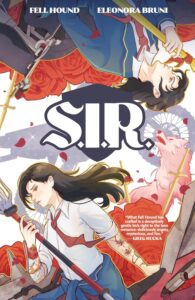
On a background of roses, over silhouette of a motorcycle, a girl and boy in school uniform, clutch weapons, moodily, while a wolf howls.So, you say, I really love Revolutionary Girl Utena-inspired stories, but sword fights are done. Let’s have something cooler than a sword fight. Well, we have just what you are looking for in S.I.R.

Avery Sakai has lost everything. Her parents, their company, her girlfriend Nico. Having lost so much, Avery is unwilling to give up the last and heads to super-elite Bridleham Academy to find her. What Avery finds is a culture of dueling by motorcycle jousting…and Nico is the enemy everyone is aiming for.

This one-volume graphic novel by Fell Hound and Eleonora Bruni is a fast-paced, electric comic that seamlessly integrates a bunch of things lesbians love: Utena, absurd dueling hierarchies, motorcycles and a heroine named Sir Athene. This series is set up for success in this household, at any rate. ^_^

Nico as the Rose Bride is pretty bad ass herself. Positioned as the conflict, Oscar Sanson makes a good try at being the baddie, but we all know that, as a lesbian drama, it’s Avery’s and Nico’s feelings of failure and self-loathing that have to be defeated first, before they can kick Oscar’s sorry ass. And, so it is. Music, metal clashy sounds, engines revving, Mokushiroku. All is right in the dueling arena.

I’m joking about Utena, but the roses are a dead giveaway. This homage is merely homage, however, as the story and characters are not at all derivative. Right from the get-go Avery is a sincere hero. Nico’s darkness is a bit more complicated, the result of ongoing harassment, but Avery’s righteousness shines a light on the darkness and helps Nico to find her own way out.

As a single volume, this story slams straight through with few twists. It would make a great OVA. ^_^

Fell Hound’s art and story are easy to follow, full of movement and energy, brought to life by Eleonora Bruni’s coloring. Becca Carey’s lettering is great throughout, and especially fun on the knight’s names.

Ratings: 

Art – 8
Story – 8
Characters – 8
Service – lesbians on motorcycles, duh
Yuri – 10

Overall – 8

For a fun, powerful manga that is sure to scratch your dueling itches, S.I.R. is super read.


It Rhymes With Takei

June 8th, 2025

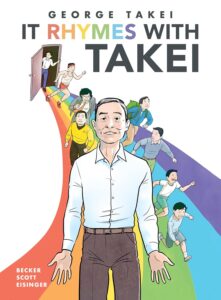
It’s a bit of a stereotype that a seinen manga protagonist has an incredible emotional journey from the beginning of their tale to the end, in classic bildingsroman fashion.  In George Takei’s autobiographical comic It Rhymes With Takei, we are along for an extraordinary journey, made even more extraordinary because it is a real person’s story of experiences he truly lived. For someone who only knows George Takei as an actor, or as an activist, this story takes us to places far more unreal than outer space. by whch I mean American politics.

Takei’s childhood as a Japanese-American citizen put into a “internment camps” by his own government is related in They Called Us Enemy and the musical stage play Allegiance. This book tells the the story of George Takei, the boy who felt different in many ways, and who carved out a career in acting, in politics, in activism and as a viral Internet memelord.

Takei’s story is told simply and plainly, his emotions and thoughts about living a closeted life and the losses he encountered when he finally came out of the closet at 68, as well as the triumphs, are conveyed strongly through the story written by Steven Scott and Justin Eisinger. Harmony Becker’s illustrations are absolutely fantastic. Characters are conveyed without portraiture, but their essences are caught perfectly, and the whole feeling of the moment is expressed with brilliant use of color and design, for a captivating whole. 

As a primer on LGBTQ+ American history  of the 20th century with a California focus, as seen by a man who was working with more than one prejudice against him, this comic is an important chronicle of the progress we’ve made and the work that went into it. 

For Pride Month 2025, I would recommend this book as way to ground ourselves, acknowledge our successes and failures and gird our loins for the next fight, knowing that there have always been good, smart and funny people like George Takei on our side.

Ratings: 

Art – 8
Story – Autobiography is always hard to score, but this is also a very compelling and surprising narrative, 10
LGBTQ+ – 10

Overall – 10

Thanks to Top Shelf Productions for the review copy of this outstanding memoir. You can get It Rhymes With Takei on Bookshop, Amazon and everywhere books are sold.


Motherlover

May 11th, 2025

Two women lie in the grass looking deeply into each other's eyes. One is a heavy-set white woman, with bright orange hair tied in a braid wearing glasses and a yellow-and-white striped tank top. The other woman is Asian with black hair, tied back in a high pony tail, wears a dark gray tank top, and has tattoos on her right arm.By Matt Marcus, Staff Writer

Where would we be without our mothers? As a parent myself, I’ve felt starved for stories about parenthood within the world of Yuri media. In fact, a large amount of Yuri centers on characters that explicitly reject the notion of having children and raising a family, and not without good reason. That’s valid and I support it. But it leaves out a few avenues for telling new stories, which is why I was excited to discover the topic of today’s review.

Motherlover is a spinoff comic (launched on Mother’s Day, of course) centered on two random characters from Lindsay Ishihiro’s long-running autobiographical comic How Baby. After creating them, she felt compelled to give them their own story. The first leading lady, Imogen, is a quintessential Midwestern homemaker, managing a household of four kids; her counterpart is Alex, a Cool Artsy Queer mom who has moved back into her parents’ house after their recent deaths.

Both leads are well-rounded characters. Imogen became a mother at 19 and flunked out of college before meeting her current husband. Her inexhaustible capacity to care for her children is only matched by her insecurity about her limited life experience. Alex, meanwhile, pushes away people who love her as a result of the emotional abuse she suffered from her extremely strict parents.

The core of the story is the dynamic between Imogen and Alex. Their friendship feels lived-in and believable, which further sells you on their compatibility as their feelings for each other deepen. You could even say that they are a bit too accepting at times; even when one is venting ugly honest feelings, the other never takes offense. It’s as if they are committed to each other before they are committed to each other. There is no moment of doubt that their connection will break, which makes for a breezy read even when the topics get heavy.

Putting my Serious Critic hat on, I would say I wish the children had more space to be characters. For instance, how did Alex’s daughter Nolan feel about her mother’s previous partner? How does her feelings parallel Imogen’s kids feelings about their parent’s divorce? The only one of the five children who is given any spotlight is Imogen’s oldest, but their arc is so siloed from the core of the story that it could have been cut without affecting the plot at all. I’ve read enough of How Baby to know that Ishihiro knows how to talk about motherhood in a raw, vulnerable, and hilarious way, but not much of that transferred over to this story.

I also find myself wishing that the issues around Imogen’s marriage didn’t boil down to cheating. I thought Ishihiro did a great job sketching Imogen’s husband as a man who is controlling and withholding, but not in a domineering manner. The way he perpetuates Imogen’s insecurity by shooting down her ideas of going back to school is compellingly insidious; it felt so strong to me that I found myself disappointed when the breaking point of their marriage turned out to be infidelity. It’s believable, but a bit expedient.

One thing that occurred to me is that this is a queer love story where very little of the challenges center on queerness: Imogen never struggles with her gay awakening, Alex doesn’t encounter hostility from the community for being loudly out, a young character comes out as trans and basically no one bats an eye. It represents a kinder world than the one we live in, and I’m sure many readers will love that part of it. (Yes, there is some queerphobia represented in the text, but it’s treated with a light touch.) My feeling is that, in a story where being a parent is the premise, I would have liked to see it tackle what it means to be a parent who is queer, AND what it means to be the parent of a queer child (though I felt the coming out scene was well-handled). To be clear, all of these critiques are quibbles for what is an easily enjoyable story.

While the comic is complete and free to read online, I was unaware of it until seeing an announcement of a physical release from Iron Circus Comics. It’s a lovely softcover book with glossy hearts embossed on top of the matte finish of the cover. The art and paneling is solid and translated well to the printed page. Also, I was pleased to see Abby Lehrke in the credits as a proofreader, given her involvement with A Certain Manga Series Set In College that I am fond of.

If you are looking for the perfect sapphic comic for Mothers’ Day, this would be one to pick up, but I’d say it can be enjoyed and celebrated on the other 364 days of the year as well, just like your mother. (And would it kill you to call every once in a while?)

Art – 8 Solid and clean
Story – 8 Tightly paced; could have been expanded but would have required a longer page count
Characters – 9 Everyone is well written, though some characters could have had more to do
Service – 1 Domestic snuggles is as spicy as as it gets
LGBTQ – 10 70% of the named characters are queer, so it gets high marks

Overall – 9 The best Mom-meets-Mom story on the market

Yes, Ishihiro is aware of the SNL skit of the same name; it’s mentioned on the comic’s About page.

Matt Marcus is a cohost of various projects on the Pitch Drop Podcast Network, as well as the writer for the blog Oh My God, They Were Bandmates analyzing How Do We Relationship in greater depth.


Just Friends by Ana Oncina, Guest Review by Em Evergreeen

January 10th, 2024

Two women hold hands by a vast, purple sea under a yellow sky. One has long curly red hair, wears a hat and  and a yellow denim skirt. The other has short black hair, wears a pink shirt with long black sleeves, a backpack and shorts. A large white cloud in the distance billows up from the horizon.Em Evergreen is a lonely lesbian with a manga addiction. Find her at linktr.ee/em.evergreen.Just Friends is a one volume Yuri manga by Spanish mangaka Ana Oncina. Originally published by Planeta Cómic in Spain in 2021, the English edition comes to us courtesy of Tokyopop, with translations by Nanette Cooper-McGuinness. Just Friends was awarded a silver medal at the Japanese Ministry of the Exterior’s International Manga Awards in 2023.Just Friends has the form of a manga, with right-to-left paneling and Japanese-language sound effects, but the lower-line-count art style hints at its overseas origin. It’s an opportunity to read a different type of Yuri, one that plays with the tropes of a culturally distinct adolescence – no sailor uniforms, student council officers, or onigiri are in evidence. Instead our story is set at sleep-away camp, where our teenage characters wear graphic tees and eat pizza and baloney sandwiches.Our protagonist, the introverted Erika, is reluctantly packed off to said camp without any close friends. On the bus there, she meets her polar opposite Emi, who takes an immediate interest in Erika and declares them “inseparable” before they even arrive. The story of their whirlwind relationship that summer is framed by more brief flash-forwards into their future, where we see them meet again as thirty-somethings. As with any good real-life sleep-away camp, the setting gives Erika the chance to step outside her comfort zone, figure out some things about herself, and perhaps explore that most new and exciting phenomenon to a teen – romance.To some young adult readers, especially queer ones raised in a similar context, the story will at times be almost painfully relatable. The realistic depictions of social anxiety, bullying, awkwardness, and underage-drinking-fueled misadventures might resonate a bit too strongly for comfort, but you’ll likely chuckle more than cry. Erika and her peers don’t have the communication or conflict resolution skills of adults, but their conflicts aren’t the focus. This is a romance at its core, with a side of navigating heteronormative expectations while figuring out who you are.Just Friends is very much not a Yuri without lesbians. Its mix of LGBTQ issues and romance is distinguished from recent standouts like Shio Usui’s Doughnuts Under a Crescent Moon or Sakaomi Yuzaki’s She Loves to Cook, She Loves to Eat by its strong focus on the drama of adolescence. In that respect, it calls to mind Yuhki Kamatani’s Our Dreams at Dusk, though it’s lighter in tone and less ambitious in scope. Just don’t go into Just Friends expecting a neat and tidy ending, or a sweet story of first love. It’s too grounded in the complexities of real-world romantic relationships, teenage and adult, to give us that. Like all good one volume manga, it leaves you wanting more.Art – 5, effective if not awe-inspiringStory – 8, a nostalgic, bittersweet romanceCharacters – 6, more realistic than memorableService – 3, sex isn’t ignored, but the teens aren’t leered at or sexualizedYuri – 10, Houston, we have lesbians (and/or bisexuals)Overall – 7


The Princess and the Grilled Cheese Sandwich, Guest Review by Paul S. Enns

June 28th, 2023

A princess in pink and a dashing young courtier in purple pull a grilled cheese sandwich apart so the oozy cheese is visible.When the whole point is to be cheesy, of course you lean into it fully.

The Princess and the Grilled Cheese Sandwich is as cheesy as can be. It was inspired by the real-life courtship between the writer/artist Deya Muniz and their now wife, Emily.

With it being so cheesy, it’s no spoiler to say that the main characters end up together. As usual, it’s the journey that makes it interesting. The theme naming used reminds me of the old Asterix books: every name is a cheese or cheese related, including place names, with one exception, and even that name is a food.

Our first hero, Lady Camembert, disguises herself as a man, rather than be forced to marry a man to inherit her father’s estate. To distance herself from people who might recognize her in Gougère, she moves to Fondue, the capital of Fromage, with her most trusted servant, Feta.

Our second hero, Princess Brie, has long been an advocate for changing the antiquated laws of her kingdom. Her friends, Gorgonzola and Ricotta, figure out that Camembert and Brie are in love with each other, as well as recognize that neither Cam nor Brie realizes it of the other.

Thus, the comedy of errors proceeds along somewhat predictable grounds. Cam has to protect her secret or risk imprisonment, and Brie—still accepting the traditional role of the askee and not the asker—waits in vain for Cam to court her. Brie’s friends are having none of that, and do their best to help things along. Unlike a lot of stories where misunderstandings are a major part of the plot, I didn’t want to scream at the characters; Gorgonzola, Ricotta, and even Feta took care of that for me.

The story has a point, but it doesn’t feel like it’s using a club to say it. While important topics are discussed, they arise naturally from the premise and setting, rather than forcing you to read a long-winded diatribe. The point is, naturally enough, anti-patriarchy.

The art is wonderful. Every character, even minor ones, are easy to distinguish. The colors used are vibrant, and themed around the characters. So Cam is usually surrounded by blues and purples, while Brie is surrounded by pinks and reds. The depictions using deformation are not quite chibi, but look inspired by it to me. The cross-popping veins are the most obvious manga-inspired art convention.

Given the whole nature of the story, it would be absurd to knock it for the anachronisms. The story seems to take place in a pre-industrial world, yet has modern kitchens, advanced printing technology, and Nintendo Switches. These may be safely ignored. Do we really want to put up with real-world accuracy for this story? Absolutely not. While I don’t think being accurate would detract from the story, the juxtaposition provides additional humor. Be sure to note the t-shirts Cam wears.

Ratings:

Art — 9 A tad cartoony at times, but overall excellent.
Story — 10 I laughed through most of it, and when I didn’t, I teared up along with the characters.
Characters — 10 Gorgonzola and Feta are standouts as secondary characters.
Service — 2 Lots of plunging necklines.
LGBTQ+ — 10 We have lesbian, agender, and questioning covered.

Overall — I’m going to go ahead and give this a 10. I’ve read it three times already, and not just because I’m reviewing it.