Archive for the English Anime Category


Yuri Anime: Yurikuma Arashi (English)

April 14th, 2015

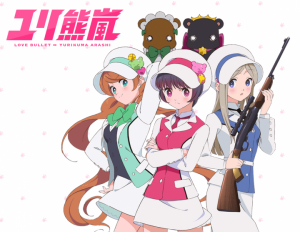
yurikumaThe Yurikuma Arashi anime from Funimation is, like so many of Ikuhara Kunihiko’s works, a fairy tale. Like so many of his previous works, in this fairy tale the fairy ex machina is the tale itself.

Tsubaki Kureha has met – and forgotten – a childhood friend who is a bear. Ginko has never forgotten her childhood friend and seeks to become a girl to be with Kureha. Surrounding this bastard child of The Gift of the Magi and every outsider story ever, is a series of repeated, variably meaningful images and a story that is never quite sure if it believes in itself or not.

Because there’s no coherence in the story in and of itself, there’s a lot of time to just enjoy the random bits of imagery and wonder what it means to Ikuhara, since it’s almost never given any meaning in the context of the story.

Buried as we were  in overuse of “Yuri” imagery, some with overtly sexual connotation, some completely lacking anything of the kind, all those lilies ceased to have any meaning, which was sort of interesting. Lily petals, whole lily flowers showering down upon the heads of characters and yet, it had almost no connection to the narrative.

There were two standout qualities of the series for me – first and foremost, seeing animated versions of Morishima Akiko-sensei’s art made watching this series worthwhile. Additionally – and I have thanked her personally on Twitter for this – I really appreciated Yuriika, an honest-to-goodness, Evil Psycho Lesbian character. She was my favorite and her death was utterly meaningless, as befits someone who is so pointlessly obsessed.

Yurrika

I do not feel that this series was compelling, in the way Utena, or even Mawaru Penguindrum was, but the ending was not predictable, none of the loose ends were tied up and everything we experience in the body of the story turned out to not be true, so that has to count for something. ^_^

Ratings:

Art – 8 Two great tastes that tasted deeply odd together
Story – 7 Once upon a time…oh fuck it.
Characters – 7 Uncarved blocks, one and all. Just remove everything that isn’t a bear
Yuri – 14 million
Service – 7 Much higher than I’d like

Overall – 7

My final thought on the end of Yurikuma Arashi is this: There’s something right/not right about “Ave Maria” becoming a Yuri anthem.


Yuri Manga: Yuri Kuma Arashi, Volume 1 (ユリ熊嵐)

January 25th, 2015

yurikuma1Today I wanted to talk about something that has been much on my mind…

Picasso.

You know, Pablo Picasso, painter. Mostly famous for his Cubist paintings, but he was a prolific artist and evolved throughout his life, so while his work is undoubtedly his, it changed as time went on, as he changed, aged, evolved.

He’s on my mind a lot as I read and watch Yuri Kuma Arashi. And we’ll get to the “why” in a bit, but first, let’s just talk about the manga.

In Volume 1 of the Yuri Kuma Arashi manga (ユリ熊嵐), we meet Tsubaki Kureha, a shy, retiring student, who has recurring dreams of being rescued by a bear princess who, coincidentally, looks just like her popular and outgoing classmate Yurishiro Ginko. Ginko takes a liking to Kureha and starts to cultivate her friendship and develop her personality.

Kureha admits that she knows Ginko is a bear and all about the tragic backstory of her planet, but Ginko’s reaction is to fall apart in laughter a such a preposterous story!

Ginko lives with her late father’s sister as her mother is forever overseas (and unbeknownst to her, maybe, is her aunt’s lover). When a new girl transfers in claiming to be in love with Ginko, it throws a wrench in Kureha’s emotional gears; she was just deciding she “liked” Ginko, you know. If it weren’t enough that Lulu is a love rival, there are persistent rumors that Ginko and the Student Council President (male) are going out. Kureha doesn’t know what to believe, honestly.

When Lulu, Ginko and Kureha accidentally burn down their dorm cooking, Ginko has both of them come live with her. And, at last, we learn that Kureha may have been right about Ginko all along. Kureha swears to protect Ginko as the volume comes to an end, with many questions and few answers.

As you know, if you have been watching the Yuri Kuma Arashi anime and/or are familiar with Ikuhara Kunihiko’s style, these questions may not have any answers.

The manga is very much Morishima Akiko-sensei’s brand of cute/sexy art, with slightly more typical fanservice than usual. Unlike the anime, which has so much fanservice it’s actively crowding out the plot (if there is one) at the moment. And, if you are familiar with Ikuhara’s work, it’s important to remember that the repetitive scenes may never have any meaning per se, just visual impact, that we will later layer with meaning. The best way to approach his work is to not try to guess what it all means, but simply go along for the ride and see where it takes you.

***

Support Yuri News and Reviews –  Subscribe to Okazu withSubcribe with Patreon

***

Which brings me back to Picasso.

One of the things Picasso was seeking to do in his Cubist portraits was show two or more angles of a person simultaneously.  His masterwork Guernica takes this to another level, in which he is simultaneously showing us all three dimensions at once, among other things. And this is why he has been much on my mind. If you treat the simultaneously released versions of Yuri Kuma Arashi as two unique perspectives on the same story, there is still no guarantee that it will make sense, but it gives you a completely different understanding of the whole.

It’s unlikely that Yuri Kuma Arashi is Ikuhara’s Guernica, but heck it might yet be, we won’t know until it’s over and we can see all the angles. And the relics of other series that echo back at us like blood red buildings by day, have started to be integrated into – maybe – a new stylist tic, as they turn blue at night. Indicating what? Who knows…yet. Or ever.

I’ve only seen two episodes of the anime as of yet, but I do want to say that of all the random repeated elements, the one I actually like is “Kuma Shock”, which @twiitar has turned into a nifty ringtone. Thanks Phil! ^_^

The service in the anime is off-putting for me, as it’s not nearly at the level of creeping horror subtlety we’ve become used to. It feels a bit slap in the face-ish.  The one element that I truly do not care for is the use of the word “Yuri” and the image of the lily as a bludgeon, for no apparent reason. Yes, yes the girls are all named Yuri something, got it. Yuri and honey imagery. Yuckers.

I hold no hope that the “trial” scenes will ever make sense.

The one thing about the anime that I genuinely find appealing is that the character designs are very much Morishima-sensei’s art, animated. ^_^

Ratings for the manga only:

Art – 8
Story – 7
Characters – 8 They appear more coherently formed than in the anime
Yuri – 9
Service – 6

Overall – 8

By the time Volume 2 comes out, if indeed it does, the anime will likely be over and I’m sure we’ll have concocted meanings for all the things that don’t mean anything at all. ^_^



Psycho-Pass 2 Anime, Guest Review by Katherine H

January 14th, 2015

P-Pass_S2Waaahhhh!!!  Two event reports and two guest reviews in two weeks! And more great stuff to come in days ahead. This. Is. So. Cool. Please welcome back Okazu Superhero and our friend Katherine H of Yuri no Boke as this week’s Guest Reviewer!

Psycho-Pass 2 (streaming for free, legally, with regional restrictions on Funimation.com, as Episodes 23-33) picks up one-and-a-half years after season 1 ended. Akane is still a seasoned badass, Shion’s still the computer person, Yayoi continues to enjoy an unusually long lifespan as an Enforcer while looking good in a suit, Gino is suddenly a worrywart over Akane, there’s a new Enforcer named Shou who doesn’t matter, there’s a new Enforcer named Tougane who is an evil dick with a mother complex, and the new Inspector who joined the team at the end of season 1, Mika, is an asshole who hates Akane and latent criminals because of her backstory but has a thing for Yayoi. Kougami’s mentor Saiga also joins to help out. Besides Tougane, villainy here comes in the form of Kamui, who wants to mess with the Sybil System for his own reasons.

This season isn’t boring and has some cool ideas and scenes, but some writing and story choices made me go “??” Think what you want about Urobuchi Gen’s story choices, but his plotting is pretty airtight, and I missed that consistency this past season. I ended season 1 confident that its writers knew exactly what they were doing, which wasn’t the case this season. My software developer girlfriend complained as we watched that the Sybil System has a terrible IT department.

Yuri-wise, Yayoi and Shion are still banging away, as evidenced by that scene in episode 7, and as I mentioned above, Mika has a thing for Yayoi. Sadly, Yayoi spends most of her time as far as we see interacting with Mika even though she isn’t interested in her at all. Mika isn’t an asshole to Yayoi like she is to her other co-workers, but their interaction mainly consists of Yayoi having the patience of a saint and advising Mika to do something, then Mika ignoring it. Mika’s decisions result in horribleness and grandma-kidnapping, so clearly the real point of her character arc isn’t her serving as a dark mirror to Akane’s development in season 1, it’s that horrible things happen when you don’t listen to your lesbian sempai.

Regarding what this season ultimately contributes—it brings up why Akane has such a clear hue, goes into how Sybil was created, and gives Sybil a new ability, but is resolved in such a way that its events probably won’t impact the movie’s new story.

Story: 7 to ??
Art: Not as good as season 1’s, but good enough for an 8. The direction took a hit, though.
Characters: All over the place. Biggest plus is Akane’s badassery, biggest disappointment is that I expected Mika to redeem herself in some way.
Yuri: 7

Overall: Didn’t hate it, but I look forward to season 1’s writers making better use of the world they created in the Psycho-Pass movie, which looks like it will focus on what things are like outside the sealed off world of Sybil System Japan. Like season 1, season 2 broached that subject a little, and I’m interested in seeing it fleshed out.

Erica here: I’m still so torn about this. I want to watch the non-horrible creepy violence stuff, but was left fairly traumatized by the excellent writing of the first season and don’t think I have it in me to put myself through the meat grinder without an amazing payoff. So thank you Katherine, for weighing in and not helping me decide at all!  I’m glad Ubakata left the lesbians alone, at least. ^_^


Dear Brother Anime, Box Set 1 (English)

October 7th, 2014

DB1I never actually thought I’d ever write a review like this, but here I am today, reviewing Osamu Dezaki’s masterful anime based on Riyoko Ikeda’s manga, Oniisama E, translated for an English-speaking audience on physical media. It’s nothing short of a miracle.

Today we speak of the first ever release of Dear Brother on DVD in English.

The story, about “average” girl Nanako, who is caught up in the affairs of her school’s brightest and most influential, is fraught with emotional highs and lows I’ve never seen in any other school life drama.  Nanako finds herself surrounded by people so powerful and so eccentric, it makes the Yamayurikai look pretty much like the normal girls they are.

This first box set covers the intense and often depressing or shocking first thirteen episodes. Issues are dealt with that modern-day dramas merely handwave. Depression, obsession, suicide, drug use…and that’s just Rei. The casual, institutional and individual emotional sadism we see in the first third of the story is breathtaking and heart breaking. The plot offers up unhealthy helpings of manipulation and bullying, but it’s tempered with some pointed socio-political commentary as well.

Like Dezaki’s other masterwork, Rose of Versailles, I can only take Dear Brother in small doses and need a lot of One Piece to wash it down with, or it’s too bitter a pill to swallow. This is Drama with a capital D. And it hurts. Much like GUNJO, you’re walking a knife bridge with Dear Brother and the tension never really lets up. I’m tense when watching any and every episode. I know, I make it sound so appealing, right? But it’s worth it.

The translation is good enough to completely ignore – which is exactly what I want out of a  translation. It should be there to facilitate my understanding, not clash with it.

But what really stands out to me is the animation. Yes, the characters styles are dated (and yes, I far far prefer them to the current character design trends) but the backgrounds, wow. Remember, when you looks at Miya-sama’s hair, or the smears on a chalkboard, or the way cloth is rendered – all that was done by hand. Every shadow, every seam was inked by someone without help of software. Every once in a while, I’m standing at Mandarake in Nakano and a cel from this series is for sale, and I stare at knowing I will never pay the price to own it, but wanting to oh so badly. (I’ve already got a Drama CD fetish, I’m not going near cels.)

***

Get Classic and New Yuri Anime Reviews

Subcribe with Patreon

Subscribe to Okazu with Patreon!

***

Ratings:

Art – 8
Story – 9
Characters – 10
Yuri – 3
Service – 4 Of a different sort, with the Beautiful Ones far, far more beautiful than high school students are in the real world.

Overall – 9

With a combination of tightly wound story-telling, unforgettable characters and timeless art, Dear Brother is, IMHO, a pinnacle of shoujo anime, a classic that I’m very proud to have helped bring to DVD.


Yuri Anime Sabagebu! (English) Guest Review by Elizabeth V.

September 30th, 2014

sabaaeIt is once again my sincere pleasure to welcome a brand new Guest Reviewer to the Okazu family! I want you all to please welcome Elizabeth V and give her your full attention. The floor is yours, Elizabeth!

Sabagebu – Survival Game Club!, is a madcap, sometimes hilarious series that doesn’t take itself too seriously, despite some actual violence.

Momoka Sanokawa, a new student at an all-girls school, is coerced into joining the school’s survival game club by its president, Miou, a pretty and popular upperclassman with a wide violent streak. As the series progresses, Momoka, Miou, and their friends in the club undergo a series of wacky adventures ranging from fighting off upskirt photographers to an all-out road war in the Australian outback against a senior citizens’ survival club. Other members include the beautiful model Maya, the quiet cosplay fanatic Kayo, and the bubbly but ultimately violent Urara, whose obsessive crush on Miou is speedily transferred to Momoka in the first episode.

Animated by Pierrot+ and airing on Crunchyroll (regional restrictions may apply) this past summer season, the series’ pacing is speedy and each episode after the first has two or three stand-alone stories. An unseen, adult male narrator helpfully offers additional, often sarcastic remarks which occasionally cause the characters to break the fourth wall. The seemingly sweet Momoka is swiftly revealed to be rather cold and ruthless, undermining the common “innocent, good-hearted moe heroine” trope. She violently reacts to Urara’s extreme advances, often punching and slapping the younger girl (who always returns with even more fervent, masochistic devotion), but while this relationship is mostly played for laughs, it doesn’t come across as homophobic or demeaning, and by the end we are led to believe that in spite of it all, Momoka doesn’t actually find Urara that objectionable.

One thing which might bother some viewers is the amount of violence in the series. Although the narrator reassures us in the first few episodes that the bloody gunshot wounds and subsequent “deaths” only occur in the characters’ imaginations as they play their games with pellet-firing replica guns, the gory visuals might be upsetting. I have to admit, at first I was not at all interested in this series after seeing a screenshot from the first episode in which a character lies “dead” with bullet wounds in both breasts, but I reconsidered and started watching Sabagebu in earnest. I’m glad I did, however, the imagery might be too off-putting for some, so view at your own discretion.

Overall, although the humor of a few of the stories fell flat, the series was funny and enjoyable. Fanservice was mostly concerned with Maya’s generous assets. The characters’ outrageous adventures kept me laughing throughout, despite my initial reservations. Aided by side characters such as a stereotypical otaku called Fried Chicken Lemon, Momoka’s bizarrely cheerful and equally violent mother, and the club’s danger-prone advisor Miss Sakura, the Survival Game Club managed to keep me entertained despite my initial doubts, and gave me a new appreciation for pretend weaponry and the “magical gun-toting girl” transformations that accompanied it.

Art – 7
Story – 7
Characters – 7
Yuri – 5
Service – 6
Overall – 7

Thank you, thank you Elizabeth for the terrific review – and for the reminder that I should watch the rest of this series. I quite enjoyed the manga volumes I read. ^_^