Archive for the English Anime Category


Yuri Anime: Azumanga Daioh Vols. 1,2, 3 (English)

September 13th, 2004

It’s always touch and go when an anime series that relies as heavily on puns and humor as Azumanga Daioh does is translated into English. ADV Manga tried to be too clever when they translated the manga, and as a result the first volume really lost some of the funnier bits…but I’ve been told that the problems were rectified in the later volumes.

Nonetheless, it was with some trepidation that I purchased the first volume of the DVD. In general I was pleasantly surprised.

Let me start off with the good – the liner notes. I have never seen such excellent liner notes *ever,* in any release. Not only do they explain the puns (and how they developed the English-language equivalents) they have fun comments from the designers and directors and other Japanese staff. Because a lot of these comments are silly and irrelevant, they fit with the general tone of the anime well. The liner notes also include character sketches, which I personally don’t care for much, but I’m sure some people would be thrilled with. (The killer for me on these was that for Sakaki-san’s character sketches, they completely don’t show her in the uber-cool gakuran she wears at the second Physical Fitness Festival. I mean – if we can’t see that, who *cares*? ^_^)

There wasn’t any “get” until the third volume – a pretty decently made cloisonne’ pin of nekokoneko. I wouldn’t mind a few more pins. (I’m betting the Otousan cat wil be one of them, though…sigh.) The DVDs come with reversible covers, which seems to be the norm now – I quite like that.

Of course, I wasn’t happy with the use of honorifics, or lack thereof, but at least they are consistent and explicable. Essentially, they left “-chan” the way it was, since they couldn’t translate it in any meaningful way, but translated “-san” as “Miss” or “Mr.” and “-sensei” the same way…mostly. It gets a bit uncomfortable when Tomo calls Yukari-sensei “Yukari-chan” and they don’t really translate that….

Again, I remain a purist on honorifics, because there is no English equivalent to the hierarchies implied by their use. PLEASE translators, leave them alone!

Because so much of Osaka’s dialogue is horrible puns, I have to admit they really went out of their way to figure out reasonable English equivalents, which was good, but…I was disappointed that they use the English-language script as the subtitle script. So we don’t get those complex puns as she says them – we get the made-up equivalents. The liner notes cover the puns, so you can learn what Osaka really says…but they could have just translated them directly for the subtitles. Oh well.

Lastly, in terms of number of episodes, this series is wildly inconsistent, running from 6 episodes to 4, depending on the volume. Which isn’t heinous. And getting 5 or 6 eps. on a DVD always makes me feel pretty good about the purchase.

In terms of story: this series still cracks me up every time I watch it. It’s one of the funniest things I’ve ever seen, all while being pretty mild and goofy. I smile a lot at the characters involuntarily.

Kaorin is *still* hugely and openly gay. Her crush on Sakaki goes well beyond akogare/admiration. You can tell because of the rainbow colored jets and church bells and lily imagery that they shove down your throat whenever she has a Sakaki moment. ^_^ This is a comedy – she’ll graduate never having told Sakaki a thing, but you can be sure that Kaori will be wearing rainbow accessories in her future. ^_^

Ratings:
Art – 6
Story – 8
Character – 9
Yuri – 7, since Kaorin is just a side character.
Music – 7
Service – 3
Overall – 8

This is laugh out loud funny and a nice change of pace from angsty Yuri. A definite must-have. ^_^





Yuri Anime: Ikkitousen DVD, Vol. 1 (English)

September 9th, 2004

The most amazing thing about this DVD is that it was a birthday present from my parents. It marks the first time *ever* that I got exactly what I wanted for my birthday – and it only took 39 years. ^_^

Despite the original threat to title this series “Battle Vixens” (and after Tokyopop actually released the manga of said series with this name) the name seem to have survived semi-intact. A step forward for fans everywhere. ^_^ Amazon lists the titles as Ikki Tosen but the DVD itself appears to be spelled correctly, sans space and with “u” – i.e, Ikkitousen

In any case, the packaging is really quite decent. No changes from the Japanese packaging – same reversible cover, Hakufu on one side,  Ryomou on the other. Inserts included a 2-sided mini pencil board, again Hakufu on one side, Ryomou on the other, both artistically naked – *and* a mini-poster of Hakufu and Ryomou. So, honestly, can’t complain there…it was all pretty good get. Four episodes always seems like a bit of a rip-off to me, but given the price and the decent freebies, it’s not *that* bad a deal – I still remember the days when the same price would have netted me two dubbed episodes on a VHS tape, with nothing inside but a market-research card. ^_^

I felt that the translators were a little prudish for this series – after all, its a pretty pervy series and there’s a fair bit of semi-explicit or downright explicit language, cursing, etc. For instance, when we first see Ryomou fight, she shouts, “I’m climaxing!” which is a bit silly. No one says that… And once or twice they miss a really good line by translating it a bit conservatively. I was all ready to trash the use of honorifics again, but by the end of the DVD I realize that basically no one in the beginning really *uses* honorifics much, so they just dropped them altogether for the few uses here and there, which worked fine. It’s sort of a shame, IMHO, because the few uses of honorifics are really quite wonderful, especially Hakufu calling Ryomou, “Mou-chan.” That name alone is worth using the damn honorifics, but…whatever.

Story wise, Ikkitousen remains one of the lamest-ass anime series ever. ^_^ The basic plot is that ancient Chinese fighters from the famous Chinese epic The Romance of the Three Kingdoms have been reborn as Japanese high school students. Go figure. The episodes are filled with such excessive fanservice that only pervs would really enjoy that part. But at the end of every episode, they give you a crumb of a plot, that makes you actually *care* for a second, until the waves of tedious and awkward panty shots wears you down again.

The fights are brutal, but not well choreographed. It’s a lot of “ki” use – so we don’t see much technique, but lots of coughing up blood. Only Ryomou appears to have *any* technique of any kind. (She does what it called “submission fighting,” i.e., she relies on joint locks and choke holds. I’ve done a fair bit of that myself – although in a *completely* different style than hers! No maid outfits. ^_^ I can honestly say that I sympathize with Ryomou quite a bit. Take that as you will.)

There’s no Yuri in the first volume – but I know that we’ll get some later, from the most unlikely character in the series. mind you….

Ratings:
Art – 6
Story – 2, with flashes of 7
Character – 8. They are the only reason to watch this piece of crap. ^_^
Yuri – 0 here, but later volumes it’ll shoot up to 10
Service – 9
Overall – 5

This is a pervy shounen series with little to no redeeming value, but I like it anyway, mostly for Ryomou and later, Ryofu and Chinkyuu. ^_^


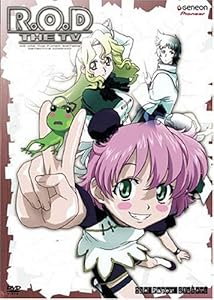
Yuri Anime: Read or Dream The TV, Vol. 1

July 12th, 2004

Part 2

So, Upon rewatching the saga of the three paper sisters and erstwhile writing prodigy, I find that my initial reactions to the storyline and characters are little changed from my initial viewing.

The main thing about the first four episodes is the omnipresence of Yomiko Readman made plain through her absence. From the locket around Nenene’s neck, to the paper-using skills of Michelle, Maggie and Anita, the picture on Nenene’s desk, her search for information, etc., etc., Yomiko’s presence fills every second of this series. It almost seems as if she’s a kind of guardian spirit – which, of course, she isn’t. Future episodes will reveal how very human she is, but at this point, we don’t really know that yet.

I am also impressed with how much of a curmudgeon Nenene has become at 20. It’s taken me nearly twice that long to become so grumpy. My hat’s off to her.

As for the Paper Sisters…they are both more and less annoying that the first time. It strikes me much more this time how innocent and…unfinished…they all seem. It may be 20/20 hindsight, but they really aren’t quite human at this point. Like Maggie throwing out furniture to “clean” the apartment. No one would really do that, unless they had no experience of human interaction.

On the other hand, Anita, who I initially loathed, I find myself watching with more interest. Her annoying qualities seem less pronouced to me, this time around.

However, I still maintain that the second episode of this series is vile. Unfunny, irritating and in many ways pointless, it sets the characters on the board, true, but also annoyed the living daylights out of me. Both times.

For a first volume of an anime seires, however, it’s a pretty damn good beginning. A strong beginning, the weaknesses of the second episode pretty much made up for by good third and excellent fourth episodes. By the time you finish the first volume, there’s more than enough to work with in terms of character and the plot has, at least in part, appeared. Compare this with something like Bakuretsu Tenshi, which took something like 13 episodes to develop any kind of plot.

Fanservice comes in many flavors in ROD The TV. Whether you’re into Gainax bounces, loli, yuri, shota, androgyny, evil psychotics, it’s all pretty much in there, somewhere.

All in all, as anime series go, ROD The TV is still one of the best I’ve ever seen, and Volume 1 is a pretty strong start to an amazing series.

Overall – 9 out of 10 for character, plot, design, writing.


Yuri Anime: Devilman Lady

May 28th, 2004

Okay, yesterday I forgot to tell you about the one great big gay character in the Devilman Lady manga, but that’s okay because I’ll be covering her today, with great enthusiasm. ^_^

Let me start off by saying that the anime version of Devilman Lady is SO lesbian, that it’s a wonder it doesn’t get more spin in Yuri circles. I guess the majority of viewers just prefer cute over tough, but call me a happy minority. I’ll take cool, competent and tough any day over cute. ^_^

Where in the manga our heroine, Fudou Jun, was a uber-tough, butched up athlete, even had been in the Olympics as a swimmer, the anime Jun is a quiet, lovely top-notch fashion model. She’s immensely popular and we can see why, because when she gets in front of the camera, she becomes something alive and animal – her charisma is obvious, and so is her hunger.

Into this life comes the (still) completely psychotic Ran Asuka, who throws Jun into a room with a guy who becomes a ravening Devilbeast. The shock of being attacked forces Jun to transform (no demon bats here…) and Asuka calmly tells Jun that she’ll help Asuka hunt other Devilbeasts around the city. Jun, who has pretty low self-esteem, does.

Asuka is openly and obviously attracted to Jun, but pretty much only when she’s in her Devilbeast form.  In any case, Asuka definitely teases her unmercifully, as she forces Jun to travel the country slaughtering people as a Devilbeast; ironically in the name of preserving humanity.

Complicating Jun’s life is the addition of a young friend, Kazumi who, after her parents are killed by a Devilbeast (and she is saved by Jun in her transformed state) moves in with Jun. It is *equally* apparent that these two LONG for each other. You’ll be happy to know that about 3/4 through the series, they finally acknowledge their feelings and even spend a night together, but this series is not a comedy – it’s a tragedy. I’ll leave you to guess the rest.

Episodes 5 and 6 of the series ought really to come with a 100% Yuri label. Kazumi has moved in and now wants to buy a bigger bed to share with Jun. She all buts says, “Look, stupid, I really want to sleep with you” but she’s young and a little unsure of Jun’s feelings. Jun, is agonizing over this, exactly *because* she wants so desperately to sleep with Kazumi. Trust me – this is not subtext. From this point on, whenever anyone other than Jun mentions Kazumi, it’s to refer to her as Jun’s lover, even though they aren’t. Jun wimps out, btw, and buys bunk beds. Kazumi is quite shocked by this admission of Jun’s, because what it says is either “I want you so much I won’t be able to control myself” – which is the truth, or, “I loathe you so much I can’t stand the thought of sharing a bed with you,” in which case she ought to make Kazumi leave. It’s pretty apparent that Jun feels she wouldn’t be able to control herself.

In the meantime,we introduce Jun’s old high school classmate (and, in the manga, rival), Big Gay Aoi.

Let me backtrack. In the manga, Kurosaki Aoi is like 6 1/2 feet tall and HUGE. Muscles everywhere. She makes butchy Jun look like a little girl. She obviously wants Jun, but they have a nasty rivalry between them and Aoi has a abusive background and doesn’t do well when she’s not letting the Devilbeast in her body eat people she hates. The Devilbeast, of course, decides it wants to eat Jun. Aoi and the beast that is her body argue and the beast eats Aoi i.e., itself. Aoi does confess her feelings and in the end, Jun is forced to admit that she was also attracted to Aoi. Duh.

Okay, here in the anime, Jun is no athlete – in fact, she’s anemic, and had a problem with passing out when she got too excited as a youth. Flashback to high school at a swim meet. Aoi sees Jun pass out and carries her to the locker room. When Jun comes to, Aoi tries to kiss her. At first Jun gives in, but then, in a moment of weakness, pushes Aoi away and they never speak again. For years. Now, Asuka sets Jun on Aoi’s tracks, because she’s exhibiting signs of being a Devilbeast. In the manga, where Aoi became a Devilbeast to avenge herself on her sexually abusive stepfather, here in the anime Aoi basically has done it for Jun. Jun visits her at the pool and Aoi blatantly asks Jun to love her back, but Jun refuses, again. (Given Jun’s reacton to Kazumi and Asuka, it seems to me that the worst enemy Jun has is herself. She obviously is attracted to women, but it scares her silly, even after all this time.) They fight and ultimately, to save Jun, Aoi sacrifices herself. Let me just add that as Jun is played by Iwao Junko (Tomoyo in Card Captor Sakura and Aoi’s voice is done by Ogata Megumi who played Tenou Haruka in Sailor Moon, we’re talkin’ serious 6 degrees of Yuri-fest right here. ^_^

Episode 6 is the story of a rival model who also wants Jun and ends up getting her naked and tied up in bed before the Devilbeast transformation happens and Jun has to kill her.

From this point on, the story becomes a triangle between Asuka, Jun and Kazumi. Kazumi wins, in a way, because she and Jun admit that they love each other, but in a more concrete way, Asuka wins, because she makes Jun into what she wants her to become. Asuka also wins because she’s the only transgender lesbian from New Jersey that I know of in anime. We learn that she was born and raised in New Jersey (Montclair, from the looks of it,) and that she was born male, but is now female. So in my book, Asuka wins, hands down, because I can say that she is a transgender lesbian from NJ. In anime. It always makes me happy to be able to say that. It doesn’t bother me that she’s insane because I love psychotic lesbians. ^_^

This series is campy horror, not as violent as the manga, but still violent and has a really sort of ambiguously happy ending. I think it’s one of the most Yuri series out there now and it’s a damn shame more people don’t know how wonderfully weird and bizarre it is. Sure, the girl doesn’t get the girl, but it really doesn’t matter, because it’s a great story, with a strange, but less super-weirdo-bizarre ending than the manga, but still plenty weird.

Ratings:

Art – 10
Characters – 10
Music – 10
Yuri – 10
Service – 10

Overall – 10

Devilman Lady is one of my very favorite anime series in the whole of Yuri-land. ^_^


Yuri Anime: Haibane Renmei

April 29th, 2004

Sometimes a series comes along that is so rare, so special, that it would be worth watching just for itself, without any of the usual hooks one expects in anime or manga. Haibane Renmei is one of those series. It is as worth watching for what doesn’t happen, as what does.

Right off the top, Haibane Renmei has the distinction of being the first anime to be based completely off a doujinshi. Yoshitoshi Abe, well-known for his character designs in Serial Experiments Lain and Niea Under 7 had a vision of a bunch of characters called “Haibane,” (which means “charcoal wings”) one day and collected a bunch of sketches of them into a book called Haibane Renmei, (“Charcoal Wings Federation,) which he published and sold at Comiket in Tokyo. The book became really popular, and people kept asking him who these Haibane were and what they were and so on – and so he drew a little doujinshi about the place they lived, called “Old Home – a sort of “slice of life” of the Haibane. The story had a lot of holes in it – there didn’t seem to be a clear beginning or end, and there were a lot of things that the author didn’t know about, by his own admission, like why they can only wear hand-me-downs, and the like.

These characteristics were, lock, stock and barrel, plopped into the anime of Haibane Renmei. The story doesn’t have a clear beginning, nor are many things explained – in fact, the whole world that the Haibane inhabit is left wide open to the imagination. Because of this, not despite it, Yoshitoshi has managed to design one of the most beautiful and intriguing anime I’ve ever seen. To be blunt, I bawled like a baby through the end, but I never felt manipulated or cheated.

The art is seriously unconventional in many ways, the story line defies description, since it seems to begin sort of in the middle of a thing and go on until it stops. The piece we’re party to are examples of truly fine writing – sweet, whimsical, serious and mature by turn and compelling all the way through. There is a great deal left to know about the world of the Haibane – what comes before, what comes after, where do the come from and where do they go? But I’m inclined, like the people that inhabit the space, to simply accept it for what it is and just enjoy the beauty and poetry of the story.

I can hear you asking, “yeah, but is there Yuri?” My answer has got to be that that depends on how you define “Yuri.” If you mean sex between women, then no, definitely not…. What you can say is that Haibane Renmei is about an incredibly intense emotional bond between two women, one that significantly alters their lives, or at least what we see of their lives. For die-hard Yuri-seekers, I think there is *definitely* a case for calling Reki woman-identified, if not women-loving. Her former intense relationship is also with a woman, and that one is portrayed as being awfully close to love. I’m of the opinion that Reki and Rakka have as close to a love relationship as is possible in the Haibane’s world.

So, despite the fact that it’s not about anything, and nothing really *happens*, and there being no overtly Yuri relationship, Haibane Renmei wins, in my opinion, as one of the hands-down finest anime I’ve ever watched.

Ratings:

Art – 9
Music – 8
Story – 10 The story is breathtakingly well-written
Characters – 8

Overall – 9

This is a must watch for anyone who loves good storytelling.

***

And now, for something completely different – here is *my* interpretation of the events of Haibane Renmei. I don’t claim to be right, or even close – this is just what feel was going on:

POSSIBLE SPOILERS WARNING

Rakka was in love with someone…let’s say, for argument’s sake, that it was another girl. She and the other girl decided to kill themselves so they could be together eternally. The crow symbolizes Rakka’s lover – she “freed” her in a sense, but is also the reason she crashes, and ultimately, she needs to let go of that attachment to her previous life before she can move on.

The world we see is a kind of Purgatory, which is why the Haibane stay there for inconsistent and erratic periods of time – because you’re going to be there as long as it takes to do whatever it is you have to do. Life isn’t bad, it’s not Hell, but it’s not great, either, because its not Heaven. And the people who live there and sort of take care of the Haibane are other people who have not committed a “sin” so much as simply died with their souls in a limbo state…so they expiate their crimes wth service and another lifetime.

What are the Haibane, then? I think that they are children who died under extreme circumstances. The older ones might have killed themselves, or been killed, the younger ones may have died through accident or injury, but whatever the circumstance was, it was a violent death and therefore a “sin.” Perhaps the little kids died without being baptized.

In any case, these children die with what *they* feel is a spot on their souls and end up here. Like they feel partially responsible for their own deaths. If they felt completely filthy, they’d likely end up in some sort of mutually created Hell, so in this case they feel ambiguous about their nature. As they do their “work,” they expiate those sins, cleanse their spirits and eventually have to move on.

So, that would explain why Reki and Rakka bond so closely…perhaps in life they had similar stories, dying on account of the oh-so-popular “forbidden love” and intuiting that they could feel safe with one another. Or maybe they were just falling for each other, who knows? But there they were in Purgatory, where relationships have to be non-sexual, and temporary, because of the nature of the thing.

We can always fantasize about what happens when Rakka goes ober the wall herself, right? Maybe she enters her version of Heaven. meets up wih Reki and they fall in real love and live in eternal happiness. Sounds nice, right? Maybe someone will write a fanfic.

Anyway, so there you have it…*my* interpretation of Haibane Renmei.