Archive for the English Manga Category


The Book of Human Insects Manga (English)

November 14th, 2011

The title Book of Human Insects is an insult to insects. Insects are rarely as harmful to their own species as the humans in this book. If one thinks of insects as grotesque and unlovely, then it’s a fitting title, perhaps, as the humans contained within are unlovely at best.

There is a real downside to reading too much of Tezuka Osamu’s manga for adults. He sees very clearly the kind of corruption power, and the drive for power, leads to. He understands too well how the powerful destroy the innocent without even noticing they exist. Read too much of his manga for grownups, and you might be ready to just pack it all in.

In Book of Human Insects we follow a psychopath who has nothing of her own. Instead, she learns from those around her, then steals their identities, their work, their reputation and everything they care about. She wreaks havoc as she moves up in the world, as a world-famous author (with a stolen manuscript) and a award-winning designer (with a stolen design.) She’s even stolen her name, Toshio Tomura.

Death and misery follow in Toshio’s wake. She’s married to a powerful executive in a wager for her own life and wins when he kills himself to avoid the scandal she leaks to the press.

If you’re familiar with Tezuka’s Black Jack series, you know that the most innocent character in the series is the most likely to die and in this book, that holds true here. You also know not to assume that the bad guy gets their comeuppance. Sometimes, when reading Tezuka, you just have to start believing in a righteous afterlife for his characters.

The book is described as a thriller, but I would venture, rather, that it’s a prototype of Dynasty, and other nighttime soaps that glorified the pathologies and lack of principals of the rich and psychopathic.

Obviously if I am reviewing this story, there is at least something of interest to you. Toshio does not hesitate to sleep with men in order to get her way and, when she is married to a man as psychopathic as herself, she seduces his female secretary who is also his lover, in order to gain access to his secrets. There is no love there, although Toshio kindly lies to Jun and tells her she loves her.

There is no moral in this story. In a sense, this is the other bookend to MW, with a beautiful female psychopath in place of the beautiful boy. We never learn anything about Toshio’s past, neither are we ever given a reason for her all-consuming selfish behavior, the way we are in MW. Nonetheless, the protagonist uses sex, smarts and a complete lack of a moral compass to move through the story, just as in MW.

The reason to read Tezuka’s work is always to experience Tezuka’s work. Because this story does not provide cosmic justice, or sense of balance, it’s unlikely to satisfy most manga fans’ desire for kick-ass, or heroism or even sexual thrill. Reading Book of Human Insects is akin to watching an ant farm – fascinating, but utterly alien.

Ratings:

Art – 8
Story – 8
Characters – 3 With two exceptions, they are all loathsome
Yuri – 8
Service – 1 There is nudity and there is sex, but these are adults and there’s no peeking at underwear.

Overall – 8

Translator extraordinaire Mari Morimoto did the translation, which I thought was excellent. Vertical flips the books left to right, but that should pose no problem. I never gave it a second thought. Ultimately, this is a very nice edition of a well-crafted story about vile people. Just like Dynasty.


Ichiroh! Manga, Volume 5 (English) Guest Review by Ayra

October 5th, 2011

Welcome back to Guest Review Wednesday here on Okazu! Today I am delighted to welcome back Ayra for a review of the last volume of this series. Thank you Ayra, thank, thank you! As always, it’s a genuine pleasure to have you here.

The decisive moment is here! In this final chapter of Ichiroh!, Nanako, Akane and company finally take the series of exams that will determine their fate. Will they pass and become proud university students, or will they fail again and become niroh?

Upon reading long-running stories, it’s not uncommon to feel as if the author ran out of ideas regarding the setup of the story and its characters. This is, unfortunately, the case for Ichiroh!, Volume 5. Even the author mentions that Nanako’s year as an ichiroh (nickname for someone who failed the university exams in their first year of studying to retake them) could not be dragged out further. This lack of ideas unfortunately shows quite clearly within the first few pages.

All volumes of Ichiroh! have pages 1 to 9 in color. In the first three volumes, they were regular story pages. In the fourth, they were story pages with fanservice overlays. In the fifth volume, they are merely pure fanservice images with no text and no relationship to the actual story. This definitely sets a bad first impression for the volume.

The first part of the story consists mainly of wrapping up ‘loose ends’ such as Wakaba’s mother returning, how the maid cafe manages to be succesful without Nanako, while Kozue improves her relationships with friends from her own school.

The second part consists of Nanako and company selecting universities to apply for, as well as actually taking the exams. Nanako and Akane both get acceptance letters but, from different universities. While Nanako resigns herself to that fact, Akane cheerfully rips her acceptance letter, stating that there’s no point in going to that university if Nanako isn’t there with her. And so, they decide to try the more difficult National University exams instead. Shino instantly rips her own acceptance letters to the best universities in Japan upon learning of this, Kozue claims that she failed the private university exams and so she ‘unfortunately’ has no choice but to try for the national exams and Mai’s reasons are never explained.

The third part has Nanako getting a huge fever right before the exams, which causes her to fail it while everyone else gets accepted. For multiple pages, every character seen in the story come to praise her about how kind, awesome, motherly, gentle, intelligent, etc.,  she is while praying and cheering for her success.

The final part has the entire cast celebrating their success with Nanako giving long speeches at how thankful she is for everyone’s support. Everyone rejoices at the fact that they will be going to the university in the same town as they had currently been in (the same university Shino has been going to), so they will be able to keep having fun with everyone else, with the last page showing the new university students going on a well-deserved trip to Okinawa.

The best word to describe Volume 5 is, “repetitive”. While it is expected for 4-koma comics to recycle jokes and punchlines, Volume 5 does it for multiple strips in a row. For example, it is common in this volume to have 5 virtually identical “Nanako is cheap” jokes in 5 consecutive strips. The result is that, while the first one may be amusing, and that the others could also be if placed at proper places further along in the volume, the constant consecutive repetition gets tiresome very quickly.

The same applies in the second and third part: We see Nanako and crew making last minute preparations to take the private exams. Then we see them doing last minute preparations for the final exams. And then we see Nanako making last minute preparations for the make-up exam.

Finally, while it is somewhat ‘touching’ to see everyone being so supportive of Nanako, it gets tiresome and repetitive extremely fast after a few pages. There’s a profound sense of ‘deja-vu’ while reading this volume, and it’s definitively not a good thing when the volume consists of only 100 pages of story (plus 10 of fanservice and nearly 20 pages of publicity for other manga at the end). It’s also a bit unsettling how no main character beyond Nanako has any goals in life beyond being where Nanako is (or Akane, in Kozue’s case).

Fortunately, there is some redeeming value. There are a few extremely funny and clever strips, the art is pretty good for a 4-koma comic and the story ends on a cheerful, happy note.

Yuri-wise, the content has been increased slightly and it’s the subject of many strips, but it’s still played mostly for laughs. Kozue is now madly in love with Akane and keeps getting in situations where she can spend as much time as possible with Akane, with a helping hand from Shino, who tries her best to hook them up – so that she has Nanako all to herself. Akane obviously loves Nanako and keeps making statements like “I’m nothing without you Nanako,” (as well as tearing up her acceptance letter just to be with Nanako,) but she doesn’t seem to actually realize her own feelings. She obviously likes Kozue very much also, although to a much lesser extent. Finally, Nanako gives Akane a kiss on the forehead to console her during the stressful examination time, which she claims was just as a  friend, while she gets teased mercilessly about it by Baa-san and Anko.

Ichiroh! is certainly no masterpiece, and Volume 5 might have been slightly underwhelming, but the series overall is relatively amusing. As far as english Yuri-ish comedy manga go, you could certainly pick worse.

Ratings:

Art – 8 (By 4-koma standards).
Story – 3
Characters – 5
Yuri – 6
Service – 6

Overall – 6


Cardcaptor Sakura Manga Omnibus, Volume 2 (English)

September 3rd, 2011

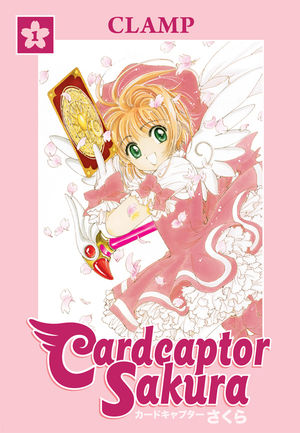
In Volume 1 of Cardcaptor Sakura, we met Kinomoto Sakura, an energetic, cheerful elementary school girl who accidentally (maybe) unleashes the power of the Clow Cards…a deck that was created generations ago by the great magician Clow Reed. We also meet Sakura’s family and friends, and the magical creature that assists her to collect all the Cards, Cereberus, nicknamed Kero-chan.

In Volume 2, we pick up where we left off as Sakura, her rival Li and besotted best friend forever Tomoyo are trapped in the Maze card and rescued by the power of Mizuki Kaho-sensei, the new substitute teacher.

At which point the story begins to be weighted down with predictions and implications and precognition. Great things are happening, powerful creatures are stirring and Sakura is merely a young girl. But Sakura rises to the challenge every time. Helped by her friends, she conquers card after card, and slowly begins to learn that Kaho-sensei has a role in all this…although she doesn’t yet know what.

Clow Reed begins, in this volume, to become a real presence. Sakura sees him in a dream, Kaho speaks of him almost as if she knew him. And, we learn, that Kaho has a bond with another man in Sakura’s life – her brother. Years ago, they dated when Toya was in middle school and Kaho, a student teacher.

What happens next I won’t spoil. If you’ve read it, you know why this is the coolest volume. Yue is worth waiting for, just for sheer prettiness. But if you haven’t, I’ll leave you to meet Yue on your own time. ^_^

Yet again, I find Dark Horse did a very acceptable translation job, and yet again, this book is so heavy, I would worry if a child tried to carry it around. But the color pages are as pretty as I remember, and the story is a delight, even the pander-y, manipulative ones that make me choke up. ^_^

As I said for the first volume, I am not nostalgic, but I truly do love this series. Every character is likable, even the unlikable ones, and it’s all so…nice.

Ratings:

Art – 9
Characters – 9
Story – 9
Yuri – 2
Service – 4

Overall – 9

I can’t wait for the next volume!

The especially wonderful thing about this volume is that it heralds the arrival of a brand new Okazu Hero! Thank you Walt R-B for sponsoring this review! Please email me at anilesbocon01 at hotmail dot com to receive your Okazu Hero Badge, suitable for display on any website of social media profile. You’re my Hero. ^_^


Wandering Son Manga, Volume 1 (English)

July 17th, 2011

Wandering Son, Volume 1 is my vote for manga most likely to cause a quiet revolution without becoming a best seller.

As you know, if you pay attention to any manga news at all, Wandering Son  by Shimura Takako, is the story of two young people as they realize and deal with the fact that their gender does not match their bodies. In Volume One, we are introduced to the cast, and to the general situation in which Shuuichi and his classmate Yoshino start to deal with puberty and the disconnect they feel about their selves and the bodies in which those selves reside.

This past week I was pleased to be part of a discussion of this book at the Manga Out Loud podcast. I hope you’ll listen to it, as we discuss both the book and the anime in some detail.

The story itself is gentle…as I say in the podcast, almost tentative. This territory is difficult for many people to accept and the manga audience is not, for all that it enjoys stories of gender switching as comedy, as socially liberal as many might think. Shimura takes her time…and ours…to introduce the idea that a body may not be the right one to be in.

As a result, Volume 1 might feel a bit timid to those readers who are more used to Aoi Hana. Having just come off reading Volume 6 of Aoi Hana, I found myself a little surprised at the tentativeness of these first chapters…and then suddenly I realized that this manga is nearly ten years old. The strength Fumi shows was not born overnight and Shuuichi and Yoshino are younger than she is. After talking with the folks on the podcast, I realized what a profound revelation this series will be to people for whom this is an entirely alien discussion. And I’m utterly blown away by how deft and masterful Shimura has become in the last decade.

In conclusion, I’m going to cheat and quote Ed Sizemore from Twitter, when he said, “Wandering Son doesn’t just open up doors of perception for me, but makes me want to learn more about the real life experience of transgender people. To see world through their eyes so I can relate to them better.”

There will be no Wandering Son cosplayers, you won’t find Wandering Son figurines or headbands at conventions. But in these pages, Shimura can bring the thoughts and experiences of the transgender community to people who have never before thought about life from Shuuichi’s or Yoshino’s perspective. That is the revolution contained in the pages of Wandering Son.

Ratings:

Art – 7
Story – 8
Characters – 9
Yuri – 0

Overall – 8

I hope you will all consider buying a copy of the manga for your library (or request that it buy a copy, if it still has the budget to do so.) Let’s change the world, one manga at a time – starting with this one. I’ve already got a copy for my Libary. ^_^


Light Novel: Strawberry Panic, the Complete Novel Collection (English)

July 13th, 2011

Strawberry Panic, the Complete Novel Collection, tells the story of Aoi Nagisa, a cheerful, otherwise unexceptional girl who is swept up in high drama at an elite Girl’s Academy when the Academy star inexplicably falls in love with her.

Nagisa is a transfer student and so, as with so many series, a catalyst for change at the old, established St. Miator school. Without meaning to do so, Nagisa brings about chaotic change not only in Miator, but also in sister schools St. Spica and St. Lu Lim. The winds of change in Spica are also heralded by the appearance of a transfer student, Konohana Hikari whho, like Nagisa, finds herself swept up in the drama of a top star of the school. These two transfer students are foils for one another in this popular Yuri series.

Nagisa and Hikari’s adventures in love are, perhaps, the Yuri-est of all things. Here in the rarefied, “peach-scented” halls of Astraea, is a great deal of love between girls, but there is only one lesbian. There are protestations of desire, there are vows to be together forever, there’s petting and kissing and possibly even sex, but there is very little thought of the world outside these halls or how any of this could ever survive graduation. Here in this fantasy world, all the tropes and conventions of Yuri congregate to become the ultimate in parody literature.

In the end, Nagisa gets her Shizuma and Hikari and Amane make the most perfect couple that Astraea has ever seen as Etoile. God’s in his heaven, all’s right with this fantasy, peach-colored world of private girls’ schools and Yuri love. Fu~ fu~ fu~, the wind blows as the cherry blossoms swirl around our lovers.

And so, at last, we come to the end.

This journey began more than 7 and a half years ago, with the news that an anime was being made of a series of short stories about girls in “Yuri couplings.” I read those stories and found nothing but deep loathing for them in my heart. The art was moe, the situations were trite, and the characters lacked character.

The anime and I started off on a bad foot, but over time I grew to enjoy it. The manga and I have never been on speaking terms, but the Light Novels convinced me that there was something more here than just a parody. The Light Novels *were* more than just the kind of parody which the anime carried off – the novels were an incredibly intelligent parody written to be slightly dumb. And so, I began to find myself un-loathing the anime more and liking the novels. As my shackles of preconceptions fell, unbound by the sheer ridiculousness of the novels – and helped by Kaname’s global warming speech in the anime –  I found things to enjoy in the series. Including, but not limited to, the helicopters. Mostly though, it was the overblown, hyper-cute, yet, ridiculously over-formal moego language that appealed to me.

This time, as I read the novels I was able to just enjoy the overcomplicated saga of Nagisa and Hikari as they overcome absurd challenges so that the girls get their girls.

Ratings:

Overall – 9, which is pretty amazing when you think of how far it had to rise to get here.

One last time, I want to thank Seven Seas for making it possible for me to be part of the process.

This review was brought to you by Act 3, Scene 2 of Julius Caesar, by Shakespeare.