Archive for the English Manga Category


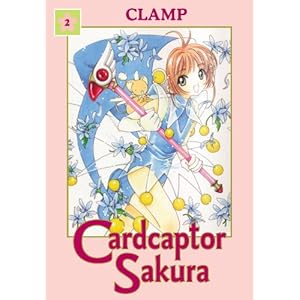
Cardcaptor Sakura Manga Omnibus, Volume 2 (English)

September 3rd, 2011

In Volume 1 of Cardcaptor Sakura, we met Kinomoto Sakura, an energetic, cheerful elementary school girl who accidentally (maybe) unleashes the power of the Clow Cards…a deck that was created generations ago by the great magician Clow Reed. We also meet Sakura’s family and friends, and the magical creature that assists her to collect all the Cards, Cereberus, nicknamed Kero-chan.

In Volume 2, we pick up where we left off as Sakura, her rival Li and besotted best friend forever Tomoyo are trapped in the Maze card and rescued by the power of Mizuki Kaho-sensei, the new substitute teacher.

At which point the story begins to be weighted down with predictions and implications and precognition. Great things are happening, powerful creatures are stirring and Sakura is merely a young girl. But Sakura rises to the challenge every time. Helped by her friends, she conquers card after card, and slowly begins to learn that Kaho-sensei has a role in all this…although she doesn’t yet know what.

Clow Reed begins, in this volume, to become a real presence. Sakura sees him in a dream, Kaho speaks of him almost as if she knew him. And, we learn, that Kaho has a bond with another man in Sakura’s life – her brother. Years ago, they dated when Toya was in middle school and Kaho, a student teacher.

What happens next I won’t spoil. If you’ve read it, you know why this is the coolest volume. Yue is worth waiting for, just for sheer prettiness. But if you haven’t, I’ll leave you to meet Yue on your own time. ^_^

Yet again, I find Dark Horse did a very acceptable translation job, and yet again, this book is so heavy, I would worry if a child tried to carry it around. But the color pages are as pretty as I remember, and the story is a delight, even the pander-y, manipulative ones that make me choke up. ^_^

As I said for the first volume, I am not nostalgic, but I truly do love this series. Every character is likable, even the unlikable ones, and it’s all so…nice.

Ratings:

Art – 9
Characters – 9
Story – 9
Yuri – 2
Service – 4

Overall – 9

I can’t wait for the next volume!

The especially wonderful thing about this volume is that it heralds the arrival of a brand new Okazu Hero! Thank you Walt R-B for sponsoring this review! Please email me at anilesbocon01 at hotmail dot com to receive your Okazu Hero Badge, suitable for display on any website of social media profile. You’re my Hero. ^_^


Wandering Son Manga, Volume 1 (English)

July 17th, 2011

Wandering Son, Volume 1 is my vote for manga most likely to cause a quiet revolution without becoming a best seller.


As you know, if you pay attention to any manga news at all, Wandering Son  by Shimura Takako, is the story of two young people as they realize and deal with the fact that their gender does not match their bodies. In Volume One, we are introduced to the cast, and to the general situation in which Shuuichi and his classmate Yoshino start to deal with puberty and the disconnect they feel about their selves and the bodies in which those selves reside.

This past week I was pleased to be part of a discussion of this book at the Manga Out Loud podcast. I hope you’ll listen to it, as we discuss both the book and the anime in some detail.

The story itself is gentle…as I say in the podcast, almost tentative. This territory is difficult for many people to accept and the manga audience is not, for all that it enjoys stories of gender switching as comedy, as socially liberal as many might think. Shimura takes her time…and ours…to introduce the idea that a body may not be the right one to be in.

As a result, Volume 1 might feel a bit timid to those readers who are more used to Aoi Hana. Having just come off reading Volume 6 of Aoi Hana, I found myself a little surprised at the tentativeness of these first chapters…and then suddenly I realized that this manga is nearly ten years old. The strength Fumi shows was not born overnight and Shuuichi and Yoshino are younger than she is. After talking with the folks on the podcast, I realized what a profound revelation this series will be to people for whom this is an entirely alien discussion. And I’m utterly blown away by how deft and masterful Shimura has become in the last decade.

In conclusion, I’m going to cheat and quote Ed Sizemore from Twitter, when he said, “Wandering Son doesn’t just open up doors of perception for me, but makes me want to learn more about the real life experience of transgender people. To see world through their eyes so I can relate to them better.”

There will be no Wandering Son cosplayers, you won’t find Wandering Son figurines or headbands at conventions. But in these pages, Shimura can bring the thoughts and experiences of the transgender community to people who have never before thought about life from Shuuichi’s or Yoshino’s perspective. That is the revolution contained in the pages of Wandering Son.

Ratings:

Art – 7
Story – 8
Characters – 9
Yuri – 0

Overall – 8

I hope you will all consider buying a copy of the manga for your library (or request that it buy a copy, if it still has the budget to do so.) Let’s change the world, one manga at a time – starting with this one. I’ve already got a copy for my Libary. ^_^


Light Novel: Strawberry Panic, the Complete Novel Collection (English)

July 13th, 2011

Strawberry Panic, the Complete Novel Collection, tells the story of Aoi Nagisa, a cheerful, otherwise unexceptional girl who is swept up in high drama at an elite Girl’s Academy when the Academy star inexplicably falls in love with her.

Nagisa is a transfer student and so, as with so many series, a catalyst for change at the old, established St. Miator school. Without meaning to do so, Nagisa brings about chaotic change not only in Miator, but also in sister schools St. Spica and St. Lu Lim. The winds of change in Spica are also heralded by the appearance of a transfer student, Konohana Hikari whho, like Nagisa, finds herself swept up in the drama of a top star of the school. These two transfer students are foils for one another in this popular Yuri series.

Nagisa and Hikari’s adventures in love are, perhaps, the Yuri-est of all things. Here in the rarefied, “peach-scented” halls of Astraea, is a great deal of love between girls, but there is only one lesbian. There are protestations of desire, there are vows to be together forever, there’s petting and kissing and possibly even sex, but there is very little thought of the world outside these halls or how any of this could ever survive graduation. Here in this fantasy world, all the tropes and conventions of Yuri congregate to become the ultimate in parody literature.

In the end, Nagisa gets her Shizuma and Hikari and Amane make the most perfect couple that Astraea has ever seen as Etoile. God’s in his heaven, all’s right with this fantasy, peach-colored world of private girls’ schools and Yuri love. Fu~ fu~ fu~, the wind blows as the cherry blossoms swirl around our lovers.

And so, at last, we come to the end.

This journey began more than 7 and a half years ago, with the news that an anime was being made of a series of short stories about girls in “Yuri couplings.” I read those stories and found nothing but deep loathing for them in my heart. The art was moe, the situations were trite, and the characters lacked character.

The anime and I started off on a bad foot, but over time I grew to enjoy it. The manga and I have never been on speaking terms, but the Light Novels convinced me that there was something more here than just a parody. The Light Novels *were* more than just the kind of parody which the anime carried off – the novels were an incredibly intelligent parody written to be slightly dumb. And so, I began to find myself un-loathing the anime more and liking the novels. As my shackles of preconceptions fell, unbound by the sheer ridiculousness of the novels – and helped by Kaname’s global warming speech in the anime –  I found things to enjoy in the series. Including, but not limited to, the helicopters. Mostly though, it was the overblown, hyper-cute, yet, ridiculously over-formal moego language that appealed to me.

This time, as I read the novels I was able to just enjoy the overcomplicated saga of Nagisa and Hikari as they overcome absurd challenges so that the girls get their girls.

Ratings:

Overall – 9, which is pretty amazing when you think of how far it had to rise to get here.

One last time, I want to thank Seven Seas for making it possible for me to be part of the process.

This review was brought to you by Act 3, Scene 2 of Julius Caesar, by Shakespeare.


A Certain Scientific Railgun Manga (English)

July 1st, 2011

A Certain Scientific Railgun 1There are two kinds of romance novel. One is the kind that everyone thinks of when they read the words “romance novel,” which is to say, romance novels targeted at adult women. These are often generically called “Harlequin novels” after the famous publisher of the genre. The other kind of romance novel are for men. They are packaged as action-adventure books, but are always as much about the hero and the beautiful woman getting together as any Harlequin. We call these “Clive Cussler novels.”

You can tell the difference between romance written for men and for women by the way they use language. A woman’s romance might describe a scene, “His bronze skin glinted in the evening sun as he closed his brawny arms around her slim waist and full hips.” Whereas Clive Cussler would describe the scene this way, “His bronze skin glinted in the evening sun as he closed his brawny arms around her slim waist and full hips.”

Many of the manga I read are for older teens, young adults. They aren’t *quite* children and they aren’t quite adult, really. I find myself reading these manga, noticing how often random bits of service are wedged into scenes that make basically no sense at all. In effect, all these manga sound like this to me:

“Hey Carol, I wanted to get those sales reports to you by End of Business day, but spent the afternoon thinking what Kim would like like in a bikini instead.”

“Oh, hey, Bob, thanks, I’m going to need those reports for a presentation I’m making in front of the marketing team. I was working on it, but spent the afternoon wondering what David looked like in the shower.”

Which brings me, at last, to A Certain Scientific Railgun. In the first scene, which begins with narrative expositions, so the audience not familiar with the world from To Aru Majutsu no Index, the mother ship franchise for this series, can know enough to get by. This is enhanced slightly by  more exposition by the teacher who is saying stuff that presumably the students in her class all know.

We are then introduced to Misaka Mikoto, one of the objectively most powerful people in the book’s world. In the shower. I’m not saying it’s pandering, I’m saying it’s *distracting*.

In any case, we quickly meet Mikoto, her admiring, pervtastic kouhai Shirai Kuroko, Kuroko’s fellow member of Judgement Uiharu Kazari and her friend Saten Ruiko. These four girls are the series’ greatest strength. They like each other, they respect each other. Kuroko and Mikoto could easily treat Saten and Uiharu, who have neither power nor money, as dirt…but they do not. They are kind – not pitying kind, genuinely kind. Mikoto and Kuroko are…nice.

The story is weaker than that in the anime, but easy enough to follow and if you don’t much care that Index is not in English, so we are indeed coming in in the middle of the story, then it should be no particular hurdle.

Yuri is thin, one-sided and a bit tired, but Kuroko’s antics cover what is probably a genuine desire for Mikoto.

As this is a Seven Seas book, all the technicals are quite good. Once again a very authentic reading experience.

Look, take your brain out of your head and watch the girls fight the bad guys. It’s fun.

Ratings:

Art – 6
Story – 7
Characters – 8
Yuri – 4
Service – 3

Overall – 7

I think this series is a decent manga, but it made a terrific anime. I’m not sure what I would make of this manga had I not seen the anime, but the one that that indubitably worked in both is the friendship of the four girls.

Many thanks to brand-new  Okazu Hero Steven M for sponsoring today’s review!


Silent Mobius Manga, Volume 3 (English)

June 28th, 2011

Silent Mobius: Complete Edition, Vol. 3Okay, so, now you’re wondering – you’re about to take off for summer vacation and if you can’t bring The Last Uniform with you to read, what can you bring?

Let me suggest you throw a copy of Silent Mobius, Volume 3 into your carry-on.

Silent Mobius is good, solid old-school sci-fi, and this volume has spaceships and computers and very obviously adult women who are sometimes in various states of undress, but you can be darn certain that they are adult.

Volume 3 picks up where Volume 2 left off, with Yuki’s backstory. I’d forgotten how honestly unsatisfying the ending of that is. It’s not that Yuki doesn’t step up, but it reeks of Tuxedo Mask on a lightpole shouting, “Do it, Sailor Moon!”

From there we move into Lebia’s story. I consider Lebia to be one of the most interesting characters in AMP. She lives alone with her AI in a luxurious apartment, with an indoor pool. On a cop’s salary? You can’t tell me Lebia isn’t manipulating playing the markets. Lebia also strikes me as a bona fide hedonist, one of very few non-evil characters I’ve ever seen who is. For that alone, I love her. Then she, like everyone at AMP, turns out to be extra super awesome, and we like her even more. ^_^

The translation in Udon’s new edition has settled down nicely. I still don’t quite feel that each character has a unique voice, but that’s common in translated material…everyone sounds like the translator. More importantly, the translation reads smoothly, the color pictures look good and in general, as women in uniform kicking ass go…this series is still as wonderful as ever.

Ratings:

Art – 9
Story – 9
Characters – 8
Service – 2 (There is nothing loser-y in appreciating adult women’s bodies.)
Yuri – 0

Overall – 8

Still no Yuri,  but we haven’t gotten to Rally yet. Get your Yuri Goggles ready though….

I just love the heck out of this series. I’m going to go and play Kindan no Pense over and over and over. Oh and by the way, Asamiya Kia is on Twitter and he’s very talkative there – go tell him how much you like Silent Mobius!