Archive for the English Manga Category


Gatch Gatcha Manga, Volume 8 (English) Guest Review by Sean Gaffney

December 21st, 2010

Gatcha Gacha Volume 8 I know it’s only Tuesday, but I’ve been sick the past few days, and so asked Sean to hustle and write me a guest review for today. And he did! So, once again, let’s welcome back Guest Reviewer, Sean Gaffney!

I’ve already reviewed Gatcha Gatcha, Volume 8 on my own blog, but since I had  previously done an overview of the series here in September 2008, I  thought that I would come back and dwell a bit on the more Yuri-friendly  aspects of the series as a whole.

First, a small digression. A lot of manga have sidebar comments  interspersed throughout the volumes. In the magazine, this is a place where the page was thinner so that an advertisement could be placed. For the volume, the publisher asks the artist to fills those spaces with original material to draw in a reader who may not want to buy something they already read in the pages of, say, Melody magazine. As readers of shoujo manga know, 90% of the time the material is the artist talking about what they ate, or where they shopped, or the awesome fellow manga artist they hung out with, or simply whining about how awful they are. And Yutaka Tachibana does this a bit too, no doubt. But she also discusses this series, and the choices she made.

She talks about Motoko, and how the editor asked for her more violent and lecherous tendencies to be toned down, but that Tachibana put her foot down. She also mentions Yuri, and said that she tried to make her a girl who’d only gone as far as kissing with her boyfriends, but felt Yuri worked better when she was ‘less pure’. More to the point, Tachibana wrote this manga ‘doing what she felt like’, and decided to simply dispense with most of the shoujo romance most series demand. Volume 8 gives us a good idea of why – it doesn’t fit the characters at mall. At least not the female characters. Yuri spends most of this volume trying to get herself to fall out of love with Yabe and in love with Hirao. She certainly does have some feelings for Hirao, and notes that she’d be jealous if she saw him with another girl. But she doesn’t get him. When she finally goes on a date with him – a very awkward one – she senses stares coming from the other females in the room, and worries that they all see Hirao as some ’empty-headed bimbo’. Later, seeing him blushing after eating a bite of her food, she compares him to… a princess.

Role reversal is the order of the day throughout this volume. Yuri dreams of being rescued from a snowy mountaintop by a ‘prince’ whose face she can’t quite make out. It’s clearly Motoko, but she hasn’t yet connected those dots. Later, she and Hirao are captured by the evil gang leader who’s been trying to make everyone’s life miserable this whole series. She then decides to disguise herself as Hirao and take the abuse and torture of her captors so that he can escape. Yuri is supposed to be the blushing shoujo heroine, only she simply can’t fall into those lines.

Neither does Motoko. Her main character arc wrapped up in Book 7, so here she simply does what she does best – makes insensitive yet telling remarks and beats up tons and tons of people. Much of this is a facade, of course – we’ve seen how much Motoko cares for Yuri, and she’s been trying to get her and Hirao to stumble towards each other almost from Day One. It’s not working, though, and clearly Yuri’s happiness is more important to her than she ever expected – Sekine understands this when he asks in a prior volume how she feels about Yuri and Hirao, and Motoko blankly replies “Dunno.”

So the climax of the series is, of course, Motoko coming to Yuri’s rescue, not Hirao. And in the final scene, we see Motoko finally at peace with herself. Her big sister is back, but seems to have lost the obsession with Motoko that led to jealous insanity. Motoko even cut her hair again, now that she doesn’t have to be ‘girly’ to ward off Kanako’s affections. And Yuri notices, saying that Motoko looks cool and makes her heart skip a beat. Now, Motoko had flirted with Yuri in a joking way several volumes earlier, but this comment seems to pull her up short. Then she just smiles and says “You bet I do.” This is lampshaded by the author, who has Sekine noting to Hirao while this is going on that Hirao has to win Yuri quickly and keep her or else he’ll lose her. But then the final line of the author’s narration is “Then again… maybe it’s already too late?”

The author already mentioned she stood her ground on keeping Yuri and Motoko the flawed yet far more awesome characters they were. More to the point, most of the time she didn’t go for the easy out, or the typical plot. The narrative, from the start, clearly was about the meeting and subsequent friendship of these two girls. And the two guys co-starring were shown, over and over, to be fairly weak and ineffectual, no matter what was done to toughen them up. As a result,
when it’s implied Yuri and Motoko get together at the end, this isn’t a surprise. It’s what the series has been working towards.

Ratings:

Art – 6. Still can get busy and confusing, especially during action scenes.

Story – 7. There are some cliches here, don’t get me wrong, but I liked the way the author stuck to her guns much of the time.

Characters – 9. Fantastic, especially the females. Even the psycho incestuous sister, Kanako, gets a depth rarely seen in psycho incestuous sisters.

Yuri (no, not the character): 5. It can still be read as hypothetical, but you’d have to squint, especially with the final pages.

Servicey – 2. There’s not a heck of a lot of service here.

Overall: 8. A highly underrated series from Tokyopop, and I’m pleased that it is finally finished. Definitely worth the effort to find it.

Also, the inside cover picture has Motoko wearing a fedora while snuggling Yuri. Fedoras make everyone sexier.


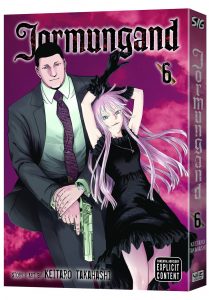
Jormungand Manga, Volume 5 (English)

December 2nd, 2010

The plotlines in Jormungand have never been really tight. In Volume 5 the plots are thin red strings that hold all the characters’ fates together.

Without these barely-there threads, the characters give the impression that they’d fly right out of their orbits around Koko. And it is Koko that holds all these strings. This is a team that exists entirely because of Koko. Because she can smile, they can smile. Because she likes practical jokes, they joke with each other. Because she treats Jonah like a son, they can all take responsibility for him.

In this volume we get a little bit of background for Lehm, the artillery expert, there’s a few chapters of fighting and, at the end, we see Valmet attempting to sneak away on her own.

Nothing in this volume is much different than in the previous four volumes, so if you are not already enamored of reading a story about people having fun killing other people, then you’re not going to be convinced to keep reading.

But for those of us who do like the series, this is more of the same – and has the added benefit of the team taking turns seeing who can throw Jonah the farthest, which made me laugh out loud.

Valmet is still Team Yuri as she proclaims her breasts only for her own and Koko’s use. I’m interested to see the spotlight turned on her next volume. I bet she’ll knife fight and people will shoot things, but that’s just me projecting. And I’m 80% convinced that Schokolade is besotted with Koko as well.

There’s a short omake with Koko’s female harem that tickled my funnybone. But overall, this ain’t high art. It’s just a dumb manga that I really like.

Ratings:

Art – 3
Story – 5
Characters – 8
Yuri – 4
Service – 5

Overall – In reality, this manga is a 4, but I like it 8


Ichiroh! Manga, Volume 3 (English)

November 30th, 2010

Ichiroh!, Vol. 3As in Volume1 and Volume 2, Ichiroh!, Volume 3, follows the wacky daily life of a number of ronin – college-aged students who failed to get into university and are now studying at supplemental schools in a second or third bid to make it to upper education. And, as in Volumes 1 and 2, the trials and travails of Nanako, a serious-minded, hardworking student are meant to be hilarious.

They might be, too, if you can overlook the basic premise that Nanako, a hard-working and serious-minded student somehow failed her attempts to get into university.

Also side-splittingly funny are meant to be the many references to how little money Nannko has and how careful she is with her money. Because poverty is always a laugh and a half.

Ichiroh is a 4-koma, with a reasonably formulaic set-up for the panels:

Panel 1: Somebody shouts or declaims. Often inexplicably.

Panel 2: Request for clarification or explanation

Panel 3:  Set-up for…

Panel 4: Punchline, which is almost always delivered in bold, italic, large font.

Slide whistle, clown horn or trombone going bwah-~wah~waaahhh~  must be supplied by the reader.

Side characters are becoming more numerous now which, like Lucky Star, allows for more combinations of jokes. Mai-chan’s fujyoshi leanings are kind of “uh-huh” for us, but when she has to come out to Nanako and Akane, it allows them to sort of develop as characters. Same when we learn that Shino’s obsession with Nanako has actual made her less selfish, in an entirely selfish way.

I had noticed towards the end of Volume 2 that the entire series was giving off more of a harem vibe than it had begun with. This is not lessened in Volume 3. If anything, with the appearance of Kozue (another student at Nanako and Akane’s school) this feeling is increased significantly. Kozue has no reason to want to be around Nanako, but always is. And the addition of yet another tsundere character was a bonus for those people who like tsundere characters. This series has, like, 5 of them at this point.

Overall, Ichiroh! remains an unmemorable, but nice enough for a few evenings’ read, comic strip.

If you’re living the poor student life, have a miko or maid fetish or just like cute 2-dimensional girls standing around shouting punchlines at each other, you’ll probably enjoy Ichiroh! 

Art – 7
Story – 6
Characters – 7
Yuri – 3
Service – 3

Overall – 7

Many thanks to Yen Press for providing a copy for today’s review and for being able to make a go of 4-koma here in the west.


K-ON! Manga, Volume 1 (English)

November 16th, 2010

After two soul-scouring days, I couldn’t think of anything better for my mental well-being than reaching for Yen Press’ translation of K-ON, Volume 1.

There are so many things to like about K-ON! and really, only a few things not to like, so let’s get those out of the way first.

If you like your manga to have *meaning* and significance and plot and other IMPORTANT things, then K-ON! will be a disappointment to you. It’s a 4-koma, which means it’s a comic strip, meant to be superficial amusement. Like the cake Mugi serves, it’s refreshment, not nutrition.

And there is service. Of course there is service. For the same reason that western female action stars wear service-y clothes or pose provocatively, there are maid costumes and panty shots because that is what is expected by the largely male Japanese audience. For those of us not so sad as to require glimpses of underwear to make a series good, there is, at least, not very much service. This series mostly confines service in later volumes to pin-up chapter splash page art and a few silly dress-up scenes.

That’s it for the downside. On the upside is a biggie – this is a 4-koma comic strip that is actually *funny.* It made me laugh out loud a number of times. More importantly than humor though, it’s fun, entertaining, it makes me smile. In fact, that would be a good summation of the series – it makes me smile.

For the three of you who aren’t familiar with K-ON!, the story follows the daily life and club activities of the keionbu, the Light Music Club, (here translated as the Pop Music Club, a choice that is ably justified in the Translation notes) and the members thereof – flaky club president and drummer Ritsu, bubble-headed lead guitarist Yui, rich girl Tsumugi on keyboards, and bassist, lyricist and dysfunctionally shy Mio. The fact that they are all reasonably talented and Yui approaches idiot-savant levels of skill is the handwave we accept to make the story work. Added to the mix is the incredibly funny all by herself club advisor and homeroom teacher, Sawa-chan-sensei, whose secret makes me laugh every time they drag it out.

What made the anime stand out is the extra-super-duper bubblegum-pop stickyness of the music. There’s just no way to get Fuwa Fuwa Time out of one’s head once one has heard it. in fact, the only CD I bought this time in Japan was the double CD Studio Mix/Cassette Mix of K-ON! songs、Houkago Tea Time II. I just adore how loopy the songs are.

What makes the manga a fun read is – everything. Ritsu’s flakiness, Mio’s teasable personality, Mugi’s play-along mentality and Yui’s bubble-headedness. But I admit to a special fondness for Mugi – not just because her fantasies are the sole Yuri in the first volume, but because she’s she so ready to do whatever the silliest, most-fun, least-responsible thing suggested is. She’s always game for…whatever. Mugi is my favorite character.

I suppose I should spend a moment reviewing Yen’s production. It’s very good. The only visible difference is the paper. Glossy color vs matte color pages just isn’t an issue to me. In every way this presentation holds up to the original. The *only* thing Yen does that sort of jars has nothing to do with the production value at all. They present translation notes in a left-to-right format, but put the pages in a schizoid order, so that they are neither really right-to-left or left-to-right. Reading from the Left, they are Page 3-4-1-2 and reading from the Right they are laid out 2-1-4-3, neither of which works. I understand that when the book is held open it’s 1-2, then turn the page to 3-4, but it’s really schizoid when you consider it from a larger perspective. Again, not a complaint, just something of note.

Detractors insist that the characters don’t seem real, or that there’s nothing to the story or that they just don’t see the appeal. All of these are completely valid, but I have to say that I have rarely watched or read a series that reminded me of my days in band in high school. K-ON! reminds me quite a bit of the best of those days.

Ratings:

Art – 7
Characters – 10
Story – 9
Yuri – 3 for “Mugi-vision”
Service – 3 for the whole underwear thing, but other than that, it’s probably more like a 1

Overall – 9

I LOVED the Music Theory 101 on the last pages. A nice, friendly touch to end a nice, friendly volume with the ladies of Afterschool Tea Time.

Thanks very much to Yen Press for allowing me an advance look at this volume. It was the best thing I’ve read in days by far and away. ^_^


Zombie-Loan Manga, Volumes 8,9,10 (English)

November 12th, 2010

Zombie-Loan, Vol. 8Zombie-Loan is a “loud” manga. The characters scream a lot, they fight a lot, they shout at one another a lot. There is a lot of expository discussion by characters who “hmmph” dismissively at the protagonists’ lack of knowledge, then proceed to monologue the entirety of the story, with punctuations of shouts of denial by the listeners.

For an action manga, there’s a lot of talking.

For a complicated plot, there’s lots of fighting.

For an occult story, there’s a ton of humanity …

Zombie-Loan, Vol. 9…and for a story about people, there’s a lot of handwaves of magic, and spells and powers being thrown around.

In the end, I find Zombie-Loan to be absolutely exhausting with very little payoff.

However, by Volume 10, Michiru is really starting to get a clue or three about her own existence and in a cliffhanger/climax she begins, for the first time, to truly assert herself.

To save Koyomi no less, although it might be too late.


Zombie-Loan, Vol. 10The rest of the characters remain rather uninteresting to me, to be honest. The more the two boys yell, the less I can hear them. So it’s rather unfortunate that the bulk of these three volumes is mixed up in Shito’s backstory of angst, incestuous affection, misery, eternity, depravity and more angst. Snooze.

Just to sort of extra super duper piss me off, it turns out that Yomi, while living inside Koyomi, is a sort of refined male spirit made from the unwanted male children of Koyomi’s family. So…the one bit of Yuri we had to hold on to is not, and Koyomi is reduced to a vessel and a nonentitiy just as we were kind of getting to like her.


Ratings:

Art – messy
Characters – angsty
Story – scattered
Yuri – nonexistent
LoserFanBoy – must exist

Overall – loud

I’ve read a few of the recent chapters of Zombie-Loan in GFantasy magazine, and it’s more of the same – screaming, always with the screaming. But they’ll have to do it without me. 10 Volumes is more than enough for me to decide that this manga is just too loud for me to read.

I would like to take this opportunity to thank Kate Dacey for Volume 10 of this set. It will be going to a good home at the library. Thank you very much!