Archive for the English Manga Category


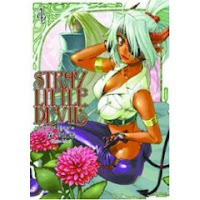
Stray Little Devil Manga, Volume 3 (English)

September 14th, 2008

This is a true story:

Once upon a time there was a girl. She met another girl and *instantly* found her to be the most irritating creature in the whole of the universe.

For many reasons, they kept running into each other and for different reasons they had to work together on some things. But never once did the girl ever dislike the other girl less. In fact, proximity created complete contempt.

In this real story, the girl never ever could stand the sight of the other girl. Even though she still runs into her from time to time, the girl can barely tolerate her for even a moment.

In the manga version of this story, you’d all be reading this and thinking, “Yuri.” Take a moment to consider how freakish a conclusion that is. ^_^

Stray Little Devil, Volume 3 starts with Pam and her friends all looking for rare ingredients to bring back her familiar’s voice, during which Pam is knocked unconscious. She is (of course) revived, and proceeds to “save” a lost soul, which is to say that she makes him face up to his crimes and take responsibility, ruining his life. The idea of a devil taking the high moral road amuses me.

The end of the book finds Lin-Fa confronted with a direct request to investigate Pam, and the gem she wears. Lin-Fa waffles back and forth about her feelings about this, and decides to brazen it out, her heart beating the whole time, and find Pam at her job. The idea that devils need part-time jobs befuddles me.

The crisis comes when Pam says that she considers Lin-Fa a *friend!* Oh no! A high-handed Angel can’t tolerate niceness like this from a lowly devil intern. So of course the only appropriate reaction is to slap her silly and reject her utterly. An act that will be the “sad” part of the next volume, until Pam has to save her ass or they have to work together to escape or something.

Thus we come to the end of Stray Little Devil Volume 3. I fear for all of you that Love, love, love! this series, that I will simply not feel the love. It’s okay. If you’ve got a tendency toward moe it’s probably very good. For me, not so much.

Ratings:

Art – 6
Story – 6
Characters – 6
Yuri – 1
Service – 4

Overall – 6

In the true version of this story, there is no Yuri, and if the girl could have slapped the other girl, possibly repeatedly, it would have been a kindness.


Shin Megami Tensei Kahn Manga, Volume 1 (English)

September 11th, 2008

Some weeks ago, my parents were visiting and my Dad, as he is wont to, was going through my piles of anime and manga looking for something crappy to read. (Me, with crappy manga? How utterly likely.) So, I pulled one of the manga off the pile and said, “Here, I’m told this one is dreadful. I haven’t read it yet. You can be my sacrificial reader.” And with that I handed him Shin Megami Tensei Kahn.

Twelve pages into it he looked up and said, “I feel my brain crinkling around the edges.” Halfway into it, he gave up. I said cheerfully, “But you didn’t get to the lesbian rape part – keep reading.”. Manfully, he churned away at it and when he was done, he handed it back and said, “I think the panel on the bottom of Page 59 sums it up nicely.” I took the book, opened up to page 59 and read the bottom panel in which Nobu, with a completely slappable expression says, “It stinks.”

So, here’s the first review on Okazu ever done by my father – Shin Megami Tensei Kahn stinks. ^_^

To be fair to Dad, it really does stink. This series takes place some time after a previous series. The synopsis of the previous series is written on the first two, almost completely unreadable, pages of the book. At first I thought it was just meant to be jumbled up letters that were artsy, but after a moment I realized that those word jumbles contained actual information that was kind of crucial to understanding what had happened previously. Assuming one wants to understand.

In short – terrible things happened in the past, leaving Nobu and Yumi the sole survivors of the demonic destruction of their former school. Nobu is instantly unlikable. His expression made me root for the punks who tried to beat his ass in the very first chapter but, sadly, he’s the hero and we’ll never be rid of him. Yumi was a typical two-dimensional, uninteresting shell of a female character who mostly spends her time obsessing about Nobu. Nobu spends his time complaining that things stink.

In the second half of the volume, Yumi is trying to forget what happened and move on with her life, but sadly her life doesn’t want to be moved on with. Her questionably lesbian roommate Saeko (the traditional name for the classmate with “issues”) is first “seduced” by the “sexy” demonic teacher who vomits worms into her mouth and then Saeko tries to turn her wormy seduction onto Yumi. Amazingly, Yumi does not succumb. The volume ends with lesbianism-inducing worms all over the place and Nobu on the run, suspected of killing his mother, which he didn’t, not that we care all that much.

Ratings:

Art – 3
Characters – 3
Story – 3
Yuri – 6, but…worms
Service – 4 for the guro set

Overall – 3

As bad as this manga is, there wasn’t anything bad enough to make me want to read more. I’m with Dad on this one. Nonetheless, my sincere thanks to Bruce M. for sponsoring today’s review and opening up a whole new world of bad for me to enjoy. ^_^


Gatcha Gacha Manga (English)

September 4th, 2008

Erica is on vacation this week. Please excuse her as she sets aside the important task of reviewing anime and manga to enjoy time with friends and roadside dinosaurs. Today we have guest reviewer Sean Gaffney to entertain and beguile us and make yet another series sound much better than it probably is. ^_^

Yuri is a girl who is utterly unlucky at love. She’s had 13 boyfriends, and been dumped by all of them. What’s worse, it’s always for the same reason – she gets too ‘heavy’ for them, too deeply involved and makes them want to back off. What’s a girl desperate to show her love to do?

Sounds like a typical shoujo manga, right? You’re expecting a bad boy to come along? Yup, he’s there. What about the misunderstood straight-man student council president with a crush? Present and correct. Tragic pasts up the wazoo? You have NO idea.

But it’s OK. Because Gatcha Gacha also has Motoko. Motoko is long-haired, long-limbed, and gorgeous, and many people think she has ‘Western’ looks. She’s the perfect pretty girl… till you get to know her. She’s grumpy, foul-mouthed, gets into fights constantly, and her bag is filled with the sorts of things only boys would like. There was a poll in Melody, the magazine that ran this in Japan, and Motoko was easily the most popular character, defeating the supposed heroine.

In case you’re wondering why this is an Okazu review, Motoko also likes looking at pretty girls. And seems to have no interest in guys. Now, for several volumes, that’s all there was, and I didn’t particularly regard it as a yuri series mostly as Motoko herself insisted she wasn’t a lesbian.

In later volumes, thought, we get a bit more to it. One part is a major spoiler, so I can’t get into it in this review. However, the other is a character introduced towards the end who knew Motoko in middle school. She definitely is far more yuri, and obsesses about Motoko as she seees them as being similar. As time goes on, though, she realizes that she’s just a cynic, while Motoko is an optimist who’s merely been crushed by events.

There’s nothing particularly original about Gatcha Gacha. But there’s likeable, interesting characters, a nice fast pace, and lots of amusing comedy and gripping drama. And even though it’s not original, several of the plot twists are layered and keep you guessing. The 7th volume, out from Tokyopop, ends with Yuri wondering just how important is her ‘BFF’ Motoko to her, and whether her friendship might actually be verging on a crush. And the 8th volume is the last, wrapping everything up.

Unfortunately, Tokyopop is currently going through difficulties, and Gatcha Gacha was never a very big seller. It’s currently on hiatus, with the final volume unscheduled. Despite that, I still recommend the series to all fans of shoujo manga, especially ones that feature actual strong women, which this title does.

Ratings:

Art – 6. Can get overly busy at times, especially during the action sequences, but is still well done, and makes all 4 protagonists very distinct.

Story – 7. It’s shoujo, but works its twists in well, so that even though the twist is obvious in hindsight, it can still keep you guessing.

Characters – 9. The main reason to read the manga, really. Even the ‘villains’ are fun and have depth.

Yuri: 3. Not really all that much canonically, but there’s some tease, and Motoko certainly has an eye for cute girls.

Service – 2. Motoko peeking at girl’s butts is the closest you’ll get, and it’s nowhere near as blatant as, say, Chikaru in Strawberry Panic.

Overall – 7. An excellent underrated Tokyopop series, and I hope they can get the final volume out some day.


Not Yuri Manga: Yen Plus (English)

August 24th, 2008

It’s obvious that I primarily focus on Yuri here at Okazu, not because I don’t read and/or watch anything else, but because there’s still very few people who blog on Yuri at all and pretty much no one who brings my particular perspective to the table. In fact, I do watch and read any number of series without Yuri (no, really, I do!) but I don’t tend to talk about them here. However…

Yen Press was kind enough to send me a copy of Yen Plus, their new manga anthology magazine (thanks Yen!). As a business model, I find it both encouraging and interesting. If I understand correctly, the intention is to run five chapters of a story in the magazine – one collected volume’s worth – then when it goes to tankoubon, move it out of the magazine and replace it with a new story. The idea being that by then, you’ll know if you want to follow the series or not. It’s not quite the same impetus as a new chapter every month eternally in a magazine followed by collected volumes, but it’s a step in that direction. Also interesting is that Yen Press chose to put the Japanese manga stories in the book reading right to left, and Korean and English stories left to right – something that I considered doing for Yuri Monogatari 5 as well, but chose not to. (The decision for not doing so was based primarily on my outreach to non-manga fans, especially lesbian comics fans. They are not used to right-to-left reading and with so many other learning curves for them to deal with when reading ALC anthologies, like honorifics, I felt that it would simply be asking too much of a non-manga-reading audience. In case you wondered why we flip the Japanese stories…)

Now, normally, I wouldn’t bother reviewing this volume because there is no Yuri (except in one advertisement for what sounds to be a brutally unfunny series with a great title, Alice on Deadlines) and because every other reviewer in the manga-verse has already reviewed it. But, I couldn’t help but notice that as I read it, I pretty much *disagreed* with every other reviewer in the manga-verse about the stories. In fact, the stories I liked, no one else seems to, and the stories everyone else raves about, (notably “Pig Bride,”) I didn’t like at all. So I decided to review this, just to put out a completely different point of view on things.

Starting with the left-to-right side:

“Maximum Drive” does not seem to have garnered much enthusiasm from reviewers. I’m not a big James Patterson fan, and yay the heroine seems to be a “cute lil’ urchin” so you can guess that I really don’t care what happens next. But. In and of itself, it didn’t seem that bad. The art’s aesthetically pleasing and easy to follow. Whether the story ends up being interesting, we’ll have to wait and see.

Unlike most reviewers, I quite liked “Nightschool” and didn’t really see the problems that most people felt it had. Too much setup, too many characters at once…neither of these bothered me. It’s true that Japanese manga tend to parse out the character introductions a few at a time, rather than dumping them all on us at once, but I found it refreshing to see a pile of players, rather than thinking we had teams established, but oh, wait, there’s a new bad guy/good guy/MOTD. This was one of the few stories I might care to follow.

Okay, I just do not know what everyone sees in “Pig Bride.” I found it cloying, predictable and utterly tedious. (Not to mention insulting to women who are not model-types.) The fact that the hero is a grade-A asshole neither surprised me nor pleased me. I’m just not seeing the charm.

The same goes for “Sarasah” – it read like a typical josei-style romance in which the horrible girl likes a horrible guy and horrible things happen. It instilled in me the same feelings of murderous frustration I felt upon reading Peach Girl. Dear straight women – what the hell is entertaining about reading/watching women being complete idiots and being abused by men?????? I just do not get you or your desire to watch women being treated like crap. UGH.

“One Fine Day” is an adorable little cartoon about the adorable little animals that live with some guy and the adorable little things they do in their adorable little girl avatar forms. I hate it, but it wasn’t the comic’s fault. I just hate kids and cats. And cute things. If you like kids, cats and cute things, it will be a very enjoyable story.

Everyone has already talked about “Jack Frost” and mentioned how violent it is, etc, etc. I didn’t mind the violence, but the disembodied head reagrding her own upraised rear end was a tad gratuitous, I felt. Violence does not put me off usually, but the story wasn’t compelling. I prefer my homicidal maniacs to be women.

Over to the Japanese side:

“Soul Eater” was dreadful. I want that time back.

I was all ready to dislike “Nabari no Ou” but amazingly, didn’t. Sean said that he felt that the lead was okay, but the premise was meh. I liked the premise, but thought the lead was meh. lol I like Aizawa and the Nindo club advisor – and I kind of liked the thought that, as stupid as they seem, they are actually right on top of things. Ninja stories are okay by me, too, as long as we stick to basics. No Naruto-esque techniques need apply. Above all, I really liked the end of the chapter and would very much like to know what happened.

“Sumomo Momomo” was also dreadful. I want that time back and the piece of my soul it took away as I flipped the pages.

I ran into a bit of a bind with “Bamboo Blade.” I *know* it becomes a totally awesome story later on, but for the first few chapters, we’re forced to watch the idiot teacher being an idiot. If I did not already know that BamBlade turned awesome, I’d probably never read another chapter after these two. (And it seemed obvious to me that chapter two was included so we could bask in the wonderfulness that is Tama-chan. I bet that they realized that if they only ran chapter one, everyone would not give a damn about the series.) But I do know it becomes awesome, so I’ll probably stick it out and start reading the collected volumes from Volume 2 on.

“Higurashi: When They Cry” was not a series I enjoyed in Japanese. I was not at all surprised that I did not enjoy it in English. I know I’m in the minority with this opinion, but there’s something very unpleasant about this series from the very first page/panel/seconds of anime, that makes me cringe. It wasn’t the violence – it was the lack of caring about the violence. There’s no meaning in it. It’s just a means to a very heavy-handed set of messages. So, I’ll pass.

Technically, I think Yen did a very excellent job. Everyone else thinks so too, so no surprise there. And everyone else has commented on the kind of “random audience” issue that one runs into with stories of such variety, so I won’t belabor that.

The outcome is that there are two stories of the eleven total that I genuinely enjoyed and one that if it was going to run long enough in the magazine, that I know I would enjoy. There were three that I’d be willing to give a little more time to and the rest I found utterly without merit. In general, that’s enough of a “okay” percentage for me to get a magazine. So, I’ll try another issue or two and see how it goes. However – and this is key – I, like most other reviewers am not sure if this magazine something that I would bother subscribing to. And there, more than anything, is the big hurdle Yen will have to confront in 5 months. Is the variety of the stories going to bring more people in, or put more people off. Tune in at the beginning of 2009 to see! In the meantime, I recommend to Yen the technique Japanese manga magazines have of finding out which series people like and do not – insert postcards with marketing questions (age, location, etc,) and which series you like best and least. These get sent in for the possibility of prizes, so the company gets a running commentary on which series are the most and least popular. This might be moot if they are planning on moving stories out of the magazine after five issue, but also might serve to help them decide what *kinds* of stories are doing the best.

Thanks again to Yen Press for the copy of Yen Plus – and by all means, do NOT make your decisions based on my opinions. Get your own copy and tell me in the comments field what you think!


Angel/Dust Manga (English) Guest Review by Eric P.

August 22nd, 2008

Today, we have another guest review – this time by Friend of Yuri Eric P, who has become a right-hand pinky to me, if not a whole right hand. lol Eric sends us news items, suggestions of things to keep an eye out for and reviews, as well as always being a big supporter of Yuricon and ALC. So, thanks Eric – take it away!

Angel/Dust is a one-shot manga about Yuina, your typical plain-jane high school girl who never stood out much and preferred it that way.

One day an angelic woman literally falls from the sky in front of her. She reveals her code-name to be ‘Seraph’ and that she’s an Emulate, a bioroid from an alternate dimension of Earth. In the world she came from, Emulates were made to integrate with human beings on an atomic level, drawing out their latent capabilities.

While stranded on Yuina’s Earth, she forms a contract with Yuina(sealed with a kiss much to Yuina’s surprise,) exchanging memories and knowledge, and thus the typical plain-jane high school girl becomes a winged super-girl and, through this, discovers many aspects of herself. Another female Emulate named Lucifer arrives on the scene, forms a contract with Yuina’s classmate Akiho, who in turn regards Yuina as a (pathetic)rival. What follows is a customary battle between Good and Evil.

At this deceptively simple manga’s heart it’s about a young girl growing up, but there are still a range of plot complexities squeezed into just nine chapters. While trying not to go into real spoiler details, it sheds light on what kind of world Earth becomes in the future. Unless Yuina just bears a striking resemblance to the woman Seraph said was important to her, it even hints Seraph and Yuina may have known each other in that world, and regardless of the manga’s bittersweet ending they would find each other again. How that happens, it doesn’t say; it just leaves you wondering.

To try to describe this manga would make it sound like a condensed mess; while it might be condensed it’s certainly not a mess, at least in my opinion. What’s important are the concepts and themes it revolves around, such as living life and not running away from facing problems, and there it says everything it needs to say.

While not groundbreaking, Aoi Nanase’s artwork is really beautiful. Maybe readers have seen better, more finely-detailed angelic imagery in manga like Angel Sanctuary, or even anime like Haibane Renmei, but the designs in Angel/Dust are still lovely eye candy. When I first followed this manga in Newtype USA (before it went defunct), it was like seeing it all on a big-screen theater, especially with the Emulate battles. In its smaller-sized manga format, it’s like appreciating it on the home TV. The pictures are still pretty to look at, but it’s really something else when you get to read it in the original Newtype size.

Whatever Yuri there is, it’s all subtext. I know what you’re all thinking; if it’s subtext, it could easily be seen as not Yuri (Ms. Friedman made it clear to me in an e-mail she doesn’t believe there’s any trace of it in this title, and this review’s not likely to change her mind). We’ve heard this argument many times over, in such titles as Haibane Renmei and Noir, and Tetragrammaton Labyrinth, all of which have plausible deniability built right into them.

After when Seraph ‘forms the contract’ with Yuina, the latter wakes up in bed the next morning and finds Seraph in bed with her and screams. Later in the story, Seraph tries making Yuina breakfast, with imperfect results. These are classic/standard scenes out of almost all awkward romances that involve one of the two characters not being human. On the other hand, they can just be seen as usual comedy/fanservice scenes and nothing more. Yuina and Seraph have many moments together that could be interpreted either way.

So what example could make readers at least open up to the idea of the subtext? For a good example, I’ll have to reference the sequel manga, Angel/Dust Neo. In this story, average-joe Akito forms a contract with not one, not two, but three Emulates. The contract-sealing ‘kiss’ itself may mostly be to exchange knowledge/memories and to bring out the person’s latent potential, but their bond still develops into something more, and they all vie for his attention and affection. So if making a contract is a metaphor fors ealing a romantic relationship of some kind, why would it be any different between Yuina and Seraph? Maybe in their case, it could be seen as an example of that ‘intense emotional connection’ that Erica has touched on before, where it’s not consciously recognized as ‘love’ or ‘desire’ but the attraction’s still there on a subtle level. \\

Quickly regarding Angel/Dust Neo; it may have a more upbeat narrative than Angel/Dust, but I wouldn’t recommend it so much. Angel/Dust’s storyline may feel rushed, but at least it had a beginning, middle, and an end. Angel/Dust Neo has a beginning—then stops. Its ets everything up for what might have been a long-running series, but then just ends before the real story gets rolling; literally nothing happens. It’s a good thing it stops before we’d have to read through another generic, formulaic harem title (even here you’d find the amnesiac girl, punkish girl, and lolicon girl), but then what’s the point? The only two things that make Angel/Dust Neo worth reading would be to see more of Aoi Nanase’s artwork, and for Yuina’s(all-too-)brief cameo in the first couple pages, which provides a miniscule, cryptic clue to how her world bridges with that of Seraph’s world.

All in all, Angel/Dust is one of those stories where you can find deeper meaning to it if you want, and even if you just take it at surface level you might still find it enjoyable light reading. Just looking at the cover should give enough sense of what you’re in for.

Ratings:

Art – 9 (you can’t go wrong with angel-images, and AoiNanase does it well)
Story – 7
Characters – 7
Yuri – 1 (I’d actually say 2, but I’ll just play it safe here)
Service – 0 (unless you count Seraph’s getup in thesecond chapter, then maybe 1)

Overall – 7

Erica here again. Thanks Eric, it’s always great to get a point of view that is not my own. It’s true that I don’t think of this series as Yuri, but plenty of people do, so I’m really glad that you wrote this review for us. ^_^