Archive for the English Manga Category


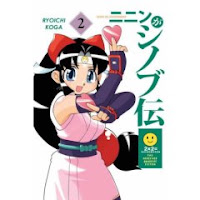
Ninin ga Shinobuden Manga, Volume 2 (English)

April 22nd, 2007

Ninin ga Shinobuden Volume 2 wins, hands down, as the manga with the most use of the words “boobs” and “boobies” that I have ever read. And given the number of shounen manga I read, that’s pretty much a feat.

There’s very little ninja-ing going on in Ninja Academy in this volume (something the author comments on in one of the author’s notes, in fact.) And the wackiness has sort of solidified into “Onsokomaru and the ninjas try to be pervs, but fail at everything.”

At one point, after Onsokomaru’s language was a little rough, I checked the age rating on this manga. It’s rated at 13+. I thought about that for a bit and decided that, yeah, that was about right, since the guys all exhibit 15-year old behavior. (It’s a standard of mine that all written works, magazines, manga, books, etc, are designed for people two to three years younger than the protagonists of the work or the stated audience. No seventeen year old, for instance, would be caught dead reading Seventeen magazine. But you’ll see plenty of 14-15 year olds with copies.)

So, bad points – the misbehaving wackiness gets a little tiring after a while – something that Kaede notes first, and Miyabi soon after. Mostly because I’d like to see more of Shinobu and Kaede, and less running around screaming.

Good points – the best point had to be when all the ninjas voted Kaede as the best ninja in the group. ^_^ Also, there’s notably less actual service with the girls than in the anime, for all the underwear flying through the air.

There’s a teeny weeny bit of Yuri in the love potion chapter where, despite not having taken the love potion, Shinobu “falls in love” with Kaede and a few moments with the dream monster where Shinobu is unable to say the right thing to support Kaede, because she likes the monster’s taste in maid costumes. All other moments are similar one-panel gags. Yup, Shinobu’s got a crush. Nope, nothing comes of it.

Ratings:

Art – 7 pretty good, actually, for what it is
Story – 5 there’s only one story, with different set-ups
Characters – 5
Yuri – 3
Service – 3 yes, there is some service, but there’s more lambasting the fanboy than there is catering to him.

Overall – 6 and I am being generous

Also, for no reason at all except that it just occurred to me – do manga artists take classes on writing incredibly dull author’s notes? ‘Cause, wow…I really needed to know about the stray cats wandering around the creator’s new home…




Yuri Manga; Strawberry Marshmallow, Volume 3

April 15th, 2007

I’m on the road today (in the middle of a huge, dangerous Nor’easter, of course. Say an Ave for me, will you?) So today we have a guest review, once again, from fellow Cult of Miu member, Sean Gaffney (who is also working on an Ichigo Mashimaro fanfic for me. Feel free to harass him into finishing it.)

We’ve hit the third volume of Ichigo Mashimaro, and this is the volume where things really change… no, wait, it’s not. Things continue on exactly as before. But that’s OK, cause this is Ichigo Mashimaro, and you aren’t watching for growth or change, you’re watching for freaky Miu and sarcastic Nobue. Which this has in abundance.

I will admit I wasn’t as fond of the first story as the others, as generally when Miu is Miu I don’t like it to have as much consequence as it does here. After that, though, this is probably one of the strongest volumes to date. Even the interstitial art, with the girls involved in various sports, looks great.

Miu’s relationship with Nobue gets a deeper look in one story where we see Nobue pushing her teasing too far and genuinely upsetting Miu. It’s probably the Yuri-est this series gets, without, of course, being Yuri at all. Oh, and it’s got an awesome punchline.

The other thing that impressed me about this volume was how it showed the friendship between Chika and Miu. Chika rarely gets a long look in the book, being the one who is there to make the others look stranger, but her interaction with Miu here, and her acceptance of Miu’s strange ideas to a degree, show how the two care about each other.

I mean, sometimes you do have to wonder why the others don’t just tell Miu to get lost. She’s certainly not friendly with Matsuri (still a drip in this volume) or Ana (who has almost become a complete non-entity, and barely registers on the page for me anymore). And Nobue tends to suffer her more than actually like her.

The answer is Chika. Chika likes Miu, and Miu likes Chika. And it shows in this volume, from the hysterical chapter when they try to avoid being loud as Nobue sleeps, to the festival where Miu’s Ultraman makes Chika break up, to Miu’s video diary, where Chika actually participates a bit in Miu’s freakiness.

To be honest, nothing much really happens in this volume, much like the other volumes. But I grow more and more enamored of these three characters every time I read more. (Sorry, Matsuri, Ana, you’re dull.) They’re just fun to read, and fun to imagine in other situations.

Art: 7. I especially liked the sporting event interstitials.
Story: 6. By story I mean catalyst more than actual plot.
Characters: 8. Love that Nobue/Miu/Chika dynamic.
Yuri: 5. Bumping it up a bit for Miu’s magic yuri pregnancy, and for the ending to the Cinderella story.
Service: 5. Naked Ana is not something I needed to see, thanks.

Overall: 7.

Definitely recommended.

E here: Gotta say, I agree completely with all of the above, but would add in Miu’s ninja skills as a plus, as well. Thanks so much Sean! I’ve been on a 3-hour train ride for 6 hours, so thank you, thank you…


Yuri Manga: Read or Dream, Volume 3 (English)

March 19th, 2007

The fantastic and wacky happenings in Read or Dream, Volume 3 have not been altered from when I originally reviewed the Japanese edition, so please click that link for an overview of plot, character, and random references to Betty Davis…and now that I look at it, Kojak, as well. ^_^

So, as the story hasn’t changed, let’s focus on the reproduction to English. In this and this alone, the volume takes a pretty bad hit. The original has a dust jacket, underneath which is a short story on the cover of the book proper. As there is no dust jacket in this version, that story is reproduced in the book in black and white. Not deadly, but…the lack of color pages means, no cool Paper Sisters mini-poster page, which I very much like, and more importantly, the lovely color reproductions of the novel covers are turned into a totally skanky black and white page which is hard to see. It sort of killed the joke, too. I liked it better when we were allowed to make the connection ourselves between those shockingly shoujo novel covers and the ROD The TV anime series.

Let me try to explain why I feel so strongly about what is, in reality, one stupid color page.

In the anime, the one single thing that fills the entirely of the first 13 episodes is that Yomiko is NOT there. Her absence is a constant presence, if you will.

In the manga, in *this* volume particularly, there is also a person whose non-existence sort of fills up the empty spaces. That person is famous author Sumiregawa Nenene. In this volume, the fact that the beginning of the anime is reproduced almost exactly, but that the author is NOT Nenene pretty much shapes the whole story – and the story to come in the next volume.

So the color page with those novels by Nishizono Haruhi instantly brings to mind the fact that she was the author that debuted right after Nenene, won the same award as Nenene, and constantly pops up in the anime to be a thorn in Nenene’s grumpy side. Those covers also bring up memories of Haruhi’s irritating little sister pimping her sister’s books in Anita and Hisa’s class. In other words, those novel covers are memory markers. They provide a link to key moments and people in the anime. And those novel covers are reproduced in the *beginning* of this volume of manga, where they can ping those memories before you even start reading what will turn out to be a cool alternate universe reading of those very same situations and characters.

In the English edition, those novels are reduced to a comment that these are some novel covers drawn for the anime by the artist for this manga and placed in the back of the book. Thus losing every bit of tension, of anticipation, of memory that they stimulated.

I am just about 100% sure that no one but me cares, but I really think Viz blew it on that. That color page may not have been intended to be the stimulant it was…but I like to think that Japanese artists, writers and publishers *are* that intelligent. Sadly, Viz was not. Boo on them.

Ratings:
Story – 8
Characters – 8
Art – 8
Yuri – 4
Service – 7 (lots of ass shots…what’s with *that*? Maggie in a suit.)

Overall – 7 (one point off the original score for Viz missing a great opportunity to up the quality of their reproduction and get the point of that page.)

This and Volume 4 make great reading. I really enjoyed the direction the story takes here, and I don’t think it gets weaker in the next volume. Another enjoyable afternoon read.


Yuri Manga: Read or Dream, Volume 2 (English)

February 27th, 2007

I originally reviewed the Japanese edition of Read or Dream, Volume 2 in 2004 and found it, like all of the Read or Dream series, amusing, but not deep. This is rather meaningful, because the TV series had been so very deep, and the manga will, in future volumes, head in that direction as well.

But in the meantime, this volume remains fun, slightly silly, comedy action fare with a little dash of romance.

The stories are, of course, the same as they were in the Japanese volume, so none of my comments on those are any different. Please read the 2004 review (linked above) if you want a synopsis of the stories.

The reproduction quality is quite high, sans the color mini-poster included with the Japanese volume. The honorifics have not been added in, as I had hoped they might be, since the current trend in translated manga seems to be more on the side of keeping them.

Like the ROD The TV Anime, the heroine is Anita, a character who annoys me a lot less now than she did at the very beginning of both anime and manga. Since the character has not changed, it must be me. ^_^

Ratings:

Story – 8
Characters – 8
Art – 8
Yuri – 4

Overall – 8

For overall goofy fun, this is not the best of the Read or Dream/ROD series, but it’s still an afternoon’s solid entertainment.


Yuri Manga: Kashimashi Girl Meets Girl, Volume 1 (English)

January 12th, 2007

I came to a conclusion today about yuri stories being “good” or “bad.” I was listening to the third Strawberry Panic Drama CD and I realized that, if Chikaru were a guy, most people would find him creepy and – in that particular scene – disgusting. And it dawned on me that that sort of defines what makes a story “good” or “bad”. If for instance, Chikane from Kannazuki no Miko had been a male character, would anyone *ever* attempt a rationalization of his behavior, much less openly declare it to be sexy? I think not.

So, going forward, when I comment that a series is “not good” you can take that to mean that, among other things, I think that if the characters were a hetero, rather than lesbian, couple the story would be boring, trite and/or vile. It’s a simpler criteria than trying to explain good writing all the time.

Ironically, none of that really applies to today’s review, as the character starts off as a boy. ^_^ I reviewed Kashimashi Girl Meets Girl, Volume 1 in Japanese back in May 2005. Because the story has not changed at all, I will not be re-reviewing the story itself. If you are not sure whether you want to read the story, by all means, please visit that first review. I rated the Volume an overall 7, if that helps.

What I do want to talk about today is the quality of the transition into English of this story. Which is, let me be honest, very, very good.

If you are a regular reader of Okazu, you know that I am constantly disappointed in English adaptations of manga and anime that remove honorifics and cultural references.

Based on that alone, it’s fair to say that this volume of Kashimashi may well be the single best adaptation of a manga into English that I have ever seen.

Every honorific – even the silly ones…especially the silly ones – are preserved. Notes are added that make sense of the puns and cultural relics, and the reading audience is assumed to have several functioning brain cells. It was the proverbial breath of fresh air to me, let me tell you. Overall, this may well be one of the best translation/adaptations I’ve ever seen. It was a seamless reading experience for this reader of the original version – my highest compliment for a translation.

The print quality is good, and although it did not bother me in any way, you should know that the sound effects are left completely untranslated. As I’ve mentioned many times, I don’t read s/fx, indeed I hardly notice them for myself (although I pay attention for review purposes.)

The story remains yuri, although with that edge of marginalization that exists in so many current Dengeki yuri series. It retains the service, the goofball plot complications, the sad wretch of a pervtastic father, and the “I’m a girl now, so I have to do abc…” and of course the aliens, that make it hard to judge this book harshly, since it’s so obviously ridiculous.

Still not my favorite example of “Yuri”, Kashimashi (which, btw, also means a loud or rambunctious sound) makes a decent enough entry into the Yuri market – and an exceptional showing for Seven Seas. Keep up the work, guys – and get some GOOD Yuri titles, please! Ask me, and I’ll be glad to offer some suggestions.

Ratings for the story:

Art – 8
Characters – 7
Story – 5
Yuri- 9

Overall – 7

Ratings for the adaptation:

Translation: 9
Print Quality: 8 (not at all easy to do…)

Overall: 9

I’ve never read a manga in English that I didn’t personally publish that felt more like reading the Japanese original. Kudos to Seven Seas.