Archive for the English Manga Category


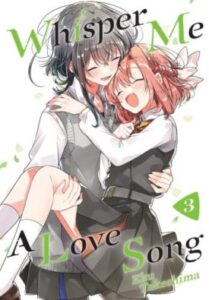
Whisper Me a Love Song, Volume 2

October 18th, 2021

Eku Takeshima’s Whisper Me a Love Song, Volume 2 is genuinely adorable, about relatable, charming characters, an idealized school setting and conflict so small and so satisfyingly reconciled that “cute and fluffy” don’t come close to doing it justice.  Amid the noise and haste of the world, this series is an oasis of innocence and joy.

Here in Volume 2, the major conflict on Himari’s side is her idea of what love is does not seem to be matching up with Yori-sempai’s but…and this is a huge but…both she and Yori are thinking about it and talking about with friends and each other. They agree on a course of action to try to see how their feelings will resolve by going out and spending time together. Well…that’s pretty much the point of dating, so rock on girls!

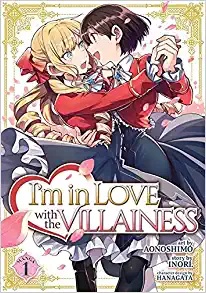
In trying to think of a way to describe this series to a group of folks in order to talk about why publisher ratings are madness, I mentioned that in 5 volumes of this series there’s been nothing more physically intimate than a kiss (and that of those 5 volumes 2 have been mostly taken up with a battle of the bands) and yet, it is rated 16+. I’ve been a manga publisher, I know why publishers are required to be cowards and how that very rating  that protects the publishers can  be a hassle for librarians. I hope that we’ll talk about that in an upcoming panel, in fact.  This is especially crazy when you realize that Even Though We’re Adults and I’m in Love With the Villianess are both give 13+ ratings and both are way more openly queer and adult. All three have different publishers and comparing across publisher is awkward, but, c’mon Kodansha. I’d happily recommend this series to 11 and up, it’s that carefree and well, harmless. I don’t think these ratings are an evil conspiracy, but it’s worth discussing why these choices are made.

Takeshima-sensei’s art really conveys Himari’s joy beautifully. Kevin Steinbach’s translation is fantastic – Yori’s voice in this volume is more perfect than the voice I read her in. At one point she said something and I though, “YES! This is exactly right!” Her cool factor is upped by several degrees, without sounding too adult. Well done. Jennifer Skarupa’s letter matched this perfectly. I’m not sure the last time I absolutely could hear every character so clearly. Tiff Ferentini did a bang-up job on editing because we never notice the editing ^_^  Well done to the entire Kodansha team.

Ratings:

Art – 7
Story – 8
Characters – 9
Service – 0
Yuri – 8

Overall – 8


Whisper Me a Love Song is a sweet treat of a Yuri manga. A genuine delight. Volume 3 and Volume 4 are available in English
and Volume 5 is available in Japanese


Even Though We’re Adults, Volume 3

October 12th, 2021

Akari and Ayano met in Volume 1, but their relationship was instantly complicated by the fact that Ayano…is married. In Volume 2, Akari moves to give herself a fresh start only to find herself literally face to face with Ayano, as her new home is across the street.

In Even Though We’re Adults, Volume 3, Akari can’t get a break…she’s walking to the train in the morning with Ayano, and home with Ayano’s husband Wataru. As they chat, Akari is sucked deeper and deeper into the quicksand of their family life and her own past. Akari returns to her previous job, which means she’s meeting her ex, as well. It’s a complicated set of circumstances in which no one is wrong, and everyone is trying, but the mortification just keeps piling up. Poor Akari.

I’m absolutely convinced that this is the best work Shimura-sensei has ever created, as the people are all relatable; from the two girls in Ayano’s class who may be targeted because they like each other, to Eri, Wataru’s shut-in sister.

Every single character here is doing their best; every single character is trying to figure out how to be, how to navigate the complicated waters of society and relationships. And nearly everyone is struggling. I love this story. There’s no good guys or bad guys, there’s no one who is more than slightly, very normally awful. Everyone is smiling, but also hurting, and trying to figure out how to make it through the rapids of life safely.

In and among all of this, I am particularly on tenterhooks about the two girls in Ayano’s class. They don’t know, yet (or ever) that they have an ally, but I hope that they end up okay.

Ratings:

Art – 8
Story – 8
Characters – 7 I’m liking most of them, even if they annoy me sometimes ^_^
Service – 0
Yuri – Yes. Also Queer.

Overall – 8

Thanks very much to Seven Seas for the review copy! Volume 3 is hitting shelves today, so grab yourself a copy of this queer and complicated story about adult life. Excellent lettering by Rina Mapa, as well as outstanding translation by Jocelyne Allen.

I especially loved this panel of a phone argument. ^_^


Failed Princesses, Volume 3 & Volume 4

October 4th, 2021

In Volume 1, we met Fujishiro and Kurokawa, girls from completely difference circles in school. In Volume 2, they have started, slowly to figure out who they are to one another. Today we’re playing catch up with two more volumes of Failed Princesses, by Ajichi.

In Volume 3, Fujishiro faces pushback from the cool group, who has taken a huge hit to their prestige, and a school trip in which important things may not get said. The cool girls turn mean girls to punish Nanaki but…when their leader pushes it too far, she finds herself in hotseat. Nanaki has it out with her former friends and throws in with the nerdy girls, who are more than happy to have a fourth for the school trip. Hijinks and refusal to say what must be said means Nanaki and Kaede are split for rooms on this trip.

As Volume 4 opens, Nanaki and Kurokawa aren’t actually spending much time together, but they are on each other’s minds. Unbeknownst to them, this sows more unhappiness, as Izumi harbors feeling for Nanaki and Iroha thinks of Kurokawa as her savior.

As I said in my review of volume two, this story feels so much like what it is, a short story that has been extended. Every character has pent-up emotions about every other character in a way I find more than a little artificial.

BUT, Volume 4 does some things that redeem that. When Izumi confesses her feelings to Nanaki, they have something close to a conversation about gay people as I’ve seen in school life Yuri manga. Nanaki, of course, plays the part of the clueless straight girl. I actually laughed the translation of her speech as “The LGBTs, right?” Well-played, translator Angela Liu!

Service is pretty high here, as bathing suits and changing rooms and baths all take up too much space in the narrative. I will forever believe that these things add nothing of value to a manga like this.

While I feel no particular urgency about Nanaki and Kaede getting together, I do like that the nerdy girls are positioned as welcoming and friendly, as opposed to just another clique. In my personal experience this has been very true of nerdy girls, even back in school, when we all lined up together for Star Wars and Star Trek and went out for Heavy Metal and Rocky Horror midnight showings.

Ajiichi’s art has definitely improved in the last four volumes, expressions level up, really, in Volume 4 overall. The story is definitely being strung out…but, really, where’s the rush? We might as well just let the story play out as it  will.

Ratings:

Art – 9
Story – 7
Characters – 7
Service – 5
Yuri – 7

Overall – 7

Many thanks to Seven Seas for the review copy of Volume 4! Another fine job. This is definitely a series for lovers of emotional school Yuri drama. ^_^

Volume 5 is slated for a late March 2022 release, so you have time to catch up!


Doughnuts Under a Crescent Moon, Volume 2

October 1st, 2021

Doughnuts Under a Crescent Moon, Volume 2 continues to be one of my favorite Yuri manga series. It has almost everything I like in it, it’s thoughtfully fraught, fully adult, and packed with unpacking all the baggage we carry in an adult life. Most importantly, it contains powerful lessons for shedding that baggage and learning to relate to people as they, and we, are.

Here in Volume 2, Hinako is absolutely sure she has some kind of feeling when she’s with Asahi, but has no way to identify that feeling…because her entire life has been lying to herself about how she feels about things.

Asahi is on the cusp of letting go of the one thing she’s been clinging to instead of living her life and it terrifies her so much that she’s in almost complete denial.

These two are women like so many women I have met, who were trained to diminish themselves to the point of barely existing. Now that they are being given room to expand, they fear it. To Hinako’s credit, we can see that she’s pushing back a lifetime of normalization of a single, narrow path to happiness. One piece at a time, she’s throwing a stepping stone down, and tentatively letting her weight rest on it. It’s absolutely beautiful when she tells her woks friends for the first time what she’s thinking and they respond in pretty much the best possible way.

Asahi’s going to be a tougher nut to crack and it will take some external pressure that Hinako cannot provide. Two other characters will be the arms of that nutcracker, Asahi’s old friend Fuuka and, much more critically, her sister, Subaru. Subaru is a fantastic character…a very aware, very smart and very sensitive young woman, surrounded by what can only be seen as adults who are incapacitated emotionally. Subaru can see that Hinako is the fulcrum of the cracker and Asahi can only be squeezed just enough, before she shatters. Watch this space, is all I’ll say about that.

I love this story, I love the art, I love the characters and the writing ….and I love the care and attention Seven Seas is giving this story! Jenny McKeon’s translation is fantastic. There were a few turns of phrase that had me clapping my hands. Adaptation and editing kept it a tight and easy read. I continue to love the logo design by George Panella and lettering and retouch by Rina Mapa. This is the kind of book where all the details of localization fade into the back, but that’s exactly the point of good localization – it reads naturally, authentically. This team brings us another authentic manga reading experience.

This book is a guaranteed top 5 on my end of year lists and I hope Usui-sensei continues for many years. This is my moe – adults finding out who they are and what is important to them.

Ratings:

Art – 9
Story – 9
Characters – 9
Yuri – 6 and climbing slowly
Service – 0

Overall – 10

I want to thank Seven Seas especially this time for offering me a review copy because this book has been particularly difficult to get a copy of in print. It was never really available at any book store or online, and is now so unavailable, Amazon isn’t even really saying “unavailable”, it’s saying “Give it up kid, you might want to just get it on Kindle.” I expect you all have heard about the supply line issues publishers are having. Well, this is affecting pretty much everything, from manga to appliances to food to clothes. My HVAC guy says he can’t get parts for air conditioning repairs. If you’re in the US, it’s not going to get better any time soon, but do consider calling your state and federal representatives to ask them what they plan on doing about it. ^_^;

Doughnuts Under a Crescent Moon is an outstanding and beautiful adult Yuri drama. Get it today from Seven Seas!


School Zone Girls, Volume 2, Guest Review by Christian LeBlanc

September 29th, 2021

Welcome to Guest Review Wednesday on Okazu! This makes a third guest review in a row and we have at least two more on the way! If you enjoy our guest reviews, I hope you will support the Okazu Patreon. Thanks to our Patrons, who make reviews like Luce’s review of Volume 1 of this series and Christian’s review of Volume 2 possible! Welcome back, Christian LeBlanc for today’s review. ^_^

So, let me admit something to you: Ningiyau’s second volume of School Zone Girls from Seven Seas has proven to be a very hard book for me to review, as I would often find myself re-reading the stories instead of trawling its pages for beats to describe and funny lines to quote. Flipping back and forth through its short, episodic chapters is like a ludic loop of dopamine hits.

With its ensemble cast of misfit high school girls and their cool-as-hell uniforms of black dress shirts and white ties, this manga feels a bit like if Azumanga Daioh went through an emo phase (at least stylistically), abandoned the 4-koma style, and leaned more towards slacker than absurdist humor. Chapters are three to eight pages long on average, and this brevity perfectly suits the lighter tones of this book full of lovable, surly idiots.

Tall, breezy, beautiful Yokoe Rei (as seen on the cover) is still disastrously crushing on her best friend since middle school, the short, perpetually-perturbed Sugiura Kei (last volume’s cover star). Their friend and classmate Negoro Yatsude is the connective tissue between most of the cast, since she’s also friends and classmates with Matsuri Fuji, and club senpai to Hinase Tsubaki, both of whom we’ll get to. Yatsude’s withering reactions of concern and/or annoyance over everyone and their bull$#!t make her the perfect foil for her friends’ eccentricities, bouts of despair, etc.

Hinase Tsubaki is a bit of a wallflower (a friend of a friend describes her as “a gloomy li’l reject loner girl”), although bright and cheerful Kaname Yamashiro keeps taking the initiative of being friends with her. Tsubaki’s twin, Hiragi, is a surly loner, and also has a bright, cheerful classmate (Utsugi Ren) she’s getting closer with. To be honest with you, it wasn’t until I got towards the end of this book that I realized these were four different people, instead of two (Volume 2, due to reasons, was my first time reading School Zone Girls). We do see some flashbacks in this volume, so I expect we’ll soon learn why Hiragi hates her twin Hinase so much (which may or may not be related to Hinase’s let’s-hope-the-author-just-drops-it sister complex, ugh).

Matsuri Fuji is new to the cast, and is first depicted playing a crane game with increasing fury; the prize (which she thinks looks stupid anyway) has twisted itself in her mind into some form of character growth, like a next stage of enlightenment she needs to attain. You’d be right to assume from this that she takes herself way too seriously; she speaks with a heightened dialect that only makes her look more awkward to the arcade employees, and tortures herself with inner dialogue spirals about honor, respect, doing good deeds for selfish reasons, etc.

Once arcade employee Kishiya admits to feeling embarrassed over something, she becomes an inadvertent mentor to Fuji, helping her realize that even adults can be imperfect – and that’s ok. It’s almost like the relationship between Miyako and Sayaka at the coffee shop in Bloom Into You, except, well, Miyako would never laugh her ass off if Sayaka freaked out and gave herself a nosebleed. (Or keep replaying the moment in her mind, laughing a little harder each time.) Incidentally, I hate to admit how much Fuji reminds me of myself at that age, and I have to wonder why I’m being called out in this manner.

Most of the time, our cast is just $#!tting around: hanging out at school, riding each other over who can’t wink with their eyes, watching TV during homework dates, falling down 3 flights of stairs into a bloody mess before admitting they need someone to walk them home because the ad for a scary movie messed them up, etc. Stakes are fairly low all around, in spite of how hard Rei freaks out whenever she interprets Kei’s gruffness as affection, or Fuji’s obsession with winning that stupid stuffed toy at the arcade.

As I said earlier, School Zone Girls eschews the 4-koma style, so the comedy has more room to breathe naturally. Chapters are exactly as long (or short) as they need to be, contributing to the natural rhythms and quick pacing. I think this makes the poignant 18-page It Was a Joke stand out that much more, increasing its dramatic impact. This tale sees present-day Rei narrating some flashback scenes from middle school that shed light on why her crush on Kei hasn’t gone any further than it has. I’ll admit, the slapstick and spit-takes up to this point had my guard down, so I wasn’t expecting to see such an affecting portrayal of why two girls would still be stuck in a “will they or won’t they?!” stasis required by the plot. And, I know I can be a bit of a soft touch for scenes like this, but I dare you to flip back to the first page of this chapter again after you’ve read it and not feel something for poor Rei.

This section actually struck me as realistic (as opposed to contrived for the plot), but I got hung up on whether or not that was for me to judge. I asked Erica for her opinion, and she reminded me that authenticity is individual, but to go with my gut; my gut simply told me not to speak for others on what is or isn’t authentic to them. And then I wondered if I wasn’t overthinking a book where someone got punched in the tit last issue. Such is the genius of School Zone Girls!

Ratings:

Art – 9 A good comedy needs expressive, inventive body language and exaggerated expressions, and this one has it. Clean lines, screen tones that expertly give depth to the page and guide the eye, and engaging character designs all contribute to this rating. Ningiyau is particularly skilled at rendering affectations of disdain.

Story – 7 There’s a lot of fun nothing happening, except when Ningiyau decides to hit us in the feels with some of those bittersweet drama times. And that’s fun too.

Characters – 7 The twins still confuse me, but there’s hints that we’re about to see their history soon. Rei is best girl and I want everything to work out for her.

Service – 2 One panel stands out as a little cheeky, but otherwise there’s a welcome lack of gaze.

Yuri – 6 The audience is meant to root for Rei and Kei to get together. I can see some relationships forming among other cast members, and others staying platonic, but everyone else is just friends at this point.

Overall – 9 There’s a fair bit of substance here, in spite of its plain title and covers. The humor is dumb but in a smart way, and it feels like there are hints of relationships and future story arcs sprinkled throughout.

Special commendations should be given to the translation/adaptation team of Avery Hutley and Jamal Joseph Jr. for translating a comedy that reads briskly, naturally, and lands all the jokes and interactions, along with slang that sounds fresh, natural and unforced. Aidan Clarke’s lettering helps convey all the different beats as well – font types and sizes change when they need to, and sound effects do a great job matching the varying ways the original kana are written.

Erica here: Thank you so much, Christian! You and Luce have convinced me to read this comic! As we mentioned last time, Volume 3 is on the way in November, as well.